Key Takeaways
When you call to request a payoff quote, also ask the representative to confirm whether your lender applies extra payments to principal automatically or only if you designate them. Get that answer in writing if possible.
Payment application policies vary widely by lender, and misapplied payments are one of the most common complaints filed with the Consumer Financial Protection Bureau (CFPB) regarding auto loans.
If you're mailing a final payoff check, send it via certified mail with return receipt requested and build in at least five extra business days before the payoff quote expires.
Mail delays can push your payment past the quote expiration date, resulting in a small remaining balance that triggers a new billing cycle — and a confusing late notice weeks later.
Set a calendar reminder for 45 days after your final payoff to verify the lien release has been recorded and the title is on its way — don't wait for it to fall through the cracks.
Lenders occasionally fail to file lien releases promptly, and the consequences only surface when you try to sell or transfer the vehicle, often at the worst possible moment.
Why Early Payoff Is Worth Considering
Most car loans are structured so that interest accrues daily on your outstanding principal balance. That means the longer your loan runs, the more you pay in total — sometimes dramatically more than the sticker price of the vehicle. Cutting months or years off your loan term directly reduces the pool of days interest can accumulate.
Consider a $28,000 auto loan at 7.5% APR over 72 months. Over the life of that loan, you'd pay roughly $5,900 in interest. Pay it off in 48 months instead and your total interest drops to about $3,800 — a savings of more than $2,100 without refinancing, without haggling, and without any financial wizardry. You just sent extra money to the principal sooner.
$2,100+
Potential interest savings on a 72-month loan
Based on a $28,000 loan at 7.5% APR paid off in 48 months instead of 72 months.
1 in 3
Auto loans with terms of 73–84 months
According to Experian's State of the Automotive Finance Market report, long-term loans now represent a growing share of new vehicle financing.
13
Effective payments per year with biweekly strategy
Splitting the monthly payment in half and paying every two weeks results in one extra full payment annually due to the 52-week calendar.
10–30 days
Typical payoff quote validity window
Lenders set expiration dates on payoff quotes because interest accrues daily and the exact payoff amount changes each day.
30–45 days
Expected wait time for title after final payoff
Processing times vary by state and lender; lien-notation states may take longer as the DMV must update its records.
Beyond the dollars, eliminating a car payment frees up monthly cash flow that can be redirected toward an emergency fund, retirement contributions, or the down payment on your next vehicle. And because your vehicle's value depreciates whether you're paying on it or not, getting ahead of that curve protects your equity position — reducing the window in which you could be upside down on the loan.
For a deeper look at exactly how interest behaves when you accelerate payoff, see what happens to your interest when you pay off a car loan early. The mechanics are simpler than most borrowers expect, and understanding them makes every strategy in this guide more intuitive.
Before You Make an Extra Payment: Read Your Loan Contract
Enthusiasm is good. Reading the fine print first is better. Before you send a single extra dollar to your lender, you need to answer three questions by reviewing your loan agreement:
- Does your loan carry a prepayment penalty? Some lenders — particularly those offering subprime financing — include a clause that charges you a fee for paying off the loan ahead of schedule. This penalty can take several forms: a flat fee, a percentage of the remaining balance, or a "Rule of 78s" calculation that front-loads your interest obligation. If a prepayment penalty exists, you need to calculate whether the interest savings outweigh the cost of triggering it.
- How does your lender apply extra payments? Some servicers automatically apply overpayments to your next scheduled payment rather than reducing your principal. That means you might inadvertently pre-pay future monthly installments rather than cutting down the principal balance. You want extra payments applied to principal only.
- Is your loan precomputed or simple interest? The majority of auto loans use simple interest, which means you benefit directly from every early payment. Precomputed loans calculate all interest up front and fold it into the total repayment figure — making early payoff much less beneficial. Check your contract or call your lender if you're unsure.
Prepayment Penalties Can Erase Your Savings
Not all auto loans allow early payoff without cost. Some contracts — especially those from buy-here-pay-here dealers or subprime lenders — include prepayment penalties that charge you a fee for paying ahead of schedule. Read your loan agreement in full before making any extra payment, and call your lender to confirm the policy verbally. If a penalty exists, calculate whether the interest savings exceed the penalty cost before proceeding.
A Zero Balance Doesn't Mean the Loan Is Closed
After your final payment posts, request written confirmation that the account is paid in full and closed. Lenders can take several weeks to formally close an account, and in rare cases, processing errors leave a small "residual" balance that generates a new billing cycle. Getting written confirmation creates a paper trail that protects you if the account shows incorrectly on your credit report months later.
If you're unfamiliar with any of the terms above, the auto loan early payoff glossary provides plain-English definitions for prepayment penalties, amortization, payoff quotes, and every other concept you'll encounter throughout this process.

Step 1 — Get a Payoff Quote
Your account balance and your payoff amount are two different numbers. Your balance is a snapshot of what you owe at this moment. Your payoff amount is the exact dollar figure — including any accrued interest, fees, or per-diem interest — required to close the account entirely on a specific date.
Payoff quotes have an expiration date (typically 10 to 30 days) because interest accrues daily. A quote good through the 15th of the month will be slightly different from one good through the 30th.
How to Request a Payoff Quote
- Online portal: Most major lenders and banks let you generate a payoff quote through your account dashboard. Look for a link labeled "Payoff Request" or "Loan Payoff Amount."
- Phone: Call the customer service number on your monthly statement. Ask specifically for a payoff quote, the date through which it is valid, and any per-diem interest rate you should know if your payment arrives after the quote date.
- Written request: Some borrowers prefer to get the quote in writing via email or mail. This creates a paper trail, which is useful if there's ever a dispute about the closing balance.
When you call to request a payoff quote, also ask the representative to confirm whether your lender applies extra payments to principal automatically or only if you designate them. Get that answer in writing if possible.
Payment application policies vary widely by lender, and misapplied payments are one of the most common complaints filed with the Consumer Financial Protection Bureau (CFPB) regarding auto loans.
If you're mailing a final payoff check, send it via certified mail with return receipt requested and build in at least five extra business days before the payoff quote expires.
Mail delays can push your payment past the quote expiration date, resulting in a small remaining balance that triggers a new billing cycle — and a confusing late notice weeks later.
Set a calendar reminder for 45 days after your final payoff to verify the lien release has been recorded and the title is on its way — don't wait for it to fall through the cracks.
Lenders occasionally fail to file lien releases promptly, and the consequences only surface when you try to sell or transfer the vehicle, often at the worst possible moment.
Keep the payoff quote on file even after you've paid. If the lender later claims a balance remains — which occasionally happens due to processing errors — you'll have documentation showing what you paid and when.
Step 2 — Choose Your Early Payoff Strategy
There is no single correct approach to paying off a car loan early. The best method depends on how much extra cash you can consistently commit, whether you prefer structure or flexibility, and how aggressively you want to accelerate the payoff timeline. Here are the four most effective strategies:
Strategy A: Round Up Every Payment
If your monthly payment is $387, pay $400 or $450 instead. This approach requires no dramatic budget overhaul — you're simply sending a few extra dollars with every payment. Over time, the rounding accumulates and can shave several months off a 60- or 72-month loan with minimal lifestyle sacrifice.
Strategy B: Make One Extra Payment Per Year
Divide your monthly payment by 12 and add that amount to each month's payment. By the end of the year, you'll have made the equivalent of 13 monthly payments instead of 12. On a 60-month loan, this single additional annual payment can reduce the payoff timeline by four to six months.
Strategy C: Biweekly Payments
Instead of paying once a month, pay half your monthly amount every two weeks. Because there are 52 weeks in a year, you end up making 26 half-payments — the equivalent of 13 full monthly payments. This mirrors the "extra payment per year" strategy but distributes the effort evenly across the calendar. Important: Confirm your lender accepts and correctly processes biweekly payments before you set this up.
Strategy D: Lump-Sum Principal Payments
Whenever you receive a windfall — a tax refund, a bonus, an inheritance, proceeds from selling something — apply a meaningful chunk directly to principal. A single $2,000 lump-sum payment on a $20,000 balance at 7% APR eliminates months of future interest in one move. This is often the highest-impact action available to borrowers who can't commit to a higher monthly payment but occasionally have extra funds.
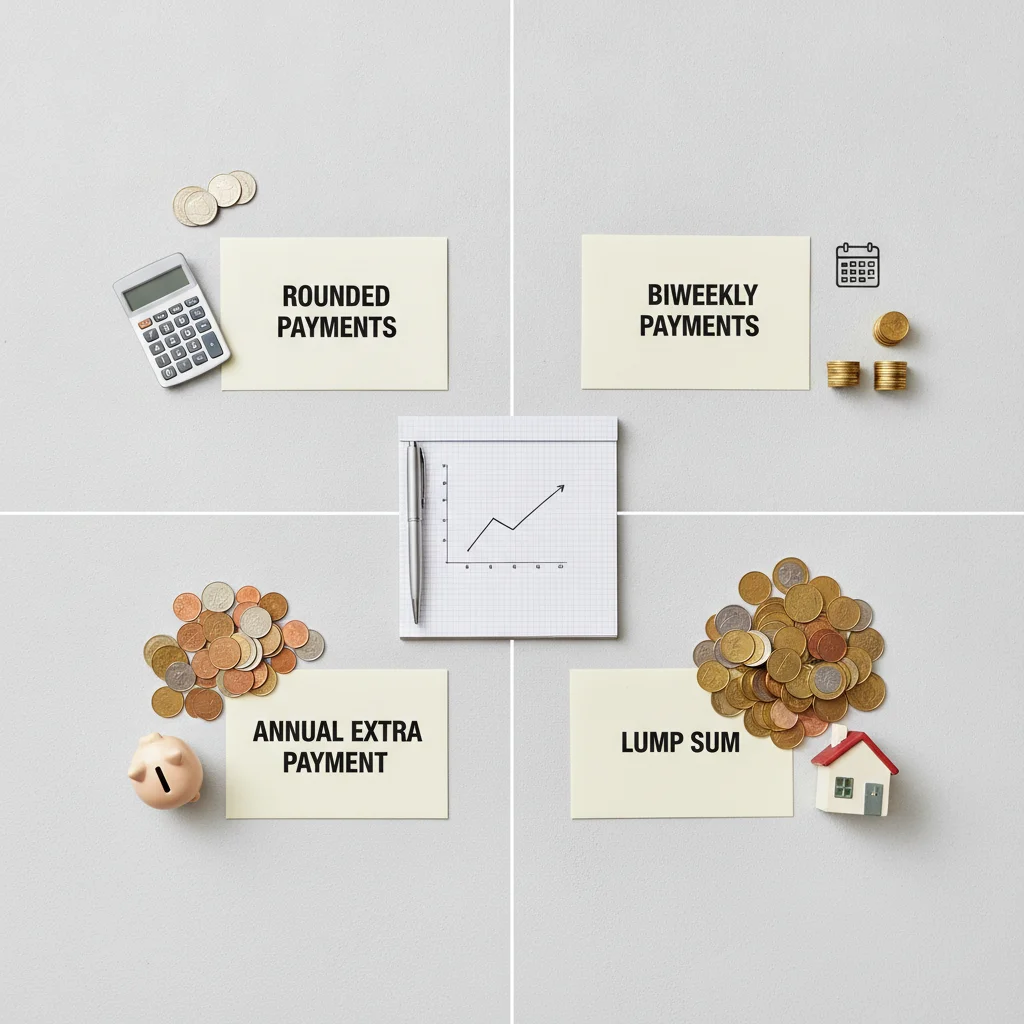
Many borrowers combine strategies — rounding up monthly while also making periodic lump-sum payments when cash allows. If you're looking for ways to find extra money in your budget to fund these strategies, freeing up cash to pay off your car loan faster offers practical tactics that don't require a major income change.
Combine Strategies for Maximum Impact
You don't have to pick just one payoff strategy. Many borrowers see the best results by rounding up every monthly payment while also applying windfalls — tax refunds, bonuses — as lump-sum principal payments. Even modest combinations can cut months off a 60- or 72-month loan without requiring a significant ongoing budget change.
Ask About Biweekly Payment Programs
Some lenders offer formal biweekly payment programs that automatically handle the scheduling and principal application for you. Ask your lender if this option exists before setting up your own manual system — an official program is less likely to result in misapplied payments than manually splitting a payment yourself.
Revisit Your Insurance Once the Loan Is Paid
Lenders typically require comprehensive and collision coverage while you have an active loan. Once you've paid it off, review whether your vehicle's current market value still justifies those premiums. On older vehicles, dropping to liability-only can save several hundred dollars a year.
Step 3 — Make Extra Payments the Right Way
Sending extra money is only half the battle. You need to make sure the lender applies it correctly — to your principal balance, not to interest or future scheduled payments.
Designate Payments as "Principal Only"
When submitting a payment online, look for a dropdown or checkbox that allows you to designate the extra amount as a "principal-only payment" or "additional principal." If you're mailing a check, write "Apply to principal" clearly in the memo line and include a separate note with the same instruction. If paying by phone, state explicitly that you want the overage applied to principal.
Extra Payments May Default to 'Next Payment Due'
If you don't explicitly designate extra funds as a principal-only payment, many lenders will treat them as prepayment of your next scheduled installment — not a reduction of your principal. This means your balance stays the same, your payoff date doesn't move, and the interest savings you were expecting never materialize. Always designate the application of any payment above your required monthly amount.
Don't Miss a Payment While Waiting to Lump Sum
A common mistake: borrowers skip or delay their regular monthly payment while saving up for a lump-sum payoff, expecting it all to wash out when they send the big check. This can trigger a late payment on your credit report before the lump sum even arrives. Continue making your scheduled payments on time regardless of any extra payoff activity happening in parallel.
Confirm the Application After Each Payment
Log into your account a few business days after each extra payment posts and check two things: (1) your principal balance has decreased by the expected amount, and (2) your next scheduled payment date has not been pushed out further into the future. If the payment was misapplied, call immediately and request a correction. Document the call with a date, time, and the representative's name.
Track Your Progress Over Time
Watching your balance drop is motivating — and tracking is also a practical safeguard. Keep a simple spreadsheet or use your lender's online tools to log each payment, the portion applied to principal, the new balance, and your revised projected payoff date. Tracking your progress toward an early auto loan payoff covers this in detail, including how to calculate how much interest you've saved to date.
“The biggest mistake auto loan borrowers make is assuming their lender will automatically do the right thing with extra money. Designating every extra payment as 'principal only' and confirming the application afterward is the difference between saving real money and simply prepaying interest.”
— Dara Flemming, Consumer Finance Journalist and Auto Loan Specialist
Step 4 — Make Your Final Payoff
When you're ready to close out the loan entirely, the process differs from making a regular or extra payment. Do not simply send your current payoff quote amount and assume you're done. Here's the correct sequence:
- Request a fresh payoff quote. Even if you got one last week, get a new one. Interest accrues daily, and a quote from seven days ago may no longer reflect the exact amount needed to zero out the account.
- Choose your payment method carefully. Personal checks can take days to clear. Cashier's checks or wire transfers reduce the risk of processing delays that push you past the quote's expiration date. Some lenders allow ACH payments from a bank account, which can post within one to two business days.
- Confirm the payment posted. After submitting, wait the appropriate number of business days and then log in or call to verify the account shows a zero balance. Request written confirmation — an email or mailed letter — that the loan is paid in full.
- Keep records indefinitely. Store the payment confirmation, the payoff quote, and any account closure letters. Auto loan errors on credit reports are not uncommon, and these documents are your evidence if one surfaces.
Prepayment Penalties Can Erase Your Savings
Not all auto loans allow early payoff without cost. Some contracts — especially those from buy-here-pay-here dealers or subprime lenders — include prepayment penalties that charge you a fee for paying ahead of schedule. Read your loan agreement in full before making any extra payment, and call your lender to confirm the policy verbally. If a penalty exists, calculate whether the interest savings exceed the penalty cost before proceeding.
A Zero Balance Doesn't Mean the Loan Is Closed
After your final payment posts, request written confirmation that the account is paid in full and closed. Lenders can take several weeks to formally close an account, and in rare cases, processing errors leave a small "residual" balance that generates a new billing cycle. Getting written confirmation creates a paper trail that protects you if the account shows incorrectly on your credit report months later.
Step 5 — Get the Title and Close the Loan
Paying off the loan is not the final step. Until the lender releases the lien on your vehicle, they are still technically a co-owner on paper. The process of removing that lien and obtaining a clear title varies by state and by whether your state is a title-holding or lien-notation state.
How Title Transfer Works
In title-holding states (such as Michigan and Minnesota), the lender holds the physical title throughout the loan. After payoff, they mail the title to you — typically within 10 to 30 days. Once you receive it, you'll see the lender's lien release notation on the document.
In lien-notation states (such as California and Texas), the DMV holds the title and records the lien. After payoff, the lender notifies the DMV electronically or sends a lien release document. The state then issues a clear title, which is mailed to you. This process can take anywhere from two weeks to several months depending on the state.

What to Do if the Title Doesn't Arrive
If 30 to 45 days pass after your final payment and you haven't received the title or a lien release, contact your lender first. Get a tracking number if the title was mailed. If the lender confirms the lien was released but the title is still missing, contact your state's DMV — you may need to apply for a duplicate title. There is usually a modest fee for this.
Update Your Insurance
Once the loan is paid off, your lender's requirement that you carry comprehensive and collision coverage no longer applies. Evaluate whether your vehicle's current value justifies those coverage levels. For an older car with a market value under $5,000, dropping comprehensive and collision can meaningfully reduce your premium — though the decision depends on your savings cushion and risk tolerance.
Electronic Lien and Title (ELT) States
Many states now participate in Electronic Lien and Title programs, where the lien is recorded and released digitally between the lender and the DMV — no paper title ever changes hands until the loan is paid. If you're in an ELT state, the DMV will mail a paper title directly to you after the lender files the electronic release. The process is typically faster and less prone to lost-mail issues than traditional paper title transfers.
Early Payoff and Your Credit Score
Closing an installment loan account can cause a temporary, modest dip in your credit score — typically 5 to 15 points — because it reduces your mix of open accounts and shortens your average account age. For most borrowers, this is a worthwhile tradeoff. If you're planning to apply for a major loan (mortgage, car loan) within the next 60 to 90 days, factor this into your timing.
Low-Rate Loans May Not Need Aggressive Payoff
If your auto loan carries a rate below 4% APR, the mathematical case for aggressive early payoff weakens considerably. Money used for extra principal payments could instead build an emergency fund, pay down higher-rate debt, or be invested. Evaluate your full financial picture — not just the loan in isolation — before committing to a fast payoff timeline.
Situations Where Early Payoff May Not Be the Best Move
This guide assumes early payoff is the goal. But it's worth pausing to acknowledge that it isn't always the financially optimal move. Here are three scenarios where you might want to reconsider — or at least weigh the decision carefully.
Your Interest Rate Is Very Low
If you locked in a 2.9% APR during a promotional financing period, your money might generate better returns elsewhere — particularly in a high-yield savings account, contributing to a 401(k) with employer match, or paying down higher-rate debt. The math changes significantly when your loan rate is below 4%.
Your Loan Has a Prepayment Penalty
As discussed earlier, if your contract includes a prepayment penalty, you need to run the numbers before paying ahead. In some cases — particularly with Rule of 78s loans — paying early can actually cost you more than completing the original schedule. Signs your auto loan terms make early payoff less worthwhile breaks down these specific contract structures in detail.
Refinancing Would Save More
If your credit has improved significantly since you took out your loan, refinancing to a lower rate might reduce your total interest cost more than aggressive extra payments would. When to refinance your auto loan outlines the signals that indicate a refinance makes more sense than a payoff push.
Electronic Lien and Title (ELT) States
Many states now participate in Electronic Lien and Title programs, where the lien is recorded and released digitally between the lender and the DMV — no paper title ever changes hands until the loan is paid. If you're in an ELT state, the DMV will mail a paper title directly to you after the lender files the electronic release. The process is typically faster and less prone to lost-mail issues than traditional paper title transfers.
Early Payoff and Your Credit Score
Closing an installment loan account can cause a temporary, modest dip in your credit score — typically 5 to 15 points — because it reduces your mix of open accounts and shortens your average account age. For most borrowers, this is a worthwhile tradeoff. If you're planning to apply for a major loan (mortgage, car loan) within the next 60 to 90 days, factor this into your timing.
Low-Rate Loans May Not Need Aggressive Payoff
If your auto loan carries a rate below 4% APR, the mathematical case for aggressive early payoff weakens considerably. Money used for extra principal payments could instead build an emergency fund, pay down higher-rate debt, or be invested. Evaluate your full financial picture — not just the loan in isolation — before committing to a fast payoff timeline.
Auto Loan Early Payoff Calculator
Enter your current balance, interest rate, and monthly extra payment to see exactly how many months you'll save and how much interest you'll avoid — before you commit to a strategy.
Auto Loan Early Payoff Terms Glossary
A plain-English reference covering every term you'll encounter during the early payoff process, from amortization and per-diem interest to lien releases and payoff quotes.
Freeing Up Cash to Pay Off Your Car Loan Faster
Practical tactics for finding extra money in your existing budget — subscription audits, cash windfalls, side income — and directing it toward principal reduction.
Early Payoff Progress Tracker Template
A simple spreadsheet for logging each payment, tracking principal reduction, monitoring interest saved to date, and projecting your revised payoff date month by month.
CFPB Auto Loan Complaint Database
Search actual borrower complaints about lenders misapplying payments or failing to release liens — useful for researching your lender's track record before escalating any dispute.
If you've worked through all five steps — reviewed your contract, obtained payoff quotes, applied extra payments correctly, made your final payoff, and received a clear title — you've done something most borrowers never accomplish: you've paid for your car entirely on your own terms, ahead of schedule, and saved real money in the process. That's worth acknowledging. Now put that freed-up payment toward whatever comes next.

All claims are backed by peer-reviewed research. Sources on request.