| Primary APR driver | Credit score (FICO Auto Score 8 or 9) (Used by most major auto lenders) |
| APR range by credit tier | 3%–25%+ depending on score (Experian State of the Automotive Finance Market, 2024) |
| Maximum dealer markup (typical) | Up to 2–3 percentage points above buy rate (Consumer Financial Protection Bureau auto lending guidelines) |
| DTI threshold most lenders target | Below 45–50% including new payment (Standard underwriting guideline across major banks and credit unions) |
| Rate premium for 84-month vs. 36-month term | 2–3.5% higher APR (Based on lender rate sheets across multiple institutions) |
| LTV limit before risk pricing activates | Typically above 110–125% (Varies by lender; specialty lenders may go higher) |
| Vehicles with mileage cap at many lenders | 100,000–125,000 miles maximum (Common underwriting limit at banks and credit unions) |
APR Is a Formula, Not a Negotiating Trick
Most buyers walk into a dealership thinking the interest rate is something that gets haggled over like the sticker price. It isn't. Your APR is largely determined before you ever shake a finance manager's hand — it's the output of several specific variables that lenders run through a pricing model the moment they pull your application.
Understanding those variables in advance does two things for you: it tells you roughly what rate to expect, and it tells you immediately when the number you're being quoted is higher than it should be. That second part is where real money gets saved. APR is more than just a percentage — it's the single most important number to scrutinize on any loan offer.
Below is every major variable that feeds into your auto loan APR, how each one moves the rate up or down, and what you can realistically do about it before you walk into a dealership.
| Primary APR driver | Credit score (FICO Auto Score 8 or 9) (Used by most major auto lenders) |
| APR range by credit tier | 3%–25%+ depending on score (Experian State of the Automotive Finance Market, 2024) |
| Maximum dealer markup (typical) | Up to 2–3 percentage points above buy rate (Consumer Financial Protection Bureau auto lending guidelines) |
| DTI threshold most lenders target | Below 45–50% including new payment (Standard underwriting guideline across major banks and credit unions) |
| Rate premium for 84-month vs. 36-month term | 2–3.5% higher APR (Based on lender rate sheets across multiple institutions) |
| LTV limit before risk pricing activates | Typically above 110–125% (Varies by lender; specialty lenders may go higher) |
| Vehicles with mileage cap at many lenders | 100,000–125,000 miles maximum (Common underwriting limit at banks and credit unions) |
Credit Score: The Biggest Single Variable
No factor carries more weight than your credit score. Lenders use it as a shortcut for predicting whether you'll repay — and they price risk accordingly. The relationship is not subtle. The difference between a 580 credit score and a 720 credit score on a 60-month, $30,000 auto loan can easily be 8–12 percentage points of APR. At those extremes, you could be paying $4,000–$7,000 more in total interest on the same vehicle.
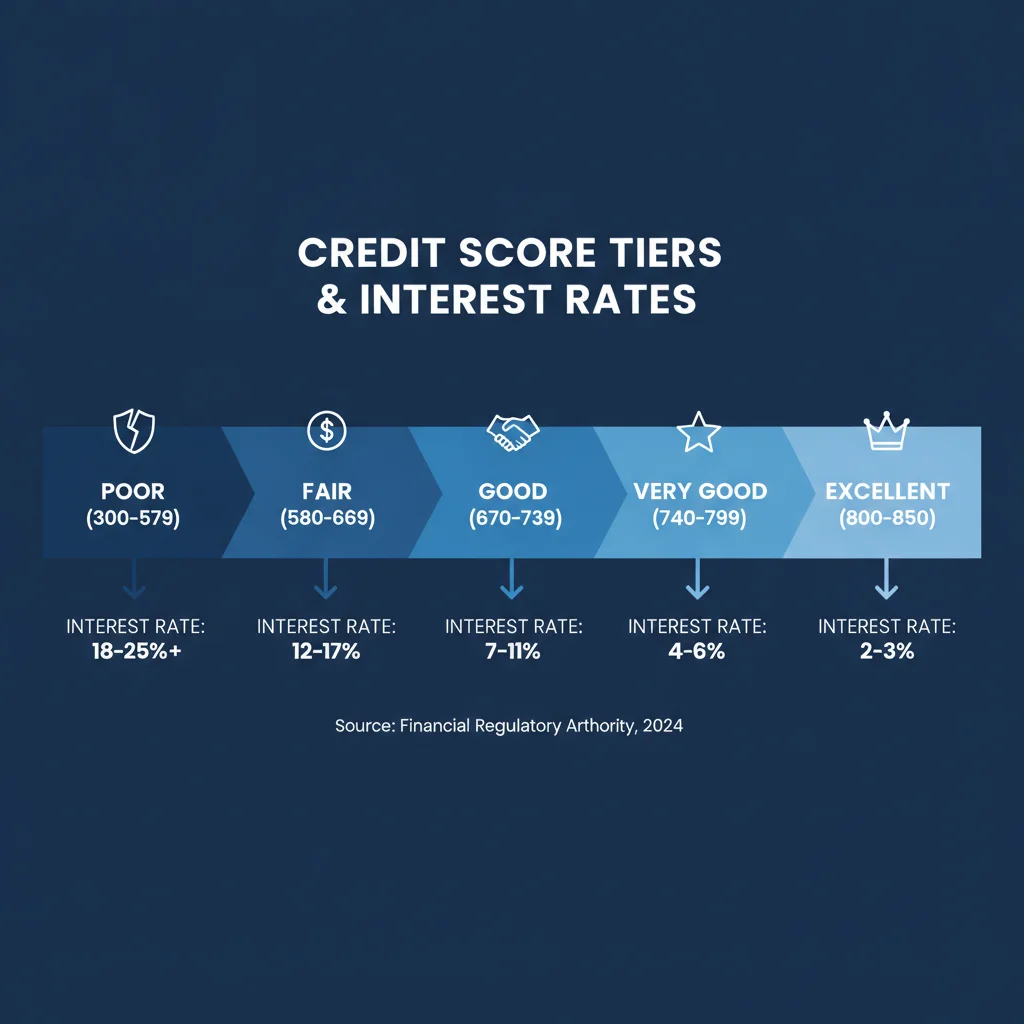
Most lenders segment borrowers into risk tiers:
- Super prime (720+): Best available rates, often within 1–2% of the prime rate
- Prime (660–719): Competitive rates, moderate markup risk
- Near prime (620–659): Rates climb noticeably — expect 8–14% at many lenders
- Subprime (580–619): Limited lender options, rates often 15–20%+
- Deep subprime (below 580): Specialty lenders only, rates can exceed 25%
The score model most auto lenders use is FICO Auto Score 8 or 9, which weighs auto-specific payment history more heavily than a standard FICO. Your mortgage or credit card score may read differently. Pull the auto-specific version if you want the most accurate preview. Your credit score directly affects the loan rates lenders will offer — understanding that relationship before you apply is essential.
~$5,500
Extra interest paid by subprime vs. prime borrowers on a $30,000 loan
Based on the difference between a 5% APR and an 18% APR over 60 months — a realistic spread between credit tiers.
1–3%
Typical dealer markup added above the lender's buy rate
According to CFPB research on dealer reserve practices in auto financing.
69%
Share of new vehicle loans financed for 60 months or longer
Experian State of the Automotive Finance Market Q4 2023 — longer terms now dominate the market.
2.5%+
Average APR premium on used vehicles vs. new at the same credit tier
Rate gap reflects collateral risk differences between new and used vehicle financing.
Loan-to-Value Ratio: What the Car Is Worth vs. What You Owe
Lenders don't just lend against your creditworthiness — they lend against collateral. The vehicle is the collateral, and the loan-to-value (LTV) ratio tells the lender how much risk they're taking if you default and they have to repossess and sell the car.
The formula is straightforward:
LTV = Loan Amount ÷ Vehicle Value × 100A $25,000 loan on a vehicle appraised at $28,000 gives you an LTV of about 89%. A $30,000 loan on that same vehicle — because you rolled in negative equity from a previous trade-in — pushes LTV above 100%, which most lenders call being "upside down."
Negative Equity Can Silently Push Your LTV Over Limits
If you're trading in a vehicle and owe more than it's worth, that difference often gets folded into the new loan. A $4,000 negative equity balance added to a $32,000 purchase puts you at $36,000 financed against a $32,000 asset — an LTV of about 113% before taxes and fees. Many lenders will still fund this, but they'll price the risk into your APR. Always get your trade-in payoff amount before negotiating to understand your true starting position.
Manufacturer Incentive Rates Don't Apply to All Buyers
Advertised 0% or 1.9% APR offers from automakers are real, but they're typically reserved for buyers with credit scores of 720 or higher, and they apply only to specific trims and model years. If your score doesn't qualify, the dealer may still show you the promotional rate to draw you in before pivoting to a standard rate once they've pulled your credit. Always confirm the actual rate you were approved for in writing before agreeing to financing terms.
Pre-Approval Freezes Your Rate Exposure
Getting pre-approved through a bank or credit union before visiting a dealership gives you a concrete APR benchmark. If the dealer's finance office can beat it, great. If they can't, you have a fallback that protects you. Pre-approval also limits the dealer's ability to exploit rate uncertainty — one of the most common ways buyers overpay on financing.
Why does this matter for APR? Lenders charge more when they're exposed to greater loss risk. If your LTV is above 125% (common when negative equity, taxes, and add-on products get rolled into the loan), many lenders will either decline outright or price in a risk premium of 1–3 additional percentage points. A larger down payment directly reduces LTV and can meaningfully lower your rate tier — even if your credit score doesn't change.
Every variable that shapes your auto loan rate interacts with LTV — your down payment is one of the fastest levers you can pull before applying.
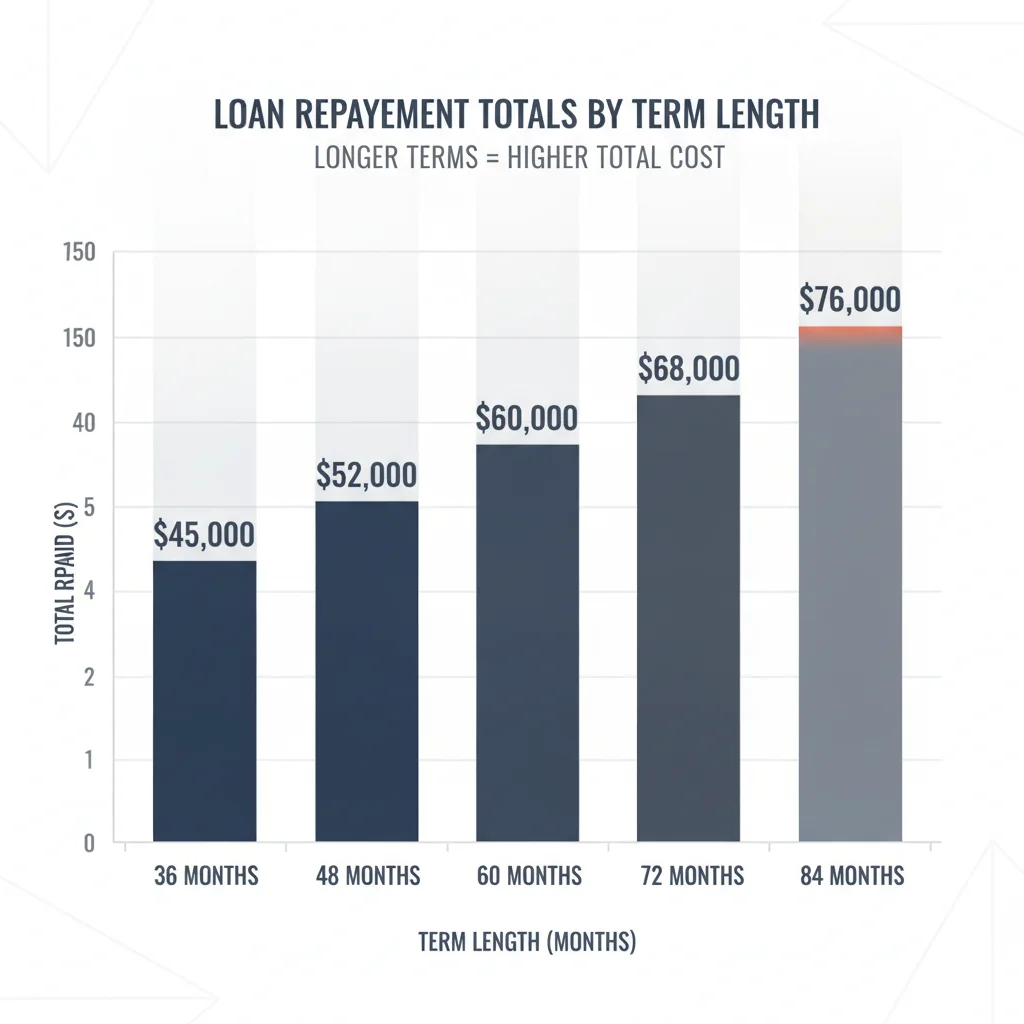
Loan Term: Longer Isn't Cheaper — It Just Looks That Way
Extending your loan from 48 months to 72 months lowers the monthly payment. What it also does, almost always, is raise your APR. Lenders charge more for longer terms because the risk of default, job loss, or the vehicle depreciating below the loan balance all increase over time.
Here's how term typically affects rate (using a prime-tier borrower as a baseline):
| Loan Term | Typical APR Adjustment | Total Interest Paid (on $30,000) |
|---|---|---|
| 36 months | Lowest rate (baseline) | ~$2,100 |
| 48 months | +0.25–0.5% | ~$2,900 |
| 60 months | +0.5–1.0% | ~$3,900 |
| 72 months | +1.0–2.0% | ~$5,600 |
| 84 months | +2.0–3.5% | ~$8,200+ |
The numbers above are illustrative but grounded in real lender behavior. Loan length, monthly payments, and total cost are not independent — they all move together, and the finance office knows it. When a finance manager leads with "we can get your payment to $350," they're very likely stretching the term, not finding you a better rate.
Vehicle Age, Mileage, and Lender Collateral Rules
Lenders treat a two-year-old car and a twelve-year-old car very differently. Older vehicles depreciate faster, are harder to repossess and resell, and carry higher mechanical risk. That means higher APRs — sometimes dramatically so.
Most traditional banks and credit unions apply tiered rate add-ons based on vehicle age:
- New vehicles: Lowest base rates, often with manufacturer incentive rates available
- Used, 1–3 years old: Marginally higher, usually 0.5–1.5% above new-car rates
- Used, 4–7 years old: Noticeably higher — 1–3% premium is common
- Used, 8+ years old: Many prime lenders step out entirely; specialty lenders charge 5–10%+ above new-car rates
Mileage compounds this. A 6-year-old vehicle with 95,000 miles is treated as riskier collateral than a 6-year-old vehicle with 40,000 miles, even if both have the same market value today. Some lenders cap loans entirely at 100,000 or 125,000 miles, regardless of credit score.
The practical implication: if you're buying an older used vehicle, budget for a meaningfully higher rate and shop lenders who specialize in used financing. The same borrower can get very different APRs depending on the lender — used car financing is one of the biggest areas of divergence.
APR (Annual Percentage Rate)
The annualized cost of borrowing, expressed as a percentage. On auto loans, APR includes the interest rate and any financed fees, making it a more complete measure of loan cost than the interest rate alone.
Loan-to-Value Ratio (LTV)
The loan amount divided by the vehicle's appraised or market value, expressed as a percentage. Higher LTV signals more lender risk and typically results in a higher APR or stricter approval conditions.
Debt-to-Income Ratio (DTI)
Your total monthly debt payments divided by your gross monthly income. Lenders use DTI to assess whether you have adequate income to support a new loan payment alongside existing obligations.
Buy Rate
The lowest APR a lender will approve for a specific borrower. Dealers receive the buy rate when they submit your financing application and are typically allowed to mark it up before presenting it to you.
Dealer Markup (Reserve)
The additional percentage points a dealership adds to the lender's buy rate. The dealer earns this spread as profit. It can range from 0% to 3% or more and is not disclosed on your contract.
FICO Auto Score
A credit score variant specifically designed for auto lending decisions. It weighs auto-specific payment history more heavily than a standard FICO score and may differ from the scores you see through consumer credit monitoring services.
Prime Rate
A benchmark interest rate set by banks, often tied to the Federal Reserve's federal funds rate. Auto loan APRs are loosely anchored to the prime rate, which is why rates rise and fall with Federal Reserve policy changes.
Negative Equity
When you owe more on a vehicle than it is currently worth. Rolling negative equity into a new loan increases the LTV ratio and can push your APR higher while also increasing your total debt burden.
Income, Debt-to-Income, and Employment Stability
Credit score gets most of the attention, but lenders also underwrite your ability to repay — not just your history of repaying. Debt-to-income ratio (DTI) is the key measure here: your total monthly debt obligations divided by your gross monthly income.
Most lenders want to see a DTI below 45–50% after including the new car payment. If your DTI is tight, lenders may approve the loan but price in additional risk, or require a larger down payment to reduce the monthly obligation. Some may cap the term shorter than you'd prefer, which has the counterintuitive effect of raising the monthly payment.
Employment type also matters. W-2 employees with two or more years at the same employer get the cleanest underwriting. Self-employed applicants, recent job changers, or gig workers often face additional documentation requests and rate adjustments — even with excellent credit scores — because income verification is harder and perceived stability is lower.
Before applying, calculate your DTI honestly:
DTI = (Total Monthly Debt Payments ÷ Gross Monthly Income) × 100If you're at 42% before the new car payment and the car adds another 8%, you're at 50% — expect lender friction. Paying down a credit card or personal loan before applying can move that needle.

Understanding all the factors lenders weigh when pricing your auto loan — including the less obvious ones like DTI and employment type — is how you walk in prepared rather than reactive.
One final variable that doesn't get discussed enough: dealer markup. When you finance through a dealership, the dealer submits your application to lenders and receives a "buy rate" — the lowest rate the lender will approve. The dealer is typically permitted to mark that rate up by 1–3%, and they pocket the difference as reserve profit. Your credit score drives the buy rate; the markup is pure negotiation. Learn to separate your score-driven rate from added dealer profit — because those two numbers can look identical on a contract but represent very different situations.
myFICO Auto Score Lookup
Pull your FICO Auto Score 8 — the score most auto lenders actually use — before applying. It often differs from your standard FICO and gives you the most accurate preview of your rate tier.
CFPB Auto Loan Shopping Sheet
The Consumer Financial Protection Bureau's comparison worksheet helps you document and compare APR, term, monthly payment, and total cost side by side across multiple lender offers.
Auto Loan APR Calculator
Enter your loan amount, term, and APR to see exactly how much interest you'll pay in total — and how different rates change that figure. Useful for evaluating competing offers.
Pre-Approval Comparison Template
A structured template for tracking pre-approval offers from multiple lenders — including APR, loan amount, term, and any fees — so you can walk into the dealership with a clear benchmark.
All claims are backed by peer-reviewed research. Sources on request.