


Key Takeaways
Auto Loan Interest Rate
An auto loan interest rate is the percentage a lender charges you annually to borrow money for a vehicle purchase. It determines how much you pay in finance charges on top of the principal you borrowed. The rate is set at the time you sign the loan and typically stays fixed for the life of the loan. APR — Annual Percentage Rate — wraps the interest rate together with any lender fees, giving you a more complete cost-of-borrowing figure.
Auto lenders often use risk-based pricing models that assign rates based on tiered credit bands, loan-to-value ratio, and debt-to-income ratio simultaneously — meaning a single weak variable can push you into a higher pricing tier even if your credit score looks strong.
Rate vs. APR: The Distinction That Can Cost You Thousands
Lenders and dealers talk about "the rate" constantly, but they're not always talking about the same number. Understanding the difference between the interest rate and the APR is foundational — and it's an easy place for a buyer to get misled.
Interest rate is the annual percentage charged on the principal loan balance. If you borrow $30,000 at a 7% interest rate, that 7% is applied to the outstanding balance each month as the loan amortizes.
APR (Annual Percentage Rate) folds in the interest rate plus most lender-imposed fees — origination fees, processing charges, documentation fees rolled into financing — expressed as a single annual percentage. APR gives you a more complete picture of what borrowing actually costs.
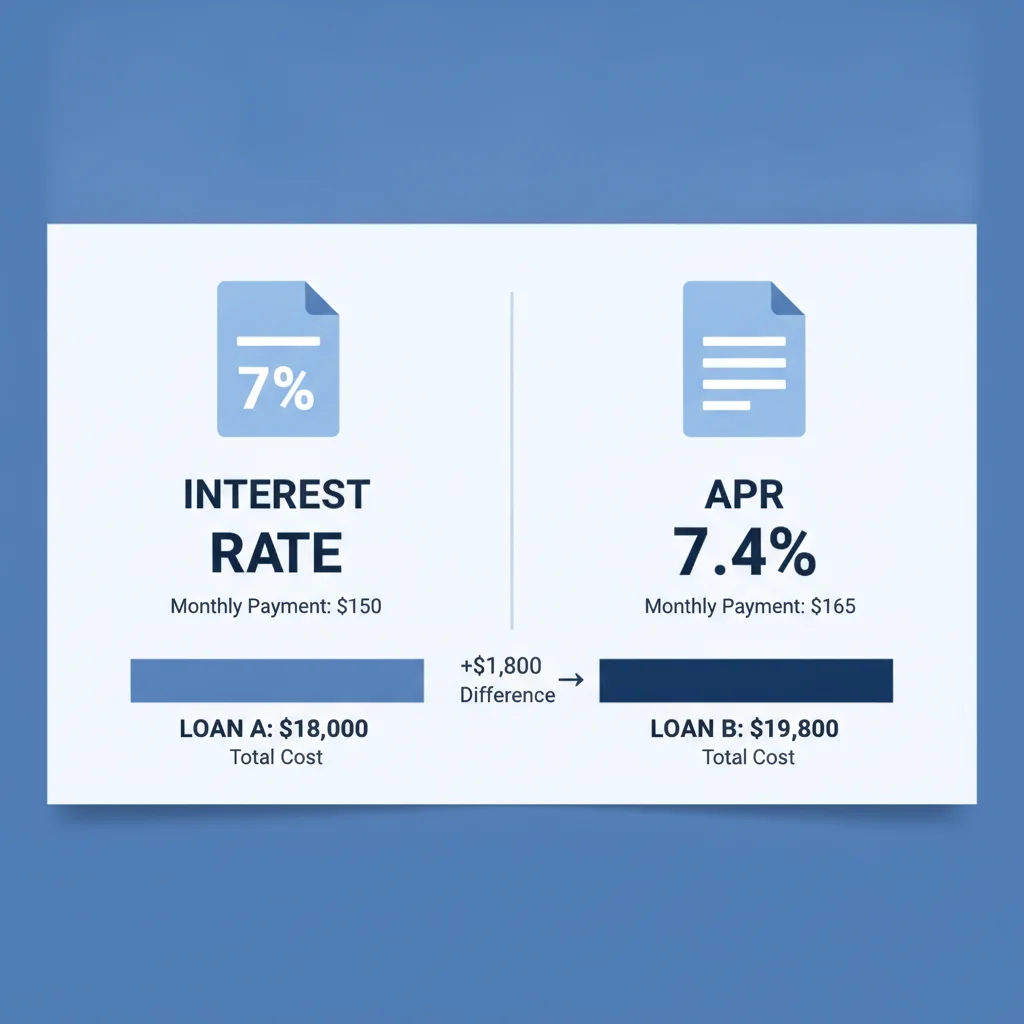
Here's a practical example: Two lenders both quote you a 7% interest rate. Lender A charges no fees. Lender B charges a $500 origination fee. Lender A's APR is 7%. Lender B's APR, on a 60-month loan, is closer to 7.4%. That gap costs you real money over the loan term.
Always compare APRs — not interest rates — when you're shopping multiple lenders. Federal law (the Truth in Lending Act) requires lenders to disclose the APR before you sign, so you have the right to see it up front. For a deeper look at all the variables baked into your APR before you even walk into a dealership, see what shapes your car loan APR.
Rate vs. APR: Always Ask for Both
Federal law requires lenders to disclose APR before you sign, but dealers sometimes lead with the interest rate because it looks lower. Make a habit of asking specifically for the APR and checking that it matches the contract before signing. A small discrepancy between the quoted rate and the contract APR can indicate undisclosed fees have been added.
Promotional Rates Are Not Universal
Manufacturer promotional rates (0% APR, 1.9% APR) are real but highly targeted. They typically require a score of 720 or higher, apply only to specific models and trim levels, and often require you to forgo a cash-back rebate. Always calculate whether taking the rebate and financing at a standard rate outperforms the promotional rate — sometimes the rebate wins.
Credit Score: The Biggest Single Variable
No factor moves your rate more than your credit score. Lenders use it as the primary proxy for how likely you are to repay. The math is blunt: higher risk, higher rate. That's how lenders cover expected losses across a pool of borrowers.
~5–6%
Average new car APR for prime borrowers
According to Experian's State of the Automotive Finance Market data, prime borrowers (720–759 score) receive average new car APRs in the 5–6% range, while deep subprime borrowers average above 14%.
1–2%
Typical dealer rate markup above lender buy rate
The dealer finance reserve — the markup above the lender's actual quote — commonly ranges from 1 to 2 percentage points and can legally reach 2.5% on most loan types.
$3,500+
Extra interest from a 100-point credit score gap
On a $35,000 loan over 60 months, a 5-point APR difference resulting from a 100-point credit score gap translates to more than $3,500 in additional interest paid over the life of the loan.
45 days
Auto loan shopping window (FICO models)
FICO Score 8 and newer models consolidate all auto loan inquiries within a 45-day window into a single inquiry for scoring purposes, minimizing the impact of comparison shopping.
1–3%
Rate premium for used vs. new vehicle loans
Experian and industry lender data consistently show used car loans carrying APRs 1–3 percentage points higher than new car loans for borrowers with identical credit profiles.
Most lenders segment borrowers into credit tiers that look roughly like this:
| Credit Tier | Typical Score Range | Rate Premium vs. Best Tier |
|---|---|---|
| Super Prime | 760+ | Baseline (lowest available rate) |
| Prime | 720–759 | +0.5% to +1.5% |
| Near Prime | 660–719 | +2% to +4% |
| Subprime | 580–659 | +5% to +10% |
| Deep Subprime | Below 580 | +10% or more (if approved at all) |
These bands are lender-specific, but the pattern is consistent. A 100-point difference in your score can easily mean a 3–5 percentage point difference in APR — which on a $35,000 loan over 60 months translates to roughly $3,500 in extra interest paid.
One nuance worth knowing: auto lenders often pull a specialized auto-industry credit score — FICO Auto Score 8 or 9 — rather than the generic FICO score you see on consumer credit monitoring apps. These scores weight auto loan payment history more heavily. Our article on which credit scores auto lenders actually use explains the difference in detail.
For more on how your credit profile shapes every dimension of your loan offer, the credit score impact hub is a good reference point.
The Five Other Factors Lenders Are Quietly Weighing
Credit score gets all the attention, but an underwriter's risk model is more complex. Here are the other variables that move your rate — sometimes significantly.
1. Loan-to-Value Ratio (LTV)
LTV is the loan amount divided by the vehicle's value. If you're borrowing $28,000 on a car worth $32,000, your LTV is 87.5%. The lower the LTV, the less risk the lender takes on — because if you stop paying, they can recover more of their money by repossessing and selling the vehicle. Lenders typically start discounting rates below 80% LTV. Going above 100% LTV (borrowing more than the car is worth, often to roll in negative equity) can trigger a rate surcharge of 0.5% to 1% or higher.
This is where your down payment becomes a direct rate lever — more down equals lower LTV equals better rate.
2. Loan Term
Longer terms equal higher rates. A 72-month loan will consistently price higher than a 48-month loan from the same lender on the same vehicle. The reason is straightforward: a longer term means more time for something to go wrong — job loss, accident, depreciation outpacing payoff. Lenders price that extended risk into the rate. On top of the higher rate, a longer term means more months of interest accumulation, so the total cost compounds in two directions.
3. Debt-to-Income Ratio (DTI)
Lenders look at your monthly debt obligations as a share of gross monthly income. A DTI above 50% is a red flag for most lenders. Even with a strong credit score, a high DTI can push you into a higher rate tier or trigger an outright denial. The threshold that triggers rate adjustments varies by lender, but keeping total monthly debt payments below 40% of gross income puts you in a comfortable position.
4. Income Stability and Employment History
Lenders want to see consistent, verifiable income. Self-employed borrowers often face more scrutiny — and sometimes higher rates — because their income is harder to verify and may be more variable. Two or more years of stable employment in the same field is generally viewed favorably. Recent job changes, especially across industries, can raise flags even if your current income is solid.
5. Vehicle Age and Mileage
Used cars get higher rates than new cars — not because of anything about you, but because an older vehicle is harder to repossess and resell if you default. Many lenders won't finance vehicles older than 8–10 years or with more than 100,000–120,000 miles, and those that do charge a premium. The car itself is the collateral, and depreciated collateral equals higher lender risk.
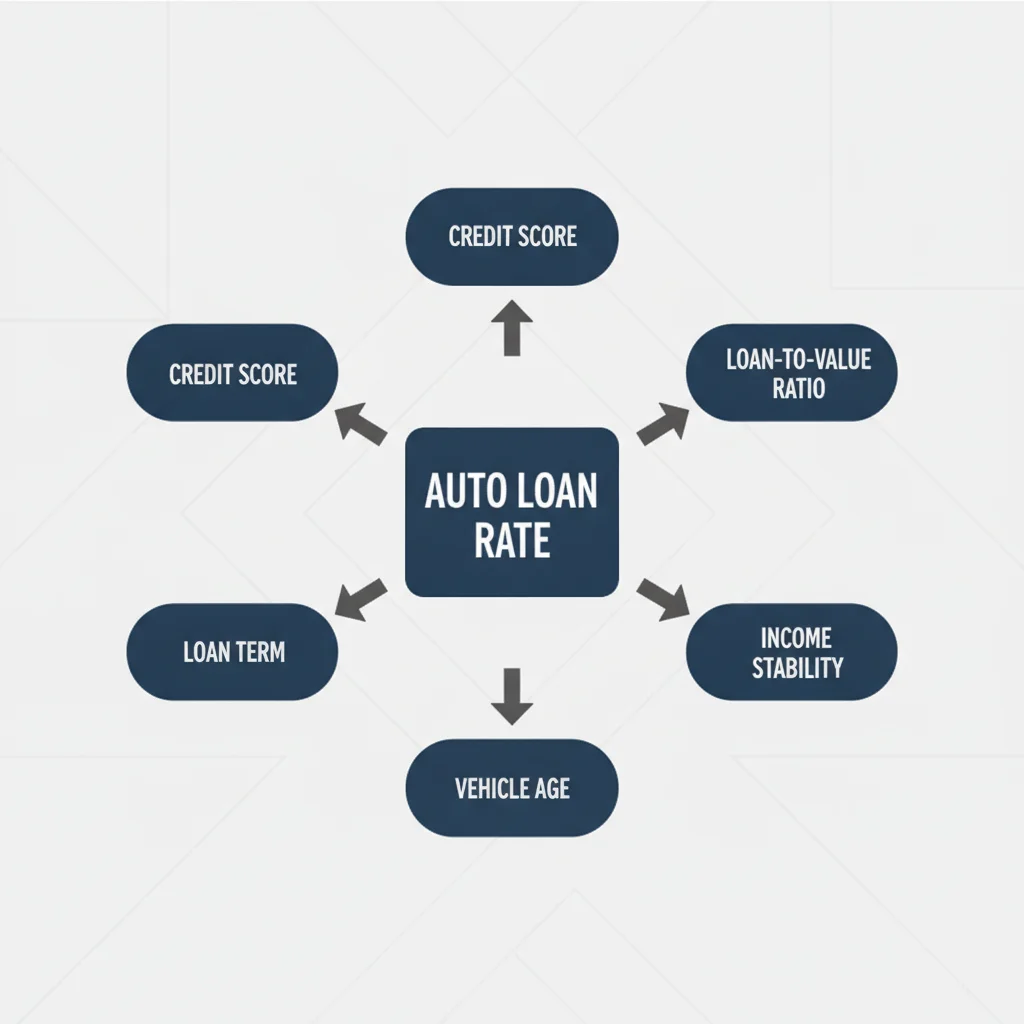
For the comprehensive breakdown of how all these variables interact, see everything that shapes your auto loan rate and what lenders look at beyond your credit score.
Get Pre-Approved Before You Shop
A pre-approval from a bank or credit union takes 15–30 minutes and locks in a rate ceiling before you set foot in a dealership. It gives you a concrete number to negotiate against and eliminates the asymmetry of the F&I office controlling all the information. Most pre-approvals are valid for 30–60 days — plenty of time to find the right vehicle.
Check Your Rate Tier Before Applying
Many lenders publish their credit tier cutoffs online or will tell you over the phone. Knowing exactly which tier your score puts you in helps you decide whether it's worth waiting 60–90 days to pay down debt and potentially move into a better pricing band. Even a half-point rate improvement on a $30,000 loan saves several hundred dollars over 60 months.
Where You Get Your Loan Matters as Much as Your Credit Profile
Most buyers focus entirely on their own creditworthiness when thinking about rates, but the lender source matters just as much. There are three main channels, each with a different cost structure.
Banks and Credit Unions
Direct lenders — particularly credit unions — typically offer the most competitive rates. Credit unions are member-owned nonprofits, which means they don't have the same profit margin pressure as a commercial bank or captive finance arm. On average, credit union auto loan rates run 1–2 percentage points lower than dealership-arranged financing for the same borrower profile. The tradeoff is more paperwork and potentially a longer approval process.
Captive Finance Companies
These are the financing arms of automakers: Ford Motor Credit, Toyota Financial Services, GM Financial, and their peers. They can offer extraordinarily low promotional rates (sometimes 0% APR for qualified buyers) to move specific models — but those offers are typically restricted to buyers with credit scores above 720 and apply only to certain trim levels or model years. Outside of promotional periods, their rates are competitive but not exceptional.
Dealer-Arranged Financing
This is the most common channel — and the most expensive on average. Dealers act as intermediaries: they submit your credit application to multiple lenders, get back offers, and present you with one. The catch is that dealers are legally allowed to mark up the rate above what the lender quoted them — called the "dealer reserve" or "finance reserve" — and pocket the difference. This markup can be 0.5% to 2.5% above the actual lender buy rate. The practice is legal, but it means the rate quoted to you at the F&I desk is rarely the lowest rate you qualify for.
“The best time to negotiate your auto loan is before you walk into the dealership. A pre-approval in your pocket changes the entire dynamic of that conversation — the dealer is no longer setting the floor, you are.”
— Melinda Zabritski, Senior Director of Automotive Financial Solutions, Experian
The smart move: Get pre-approved from your bank or credit union before you go to a dealership. Then let the dealer try to beat it. If they can, great. If not, use your pre-approval. This forces the dealer's finance office to compete rather than set the opening number.
Which Factors You Can Actually Influence
Some rate factors are fixed at the moment you apply — vehicle age, the prevailing rate environment, the lender's current pricing model. But several are genuinely within your control, and moving them meaningfully before you apply can shift your rate by multiple percentage points.
Before You Apply
- Pull and review your credit reports. Errors are common. Disputing inaccurate derogatory marks can move your score meaningfully within 30–60 days. You're entitled to free reports at AnnualCreditReport.com.
- Pay down revolving balances. Credit utilization — how much of your available revolving credit you're using — is one of the fastest-moving score factors. Getting utilization below 30% (ideally below 10%) can add 20–40 points to your score in a single billing cycle.
- Avoid opening new credit accounts in the 3–6 months before applying. New accounts lower your average account age and generate hard inquiries, both of which temporarily reduce your score.
At the Time of the Loan
- Make a larger down payment. Every dollar down reduces your LTV. Moving from 95% LTV to 80% LTV can push you into a better rate tier.
- Choose a shorter loan term. Yes, the monthly payment is higher — but the rate is lower and the total interest paid is substantially less. Run the actual numbers rather than optimizing for the monthly payment alone.
- Shop multiple lenders in a short window. As noted above, multiple auto loan inquiries within 14–45 days are treated as one inquiry by the major credit scoring models. There's no reason not to get 3–5 competing offers. Our guide on how rate shopping affects your credit score explains exactly how the shopping window works.

Get Pre-Approved Before You Shop
A pre-approval from a bank or credit union takes 15–30 minutes and locks in a rate ceiling before you set foot in a dealership. It gives you a concrete number to negotiate against and eliminates the asymmetry of the F&I office controlling all the information. Most pre-approvals are valid for 30–60 days — plenty of time to find the right vehicle.
Check Your Rate Tier Before Applying
Many lenders publish their credit tier cutoffs online or will tell you over the phone. Knowing exactly which tier your score puts you in helps you decide whether it's worth waiting 60–90 days to pay down debt and potentially move into a better pricing band. Even a half-point rate improvement on a $30,000 loan saves several hundred dollars over 60 months.
If you're currently upside-down on a loan and considering refinancing rather than a new purchase, the evaluation criteria shift somewhat — lenders focus heavily on current loan-to-value and payment history. See what lenders examine before approving a refinance for that specific scenario.
The Rate Shopping Process: A Practical Sequence
Knowing what lenders evaluate is only useful if you translate it into action. Here's the sequence that puts you in the strongest position before you sign anything.
- Check your credit reports and scores — all three bureaus (Equifax, Experian, TransUnion) at least 60 days before you plan to buy. Dispute any errors immediately.
- Get pre-approved from at least two direct lenders — your bank and a credit union are the obvious starting points. Online lenders like LightStream or PenFed are worth including. A pre-approval letter tells you the maximum rate you'll pay.
- Decide on your loan term before you shop vehicles — knowing you want a 48- or 60-month term helps you evaluate monthly payment offers honestly rather than letting the dealer extend your term to make an unaffordable car seem manageable.
- Bring your pre-approval to the dealership. Tell the F&I manager you're financing and that you have a competing offer. Ask if they can beat it. If their rate is lower, take it. If not, use your pre-approval.
- Read the APR on the contract — not the interest rate, not the monthly payment. The APR is the number that tells you what the loan actually costs.
For more detail on how rate shopping multiple lenders interacts with your credit file, see auto loan rate shopping and credit scores.
Rate vs. APR: Always Ask for Both
Federal law requires lenders to disclose APR before you sign, but dealers sometimes lead with the interest rate because it looks lower. Make a habit of asking specifically for the APR and checking that it matches the contract before signing. A small discrepancy between the quoted rate and the contract APR can indicate undisclosed fees have been added.
Promotional Rates Are Not Universal
Manufacturer promotional rates (0% APR, 1.9% APR) are real but highly targeted. They typically require a score of 720 or higher, apply only to specific models and trim levels, and often require you to forgo a cash-back rebate. Always calculate whether taking the rebate and financing at a standard rate outperforms the promotional rate — sometimes the rebate wins.
All claims are backed by peer-reviewed research. Sources on request.