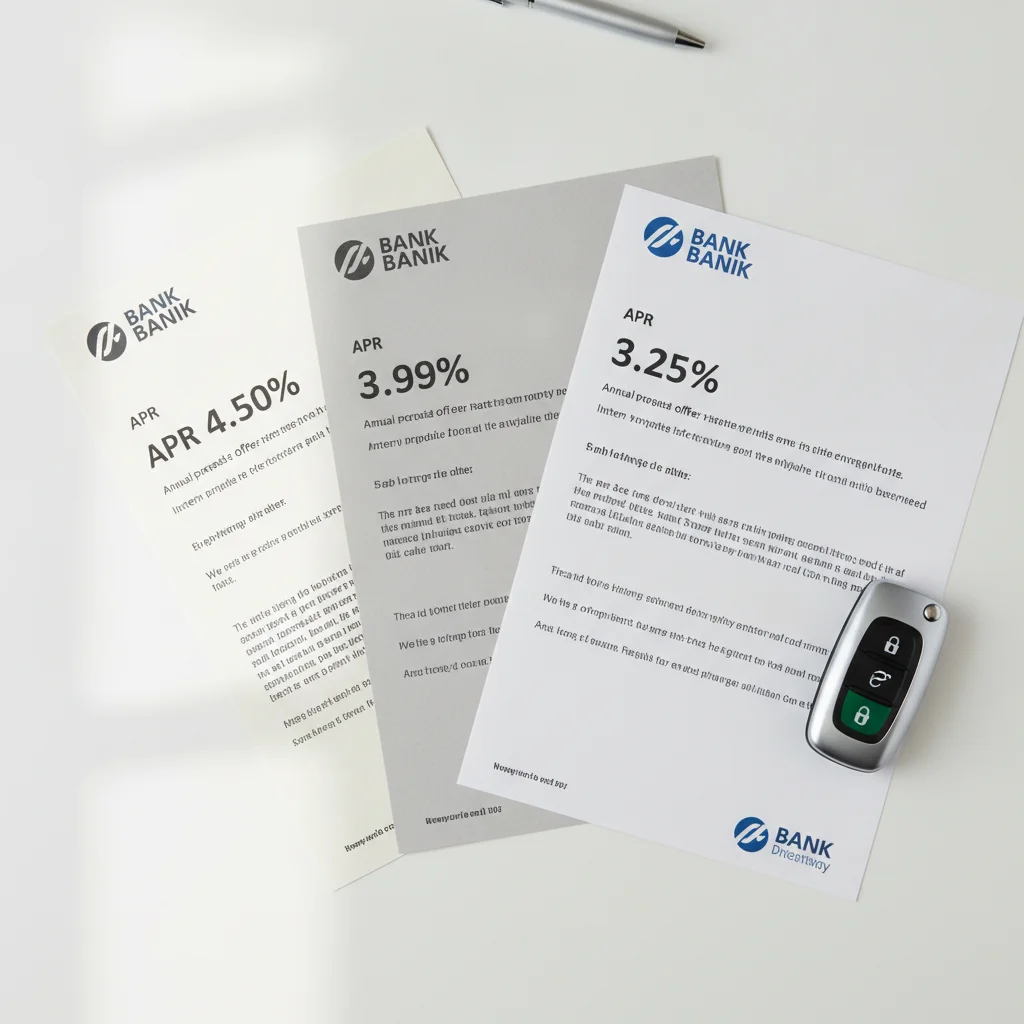

Key Takeaways
Why Monthly Payment Comparisons Will Cost You Money
Most car buyers make the same mistake: they hand a lender their budget — say, $450 a month — and let the lender build a loan around it. The problem is that monthly payment is the easiest number to manipulate. Stretch the term from 48 to 72 months and suddenly almost any amount fits your budget, while you quietly absorb thousands more in interest.
When I was on the finance desk, we were trained to lead with the payment. It's effective precisely because it's emotionally satisfying — the number fits, so the deal feels right. What it obscures is the actual cost of borrowing: the APR, origination fees, prepayment penalties, and the compounding effect of a longer term.
A $30,000 loan at 5.9% APR for 48 months costs you roughly $3,750 in interest. That same loan stretched to 72 months at the same rate costs you about $5,640. The monthly payment drops by around $140, but you pay almost $1,900 more over the life of the loan. Now imagine that the rate isn't the same — that the 72-month offer carries a 7.4% APR. Your total interest climbs to over $7,000.
This is why you need a framework that compares offers on equal terms before you sit across from anyone. The steps below give you exactly that.

Before diving in, make sure you understand why your offers vary in the first place. Two lenders can quote very different rates for the same application — understanding why puts you in a stronger negotiating position.
What You Need Before You Can Compare
You can't do a real comparison until you have structured offers in hand. That means going through the preapproval process with at least three lenders — your bank or credit union, an online lender, and the dealership's financing arm — before you commit to anything.
What you will need
When requesting quotes, ask each lender to provide the following in writing: the loan amount, the interest rate, the APR, the loan term in months, any origination or documentation fees, and whether there is a prepayment penalty. Some lenders will resist putting everything on one sheet. That resistance is informative.
One concern buyers often raise is whether applying to multiple lenders will hurt their credit score. The short answer is: not significantly, as long as you do it within the right window. Credit bureaus treat auto loan inquiries made within a 14–45 day period as a single inquiry, so you can shop aggressively without compounding the damage.
Loan amortization calculator
Calculates total interest paid and monthly payment for any combination of loan amount, rate, and term so you can compare offers on equal footing.
Spreadsheet (Excel or Google Sheets)
Lets you build a side-by-side comparison table of all offers with consistent fields: APR, term, fees, monthly payment, and total cost.
Written preapproval letters from each lender
Provides the official loan terms — rate, APR, amount, and conditions — needed to make an accurate comparison and use as leverage at the dealership.
Credit report (AnnualCreditReport.com)
Confirms what lenders are seeing when they price your loan and helps you spot errors that may be inflating your rate.
Step-by-Step: Comparing Loan Offers the Right Way
Work through the following steps for every offer you receive. The goal is to reduce each offer to the same three comparable numbers: APR, total interest paid, and total cost of the loan. Once you have those three numbers for each lender, the decision becomes straightforward.
Collect the full terms of each offer in writing
Call or email each lender and request a written disclosure that includes: the interest rate (nominal), the APR, the loan term in months, any origination or documentation fees, and any prepayment penalty. If a lender won't give you APR in writing, move on — that's a red flag, not a negotiating chip.
For dealer financing, request the buyer's order or a financing worksheet before signing anything. This document should show the rate, term, and all ancillary products being added to the loan.
Standardize the loan amount across all offers
Different lenders may quote on slightly different amounts depending on what they're rolling in. Before comparing, pick a single loan amount — your actual intended financed amount — and recalculate every offer against that number. Most online amortization calculators let you plug in any principal, rate, and term.
For example: if you're financing $27,500, make sure every offer in your comparison is based on $27,500 — not $28,200 because one lender included gap insurance in the principal.
Calculate total interest paid for each offer
Use an amortization calculator to find the total interest paid over the full loan term for each offer. Enter the standardized loan amount, the APR (not the nominal rate), and the term. The calculator will return a monthly payment and a total interest figure.
Record these in a simple table:
- Lender name
- APR
- Term (months)
- Monthly payment
- Total interest paid
- Total amount repaid (principal + interest)
Add fees not captured in the APR
Some fees fall outside the APR calculation — particularly dealer add-ons like extended warranties or paint sealant, which get folded into the loan principal rather than disclosed as financing costs. Identify every fee being added to your loan amount that isn't part of the vehicle purchase price.
Add those fees to the total cost column in your comparison table. This gives you the true all-in cost for each offer.
Rank offers by total cost, not monthly payment
Once your table is complete, sort it by total amount repaid — lowest to highest. This is your primary ranking. In most cases, the offer with the lowest APR at the shortest term you can afford will win. But occasionally a slightly higher APR with zero fees on a shorter term beats a lower-rate, fee-heavy offer.
Your monthly payment column is a reality check, not a ranking criterion. If the lowest total-cost offer requires a monthly payment you genuinely cannot manage, the next-best option becomes your target — and you look for ways to increase your down payment to close the gap.
Use your best offer as a negotiating baseline
Take your top-ranked offer to every other lender — including the dealer — and ask them to beat it. State the APR and total cost, not just the monthly payment. This forces the conversation onto your terms. A dealer finance manager who knows you have a 5.75% APR preapproval from your credit union will work harder to hit 5.5% than one who thinks you're shopping by payment.
If the dealer can legitimately beat your best preapproval, let them. Just confirm the final rate, term, and total cost in writing before you sign.
If you want a broader framework for evaluating preapproval offers once you have several in hand, this structured approach for comparing multiple preapproval offers side by side covers the full process in detail.
Watch for yo-yo financing at the dealership
Some dealers let you drive home on a financing agreement that isn't finalized, then call days later to say the deal 'fell through' and you need to return to sign at a higher rate. This tactic, called yo-yo financing, is predatory and often targets buyers with marginal credit. If financing isn't fully approved before you leave the lot, do not take the car home. Get full approval in writing — with a signed contract, not a conditional agreement — before the vehicle leaves the dealership.
Don't let the term extend to close a rate gap
If a lender's rate is higher than your preapproval but they offer to lower your monthly payment by extending the term, decline. A longer term at the same rate — or worse, a higher rate — increases your total interest cost substantially. Run the numbers on total cost before agreeing to any term change, even one framed as doing you a favor.
Rate vs. APR: The Distinction That Saves You Money
The single most important concept in this entire process is the difference between the interest rate and the APR. Most people use the terms interchangeably. That's a mistake that costs real money.
The interest rate (also called the nominal rate) is simply the percentage used to calculate your monthly interest charge on the outstanding principal. It does not include fees.
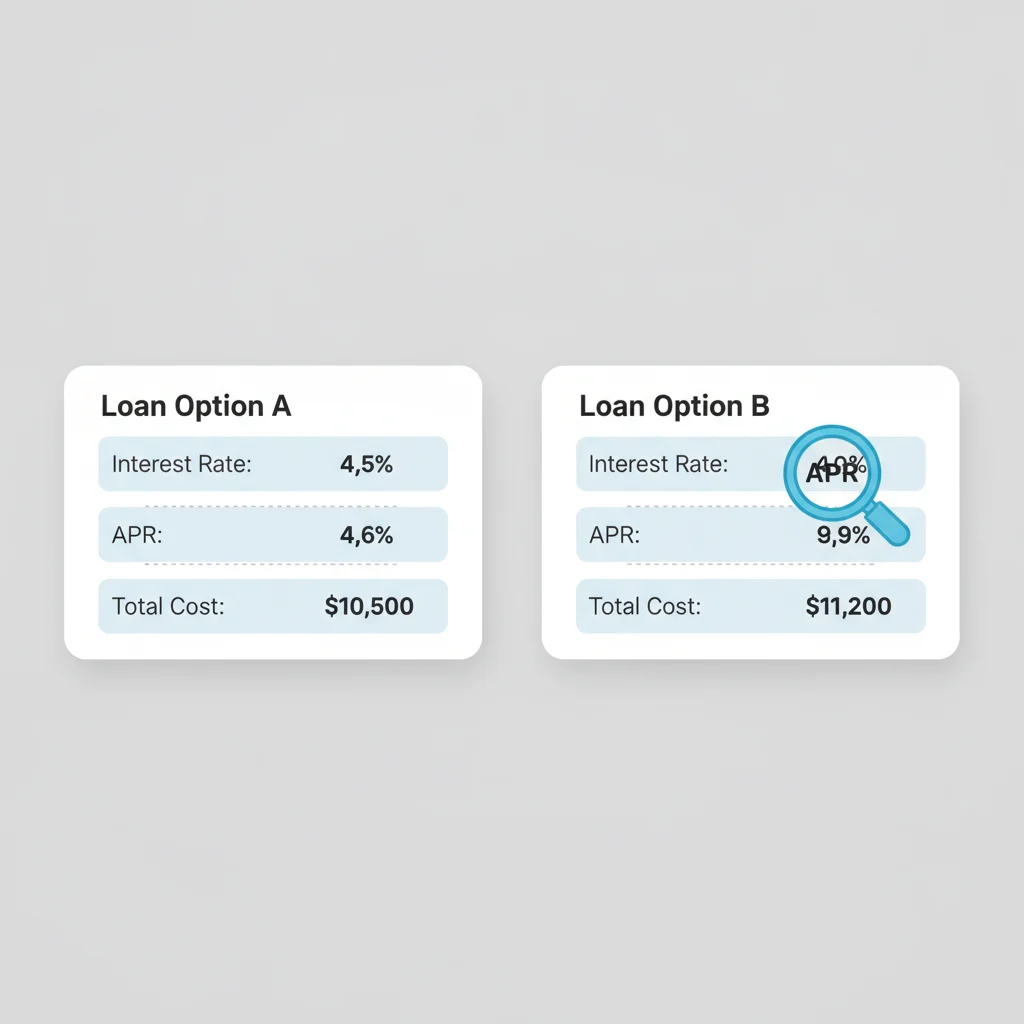
The APR (Annual Percentage Rate) is the interest rate plus all lender-imposed fees, expressed as a single annualized percentage. It represents the true cost of borrowing for a given year.
| Metric | Lender A | Lender B |
|---|---|---|
| Loan Amount | $28,000 | $28,000 |
| Interest Rate | 5.50% | 5.25% |
| Origination Fee | $0 | $650 |
| APR | 5.50% | 5.91% |
| Term | 60 months | 60 months |
| Total Interest Paid | $4,073 | $4,397 |
| Total Cost | $32,073 | $32,397 |
Lender B quoted a lower interest rate and would win the deal from most buyers who didn't look further. But after accounting for the origination fee, Lender B's APR is nearly half a point higher and the loan costs $324 more in total. That's not a rounding error — that's a dinner out every month for the life of the loan.
To understand why lenders price loans the way they do — and which factors in your profile they're responding to — read how lenders determine your auto loan interest rate. Knowing their logic helps you negotiate more effectively.
Credit unions typically offer the best base rates
If you're a member of a credit union, get their preapproval first. Credit unions are member-owned and don't have the same profit incentives as banks or dealer financing arms. Their rates on auto loans are frequently 0.5–1.5 percentage points below what you'll see from a commercial bank. Even if you end up financing through the dealer, you'll have a strong baseline to negotiate against.
Shorter terms almost always win on total cost
When you're comparing offers, run each one at both your target term and a term that's 12 months shorter. The difference in total interest is often surprising enough to motivate a larger down payment or a slightly tighter monthly budget. On a $25,000 loan at 6% APR, shortening from 72 to 60 months saves you about $1,300 in interest.
Refinancing is a valid exit strategy
If you're in a time crunch and your best available rate isn't great, accept it with a plan to refinance in 12–18 months once your credit profile strengthens or market rates drop. There's no rule requiring you to carry the original loan to term. Just confirm there's no prepayment penalty before you sign.
APR Is the Only Fair Comparison Point
Do not compare loan offers using the nominal interest rate. The interest rate ignores fees and will lead you to choose the wrong offer. Always demand APR in writing from every lender and use that number — and only that number — when ranking offers. This is the rule that overrides everything else in this process.
Dealer Markups Are Negotiable — and Common
The rate the dealer quotes you is almost never the buy rate from the lender. Federal regulations require dealers to disclose that a markup may exist, but they are not required to tell you the actual buy rate. Your leverage is a competing preapproval. Come in with one, and you shift the negotiation from 'take it or leave it' to 'beat this or I finance elsewhere.'
Dealer Financing: What the Finance Office Doesn't Tell You
Dealer financing works differently from a bank or credit union loan. The dealership doesn't actually lend you money — it acts as a broker between you and the lender, submitting your application to one or more financing sources. When the lender approves you at, say, 5.9% APR, the dealer is allowed to mark that rate up — typically up to 2–2.5 percentage points — and keep the difference as profit. This is called the dealer reserve, and it's perfectly legal.
So if you're quoted 7.4% at the finance desk, the actual buy rate from the lender might be 5.4%. The 2% spread on a $30,000 loan over 60 months is roughly $1,600 in extra interest going to the dealer, not the bank.
Here's how to use this against them: come in with a preapproval from your bank or credit union. Show it to the finance manager and tell them you'll finance through the dealer only if they beat your rate. They frequently can — because even with a 1% markup, the lender's buy rate may still undercut your bank. Now you're negotiating from a position of knowledge instead of desperation.
Your down payment also plays a role here. A larger down payment reduces the financed amount, which reduces both the lender's risk and your total interest exposure. Understanding how down payment size shapes your loan structure can help you think through the right number before you walk in.

Common Mistakes That Undermine a Good Comparison
Even buyers who do the research often make avoidable errors in the final stretch. Here are the ones I saw most frequently on the finance desk — and how to sidestep them.
Comparing offers with different loan amounts
If Lender A is quoting on $27,000 and Lender B is quoting on $29,500 (perhaps because they rolled in an extended warranty or gap insurance), you're not comparing the same thing. Standardize the loan amount before you run any comparisons.
Ignoring add-on products in the finance office
Extended warranties, gap insurance, credit life insurance, and paint protection packages are all high-margin products that get folded into the loan amount. Each one increases your principal, which increases your interest. If you want gap insurance — and on a long-term loan with a small down payment, you probably should consider it — price it independently through your auto insurer before the dealer quotes it.
Failing to account for prepayment penalties
Some lenders charge a fee if you pay the loan off early. This matters if you plan to refinance once your credit improves or if you expect a lump sum (bonus, tax refund) that you'd apply to the balance. Ask explicitly. It's not always disclosed upfront.
Letting the term drift to close a deal
The finance office knows that extending the term is the easiest way to make a deal work when a buyer balks at the monthly payment. Extending from 60 to 72 months on a $30,000 loan at 6.5% APR adds about $1,850 in interest. Treat any term extension as the cost increase it actually is.
The same discipline applies when comparing car listings — there are a lot of variables to juggle. A structured system for narrowing car listings without getting overwhelmed can help you work the vehicle side of the equation with the same rigor you're bringing to the financing.
All claims are backed by peer-reviewed research. Sources on request.