
Key Takeaways
Preapproval Rate Variation
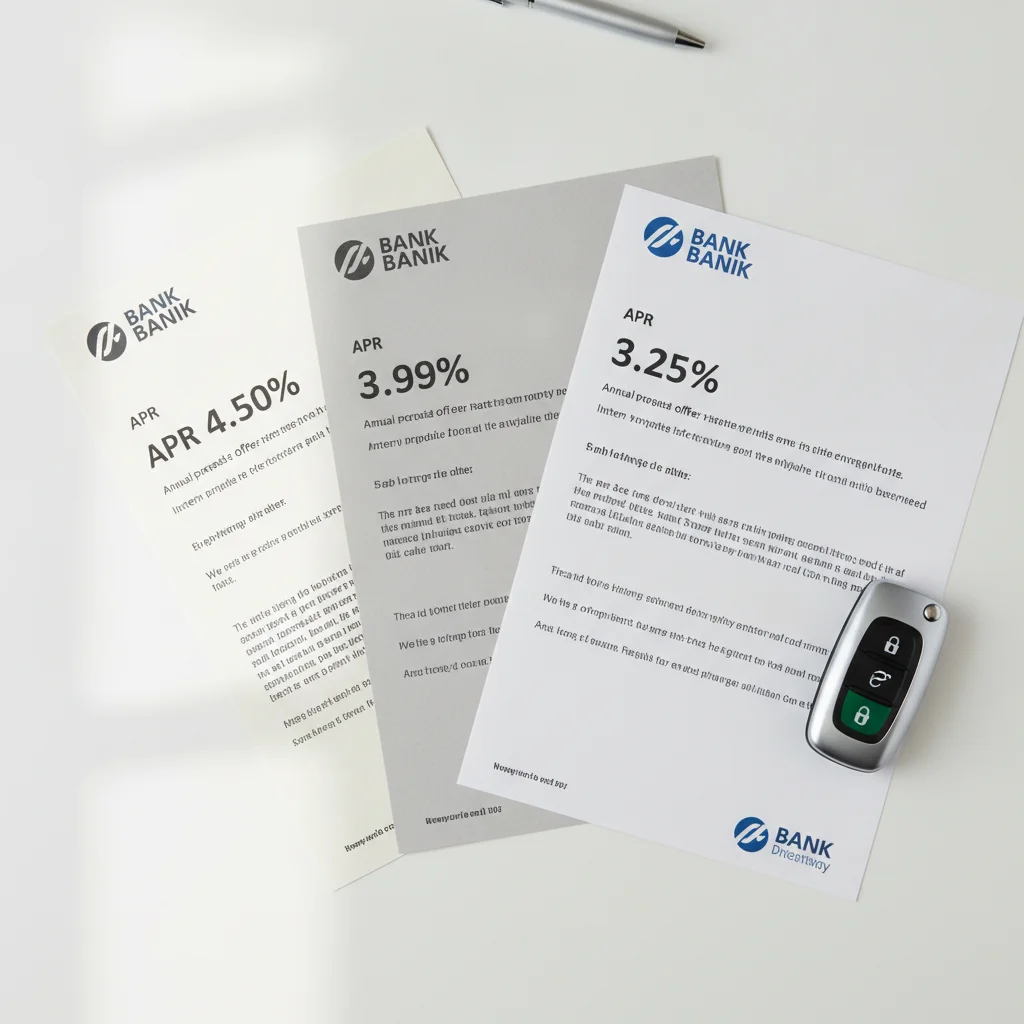
Preapproval rate variation refers to the fact that different lenders can evaluate the same borrower and the same loan request and still arrive at meaningfully different interest rates. This happens because each lender uses its own underwriting model, risk appetite, cost of funds, and business priorities to price a loan. Two offers on identical loan amounts can differ by a full percentage point or more — a gap that translates to hundreds of dollars over the life of the loan.
Lenders price auto loans off their cost of funds (often tied to the federal funds rate or wholesale deposit rates) plus a risk premium determined by proprietary credit models. Differences in those two inputs — and in each lender's target profit margin — explain most of the variation buyers see.
Why the Same Application Gets Different Rates
Here's something the dealership finance office would rather you not know: when you sign on the dotted line for dealer-arranged financing, the dealer is not a lender. They're a middleman. They shop your application to a network of banks and captive lenders, mark up the rate they're offered, and pocket the difference — sometimes called a "dealer reserve." That spread can be 1–2 percentage points on top of whatever the lender actually approved you for.
But even if you bypass the dealer entirely and go direct to three separate lenders, you'll likely see three different rates. Why? Because no two lenders share the same underwriting formula. Each institution builds its own model to predict the probability that a given borrower will default, and each one prices that risk differently based on:
- Cost of funds: A credit union funded by member deposits often has a lower cost of capital than a large bank reliant on bond markets. That savings can get passed to borrowers.
- Risk appetite: Some lenders specialize in near-prime borrowers and have optimized their models to price that segment aggressively. Others focus on prime borrowers and quote higher rates for anyone outside their sweet spot.
- Portfolio goals: A lender that needs to grow its auto loan book this quarter may intentionally price more competitively to win business. A lender near its concentration limit may price to discourage applications.
- Proprietary credit scoring: Most lenders pull a FICO Auto Score in addition to (or instead of) a generic FICO score. Auto-specific scores weight your history with auto loans more heavily — and each lender may use a different FICO Auto Score version (2, 4, 5, 8, or 9), producing different numbers from the same credit file.

The net effect: rate variation across lenders is structural, not random. Understanding the drivers lets you predict where the best offer is likely to come from — and who to approach first.
The Factors Inside Your Application That Move the Rate
Your credit score gets most of the headlines, but lenders are evaluating several dimensions simultaneously. Improving on even one or two of these can meaningfully shift offers. Your credit score directly affects the loan rates lenders offer, but it's rarely the only variable in play.
Credit Score Band
Lenders tier their rates around credit score ranges. The difference between a 719 and a 720 can be the difference between two pricing tiers — sometimes 0.5–1.0 percentage points. If you're near a threshold, pulling your credit reports before applying (using a soft inquiry) to identify any quick-fix errors is worth the effort.
Loan-to-Value Ratio (LTV)
Lenders look at how much you're borrowing relative to the car's value. A large down payment lowers LTV and reduces the lender's collateral risk — which typically earns a lower rate. Borrowing 120% of a vehicle's value (common when rolling in negative equity) signals elevated risk and triggers rate increases.
Loan Term
Longer terms mean more time for something to go wrong. Most lenders charge higher rates on 72- and 84-month loans than on 48- or 60-month terms for exactly this reason. A buyer who compares only the monthly payment and not the rate-by-term combination is likely leaving money on the table. See our guide to how interest rates and APR affect the true cost of your car loan for a deeper breakdown.
Vehicle Age and Mileage
Used vehicles depreciate faster and are harder to resell at full value if repossessed. Most lenders charge 1–2 percentage points more on vehicles older than five years, and some refuse to finance vehicles beyond a certain age or mileage entirely.
Debt-to-Income Ratio (DTI)
Even a borrower with an excellent credit score can be declined or quoted a higher rate if their monthly debt obligations consume too large a share of their gross income. Most lenders prefer a back-end DTI below 43%, though some allow higher ratios for strong credit profiles.
“The auto loan market is not a commodity market where all prices converge. Every lender has a different model, different funding costs, and different goals. Consumers who treat rate shopping like a chore are leaving real money on the table.”
— Melinda Zabritski, Senior Director of Automotive Financial Solutions, Experian
How Lender Type Shapes the Rate You See
Not all lenders compete on the same terms. The institution you approach shapes the offer before your application even hits an underwriter's desk.

Credit Unions
Member-owned, not-for-profit, and often the best starting point for buyers with good-to-excellent credit. Credit unions tend to offer rates 1–2 percentage points below banks on comparable loans. Membership requirements exist, but most are easily satisfied — employer affiliation, geographic area, or a small donation to an affiliated organization.
Community Banks and Regional Banks
Often competitive for local buyers and may have more flexibility on underwriting edge cases than national banks. Building a relationship with a branch you already bank at can sometimes unlock a relationship discount.
National Banks
Fast approvals, broad loan menus, and consistent underwriting — but rates are typically higher than credit unions. National banks compete on convenience and brand familiarity more than rate.
Captive Lenders (Manufacturer Finance Arms)
Toyota Financial, Ford Motor Credit, GM Financial, and their counterparts exist to sell more cars, not to maximize interest income. This means they sometimes offer deeply subsidized promotional rates (0%–1.9% APR deals) on specific models to move inventory. The catch: those promotional rates are usually reserved for buyers with top-tier credit and may come with shorter terms or require forgoing a manufacturer rebate. Always calculate whether the cash rebate plus a market-rate loan beats the promotional rate with no rebate.
Online and Fintech Lenders
Lenders like LightStream, Consumers Credit Union (national membership available), and others operate entirely online. Lower overhead can mean competitive rates, and the application process is fast. Worth including in your rate-shopping sweep.
1–3%
Typical rate spread across lenders for same borrower
Industry data and consumer advocacy research consistently show that auto loan rate offers for the same applicant can vary by 1 to 3 percentage points depending on the lender type and risk model used.
$1,500+
Potential interest savings from rate shopping
On a $30,000 loan at 60 months, a 2-percentage-point rate difference amounts to approximately $1,600 in total interest savings over the life of the loan.
45 days
FICO rate-shopping window for auto loans
Under newer FICO scoring models, all auto loan hard inquiries within a 45-day window are counted as a single inquiry, protecting credit scores during rate shopping.
1–2%
Average dealer rate markup over lender approval
According to consumer finance research, dealers commonly add 1 to 2 percentage points above the rate their lender partner actually approved — a practice known as dealer reserve.
~5 pts
Typical credit score impact from rate-shopping inquiries
FICO data indicates that rate-shopping inquiries from multiple auto lenders within the scoring window typically reduce a credit score by fewer than 5 points.
Turning Preapproval Variation Into Negotiating Leverage
This is where the work pays off. Most buyers walk into a dealership with no financing in place, hand the finance manager their Social Security number, and wait. That positions the dealer as the gatekeeper to financing — which is exactly where they want to be.
Walking in with a preapproval letter flips the dynamic. Here's how to use it:
- Establish your ceiling before you negotiate price. Your preapproval is the maximum rate you'll accept. Keep the number close to your chest; you don't need to share the exact rate until the dealer presents their offer.
- Negotiate vehicle price first, financing second. Dealers are skilled at bundling price and payment into a single conversation that obscures the true cost. Agree on an out-the-door price, then introduce financing.
- Let the dealer try to beat your rate. Tell the finance manager: "I have a preapproval at X%. If you can beat that rate with no added products I don't want, I'm happy to use your financing." Dealers earn a spread on the loans they arrange, so they're motivated to close — but they can only profit if the rate they offer you is still above what their lender approved.
- Watch for add-on products that offset a better rate. If the dealer offers a slightly lower rate but bundles in a mandatory extended warranty or GAP insurance you didn't ask for, calculate the true cost of the package, not just the rate.
Comparing preapproval offers side by side using APR, term, and total interest paid before you walk into the dealer ensures you know which offer is genuinely best — not just the one with the lowest monthly payment.
Get Preapprovals Before You Visit Any Lot
Apply to at least three lenders and secure written preapproval letters before setting foot in a dealership. Lenders typically honor preapproval rates for 30 to 60 days — plenty of time to shop. Walking in with a letter removes the dealer's ability to anchor the conversation around their financing terms.
Separate the Car Deal from the Financing Deal
Negotiate the vehicle's out-the-door price to your satisfaction before discussing how you'll pay. Finance managers are trained to blend price and payment into one conversation that makes it harder to track where money is moving. Once price is locked, then introduce your preapproval rate and invite them to compete.
How Many Lenders Should You Apply To?
The concern most buyers have about shopping multiple lenders is damage to their credit score. It's a legitimate concern — but it's also largely overblown when you understand how the scoring models work.
FICO and VantageScore both include rate-shopping windows specifically for auto loans. Multiple hard inquiries from auto lenders within a concentrated period (FICO uses a 45-day window in its newer models; VantageScore uses 14 days) are treated as a single inquiry for scoring purposes. The practical impact of rate-shopping on your score is typically 5 points or fewer — far less than the savings you could achieve by finding a lower rate.
The rate-shopping window rule explained in plain terms goes into more detail if you want to understand the mechanics. The short version: apply to three to five lenders within two weeks, and the credit impact is minimal.
A practical sweep might include:
- Your primary bank or credit union (relationship advantage)
- One or two additional credit unions you qualify for
- One national bank for a benchmark
- One online lender
Five applications, two weeks, and you'll have a genuine competitive picture — not a guess. Timing your application around Fed rate cycles and dealer incentive periods can add another edge on top of this strategy.
Preapproval Is Not a Commitment to Borrow
Receiving a preapproval offer doesn't obligate you to use that lender or take out any loan at all. A preapproval is simply a conditional offer based on the information you've provided. You can collect several preapprovals, compare them, and let any or all of them expire if you decide not to purchase. There is no penalty for declining.
Soft vs. Hard Inquiries During Rate Shopping
Some lenders offer a preliminary rate estimate using a soft inquiry, which does not affect your credit score. The hard inquiry — the one that temporarily affects your score — happens when you formally apply for a preapproval. Clarify with each lender which type of pull they're running before submitting your full application if credit impact is a concern.
What to Do If Your Offers Are Disappointing
If your preapproval rates come back higher than expected, don't panic — and don't accept them as final. You have options.
Find Out Why
Lenders are required to provide an adverse action notice if they deny you or offer less favorable terms. That notice will specify the factors that most negatively affected your rate. Use it as a diagnostic tool: if your score is lower than expected, check for reporting errors. If your DTI is flagged, consider whether paying down a small balance before reapplying would move the needle.
Consider a Larger Down Payment
Dropping LTV from 100% to 80% by putting more down can shift you into a more favorable pricing tier at many lenders. Run the math: if a larger down payment saves 0.75% APR over 60 months on a $30,000 loan, you'd save roughly $675 in interest — in addition to reducing your principal.
Apply to a Credit Union You Haven't Tried
Credit union membership is more accessible than most buyers realize. Many people qualify for two or three credit unions they've never banked with. How lenders make rate decisions based on credit profile can help you understand where you stand relative to the tiers each institution uses.
Understand the Rate-Term Trade-off
If a lender won't budge on rate, ask about the rate on a shorter term. You may not want the higher monthly payment of a 48-month loan, but knowing the rate difference confirms whether the long-term loan is being priced punitively. Fixed vs. variable rate structures on auto loans is also worth reviewing if any lender is quoting you a variable-rate product — most auto loans are fixed, and variable structures carry risks buyers should understand before signing.


All claims are backed by peer-reviewed research. Sources on request.