
Key Takeaways
Rate-Shopping Inquiry Window
When you apply to multiple auto lenders within a short time frame, credit scoring models are designed to recognize that you're shopping for the best rate — not recklessly seeking new credit. Instead of counting each application as a separate hard inquiry, the bureaus group them together and typically treat the cluster as a single inquiry. This protects your score while giving you the freedom to compare real loan offers.
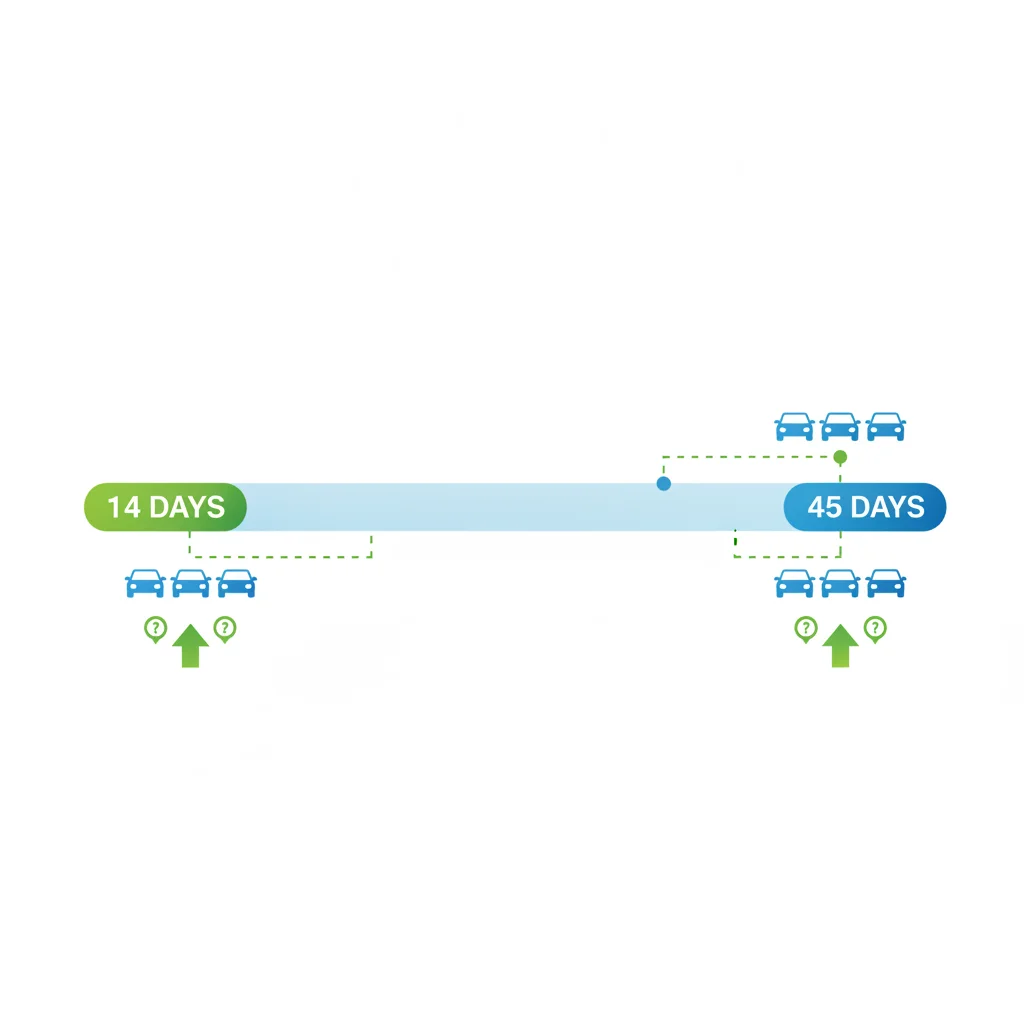
FICO Score models use a 45-day window for auto loan inquiries; older FICO versions use a 14-day window. VantageScore uses a 14-day rolling window. All deduplicated inquiries are treated as one, applied on the date of the first inquiry in the cluster.
Why Subprime Borrowers Fear Shopping Around — And Why That Fear Costs Money
If your credit score is in the subprime range — generally below 620 — applying for an auto loan already feels like a gamble. The last thing you want to do is something that might make your score even lower before a lender reviews it. So a lot of subprime borrowers do what feels safe: they apply to one lender, accept whatever terms they're offered, and move on.
That instinct is understandable. But it's expensive. The spread between the highest and lowest auto loan interest rate a subprime borrower might receive across different lenders is often 5 to 10 percentage points. On a $20,000 loan over 60 months, that difference can mean paying $3,000 to $6,000 more in interest over the life of the loan.
The fear of credit score damage is real but frequently overstated. Understanding exactly what happens to your credit when you apply to multiple lenders — and how the credit bureaus are actually set up to protect shoppers — is one of the most practical things you can do before you finance a vehicle.

This article explains the mechanics behind loan inquiry clustering, how much a hard inquiry actually moves the needle on a subprime score, and how to time your applications to get the most lender comparisons with the least scoring impact. For a broader look at how your score affects the rates lenders offer, see the Credit Score Impact hub.
The Difference Between a Soft Pull and a Hard Pull
Not every credit check is created equal. Before you apply anywhere, it helps to understand the two types of credit inquiries and how each affects your report.
Soft Inquiries
A soft pull occurs when a lender checks your credit for informational purposes — such as a prequalification, a rate estimate, or a background check. Soft inquiries are visible only to you on your credit report. They are completely invisible to other lenders and have zero impact on your credit score, no matter how many occur.
Most online prequalification tools use soft pulls. This makes them an excellent way to gauge your likely rate range and narrow down which lenders are worth pursuing formally — without touching your score at all. See our deeper breakdown in Soft Pull vs. Hard Pull: What Happens to Your Credit When You Apply for an Auto Loan.
Hard Inquiries
A hard pull occurs when you submit a formal loan application and authorize a lender to access your full credit file. Hard inquiries are visible to other lenders for two years and can reduce your score — typically by fewer than 5 points per inquiry. They affect your score for approximately 12 months.
Here's the critical nuance: hard inquiries triggered by auto loan shopping are treated differently from hard inquiries for credit cards or personal loans. Credit scoring models have a built-in mechanism to cluster auto loan inquiries together so that comparison shopping doesn't unfairly punish borrowers.
Not All Lenders Use the Same Scoring Model
Auto lenders may use different versions of FICO or VantageScore, which affects the length of the rate-shopping window they apply. While FICO 8 offers a 45-day window, older FICO versions and VantageScore use 14 days. If you're unsure which model a lender uses, defaulting to the 14-day window as your planning benchmark is the safest approach.
Inquiry Clustering Only Applies Within the Same Loan Type
The rate-shopping window groups inquiries only when they're from the same loan category — auto, mortgage, or student loan. Credit card applications, personal loan applications, or HELOC inquiries made during the same period are treated separately and are not clustered with your auto loan inquiries. Mixing loan types during your shopping window can compound your score impact.
Hard Inquiries Are Visible — But Context Matters
Future lenders who review your credit report will see the auto loan inquiries from your shopping period for up to two years. However, multiple auto loan inquiries clustered within a short window are generally interpreted as comparison shopping behavior — not financial desperation. Lenders are experienced in reading inquiry patterns and typically distinguish between focused rate shopping and scattered credit-seeking.
How the Rate-Shopping Window Actually Works
The rate-shopping window is the feature of FICO and VantageScore models that makes shopping multiple auto lenders possible without stacking up individual inquiry penalties.
Here's how it works in practice:
- You submit your first formal auto loan application. That triggers a hard inquiry, which is recorded on the date it occurs.
- Within the window period, you apply to additional lenders. Each lender pulls your credit, generating additional hard inquiry records.
- The scoring model groups all auto loan inquiries within the window. Rather than penalizing each one separately, the model treats the entire cluster as a single inquiry — and applies the score impact only once, on the date of the first pull.
45 days
FICO 8 rate-shopping window for auto loans
FICO's current flagship scoring model groups all auto loan inquiries within a 45-day period into a single inquiry event.
<5 pts
Typical score drop from one hard inquiry
According to FICO, a single hard inquiry reduces most consumers' scores by fewer than 5 points.
12 months
Duration hard inquiries actively affect your score
Hard inquiries remain on your credit report for 2 years but stop influencing your score after approximately 12 months.
$4,700+
Potential extra interest from not shopping lenders
On a $18,000 auto loan over 60 months, a 5-percentage-point rate difference can add over $4,700 in total interest paid.
14 days
Window covered by all major scoring models
Compressing applications into 14 days ensures inquiry clustering protection under both FICO and VantageScore models.
The key variable is which scoring model a lender uses:
- FICO 8 and newer versions: 45-day window for mortgage, auto, and student loan inquiries.
- FICO versions 2, 4, and 5 (commonly used by mortgage lenders): 14-day window.
- VantageScore 3.0 and 4.0: 14-day rolling window.
Most auto lenders use FICO 8 or a variant, meaning you typically have 45 days to submit applications and have them grouped. If you're unsure which model a specific lender uses, it's reasonable to ask — though many won't disclose the specific version.
For a complementary explanation of how this applies to refinancing situations, see What a Hard Inquiry Does to Your Credit When You Refinance.
How Much Does a Hard Inquiry Actually Move a Subprime Score?
Here's a number worth anchoring to: according to FICO, a single hard inquiry typically lowers a credit score by fewer than 5 points. For many borrowers, the impact is closer to 2–3 points.
Now consider what that means for a subprime borrower with a 580 score. A 5-point drop brings them to 575. That's unlikely to change which lender tier they qualify for. But the interest rate difference between a 12% and a 17% APR auto loan on a $18,000 vehicle over 60 months is roughly $4,700 in total interest paid.
The math is not close. The inquiry risk is minor. The rate risk of not shopping is substantial.
“When it comes to buying a home or a car, consumers should feel free to shop around for the best rates and not worry that the comparison shopping will hurt their credit scores.”
— Ethan Dornhelm, Vice President of Scores and Predictive Analytics at FICO
That said, subprime scores do have some additional sensitivity to inquiries that borrowers should be aware of:
- Thin credit files — fewer total accounts — mean each individual factor, including inquiries, carries more weight relative to the overall profile.
- Recent derogatory marks (late payments, collections) combined with fresh inquiries can create a pattern that some lenders interpret as credit-seeking behavior under financial stress.
- Multiple inquiries outside the auto loan category — credit cards, personal loans, etc. — that appear around the same time as your auto loan applications are not protected by the rate-shopping window and may compound the perceived risk.
The practical implication: keep your auto loan applications focused and avoid applying for other new credit in the weeks before and during your car financing search. And before you apply anywhere, make sure you've done the groundwork outlined in Before Applying for a Bad Credit Car Loan: What to Verify.
A Practical Strategy for Subprime Borrowers Shopping Lenders
The goal is to collect as many genuine loan offers as possible within the shortest window — ideally the same two-week stretch — so that all inquiries cluster under both FICO and VantageScore rules. Here's a step-by-step approach that works in practice.
Step 1: Use Soft-Pull Prequalification to Build Your Short List
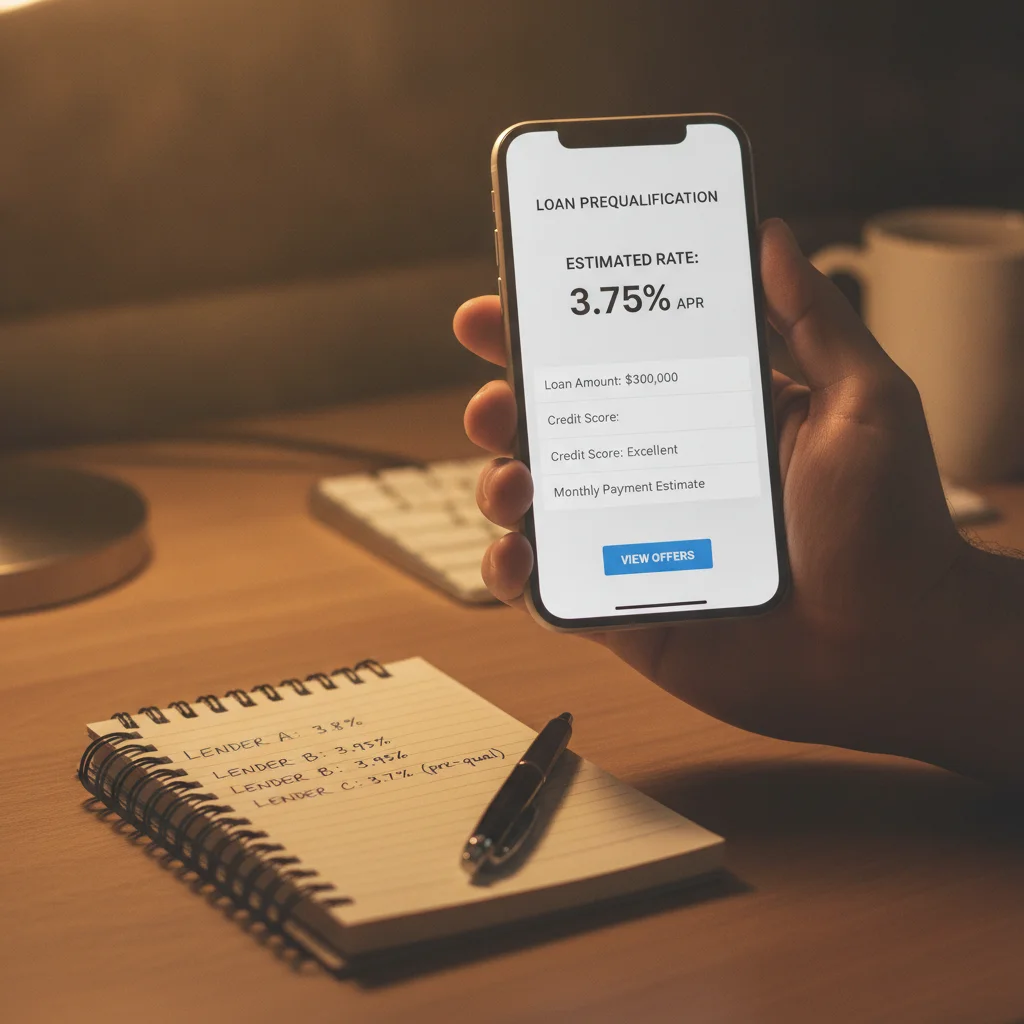
Many lenders — including credit unions, online auto lenders, and banks — offer soft-pull prequalification tools that return estimated rate ranges without a hard inquiry. Use these to identify which lenders are even likely to approve you, and at what approximate rate, before you commit to a formal application. This narrows your list to 3–5 realistic candidates.
Start With Soft Pulls to Filter Your List
Before submitting any formal application, use lender prequalification tools that run a soft pull. These give you an estimated rate range without touching your score, letting you eliminate lenders unlikely to approve you or likely to offer uncompetitive rates. You can then focus your hard-pull applications on the 2–4 lenders most likely to give you a strong offer.
Compress All Applications Into One Week
Even though FICO 8 allows a 45-day window, VantageScore uses a 14-day window — and you won't always know which model your lender uses. Submitting all formal applications within the same one-week period guarantees you're protected under every major scoring model variant. Treat it like a focused sprint rather than a slow, extended process.
Step 2: Submit All Formal Applications Within Two Weeks
Even if your lender uses the 45-day FICO window, compressing your applications into 14 days ensures you're protected under all scoring model variations. Pick a specific two-week period, submit your formal applications in sequence, and collect the hard offers.
Step 3: Compare the Full Loan Offer — Not Just the Rate
APR, loan term, prepayment penalties, dealer markup provisions (if financing through a dealership), and total interest paid all matter. A lender offering 14% with no prepayment penalty may be more valuable than one at 13.5% with a steep early payoff fee. See How to Compare Auto Loan Offers Across Multiple Lenders for a full framework.
Step 4: Factor in Down Payment Before You Finalize
If you're on the edge of approval tiers, a larger down payment can sometimes shift your offer to a more favorable rate band. The Down Payments hub explains how down payment size shapes your loan structure and what lenders are actually looking for.
Step 5: Watch for Non-Auto Inquiries
Remember, the rate-shopping window only applies to inquiries within the same loan category. Don't apply for a store credit card, personal loan, or new credit card during this window. Keep all your credit activity focused exclusively on your auto loan search.
What Happens to Inquiries After You Accept an Offer
Once you've secured your loan, the inquiries from your shopping period will remain on your credit report for two years. During that time, other lenders can see them — but their active influence on your score diminishes after 12 months and disappears from score calculations entirely after that.
In practice, the cluster of auto loan inquiries signals one thing to a future lender: you were comparison shopping for a car loan. That's a reasonable, responsible behavior. It doesn't signal financial distress the way a pattern of credit card applications or payday loan inquiries might.
Not All Lenders Use the Same Scoring Model
Auto lenders may use different versions of FICO or VantageScore, which affects the length of the rate-shopping window they apply. While FICO 8 offers a 45-day window, older FICO versions and VantageScore use 14 days. If you're unsure which model a lender uses, defaulting to the 14-day window as your planning benchmark is the safest approach.
Inquiry Clustering Only Applies Within the Same Loan Type
The rate-shopping window groups inquiries only when they're from the same loan category — auto, mortgage, or student loan. Credit card applications, personal loan applications, or HELOC inquiries made during the same period are treated separately and are not clustered with your auto loan inquiries. Mixing loan types during your shopping window can compound your score impact.
Hard Inquiries Are Visible — But Context Matters
Future lenders who review your credit report will see the auto loan inquiries from your shopping period for up to two years. However, multiple auto loan inquiries clustered within a short window are generally interpreted as comparison shopping behavior — not financial desperation. Lenders are experienced in reading inquiry patterns and typically distinguish between focused rate shopping and scattered credit-seeking.
If you're thinking about refinancing after the initial loan, a similar dynamic applies. Refinancing requires another hard inquiry, but the same rate-shopping window protections apply if you shop multiple refinance lenders within the window period. See Rate Shopping Without Wrecking Your Credit Score for guidance on that scenario.
One more thing worth mentioning: your credit utilization on revolving accounts (credit cards) has a much larger and more immediate effect on your credit score than auto loan inquiries do. If you're carrying high card balances, reducing them before you apply for your auto loan may do more for your score than any inquiry strategy could. Our article on Credit Utilization and Car Loans: The Connection Buyers Overlook walks through exactly how that interaction works.
The Bottom Line on Multiple Applications and Credit
The credit system's rate-shopping window exists precisely because regulators and scoring companies recognized that shopping for the best loan rate is financially responsible behavior that shouldn't be penalized. For subprime borrowers especially, the stakes of accepting the first offer are too high to ignore the benefit of comparison shopping.
A clustered set of auto loan inquiries during a focused two-week window is likely to cost you 2–5 points temporarily. Accepting a loan rate that's 3–6 percentage points higher than you might have received elsewhere could cost you thousands of dollars over the life of the loan. Those are not equivalent trade-offs.
The informed approach is to use soft-pull prequalification freely, compress your formal applications into the shortest window possible, and evaluate offers on total cost — not just monthly payment. For a comprehensive look at how multiple preapproval applications interact with your credit specifically, see How Multiple Preapproval Applications Affect Your Credit Score.
You have more protection than you think. Use it.

All claims are backed by peer-reviewed research. Sources on request.