Key Takeaways
Why Preapproval Comparison Is Worth the Extra Hour
Most car buyers walk into a dealership with one preapproval — or none at all — and let the finance office set the terms. That single decision hands thousands of dollars of negotiating power to the dealer. The buyers who end up with genuinely good financing are the ones who did something boring and unglamorous before they arrived: they compared multiple preapproval offers with a spreadsheet and a calculator.
The auto loan preapproval process is designed to give you a firm rate offer from a lender before you negotiate the vehicle price — but that advantage multiplies when you have competing offers. When a finance manager knows you're holding a 6.4% APR approval from your credit union, they can't quietly slide a 9.9% loan past you. The comparison creates accountability.
The reason buyers skip this step isn't laziness — it's confusion. Multiple offers with different APRs, different term lengths, and different monthly payments look like a puzzle with no obvious solution. This guide gives you a repeatable framework to cut through that confusion and identify the offer that actually costs you the least money.
If you haven't yet applied for preapproval anywhere, start with getting preapproved for a car loan before you step on the lot, then return here once you have offers in hand. For a breakdown of what lenders are evaluating when they issue those offers, see everything your lender looks at before issuing a preapproval.
What you will need
Loan amortization calculator
Calculates exact monthly payments and total interest paid for any APR and term combination.
Comparison spreadsheet (Excel, Google Sheets, or similar)
Lets you align all offer variables in one view so differences become immediately visible.
Preapproval offer letters or emails
The source documents containing APR, term, loan amount cap, and any conditions.
Credit report (annualcreditreport.com)
Confirms what lenders are seeing and helps explain why rates differ between offers.
Step-by-Step: How to Compare Preapproval Offers
Follow these steps in order. Each one builds the context you need for the next. Skipping ahead — especially to the dealership conversation before you've done the math — is the single most common mistake buyers make with preapproval offers.
Never Lead with Monthly Payment at the Dealership
If a finance manager asks 'What monthly payment works for you?' — stop. That question is a trap designed to stretch your loan term and bury the true cost. Always negotiate the total price and APR first, then let the monthly payment be a result of those numbers, not the other way around. Your preapproval letter gives you the leverage to do exactly this.
Preapproval Offers Have Expiration Dates
Most preapproval offers expire in 30 to 60 days. If you let one lapse, you'll need to reapply, which triggers another hard inquiry. Time your rate-shopping window so you collect all offers within the same 14-day period, then move quickly to find your vehicle before the best offer expires.
Gather All Offer Documents in One Place
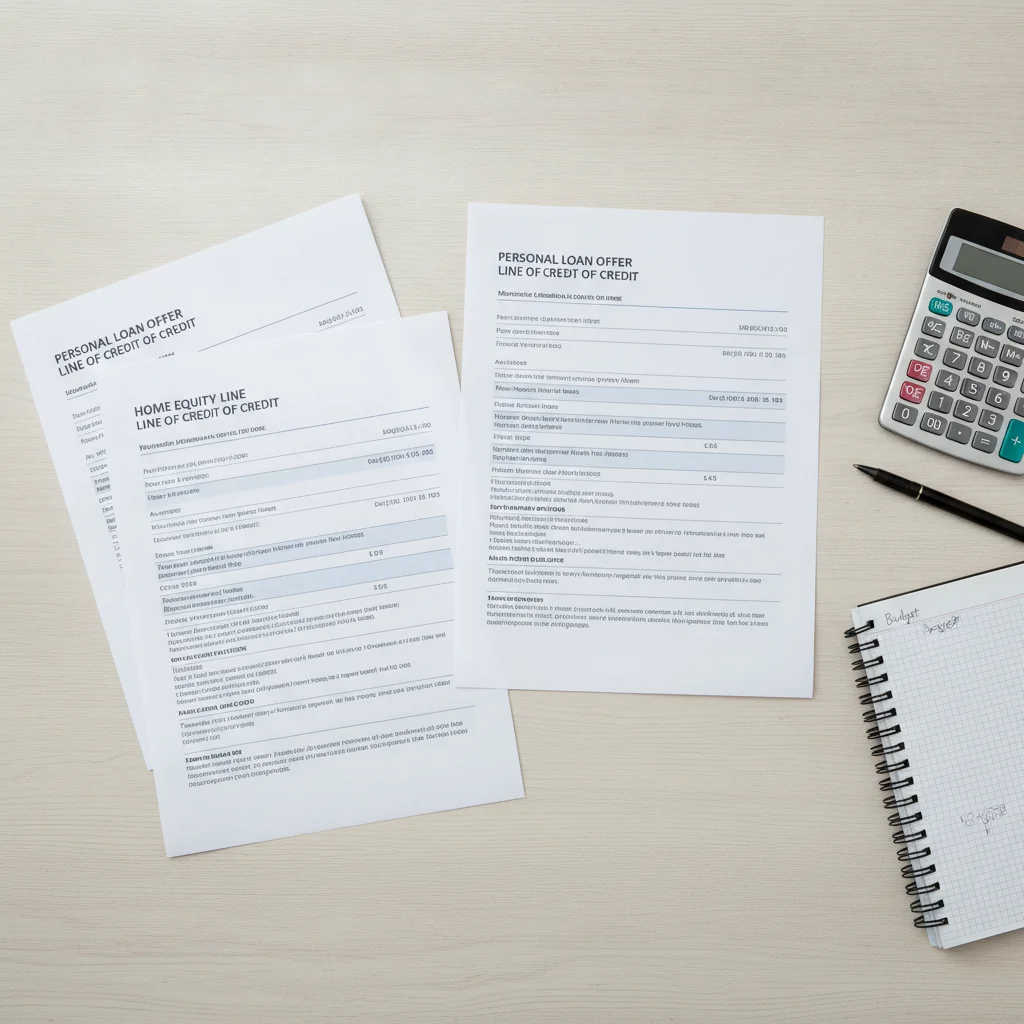
Before you can compare anything, you need every offer in front of you simultaneously. Pull together the preapproval letters, emails, or online dashboard printouts from each lender. If you applied digitally, screenshot or export each offer summary so you have a static record — online portals sometimes update rates without warning.
For each offer, locate and record the following data points:
- Annual Percentage Rate (APR) — not just the interest rate
- Loan term — in months, not years
- Maximum loan amount — the ceiling the lender will fund
- Any origination or processing fees
- Prepayment penalty — yes or no, and under what conditions
- Offer expiration date
If any offer doesn't clearly state all of these items, call the lender directly before proceeding. Missing information is not a minor detail — it's the detail that will cost you.
Standardize the Loan Amount Across All Offers
Lenders may have approved you for different maximum amounts, but comparing offers only makes sense if you use the same loan amount for every calculation. Decide on a realistic target vehicle price, subtract your expected down payment, and use the resulting figure as your comparison loan amount.
For example: if your target vehicle costs $28,000 and you're putting $4,000 down, your comparison loan amount is $24,000. Plug that same $24,000 into the math for every lender — even if one lender approved you for $30,000 and another for $25,000.
This standardization matters because monthly payments and total interest paid are both functions of principal. If you compare Lender A's payment on $20,000 against Lender B's payment on $24,000, the comparison is meaningless.
Calculate Total Interest Paid for Each Offer
Monthly payment is the number dealers love you to focus on — it's easy to manipulate by stretching the loan term. Total interest paid is the number that actually tells you what the loan costs. Here's how to calculate it for each offer:
- Use a loan amortization calculator (free versions are available online) with your standardized loan amount, each lender's APR, and their offered loan term.
- Record the monthly payment the calculator produces.
- Multiply the monthly payment by the number of months in the term.
- Subtract the original loan principal from that result.
- The remainder is your total interest paid.
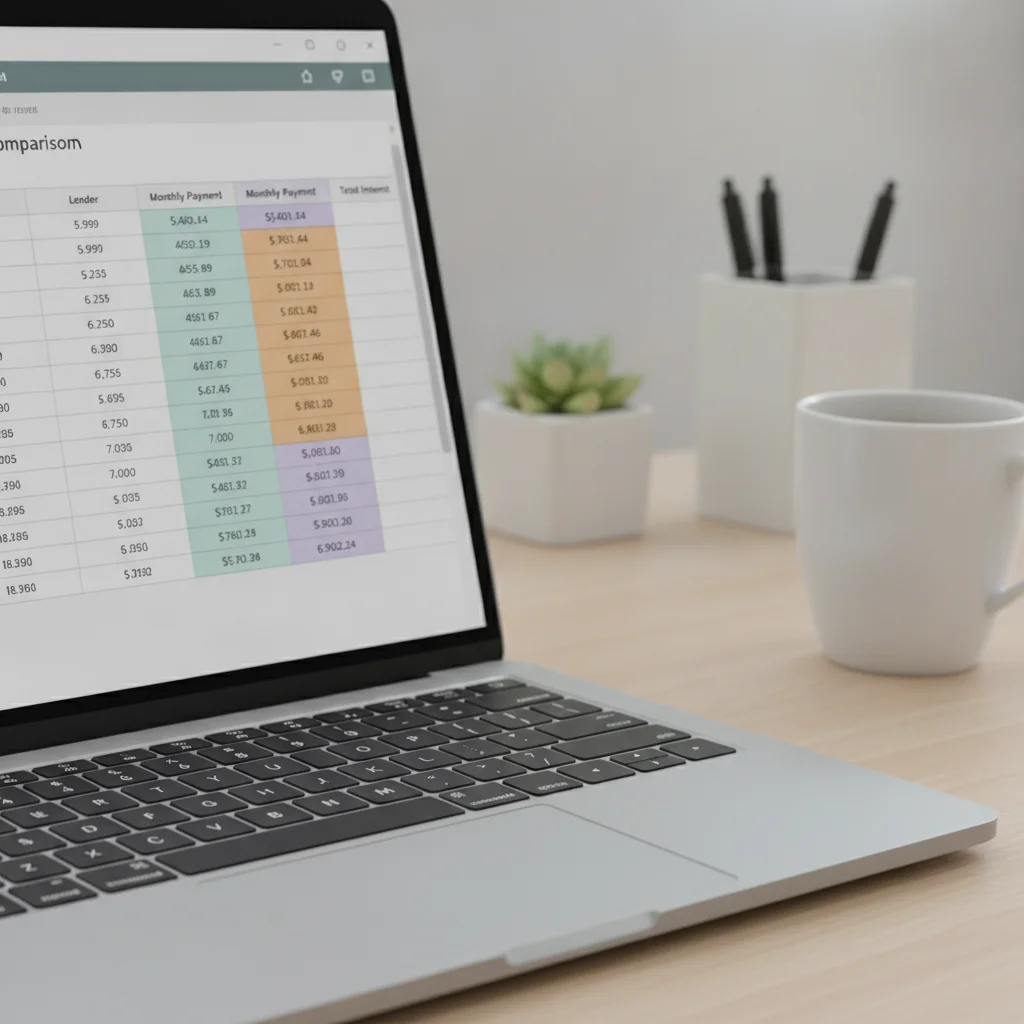
Do this for every single offer and enter the results into your comparison spreadsheet. The visual difference will often surprise you. A half-percentage-point APR difference on a $24,000 loan over 60 months can easily mean $600 to $800 more in total interest — real money you keep or give away.
[in_content_images:0]Factor In All Fees and True Cost
An offer with the lowest APR isn't automatically the cheapest option if it comes attached to a significant origination fee. Some lenders charge a flat fee (e.g., $200–$400) to originate the loan. Others fold fees into the rate, making their APR look higher but their actual cost comparable.
To account for fees properly, add any upfront lender fees to your total interest paid figure. This gives you a true cost of borrowing for each offer:
- True Cost = Total Interest Paid + Origination/Processing Fees
Also check whether any offer includes a prepayment penalty. If you plan to pay the loan off early — or if you might sell the car within the loan term — a prepayment penalty can eliminate the benefit of a low rate entirely. Avoid any offer with a prepayment clause if you have any intention of paying early.
See the preapproval terms glossary for plain-language definitions of every fee type you might encounter.
Rank Offers and Identify Your Best Two
By now your comparison spreadsheet should show every offer side by side with APR, term, monthly payment, total interest paid, fees, and true cost. Sort the offers by true cost — lowest to highest. This ranking is your objective answer to the question 'Which offer is best?'
Don't just pick the single winner and discard the rest. Identify your top two offers. Here's why: you'll use the best offer as your target rate at the dealership, and the second-best offer as your fallback if the first lender's offer expires or is conditional on a vehicle the first lender won't finance (some lenders restrict funding for high-mileage or older vehicles).
Also note whether your top offer has any vehicle restrictions — some credit union and bank preapprovals only cover vehicles of a certain model year or below a certain mileage threshold. Confirm your target vehicle will qualify under the preapproval terms before you rely on it.
[in_content_images:1]Use Your Best Offer as Negotiating Leverage at the Dealership
This is where the preapproval work pays off. Walk into the dealership knowing your best rate and the total cost you're willing to accept. When the finance manager presents their financing options, hand them your preapproval letter and say: 'I'm already approved at [APR]% for [term] months. Can you beat this?'
At this point, one of three things happens:
- They beat it — take the deal and save even more.
- They match it — you've confirmed the rate is fair; your preapproval did its job.
- They can't match it — use your preapproval and walk out with the financing you already secured.
Never let the dealer pivot to monthly payment. If they say 'We can get you at $450 a month,' ask immediately: 'At what APR and for how many months?' Make them show you the full loan structure before you agree to anything.
For a broader look at how lender competition works in your favor, see how to compare auto loan offers across multiple lenders.
[warning_callout]Finalize and Confirm Before Signing
Before you sign the finance contract, verify that the numbers on the contract match the offer you agreed to. Dealers occasionally make 'clerical errors' that add backend products — GAP insurance, extended warranties, tire protection — into the financed amount, inflating your loan balance without your explicit approval.
Check the contract for:
- APR — matches your agreed rate exactly
- Loan term — the number of months you agreed to
- Principal financed — matches vehicle price minus down payment, nothing extra
- Itemized additions — question any line item you didn't specifically request
- Lender name — if using your preapproval, confirm it's through your chosen lender
If anything doesn't match, stop signing and ask for a corrected contract. You have every right to review a clean document before committing. Take as long as you need — the urgency dealers project at signing time is manufactured pressure, not a real deadline.
Build a Simple Comparison Spreadsheet
Create a table with columns for lender name, APR, loan term, monthly payment, total interest paid, fees, and prepayment penalty. This removes emotion from the decision and makes the winner obvious at a glance. Even a basic spreadsheet app on your phone works fine.
Use Your Best Offer as Your Opening Bid
Before signing anything at a dealership, show the finance manager your lowest preapproval offer and ask them to beat it. Dealers have access to wholesale lending rates and sometimes can — but they will never volunteer a lower rate unless you give them a number to compete with.
Check Credit Union Rates Last
Credit unions frequently offer the lowest auto loan rates available to consumers, but their preapproval processes can take longer. Apply to credit unions first so you have time to get their decision, then compare against bank and online lender offers before you set foot on a lot.
Common Mistakes That Erase the Preapproval Advantage
Even buyers who do the work of collecting multiple preapprovals sometimes lose the advantage at critical moments. Here are the pitfalls that most frequently derail the process:
Focusing on Term Instead of APR
A 72-month loan at 5.9% and a 48-month loan at 5.9% are the same rate — but the 72-month loan will cost you significantly more in total interest. When lenders offer different term options, always run the total-cost calculation rather than defaulting to the longest term to get a lower payment.
Applying Too Far in Advance
If your preapproval expires before you find the right vehicle, you'll need to reapply. Time your applications so you're shopping for a vehicle actively within the offer window. Most preapprovals last 30 to 60 days — enough time to find a car, but not enough to browse casually for months.
Revealing Your Preapproval Too Early
Don't mention your preapproval before you've agreed on the vehicle price. Negotiate the purchase price first. Once the price is set, introduce your preapproval. This prevents dealers from adjusting one number to compensate for the other.
Ignoring Vehicle Restrictions in the Offer
Some lenders — particularly credit unions — won't finance vehicles older than a certain model year or above a specific mileage threshold. Read the fine print on every preapproval before you assume it applies to the specific car you want to buy. This is especially relevant if you're buying a used car with higher mileage.
Treating the Preapproval Rate as Final
Your preapproval rate is a floor, not a ceiling on negotiation. Dealers can sometimes access wholesale rates that beat even well-qualified credit union approvals — but only if you give them something to compete against. Show the offer; ask them to beat it. The worst they can do is say no.

Monthly Payment Comparisons Will Mislead You
Two offers with identical monthly payments can cost thousands of dollars apart in total interest if they carry different loan terms. Always calculate the total amount paid over the life of each loan before making any decision. Multiply the monthly payment by the number of months to get the raw total, then subtract the principal.
Watch for Dealer Rate Markups
When a dealership arranges financing through a third-party lender, they often mark up the buy rate — the actual rate the lender approved — by 1 to 3 percentage points and pocket the difference. Your preapproval offer is the benchmark that prevents this from happening to you.

All claims are backed by peer-reviewed research. Sources on request.