
Key Takeaways
0% APR Car Loan
A 0% APR car loan is a manufacturer-subsidized financing offer where you pay no interest on the amount you borrow — meaning your monthly payments go entirely toward the vehicle's principal balance. These deals are offered directly through the automaker's captive finance arm (like Ford Motor Credit or Toyota Financial Services) and are typically reserved for buyers with excellent credit. The total amount you repay equals exactly what you borrowed, with no interest added on top.
APR stands for Annual Percentage Rate and is designed to capture the true cost of borrowing, including fees. At a genuine 0% APR, no interest accrues and — in the absence of additional fees — the loan's APR and interest rate are functionally identical: zero. However, the trade-off is almost always baked into the vehicle's purchase price or foregone cash rebates rather than loan terms themselves.
The Mechanics Behind the 0% Offer
When a manufacturer advertises 0% APR, they aren't doing you a favor out of goodwill. They're using financing as a sales tool — typically to clear out slow-moving inventory, end-of-model-year stock, or to compete aggressively in a crowded segment. The automaker's captive finance division (the in-house bank) funds the loan at zero interest, and the manufacturer compensates that division for the lost interest revenue. Someone is paying for that zero — it's just baked into the deal structure rather than your loan statement.
To understand what APR actually means on an auto loan, it helps to know that the rate reflects the annualized cost of borrowing. At 0%, that cost is literally nothing — which sounds great until you look at what you gave up to get there.
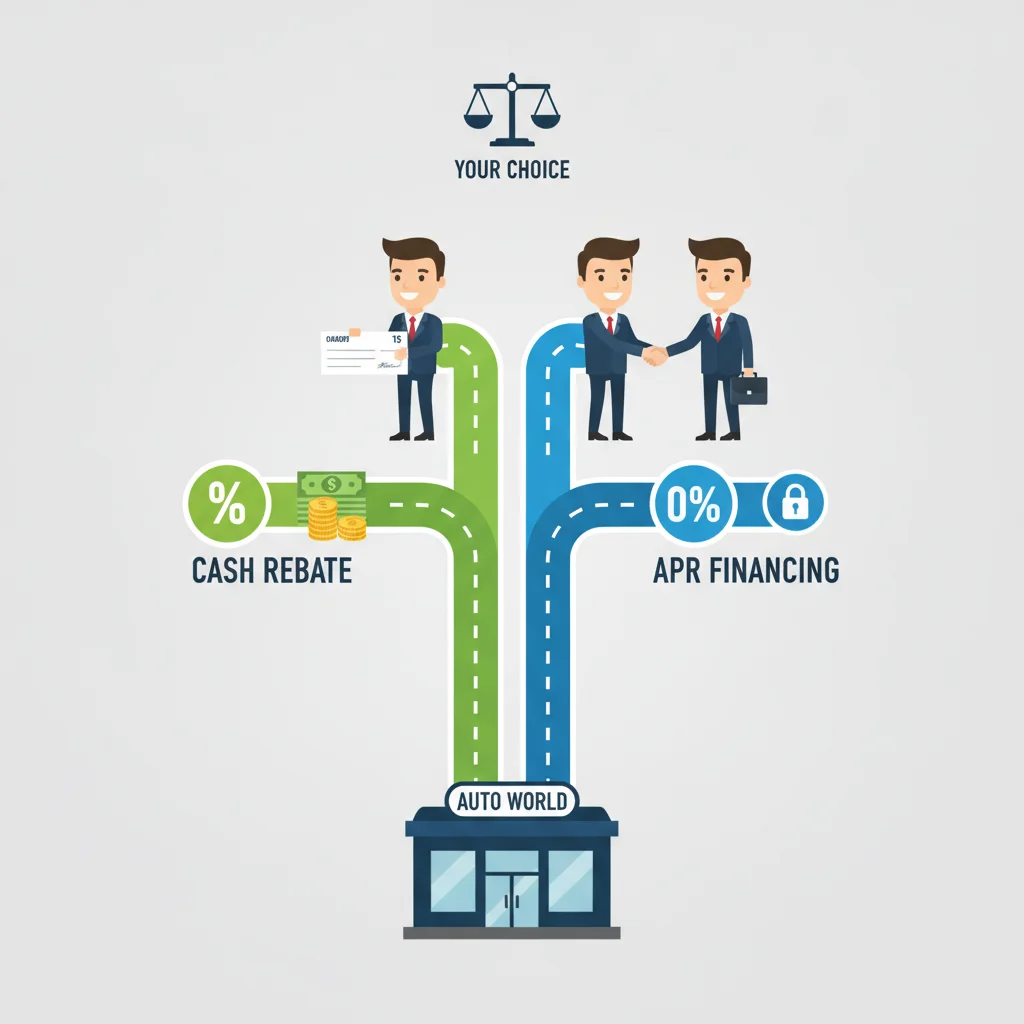
Here's the fundamental mechanic: the money the manufacturer foregoes in interest revenue is typically equivalent to — or less than — the cash rebate you would have received if you'd chosen standard financing. In other words, the 0% rate and the cash rebate are two different ways of delivering the same incentive. You almost always have to pick one.
How Manufacturers Fund the Zero Rate
When a manufacturer offers 0% APR, the automaker's marketing or incentive budget pays the captive finance division the equivalent of the forgone interest. It's a calculated promotional expense — similar to a rebate — designed to drive unit sales volume. The cost is real; it's just absorbed upstream rather than showing up in your loan statement. This is why 0% offers tend to appear on specific models and trim levels that need sales velocity, not on already-popular vehicles selling above MSRP.
Deferred Interest: Not the Same as 0% APR
If any part of your loan paperwork references a 'promotional period,' 'deferred finance charges,' or a balance due by a specific date to avoid interest, you are looking at a deferred-interest product — not a true zero-interest loan. With deferred interest, the lender tracks accruing interest throughout the loan but waives it only if you pay off the full balance by the deadline. Failing to meet that condition triggers a retroactive interest charge that can be substantial. Always ask: 'Is interest accruing during this period?' and get the answer confirmed in writing.
Who Actually Qualifies — and Who Gets Turned Away
The fine print on every 0% APR advertisement includes the phrase "well-qualified buyers" or something equivalent. That phrase is doing a lot of work. In practice, it means buyers with a FICO auto score of roughly 720–740 or higher, a strong credit history with no recent delinquencies, a debt-to-income ratio that meets the captive lender's threshold, and often verifiable income documentation.
720+
Minimum credit score for most 0% APR offers
Captive lenders like Toyota Financial Services and Ford Motor Credit typically require scores of 720–740 or higher to qualify for promotional zero-interest financing.
$1,500–$4,500
Typical cash rebate forfeited for 0% APR
According to Edmunds incentive tracking data, manufacturer cash rebates on popular segments frequently range from $1,500 to $4,500 when 0% APR is the alternative incentive choice.
36–48 months
Typical loan term attached to 0% APR offers
Most manufacturer promotional 0% financing is offered on compressed terms of 36 to 48 months, versus the 60–72 month loans most buyers use for standard-rate financing.
~30%
Share of new car buyers who qualify for promotional rates
Industry estimates suggest only about 30% of new car buyers have the credit profile needed to access the best promotional financing rates advertised by manufacturers.
If your credit score is 680, the dealership's finance manager may still try to get you financed — but not at 0%. They'll submit your application, get a counter at 6.9% or 8.4%, and then present it to you as if the promotional rate just didn't quite work out. That's not deception; it's math. The captive lender set the cutoff, and you didn't clear it.
What is worth flagging: some dealerships advertise 0% APR prominently and then qualify almost nobody for it, using the low rate as a foot-in-the-door to get you into the F&I (finance and insurance) office. If you have any doubt about your credit standing, pull your own credit report before you go. Sites like AnnualCreditReport.com let you do this for free. Walking in knowing your score prevents the finance office from using it as a surprise.
Check Your Credit Score Before Visiting the Dealer
Pull your credit report and score at least two weeks before visiting a dealership. This gives you time to dispute any errors and understand exactly where you stand. If your score is below 720, spend time shopping rates at your bank and credit union first — you'll likely get better terms than the dealer's fallback rate, and you'll have a competing offer to use as leverage. Sites like AnnualCreditReport.com provide free reports from all three bureaus.
Set Up Autopay the Day You Sign
Many promotional rate loans include a clause that converts your rate to a penalty rate — sometimes 20% or higher — if you miss a single payment. Set up automatic payment from your bank account the same day you take delivery. Use the statement payment date, not the 'grace period' end date, as your mental deadline. A four-day bank processing delay shouldn't cost you thousands of dollars, but it can if you're not proactive.
The Real Cost Hidden in the Trade-Off
Here's where most buyers make the expensive mistake. They see "0% APR" and stop doing math. The question you should actually be asking is: what did I have to give up to get this rate?
The most common trade-off is a cash rebate — sometimes called a "customer cash" incentive or a "factory rebate." When you choose 0% APR financing, you typically forfeit this rebate. Let's put real numbers on that decision.
| Scenario | Vehicle Price | Rebate Applied | Loan Amount | APR | Term | Total Paid |
|---|---|---|---|---|---|---|
| 0% APR, No Rebate | $38,000 | $0 | $38,000 | 0% | 48 months | $38,000 |
| Standard Rate + Rebate | $38,000 | $3,000 | $35,000 | 5.9% | 48 months | $39,333 |
| Low Rate + Rebate (credit union) | $38,000 | $3,000 | $35,000 | 4.5% | 48 months | $38,694 |
In this example, 0% APR actually wins — but only barely over a credit union rate with the rebate applied, and only because the rebate is relatively modest at $3,000. Bump that rebate to $4,500 and the math flips. This is why you have to run your own numbers rather than assume the 0% offer is automatically the best deal. Our 0% APR vs. cash rebate comparison walks through the full calculation framework.
“The 0% rate is the headline. The rebate you gave up is the story. Most buyers never do that second calculation, and manufacturers know it.”
— Ivan Drury, Director of Insights, Edmunds
Loan Terms: Why Shorter Isn't Always Better for Your Budget
Manufacturer 0% APR deals almost always come attached to specific loan term lengths — typically 36 or 48 months. Occasionally you'll see 60-month terms on a 0% offer, but that's less common. The short term means higher monthly payments, and that's where buyers who are stretching their budget get into trouble.
Consider the same $38,000 vehicle at 0% over 36 months versus 72 months at a market rate of 5.9%:
- 0% APR, 36 months: $1,056/month, total paid $38,000
- 5.9% APR, 72 months: $633/month, total paid $45,576
The 0% deal saves $7,576 in total cost — but demands $423 more per month. If that higher payment forces you to put less toward an emergency fund, run up credit card balances, or skip other financial priorities, the math advantage evaporates in other parts of your budget. The loan terms explained hub covers exactly how term length interacts with monthly payment and total cost.
The right move is to build your budget around the monthly payment first, then evaluate whether the 0% offer fits that payment ceiling. Don't let the allure of zero interest pressure you into a monthly obligation that's too tight.
Deferred Interest vs. True Zero Interest — Know the Difference
This distinction matters more than most buyers realize. A true 0% APR loan charges no interest for the entire life of the loan. Your balance decreases with every payment, and at the end of the term you've paid exactly what you borrowed — nothing more.
A deferred-interest promotion works very differently. Interest accrues on your balance from day one, but the lender agrees not to collect it as long as you meet the terms — usually paying off the full balance before a specific date. Miss that deadline by a single day, or fail to pay the full balance, and the lender charges you all the interest that accrued during the promotional period retroactively. These structures are more common in retail credit cards than auto loans, but they do appear in some dealer-arranged financing and aftermarket financing products.
How Manufacturers Fund the Zero Rate
When a manufacturer offers 0% APR, the automaker's marketing or incentive budget pays the captive finance division the equivalent of the forgone interest. It's a calculated promotional expense — similar to a rebate — designed to drive unit sales volume. The cost is real; it's just absorbed upstream rather than showing up in your loan statement. This is why 0% offers tend to appear on specific models and trim levels that need sales velocity, not on already-popular vehicles selling above MSRP.
Deferred Interest: Not the Same as 0% APR
If any part of your loan paperwork references a 'promotional period,' 'deferred finance charges,' or a balance due by a specific date to avoid interest, you are looking at a deferred-interest product — not a true zero-interest loan. With deferred interest, the lender tracks accruing interest throughout the loan but waives it only if you pay off the full balance by the deadline. Failing to meet that condition triggers a retroactive interest charge that can be substantial. Always ask: 'Is interest accruing during this period?' and get the answer confirmed in writing.
When a dealership presents you with any promotional financing, ask directly: "Is this a true zero-interest loan, or is interest being deferred?" Get the answer in writing — specifically in the loan agreement. If the contract references a "promotional period" or a "deferred finance charge," that's a deferred-interest product, not a true 0% APR loan. The APR myths that cost buyers money article addresses several financing misconceptions that trip up buyers in exactly this scenario.
Red Flags and Fine Print to Read Before You Sign
After years in dealership finance, I can tell you that the most expensive mistakes buyers make happen in the last 20 minutes of a transaction — when they're tired, excited, and ready to drive home. That's when the fine print matters most.
Watch for these specific conditions:
- Prepayment clauses: Some 0% loans include a clause that triggers a finance charge if you pay off the loan early. It's uncommon but not unheard of — read the payoff section of your contract.
- Rate forfeiture on late payment: Many promotional rate loans convert to a penalty rate if you miss even one payment. Find the specific language about what constitutes a default and what rate applies afterward.
- Eligibility restrictions by trim or package: The 0% offer may apply only to base or mid-tier trims, not the loaded model the salesperson walked you to. Confirm the offer applies to the specific VIN you're buying.
- Down payment requirements: Some captive lenders require a minimum down payment — often 10–20% — to qualify for the promotional rate. This affects your zero-down financing options if you were planning to put little down.
- Residency and income verification: Promotional financing sometimes requires proof of income and residency that standard financing doesn't. Have your documents ready.

None of these conditions make a 0% offer bad on its own. But they can turn a good deal into a bad one if you're caught off guard. Read the retail installment contract before you sign — all of it, not just the payment and rate boxes.
Check Your Credit Score Before Visiting the Dealer
Pull your credit report and score at least two weeks before visiting a dealership. This gives you time to dispute any errors and understand exactly where you stand. If your score is below 720, spend time shopping rates at your bank and credit union first — you'll likely get better terms than the dealer's fallback rate, and you'll have a competing offer to use as leverage. Sites like AnnualCreditReport.com provide free reports from all three bureaus.
Set Up Autopay the Day You Sign
Many promotional rate loans include a clause that converts your rate to a penalty rate — sometimes 20% or higher — if you miss a single payment. Set up automatic payment from your bank account the same day you take delivery. Use the statement payment date, not the 'grace period' end date, as your mental deadline. A four-day bank processing delay shouldn't cost you thousands of dollars, but it can if you're not proactive.
How to Decide if 0% APR Is Actually the Right Choice for You
Strip away the marketing and the decision comes down to four questions:
1. Do you qualify?
If your credit score is below 720, skip straight to comparing standard loan rates from your bank and credit union. The promotional offer isn't on the table for you, and there's no point building your negotiation around it.
2. What's the rebate alternative worth?
Ask the dealer specifically: "What cash rebate am I forfeiting by choosing 0% financing?" Then calculate total cost both ways using the actual numbers. If the rebate plus a reasonable loan rate comes out cheaper in total dollars paid, take the rebate.
3. Can you handle the monthly payment?
0% deals come with compressed terms. Run the monthly payment on a 36- or 48-month payoff and make sure it fits your actual budget — not the budget you wish you had. A higher payment that strains your finances isn't a deal; it's a liability.
4. Are you buying a vehicle that holds value?
Zero-interest financing on a vehicle that depreciates 30% in two years is still a better outcome than paying interest on a vehicle that holds its value — but not by as much as buyers assume. Factor in your intended ownership duration. If you're trading in within 36 months, the interest savings matter less than the vehicle's residual value.
If you answer all four questions clearly and 0% still wins, take it. It's a genuinely useful financial product when the conditions align. Just make sure you're doing the math, not just responding to the marketing.

All claims are backed by peer-reviewed research. Sources on request.