Key Takeaways
Option A
Interest Rate
The base cost of borrowing — nothing more.
Best for: Understanding your monthly payment calculation, but not the full picture of what a loan actually costs you.
Option B
APR (Annual Percentage Rate)
The complete cost of the loan expressed as a yearly rate.
Best for: Comparing loan offers apples-to-apples, since it folds in fees that the interest rate ignores.
If you want to understand how your monthly payment is calculated
Interest Rate
Monthly payment math is driven by the interest rate, loan balance, and term. Knowing the rate lets you verify what the dealer shows you on paper.
If you're comparing loan offers from multiple lenders
APR (Annual Percentage Rate)
APR levels the playing field by including fees. A lender with a lower rate but higher fees can easily cost more than one with a slightly higher rate and no fees.
If you suspect a dealer is burying fees in your loan
APR (Annual Percentage Rate)
A rate-to-APR gap that's wider than 0.5% on a standard auto loan warrants scrutiny. Ask the dealer to itemize every fee contributing to the spread.
If you have strong credit and are negotiating dealer financing
APR (Annual Percentage Rate)
Dealers often mark up the buy rate they receive from lenders. Tracking APR rather than just the quoted rate makes it harder for them to hide that markup.
If you're doing quick loan math on the fly at a dealership
Interest Rate
Interest rate is simpler for back-of-napkin payment estimates, but always circle back to APR before you sign anything.
What Each Number Actually Measures
Dealers and lenders throw around "rate" and "APR" as if they're interchangeable. They are not, and confusing them can cost you real money. Here's a clean definition of each before we get into why the gap between them matters so much.
Interest Rate: The Naked Cost of Borrowing
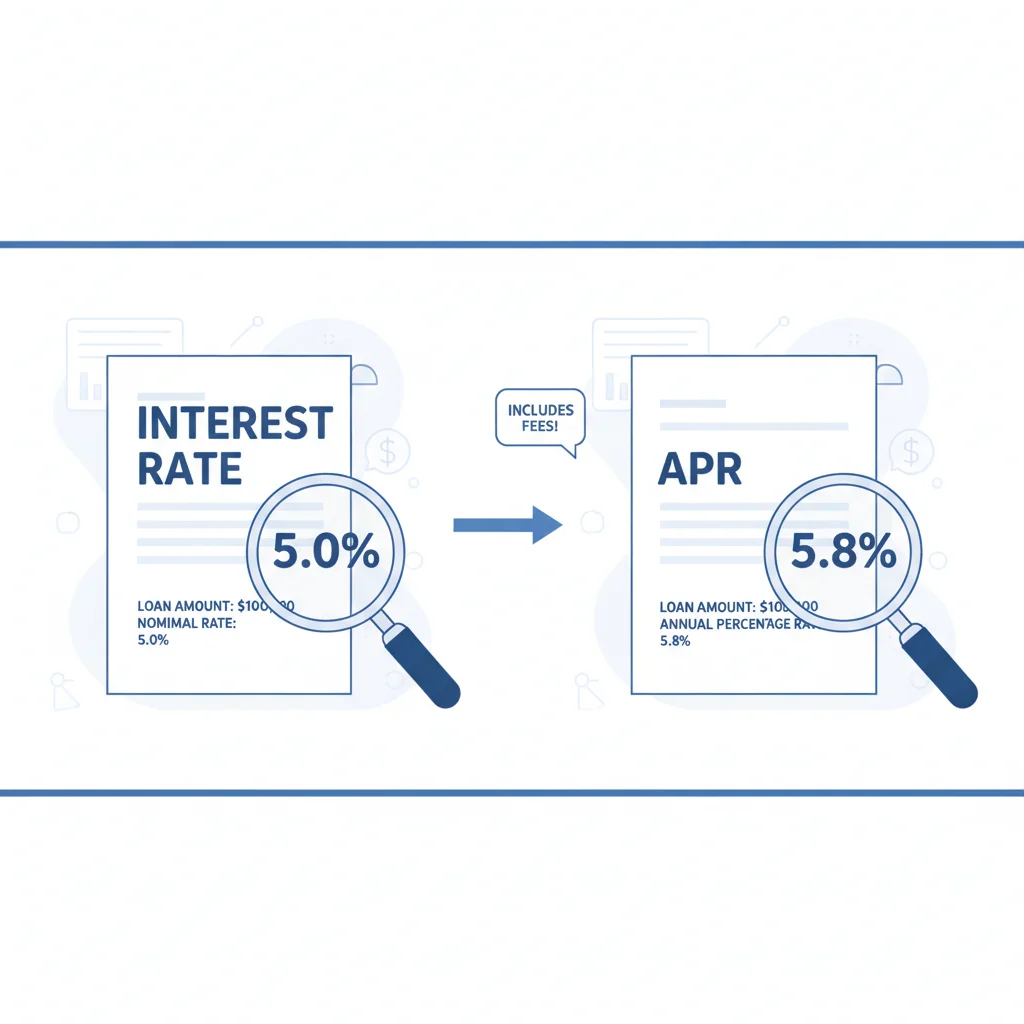
Your interest rate — sometimes called the nominal rate — is the annual percentage the lender charges on the principal balance of your loan. That's it. It does not include origination fees, documentation fees, dealer finance reserve markups, or any other cost associated with getting the loan. It's a single-ingredient number.
If you borrow $30,000 at a 6% interest rate for 60 months, that 6% is what the lender uses to calculate the interest portion of each monthly payment. Nothing more is baked in.
APR: The All-In Annual Cost
APR — Annual Percentage Rate — starts with the interest rate and then folds in certain fees and costs associated with the loan, expressing the combined total as a yearly percentage. Under the federal Truth in Lending Act (TILA), lenders and dealers must disclose APR before you sign.
Because APR captures more of the true cost, it will almost always be higher than the interest rate. The only time they're equal is when the loan has zero fees — which is increasingly rare in the real world.
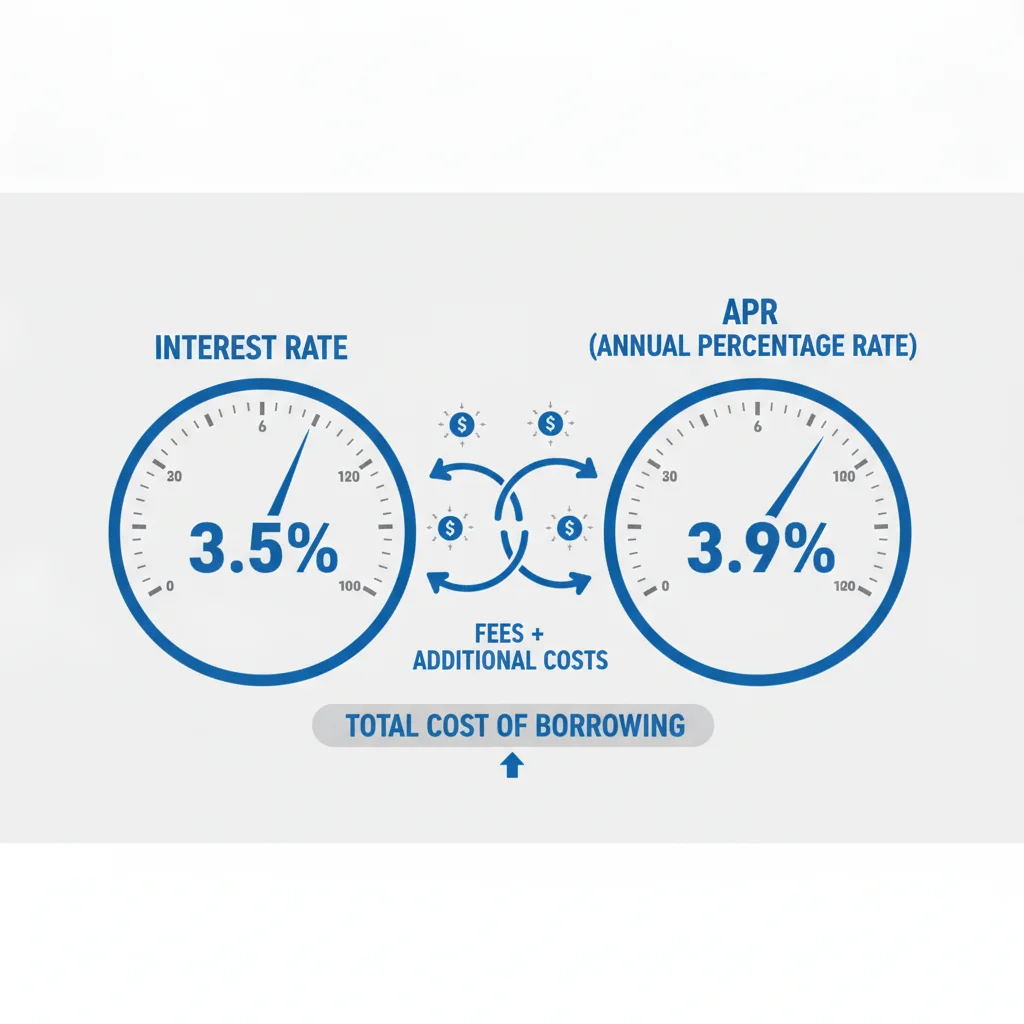
Think of it this way: the interest rate tells you the speed limit; APR tells you the actual speed of your money leaving your pocket. For a deeper breakdown of everything that gets folded into this number, see what APR actually means on an auto loan.
Head-to-Head: Interest Rate vs. APR
The table below lays out the key distinctions clearly. Keep these differences in mind every time a dealer quotes you a rate.
| Criterion | Interest Rate | APR (Annual Percentage Rate) |
|---|---|---|
| What it measures | Cost of borrowing the principal only | Total annual cost including fees |
| Includes lender fees | No | Yes (most fees) |
| Drives monthly payment | Yes | No (disclosure only) |
| Best for comparing lenders | No — misses fee differences | Yes — levels the playing field |
| Federally required disclosure | Yes | Yes (TILA mandated) |
| Captures dealer markup | No | Partially (if classified as finance charge) |
| Will always be higher | N/A | Yes, unless zero fees |
| Red flag if this number is high | Shows expensive borrowing | Wide gap signals hidden fees |
One point worth emphasizing: the interest rate is what drives your monthly payment calculation. APR does not directly determine your payment — it's a disclosure tool, not a payment formula. This is a source of genuine confusion. You can have a 6% rate and a 6.4% APR and your monthly payment is still based on the 6% rate. The fees that create that 0.4% gap were either paid upfront or rolled into your loan balance.
APR Doesn't Include Every Fee
Federal law requires lenders to include most finance charges in the APR calculation, but some costs are specifically excluded — including certain state and local taxes, title and registration fees, and optional add-ons purchased separately. This means APR, while more complete than the interest rate alone, still doesn't capture 100% of what you'll pay to close and operate the loan. Always review the full loan disclosure statement, not just the APR headline.
Why the Gap Between Rate and APR Is a Signal
When you see a meaningful spread between the interest rate and APR on any loan offer, treat it as a flag. It means fees are in the picture — and you need to find out exactly which ones.
Common Fees That Inflate APR
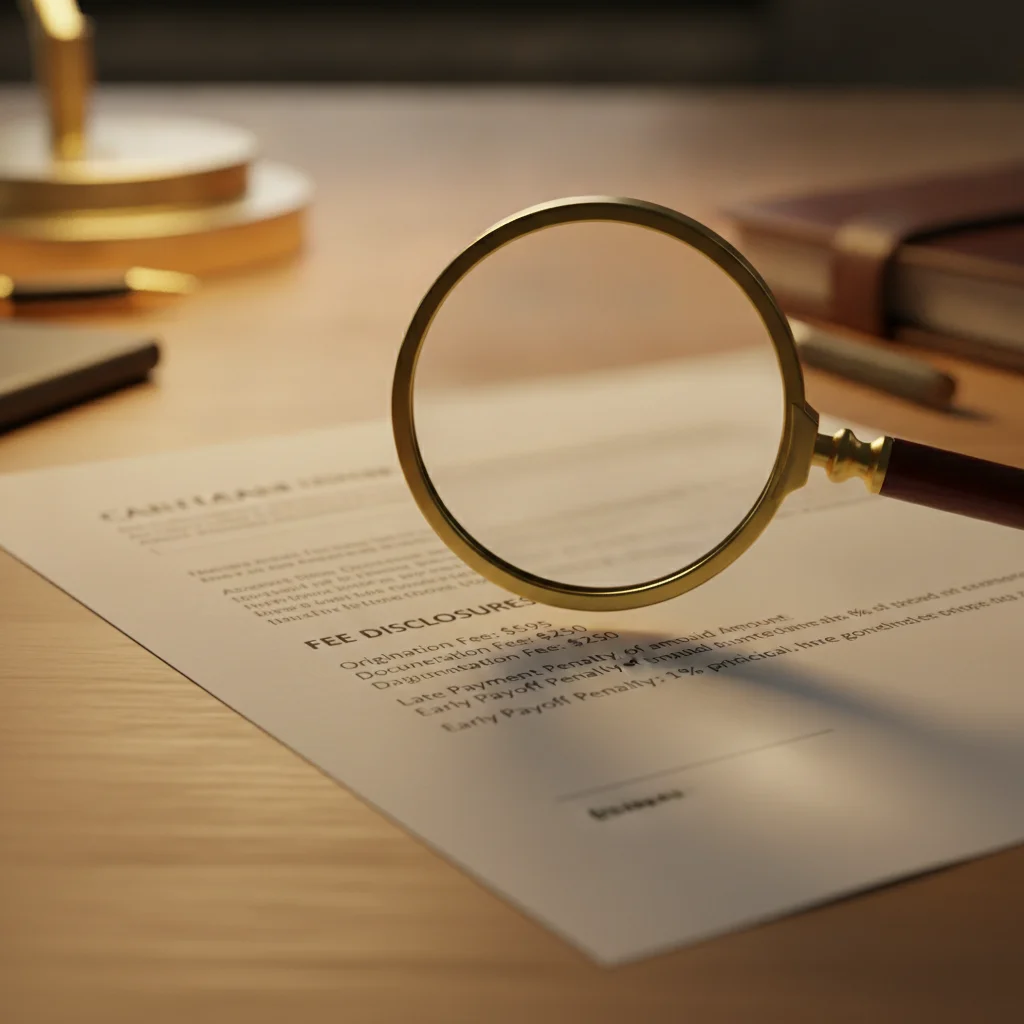
- Loan origination fee: A flat charge or percentage of the loan amount the lender collects for processing the loan.
- Dealer documentation fee: Charged for paperwork. Can range from $100 to over $700 depending on state.
- Finance reserve markup: Dealers receive a "buy rate" from the lender and are often allowed to mark it up — sometimes by 1–2 percentage points — and pocket the difference. That markup widens the effective APR.
- GAP insurance rolled into the loan: If you finance GAP coverage, it adds to your loan balance, which can affect the overall cost calculation.
1–2%
Typical dealer finance reserve markup range
Consumer Financial Protection Bureau data has identified dealer markup as a key driver of APR inflation on indirect auto loans.
$900+
Extra cost from a 1% APR difference on $35K loan
Calculated over a standard 60-month term at prevailing market rates, a one-percentage-point APR gap adds roughly $900 in total interest paid.
0.25%
Expected rate-to-APR gap on a clean loan
Industry norm for straightforward auto loans with minimal origination fees; gaps significantly wider than this typically indicate meaningful added charges.
How Wide Is Too Wide?
On a straightforward auto loan with minimal fees, the gap between rate and APR should be small — often under 0.25%. If you're seeing a spread of 1% or more, that's meaningful money. On a $35,000 loan over 60 months, a 1% APR difference translates to roughly $900 in additional interest costs. See how a half-point APR difference can cost you hundreds for the math worked out across common loan amounts.
To understand which fees get counted in APR and which ones slip through uncounted, read the fees hidden inside your APR — and the ones that aren't. Some charges, like certain state taxes and title fees, are excluded from the APR calculation entirely, meaning even APR doesn't capture 100% of your borrowing cost.

How to Use This Knowledge at the Dealership
I spent years on the finance side of a dealership. The single most effective thing a buyer can do to protect themselves is ask for the APR in writing before discussing monthly payments. Here's why that order matters.
The Monthly Payment Trap
Dealers are trained to anchor negotiations around monthly payments, not total cost or APR. If you agree to a $450/month payment, that number can be achieved with a lower rate over a longer term or a higher rate over a shorter term. You might end up paying thousands more in total interest either way, and never notice because the monthly number looked fine.
Locking in on APR first forces the conversation to total cost. It's harder for the dealer to obscure what's happening inside the loan structure when you're measuring APR directly.
Get Competing APR Quotes Before You Walk In
Your credit union, bank, or an online lender will give you a pre-approval with a stated APR. That becomes your benchmark. When the dealer's finance office presents their offer, you compare APRs directly — not rates, not monthly payments. If the dealer can beat your pre-approval APR, take it. If they can't, use your outside financing.
Your credit score plays a direct role in what APR you'll qualify for, so check yours before applying anywhere. Knowing your tier going in means you won't be surprised by what lenders offer — or manipulated into accepting a rate that doesn't match your credit profile.
Ask for the Fee Itemization
Under TILA, lenders must give you an itemized list of finance charges. Request it. If a dealer resists producing one, that resistance itself is informative. Walk through each line item and confirm which fees are included in the disclosed APR and which are not. Any fee not captured in APR still costs you money — it's just not reflected in that headline number.
For a full breakdown of common misconceptions buyers bring to this conversation, auto loan APR myths that cost buyers real money is worth reading before you negotiate.
Real Numbers: What the Rate-APR Gap Looks Like in Practice
Abstractions are easy to ignore. Numbers are harder. Here are two side-by-side loan scenarios that illustrate exactly how a rate-APR gap translates into real cost differences.
Scenario A: Minimal Fees (Small Gap)
- Loan amount: $28,000
- Interest rate: 5.9%
- APR: 6.05%
- Gap: 0.15%
- 60-month payment: ~$541/month
- Total cost over term: ~$32,460
This is what a clean loan looks like. The lender is charging a small origination fee, but it's modest. The gap is narrow. Most of the cost comes from the interest rate itself.
Scenario B: Fee-Heavy Loan (Wide Gap)
- Loan amount: $28,000
- Interest rate: 5.9%
- APR: 7.2%
- Gap: 1.3%
- 60-month payment: ~$541/month
- Total cost over term: ~$32,460 plus the fees already paid or financed
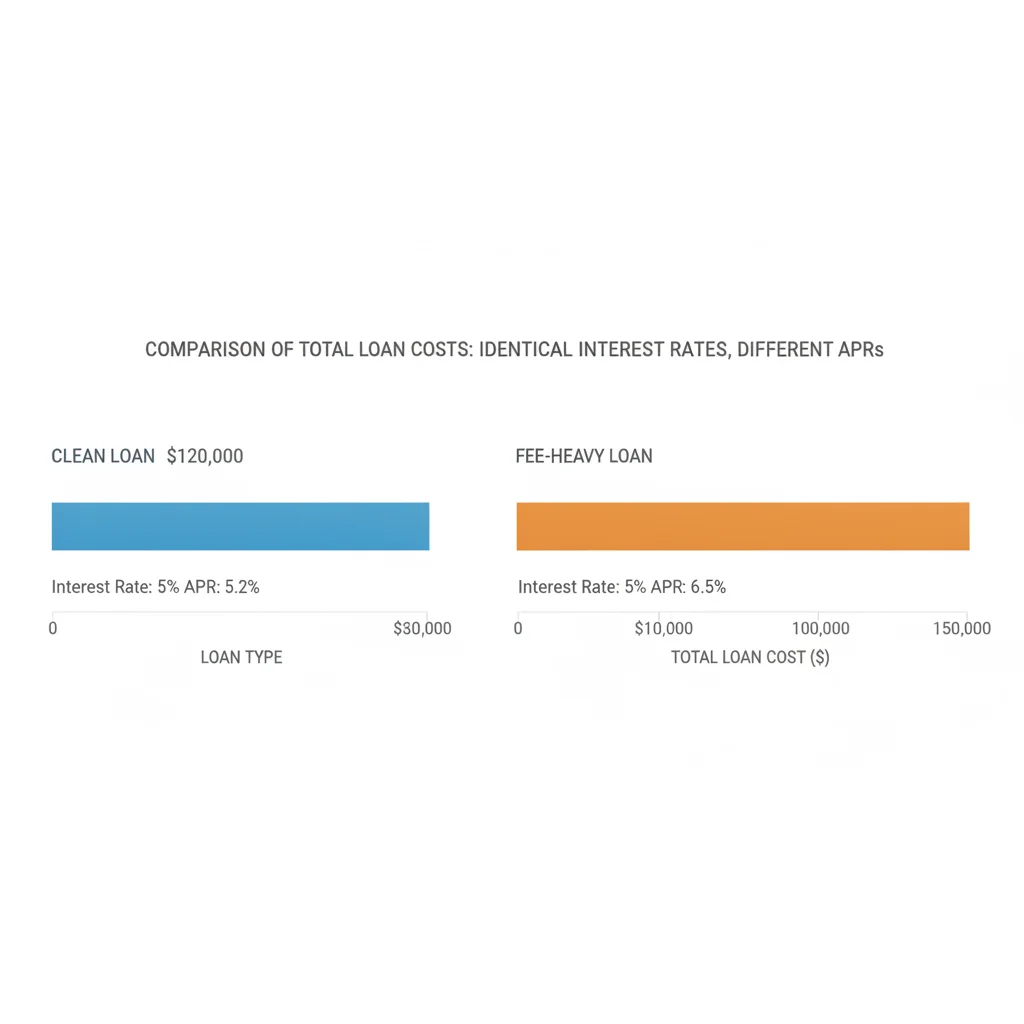
Notice that the monthly payment looks identical in both scenarios — because the payment is calculated off the interest rate, not the APR. But in Scenario B, you've paid significantly more through fees. If those fees were rolled into the loan balance (common when buyers don't have cash upfront), you're also paying interest on the fees themselves, compounding the cost.
This is the core reason why APR is the more accurate comparison tool when you're shopping lenders. Two loans with identical interest rates can have very different APRs — and very different true costs.
For broader context on how loan length, payments, and total cost interact, the Loan Terms Explained hub covers the full picture.
The Bottom Line on Rate vs. APR
Here's the short version: interest rate determines your payment. APR determines your cost. You need to understand both, but when you're comparing offers, APR wins every time as the more honest number.
The gap between the two is not just a technical detail — it's a direct measure of how much the loan is costing you beyond the basic interest. A small gap means a clean loan. A large gap means fees, and fees mean you need to ask questions before you sign.
Dealers count on buyers fixating on the monthly payment and ignoring the rate-APR spread. Don't give them that advantage. Walk in knowing your credit score, armed with a pre-approval APR from an outside lender, and ask for a fee itemization the moment they present financing. That's not being difficult — that's being a smart buyer.
All claims are backed by peer-reviewed research. Sources on request.