
Key Takeaways
Why Preapproval Myths Are Expensive
I spent years sitting on the finance side of the dealership desk. Every day, buyers walked in without preapproval because of something they'd heard — that it would tank their credit, lock them into a loan, or that the dealer would just ignore it anyway. Every one of those beliefs was wrong. And every one of them cost those buyers money.
Preapproval is one of the most powerful tools a car buyer has. It converts you from a passive borrower being quoted a rate into an active buyer presenting competing financing. That single shift changes everything about how a dealership negotiates with you. Instead of working from the dealer's rate outward, you work from your preapproved rate downward.
The problem is that a cluster of persistent myths keeps buyers from using this leverage. These aren't minor misunderstandings — they translate directly into higher interest rates, inflated monthly payments, and thousands of dollars in unnecessary financing costs over a typical loan term. See exactly how skipping preapproval costs you for a breakdown of the real numbers.
Let's go through the myths one by one and replace them with facts you can use the next time you walk onto a lot.
The Myths, Corrected
The following misconceptions are the ones I saw derail buyers most often. Each one has a specific mechanism by which it causes financial harm — understanding that mechanism is what makes the correction stick.
Myth
Getting preapproved will seriously hurt my credit score.
Fact
A single auto loan preapproval inquiry typically drops your score by fewer than 5 points, and rate-shopping with multiple lenders within a 14–45 day window counts as just one inquiry under FICO and VantageScore models.
This is the myth I heard more than any other. Buyers would skip preapproval entirely — costing themselves thousands in financing — to protect a credit score impact measured in single digits. The math doesn't hold up.
When you apply for preapproval, lenders perform what's called a hard inquiry on your credit file. Hard inquiries do have a small negative effect, but the actual impact on a typical score is negligible — usually 2–5 points, and temporary. More importantly, credit scoring models are specifically designed to encourage rate shopping. FICO 8, the score most auto lenders use, treats all auto loan inquiries made within a 45-day window as a single inquiry for scoring purposes. Older FICO versions use a 14-day window. VantageScore uses 14 days as well.
This means you can apply to five lenders in a week and take the same scoring hit as applying to one. There is no penalty for shopping around — the system is built to reward it.
For a full breakdown of how auto loan applications interact with your credit file, see does getting pre-approved for a car loan hurt your credit.
Myth
Preapproval locks me into that lender — I can't change my mind.
Fact
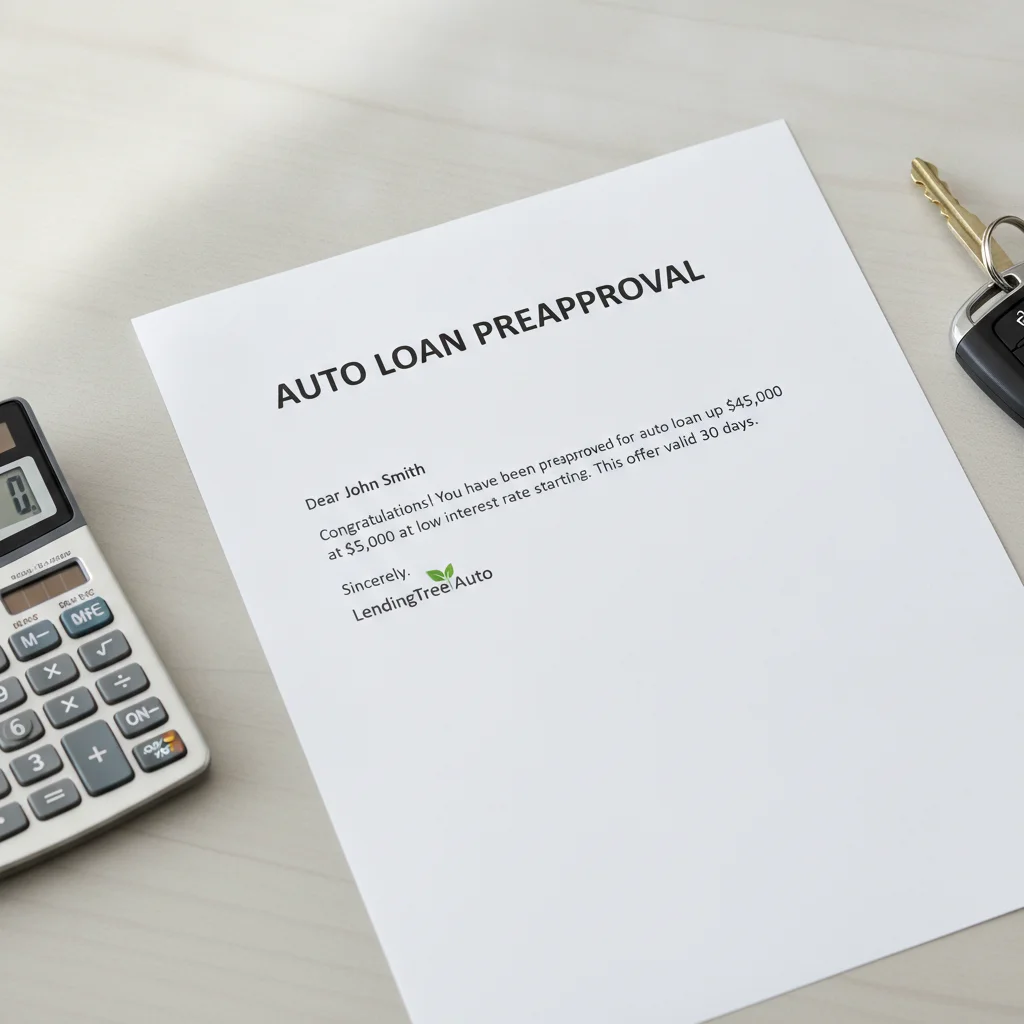
A preapproval is an offer, not a contract. You have no obligation to use it, and you're free to choose dealer financing, a different lender, or walk away entirely.
Buyers often treat preapproval with the same weight as signing a loan agreement. They're not even close to the same thing. A preapproval is a conditional commitment from a lender — they're committing to lend you money at those terms if you choose to use it. You have committed to nothing.
You can take your preapproval to a dealership, let the finance office try to beat it, and if they offer a lower rate, take their loan instead. The preapproval from your bank simply goes unused. No penalty, no fee, no obligation.
This matters tactically: your preapproval functions as a ceiling on what you pay. If the dealer can't beat your rate, you use your preapproval. If they can, you benefit from the competition. You can't lose that negotiation. Why a preapproval doesn't lock you into anything explains this in more detail if you want to walk in fully confident about your flexibility.
Myth
Dealers won't honor or care about an outside preapproval.
Fact
Dealers not only honor valid preapprovals — many actively try to beat them because they earn a markup on loans they originate, giving them a financial incentive to compete for your financing business.
Here's something most buyers don't know: when a dealership arranges your financing through one of their lender partners, they typically mark up the interest rate above what the lender actually approved you for. That markup — called the dealer reserve — goes straight into the dealer's pocket. It can range from 0.5% to 2.5% above your actual approved rate, and on a $35,000 loan over 72 months, that spread is worth hundreds of dollars.
So when you walk in with an outside preapproval, you're not threatening the dealer — you're actually giving their finance department an opportunity to earn revenue by competing for your loan. They'd rather have you finance through them (at a rate they control) than lose the financing entirely to your bank or credit union.
A preapproval doesn't close doors. It opens a competition that benefits you. Dealers who tell you their financing is automatically better are using your lack of comparison point against you. Arrive with one and that leverage disappears.
Myth
You need perfect credit to get preapproved.
Fact
Lenders offer preapproval across a wide range of credit profiles. Buyers with fair or even poor credit can often get preapproved — the rate will vary, but having a benchmark is still valuable regardless of your score.
Credit unions and online lenders in particular work with borrowers across the full credit spectrum. Subprime auto lenders exist specifically to serve buyers with credit challenges. Even if your score is in the 580–650 range, you can likely get preapproved somewhere — and that preapproval still gives you a rate baseline.
Where this matters: without any preapproval, a dealership can quote you essentially any rate it wants. If you have limited credit history and no external benchmark, you have no way to know whether the 14.9% APR you're being quoted reflects your actual risk profile or an inflated dealer markup on top of an already high rate. A preapproval — even a high-rate one — tells you the floor of what the market thinks your credit risk is worth. That's information the dealer currently has and you don't.
Buyers with lower scores should also understand that the credit score the dealer sees may differ from the one you checked. Dealers typically pull an auto-specific FICO score, which weights your credit history differently than general FICO scores. Credit score myths that trip up car buyers explains exactly which score version matters most in an auto financing context.
Myth
Getting preapproved online isn't as reliable as going to a bank in person.
Fact
Preapprovals from reputable online lenders carry the same legal weight as in-person bank preapprovals and are often processed faster, with competitive rates due to lower overhead.
The technology behind online lending is the same underwriting model used by traditional banks — the interface is just different. Major online auto lenders have partnerships with dealer networks across the country and process billions of dollars in loans annually. A preapproval letter from a well-established online lender is taken just as seriously by a dealership's finance desk as one from a brick-and-mortar bank.
In fact, online lenders often have a rate advantage because they carry lower overhead than branch-based banks. Credit unions tend to offer the lowest rates of all for members, and most credit unions now offer online applications. The practical advantage of going online is speed and the ability to apply to multiple lenders in the same afternoon without making multiple appointments.
The one caution: verify any online lender you use. Stick to established names with clear terms, verifiable contact information, and no requests for upfront fees. Preapproval itself should never cost you anything.
Myth
If I'm preapproved, the dealership has to give me that rate.
Fact
A preapproval guarantees the rate your lender offered — the dealer has no obligation to match it, but also cannot override it. You simply use your preapproval to fund the purchase if the dealer's terms are worse.
There's sometimes confusion about what a preapproval actually does at the dealership. To clarify: the dealer doesn't become obligated to honor a third-party lender's rate. They have their own lending relationships and their own rates. Your preapproval doesn't override their financing — it competes with it.
The mechanism works like this: you negotiate a vehicle price, then you compare two financing options — your preapproval from your bank versus what the dealer's finance office offers. You choose whichever is better. If the dealer's rate is lower, you use theirs. If your preapproval is better, you use that and the dealer simply coordinates with your lender to fund the purchase. This is a routine transaction — dealers do it regularly.
What a preapproval actually guarantees is that you'll never pay more than the rate your lender quoted, because you can always fall back on it. That guarantee is the leverage. See the full comparison between buying new cars and financing options to understand where preapproval fits in your overall purchase plan.
Myth
Preapproval is only useful if you have a specific car in mind.
Fact
Preapproval is granted for a loan amount and term, not a specific vehicle. You can shop freely across dealers and vehicles within your approved parameters.
This myth causes buyers to delay getting preapproved until late in the shopping process — which is exactly when they have the least leverage. By the time you've emotionally committed to a specific car at a specific dealership, your negotiating position is weakest. The dealer knows you want this car.
A preapproval is structured around a dollar amount and loan term — something like "up to $40,000 for 60 months at 6.4% APR." That's a financial parameter, not a vehicle-specific commitment. You can walk onto any lot, find a vehicle that fits within that budget, and use your preapproval. You can also test multiple dealerships against each other when you're not locked to a single vehicle.
Getting preapproved before you even know which vehicle you want is actually the strongest position. You arrive at every lot knowing your budget ceiling and your financing floor. The negotiation starts from a position of complete financial clarity, which is where you want to be. If you're still sorting out new versus used, new car buying myths and used car buying myths can help you nail down that decision before you apply.
< 5 pts
Typical score drop from a preapproval inquiry
According to FICO, a single auto loan hard inquiry generally reduces a score by fewer than 5 points, with the effect fading within a few months.
45 days
Rate-shopping window for a single FICO inquiry
Under FICO 8, all auto loan inquiries within a 45-day period are treated as one inquiry, enabling buyers to compare multiple lenders without extra score damage.
$1,000–$3,000+
Extra interest paid without preapproval leverage
Consumer Financial Protection Bureau research found that buyers who finance through dealers without a competing offer frequently pay significantly more over the life of a 60–72 month loan.
0.5%–2.5%
Typical dealer interest rate markup (reserve)
The dealer reserve — the spread between a buyer's approved rate and the rate they're quoted — adds hundreds to thousands in financing cost on an average vehicle purchase.
69+ months
Average new car loan term in the U.S.
Experian's State of the Automotive Finance Market report shows the average new vehicle loan term has extended past 69 months, amplifying the financial impact of rate differences.
How to Use a Preapproval Effectively at the Dealership
Getting preapproved is step one. Using it correctly at the dealership is step two, and most guides skip this part entirely.
Keep the preapproval in your pocket at first
Don't lead with it the moment you walk in. Let the salesperson show you vehicles, let negotiations on the vehicle price develop. Once you've agreed on a vehicle price — not monthly payments — then reveal your preapproval. This sequence matters because some dealers will use knowledge of your financing situation to structure the overall deal in their favor.
Negotiate the total price, not the monthly payment
This is the single biggest mistake buyers make regardless of whether they have preapproval. A dealer can make almost any number look affordable by extending the loan term. Focus every conversation on the out-the-door price. Your preapproval gives you an anchor here: you know exactly what your rate is and can calculate the payment yourself. APR myths that inflate your real cost are worth reviewing before you sit down at the finance desk.
Let the dealer try to beat your rate
Hand the finance manager your preapproval and say: "This is what I have. Can you beat it?" This is not confrontational — it's standard practice. The dealer's finance department earns a markup (called the dealer reserve) on loans they originate, so they have a genuine incentive to compete. If they can beat your rate, take their offer. If they can't, use your preapproval. Either way, you win.

Don't Let the Dealer Run Your Credit Before You're Ready
Some dealerships will ask for your Social Security number early in the process — often framed as a routine step or needed to "find you the best deal." This triggers a hard inquiry before you've agreed on a price or decided to finance through them. Always negotiate the vehicle price first. Only authorize a credit pull once you're ready to finalize financing terms. Having your preapproval in hand gives you a reason to hold off: you already have financing arranged.
Dealer Add-Ons Can Negate Your Rate Savings
Even if you secure an excellent rate — through preapproval or by getting the dealer to compete — finance office add-ons like extended warranties, GAP insurance, paint protection, and credit life insurance can quickly consume your savings. These products are almost always negotiable and frequently overpriced at the dealership. Review every item on the finance menu carefully and decline anything you didn't plan for before entering the office.
Watch the expiration date
Most preapprovals are valid for 30 to 60 days. If your car search runs long, you may need to reapply. Preapproval expiration dates matter more than most buyers realize — a lapsed preapproval can leave you negotiating without leverage at exactly the wrong moment.
Time your preapproval applications so they align with when you expect to actually purchase. If you're still in the browsing phase, consider prequalification first to check your likely rate without a hard inquiry, then formalize into a full preapproval once you're ready to buy within the next 30–45 days. See how these two processes differ in our guide: Preapproval vs. Prequalification.
Where to Get Preapproved
Not all preapprovals carry equal weight. Here's how the main sources compare:
| Source | Strengths | Watch Out For |
|---|---|---|
| Credit Union | Typically lowest rates; member-focused underwriting | Must be a member; approval can take 1–2 days |
| Bank | Familiar relationship; may offer rate discounts for existing customers | Rates often higher than credit unions |
| Online Lender | Fast decisions; easy rate shopping across multiple lenders | Verify lender legitimacy; terms vary widely |
| Dealer Financing | Convenient; sometimes manufacturer subvented rates below market | Dealer reserve markup inflates the rate you're quoted |
The optimal strategy is to get at least two or three preapprovals from banks, credit unions, or online lenders before visiting a dealership. Then use the best offer as your baseline when you arrive. If the dealer beats it, take theirs. If not, you already have what you need.

For buyers navigating certified pre-owned purchases, the same logic applies. Financing through certified pre-owned programs often carries manufacturer-backed rates, but independently verifying those rates with a preapproval benchmark ensures you're actually getting a good deal and not just a rate that sounds good relative to a used car loan.
For a deeper look at how all these credit factors interact before you apply, credit score myths that trip up car buyers is required reading. Lenders weigh more than just your score, and knowing what else they're looking at lets you present the strongest possible application.
Preapproval Is Not the Same as Prequalification
These two terms sound interchangeable but carry very different weight. Prequalification is a soft inquiry — it gives you an estimated rate range without affecting your credit, but it doesn't represent a firm offer a dealer must take seriously. Preapproval involves a hard inquiry and produces an actual conditional loan offer backed by underwriting. When you walk into a dealership, only a preapproval gives you meaningful negotiating leverage. See the full breakdown: <a href="/auto-loans/credit-and-approval/loan-preapproval/preapproval-vs-prequalification-two-terms-that-are-not-the-same">Preapproval vs. Prequalification</a>.
The Bottom Line
Preapproval isn't a complex financial instrument or a commitment carved in stone. It's a rate quote from a lender that gives you something dealers don't want you to have: an independent benchmark. Every myth on this list exists, in part, because a buyer without preapproval is easier to work with from a dealership margin perspective.
Getting preapproved takes 15 minutes online with most lenders. The average auto loan term is now over 69 months. Over that span, the difference between a rate you negotiated from a position of strength versus one you accepted because you had no alternative can easily exceed $2,000 — sometimes significantly more on larger loan amounts.
Don't skip it because of a myth. A preapproval doesn't lock you into anything. It only opens options. And on a major purchase like a vehicle, more options always translate to a better outcome for the buyer.
If you're also navigating the broader vehicle purchase decision, the same critical thinking applies to the car itself — new car buying myths and used car buying myths are worth reading before you set foot on any lot. The buyers who do the best aren't the most aggressive — they're simply the most prepared.


All claims are backed by peer-reviewed research. Sources on request.