Key Takeaways
Option A
Cash Down Payment
The straightforward, lender-preferred upfront reduction.
Best for: Buyers who have liquid savings and want maximum control over their loan terms and lender options.
Option B
Trade-In Value
The asset-conversion approach that turns your old car into equity.
Best for: Buyers who own a vehicle with meaningful equity and want a convenient, single-transaction path to their next car.
If you have strong savings but no vehicle to trade
Cash Down Payment
A cash down payment directly reduces your principal and signals creditworthiness to lenders, often unlocking lower APRs. There's no negotiation complexity involved.
If you own a car outright or have significant positive equity
Trade-In Value
Converting existing equity into a down payment is efficient, especially in states that apply a sales tax credit to the trade-in — effectively reducing the sticker price before tax is calculated.
If you still owe money on the car you're trading in
Cash Down Payment
Negative equity rolled into a new loan increases what you finance and total interest paid. Supplementing with cash is often a smarter financial move.
If you want to maximize total loan reduction with minimal cash outlay
Trade-In Value
When trade-in equity is healthy and the dealer's offer is close to market value, the trade-in covers a large chunk of the down payment requirement without touching your savings.
If you want the fastest path to the lowest possible monthly payment
Cash Down Payment
Cash is applied directly and predictably to principal. Combined with a competitive interest rate, it reliably produces the smallest monthly obligation.
How Each Method Actually Reduces Your Loan
At first glance, a $5,000 cash down payment and a $5,000 trade-in seem identical — both shave $5,000 off the amount you finance. But the path each takes to get there is meaningfully different, and those differences affect your negotiating position, your tax bill, and your total cost of ownership.
A cash down payment is money you hand over — or authorize — at signing. The dealer applies it directly against the vehicle's purchase price before calculating your loan. Lenders love cash down payments because they reduce their exposure immediately and verifiably. Some lenders will only approve a loan or offer their best rate if a minimum cash contribution is in the deal.
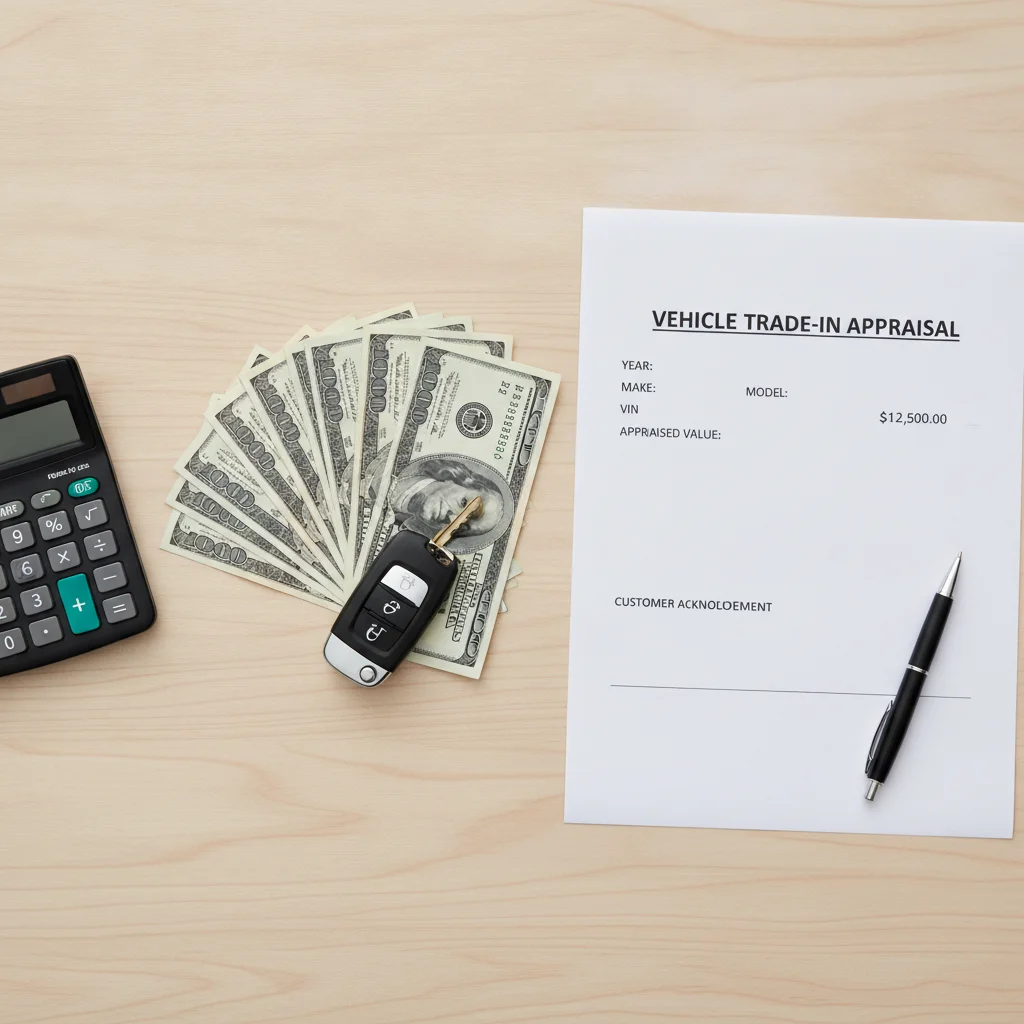
A trade-in, by contrast, is an asset you're converting into value. The dealer appraises your current vehicle, makes an offer, and applies that offer as a credit toward your new purchase. If you owe nothing on the trade, the full appraised value becomes a loan-reducing credit. If you still owe a balance on it, that loan gets paid off first — and only what's left over reduces your new loan. See our guide to trading in a car with existing financing if your vehicle is still under a loan.
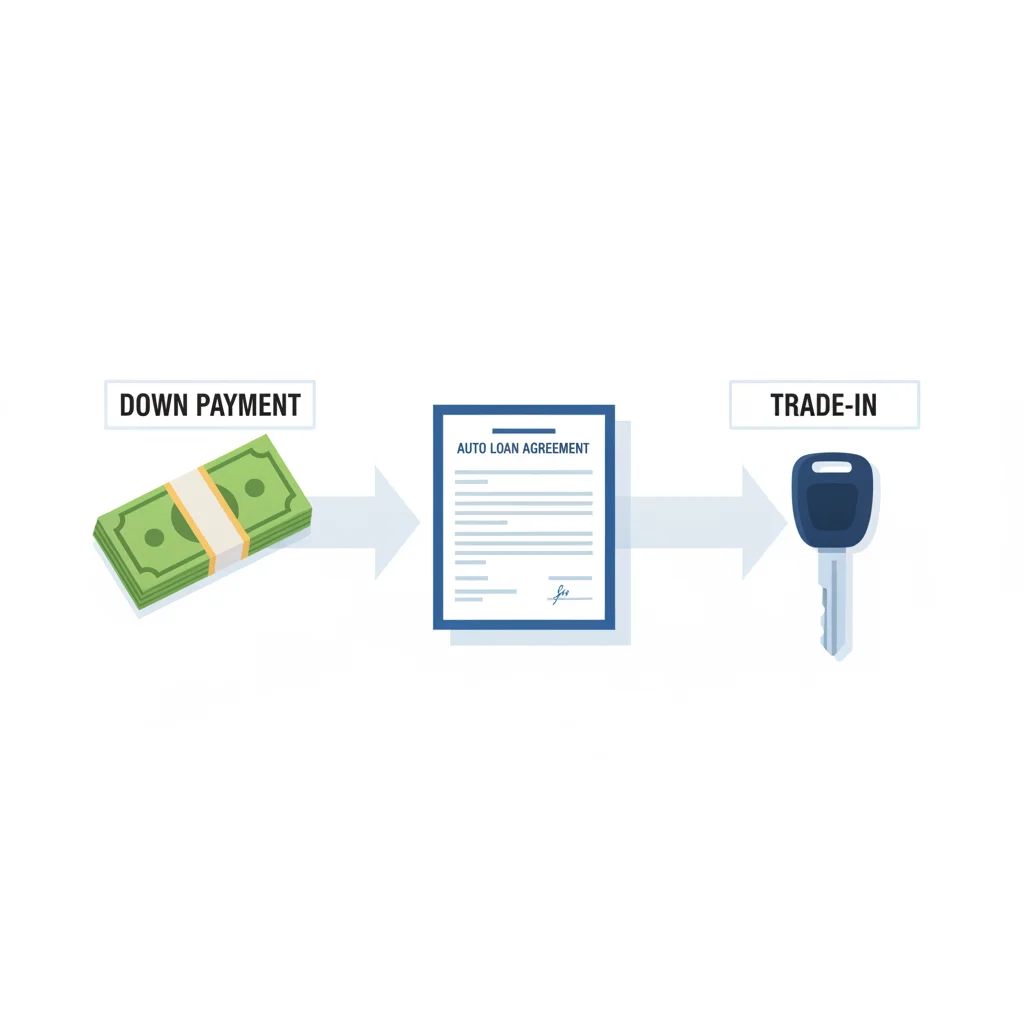
Here's a concrete example. Say you're buying a $35,000 car:
- Scenario A: You put $5,000 cash down. You finance $30,000.
- Scenario B: You trade in a car worth $5,000 that you own free and clear. You also finance $30,000.
- Scenario C: You trade in a car the dealer values at $5,000, but you still owe $2,000 on it. The dealer pays off your existing loan first. You get a $3,000 credit — so you finance $32,000.
In Scenario C, a $5,000 trade-in only reduces your loan by $3,000. That's the critical distinction many buyers miss.
| Criterion | Cash Down Payment | Trade-In Value |
|---|---|---|
| How it reduces the loan | Applied directly to purchase price at signing | Trade equity credited against new car price |
| Sales tax impact | Tax calculated on full price before down payment | Tax calculated on price minus trade-in (most states) |
| Lender preference | Strongly preferred; easy to verify | Accepted; subject to independent value check |
| Negative equity risk | None — cash is always positive | High — existing loan balance reduces or eliminates credit |
| Negotiation complexity | Simple — one fixed number | Higher — appraisal and price often linked by dealer |
| Requires existing vehicle | No | Yes |
| Potential to beat market value | N/A | Rarely — dealer offers typically 10–20% below retail |
| Best combined with | A strong trade-in offer | A cash contribution to bridge any shortfall |
The Tax Credit Advantage of Trading In
In 46 states, trading in a vehicle at a dealership triggers a sales tax credit that can make a trade-in worth more than its nominal dollar value. Here's the mechanism: in most states, sales tax is calculated on the net purchase price — meaning the vehicle price after subtracting your trade-in credit.
Let's run the numbers on a $35,000 car purchase with a $10,000 trade-in, assuming an 8% state sales tax:
- Without trade-in: Sales tax on $35,000 = $2,800
- With trade-in: Sales tax on $25,000 = $2,000
That's $800 in tax savings you receive purely because you traded in rather than sold privately and brought cash. A cash down payment does not reduce the taxable purchase price in most states — it simply reduces what you borrow after tax is calculated.
46
U.S. states offering trade-in sales tax credit
According to the National Conference of State Legislatures, 46 states reduce the taxable purchase price when a vehicle is traded in at a dealership.
~15%
Typical dealer trade-in discount below market
Cox Automotive data consistently shows dealer appraisals run roughly 10–20% below private party values, with 15% as a common midpoint in normal market conditions.
$1,300+
Potential interest saved with 10–20% down payment
On a $30,000 auto loan at 60 months, moving from a 6.9% to a 5.4% APR — a common rate improvement from a stronger LTV — saves approximately $1,300 in total interest.
120–125%
Maximum LTV most lenders allow with rolled-in negative equity
Most major auto lenders cap loan-to-value at 120–125% of the vehicle's actual value, meaning severely upside-down trade-ins may require a cash contribution to close.
This means that in a high-tax state, a $10,000 trade-in can be functionally equivalent to roughly $10,800 in cash — because the cash buyer would need an extra $800 to cover the higher tax bill. This advantage narrows or disappears in the handful of states that don't offer a trade-in tax credit, so check your state's rules before assuming the trade-in wins.
For a deeper look at how trade-in values compare to what you'd net from a private sale — which typically produces a higher gross number but no tax credit — see our piece on trade-in value vs. private sale price.
States Without a Trade-In Tax Credit
California, Hawaii, Michigan, and Virginia are among the states that do not offer a sales tax credit on trade-ins — meaning the tax savings argument for trading in rather than selling privately doesn't apply there. Always confirm your state's specific rules with the DMV or a tax advisor before making your decision based on assumed tax treatment.
When Negative Equity Changes Everything
If you owe more on your current vehicle than it's worth, the trade-in can't serve as a loan reducer — it becomes a loan increaser. In this scenario, cash is almost always the better tool. You may also want to consider paying down the existing loan before trading in, which can shift you into positive equity territory and restore the trade-in's value as a financing lever.
How Lenders View Each Method
From a lender's perspective, both approaches reduce the loan-to-value (LTV) ratio — the relationship between what you borrow and what the car is worth. A lower LTV means lower risk. But lenders treat the two sources of down payment slightly differently.
Cash down payments are straightforward. The lender sees a reduced principal, a lower LTV, and a borrower who demonstrated the discipline to save. Some lenders — particularly credit unions and banks offering their best tier rates — have a stated preference for borrowers with a cash contribution. A 10–20% cash down payment can be the difference between a 6.9% APR and a 5.4% APR, which on a $30,000 loan over 60 months translates to roughly $1,300 in total interest savings.
Trade-in credits are also LTV-reducing, but lenders will independently verify the trade-in's value using tools like Kelley Blue Book or Black Book. If the dealer is applying a trade-in credit that looks inflated relative to the car's actual market value, a cautious lender may not count the full amount. In practice this is rare with franchise dealers, but it's worth knowing.

One area where lenders draw a hard line: negative equity rolled into a new loan. If your trade-in is worth $8,000 but you owe $11,000 on it, the dealer will pay off the $11,000 — and that extra $3,000 gets added to your new loan balance. Your new loan starts at $38,000 instead of $35,000. Lenders typically allow this but may cap it at 120–125% LTV. Going over that threshold can result in loan denial or a required cash contribution to bridge the gap.
See our full breakdown of what a down payment actually does to your loan for a deeper look at the LTV mechanics lenders use.
Getting the Most From Your Trade-In
The biggest risk with using a trade-in as a loan reducer is accepting a dealer offer that's well below market value. Dealers build profit into their appraisals — it's standard practice. The spread between what they offer you and what they'll sell your car for on the lot (or at auction) is part of their business model.
Before you walk into a dealership, do this:
- Get an independent offer. Services like Carmax, Carvana, and Vroom will give you a written offer, typically valid for seven days. This is your floor — no dealer should offer you less.
- Pull your own comps. Check Kelley Blue Book private party value and dealer retail value for your exact trim, mileage, and condition. Know the range before you negotiate.
- Negotiate the trade-in separately from the vehicle price. Dealers sometimes inflate the trade-in credit while quietly raising the selling price on the new car. Keep the two numbers in separate columns.
- Consider the tax credit math. If a private buyer offers you $12,000 and the dealer offers $10,500, the after-tax difference may be smaller than the gross numbers suggest — especially in a high-tax state.

Our dealer trade-in hub covers the appraisal process and negotiation tactics in detail. And if you're weighing whether a dealer trade-in or a private sale puts more cash in your pocket overall, our dealer trade-in vs. private party sale comparison breaks it down scenario by scenario.
Combining Both Strategies for Maximum Loan Reduction
The most effective approach for many buyers isn't choosing between a down payment and a trade-in — it's using both. This is sometimes called a blended down payment, and it's how financially savvy buyers minimize the amount they finance.
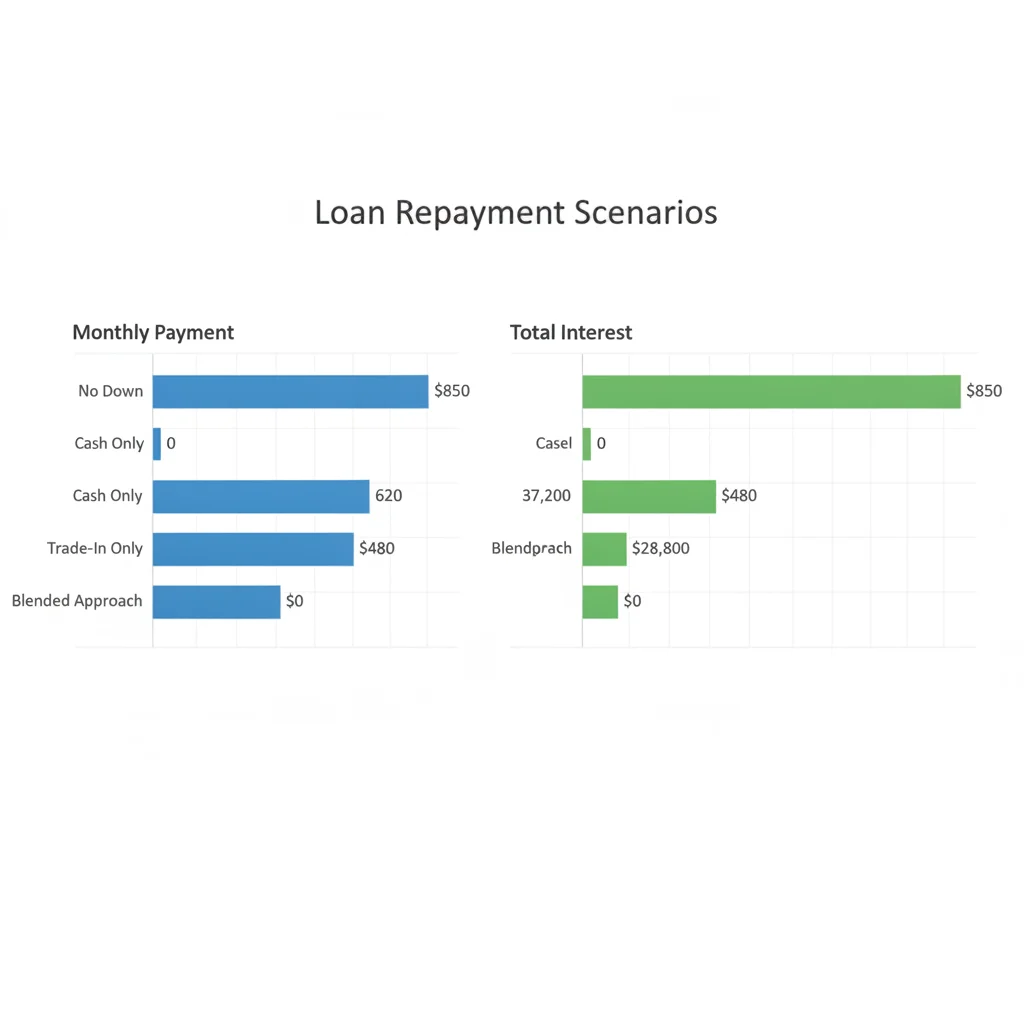
Here's how it stacks up on a $40,000 vehicle purchase at 7% APR over 60 months:
| Strategy | Amount Financed | Monthly Payment | Total Interest Paid |
|---|---|---|---|
| No down payment or trade | $40,000 | $792 | $7,524 |
| $5,000 cash down only | $35,000 | $693 | $6,584 |
| $5,000 trade-in only | $35,000 | $693 | $6,584 |
| $5,000 cash + $5,000 trade-in | $30,000 | $594 | $5,644 |
The blended approach cuts the monthly payment by nearly $200 compared to financing the full amount and saves almost $1,900 in interest over the life of the loan. Neither strategy alone gets you to that number — the combination does.
If your trade-in doesn't have much equity but you have savings, lean on cash. If your trade-in has significant equity but your savings are thin, let the vehicle carry more weight. The key principle is the same regardless: every dollar applied before financing begins saves you money in interest, not just principal.
For broader strategy on maximizing what you get from your trade-in when buying another car, explore our trade-in strategies hub. And if you're curious how donation compares to trading in on the tax side, our trade-in vs. donation comparison walks through the numbers.
Making the Call: Which Is Right for You?
The honest answer is that a cash down payment and a trade-in credit do the same fundamental job — they reduce the amount you borrow. Dollar for dollar, on a clean deal with no existing loan on the trade, they're equivalent in their direct effect on your principal. The differences show up in the surrounding details: tax treatment, dealer negotiation dynamics, lender preferences, and what happens when you have negative equity.
Use this decision framework:
- Choose cash if:
- You don't own a vehicle, you own one with little equity, you have a loan balance close to or above the car's value, or you want the cleanest possible deal structure for a lender.
- Choose trade-in if:
- You own a vehicle outright or have significant positive equity, you're in a state with a trade-in sales tax credit, and you've verified the dealer's offer against third-party appraisals.
- Use both if:
- You want to minimize your financed amount as aggressively as possible and have access to both sources of value.
Whatever combination you choose, the math always rewards one behavior: putting more down before you borrow. The interest you don't pay on a dollar you never financed is the best return available in a car deal.
States Without a Trade-In Tax Credit
California, Hawaii, Michigan, and Virginia are among the states that do not offer a sales tax credit on trade-ins — meaning the tax savings argument for trading in rather than selling privately doesn't apply there. Always confirm your state's specific rules with the DMV or a tax advisor before making your decision based on assumed tax treatment.
When Negative Equity Changes Everything
If you owe more on your current vehicle than it's worth, the trade-in can't serve as a loan reducer — it becomes a loan increaser. In this scenario, cash is almost always the better tool. You may also want to consider paying down the existing loan before trading in, which can shift you into positive equity territory and restore the trade-in's value as a financing lever.

All claims are backed by peer-reviewed research. Sources on request.