Key Takeaways
Option A
10% Down Payment
The accessible, lower-barrier entry point for most buyers.
Best for: Buyers who need to preserve cash flow or are purchasing a moderately priced vehicle with a solid credit profile.
Option B
20% Down Payment
The equity-building, cost-minimizing standard for financially prepared buyers.
Best for: Buyers who want the lowest total loan cost, faster equity accumulation, and protection against depreciation exposure.
If you want the lowest possible total loan cost
20% Down Payment
A 20% down payment reduces both the principal balance and often the interest rate itself, compounding your savings across the full loan term.
If you need to keep cash available for emergencies or other financial goals
10% Down Payment
Preserving liquidity matters. A $3,500 emergency fund can protect you from missed payments better than an extra $3,500 applied to a down payment.
If you're buying a vehicle that depreciates quickly
20% Down Payment
Rapidly depreciating vehicles — like many sedans and entry-level cars — leave you underwater faster. A 20% down payment provides a meaningful equity buffer from day one.
If you have excellent credit (750+) and plan to refinance later
10% Down Payment
Strong credit often unlocks competitive rates even at 10% down. You can apply freed-up cash elsewhere and refinance if rates drop.
If you're a first-time buyer with limited savings history
20% Down Payment
Lenders view first-time buyers as higher risk. A larger down payment signals commitment and can be the factor that unlocks better loan terms.
What Each Down Payment Actually Costs You Upfront
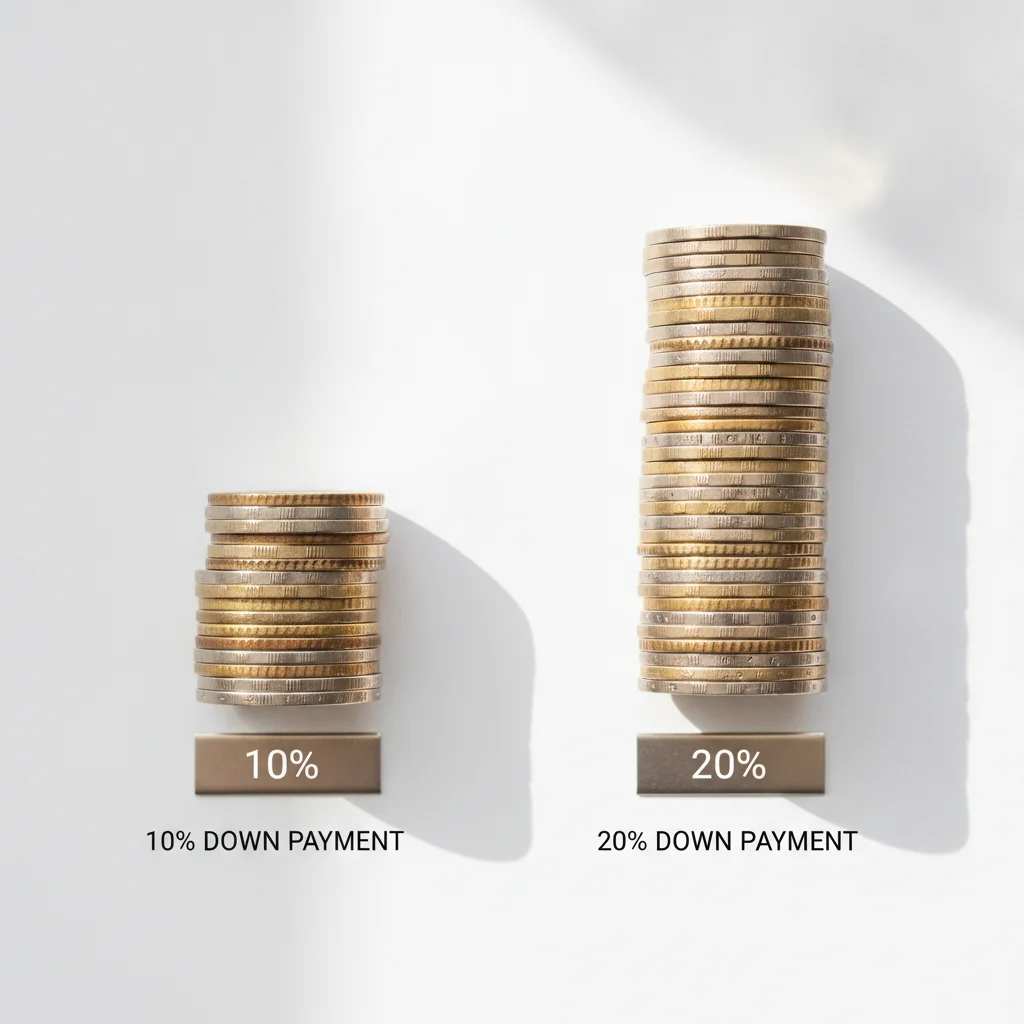
Before diving into which is better, let's anchor both benchmarks to real numbers. For a $35,000 vehicle — roughly the average new car transaction price in the U.S. — a 10% down payment means $3,500 out of pocket at signing. A 20% down payment means $7,000. That $3,500 gap is the first number most buyers fixate on, but it's not where the real story lives.
The more important number is what each choice does to your loan principal and, by extension, your monthly payment and total interest paid. Here's how those break down across a standard 60-month loan:
| Criterion | 10% Down Payment | 20% Down Payment |
|---|---|---|
| Upfront cash required (on $35,000 car) | $3,500 | $7,000 |
| Loan amount financed | $31,500 | $28,000 |
| Approximate monthly payment (60 mo / 7%) | ~$622/mo | ~$554/mo |
| Total interest paid (60 mo / 7%) | ~$5,820 | ~$5,220 (at same rate) |
| Loan-to-value ratio at signing | ~90% | ~80% |
| Equity position at signing | $3,500 | $7,000 |
| Risk of going underwater in year one | Moderate to high | Low |
| Likely rate improvement from LTV | Minimal | Possible 0.25–0.75% |
| Cash reserved after down payment | More liquidity retained | Less liquidity retained |
| Best for | Cash-conscious buyers, strong credit | Cost-minimizers, higher depreciation risk |
At a 7% APR, putting 10% down on a $35,000 car means you're financing $31,500. Put 20% down and you're financing $28,000. The $3,500 difference in principal results in roughly $60–$65 less per month and approximately $1,400 less in total interest paid over five years — without even accounting for any rate improvement a larger down payment might earn you.
For a deeper look at how principal reduction interacts with your loan-to-value ratio, see the math behind putting more money down on a car — it walks through the LTV mechanics step by step.
How Down Payment Size Affects Your Interest Rate
Most buyers treat the interest rate as a fixed input — whatever the lender quotes, that's the rate. But lenders actually price your rate based on several factors, and your loan-to-value (LTV) ratio is one of them. LTV is simply your loan amount divided by the vehicle's value. A lower LTV means less risk for the lender, and less risk often translates to a better rate.
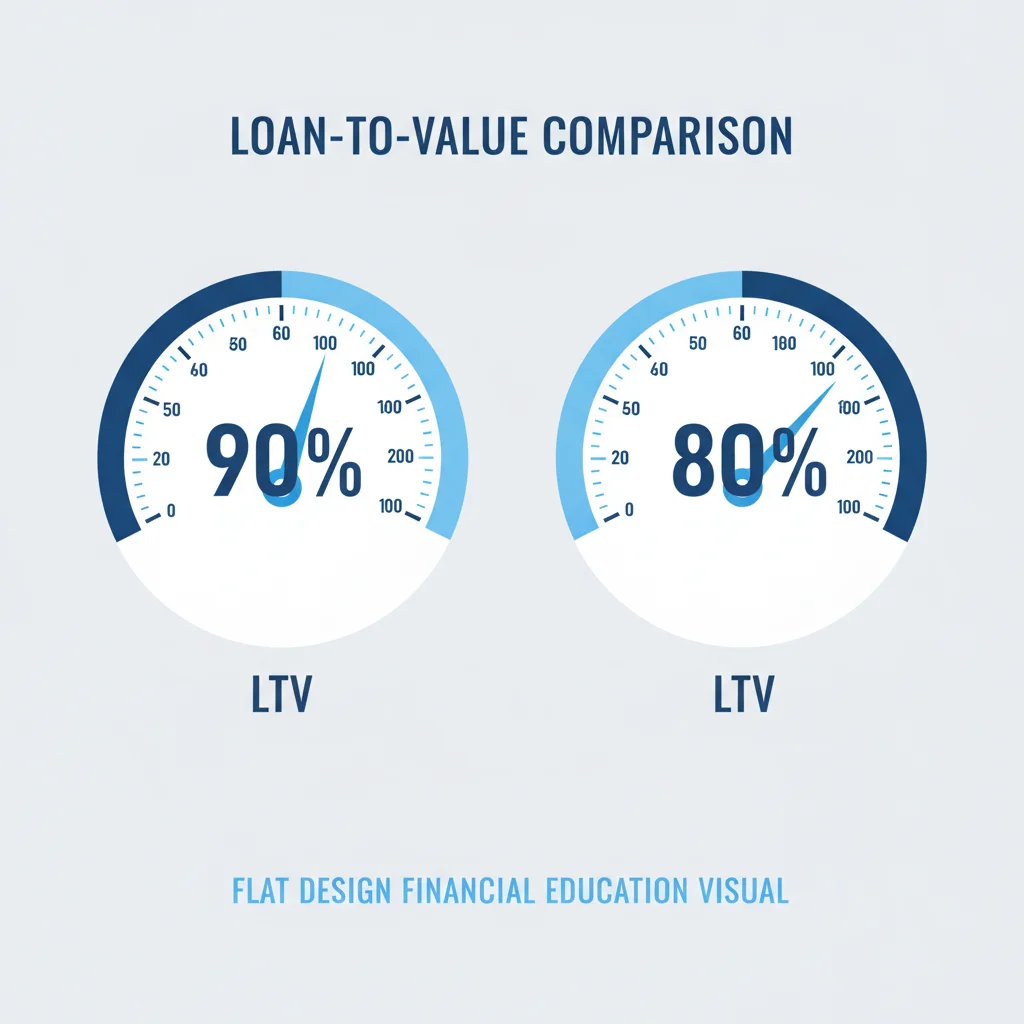
Here's a concrete example: Say your credit score qualifies you for a rate between 6.5% and 7.5% depending on LTV. A 10% down payment on a $35,000 car produces an LTV of about 90% — likely landing you at the higher end of that range. A 20% down payment drops your LTV to 80%, potentially unlocking the lower rate.
That 1% rate difference on a $28,000–$31,500 loan over 60 months isn't trivial. To understand exactly how much a rate point is worth in dollar terms, see how rate reductions translate to real savings.
~$1,230
Interest saved by going 20% vs. 10% down
Based on a $35,000 vehicle financed over 60 months with a 0.5% rate improvement at 20% down, using mid-2024 rate benchmarks.
15–20%
Typical first-year depreciation on new cars
According to Edmunds and iSeeCars depreciation data, most new vehicles lose 15–20% of value within the first 12 months of ownership.
80%
LTV threshold that often unlocks better rates
Many lenders apply risk-based pricing adjustments for LTVs above 80%, making 20% down a meaningful cutoff in loan pricing models.
$48,000+
Average new car transaction price in the U.S.
Cox Automotive data from 2024 shows average new vehicle transaction prices hovering above $48,000, making down payment math increasingly consequential.
12–18 months
Extra time underwater with 10% vs. 20% down
On a fast-depreciating sedan, buyers putting 10% down typically remain underwater 12–18 months longer than those who put 20% down at signing.
It's worth noting that credit score plays the dominant role in rate-setting — down payment is a secondary lever. If your score is already 750+, the rate improvement from 10% to 20% down might be minimal. But for buyers in the 620–700 range, a lower LTV can make a meaningful difference. See how your credit score directly affects what lenders will offer you.
Gap Insurance Can Bridge the Underwater Risk
If you put 10% down on a vehicle with high depreciation and worry about being underwater, gap insurance is worth considering. It covers the difference between what you owe and what your car is worth if the vehicle is totaled or stolen. Gap coverage typically costs $20–$40 per year added to your auto insurance policy — a relatively cheap hedge against the equity risk a smaller down payment creates. That said, it doesn't reduce your total loan cost; it only protects against a worst-case scenario.
The Equity Timeline: When You Stop Being Underwater
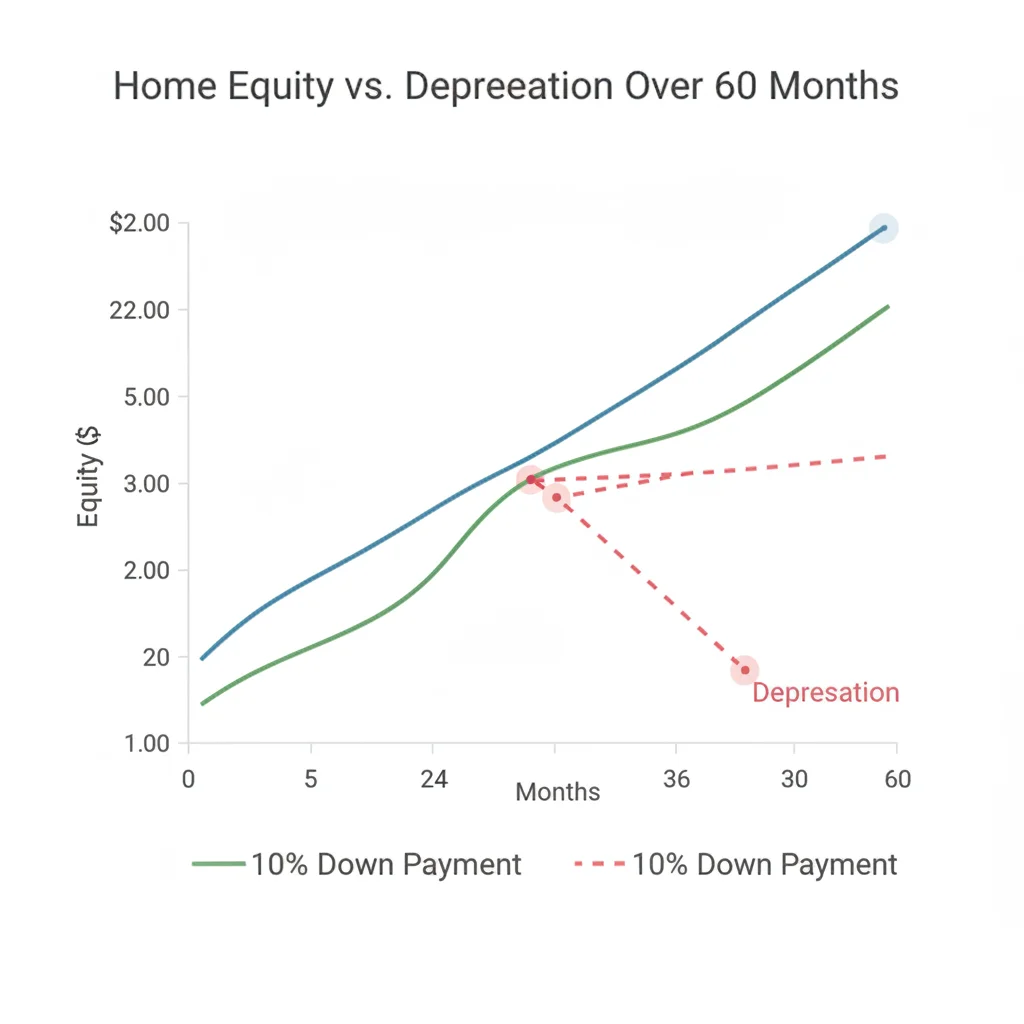
"Underwater" means you owe more on the loan than the car is currently worth. It happens because cars depreciate — often 15–20% in the first year — while your loan balance shrinks slowly, especially in the early months when most of your payment goes toward interest rather than principal.
Your down payment is the single fastest way to shift this timeline. Here's how it plays out for a $35,000 vehicle with typical depreciation:
- 10% down ($3,500): You start with $31,500 owed on a car worth $35,000. After one year, the car may be worth roughly $28,000–$29,000 while your balance is around $26,500–$27,500. You're near break-even after 12–15 months but may still be slightly underwater.
- 20% down ($7,000): You start with $28,000 owed on a car worth $35,000 — already $7,000 in equity. Even after a 15–20% first-year depreciation drop, you likely maintain positive equity from day one.
Why does this matter practically? If you total the car, get laid off, or need to sell quickly, being underwater means your insurance payout or sale proceeds won't cover the remaining loan balance. You'd still owe money on a car you no longer have.
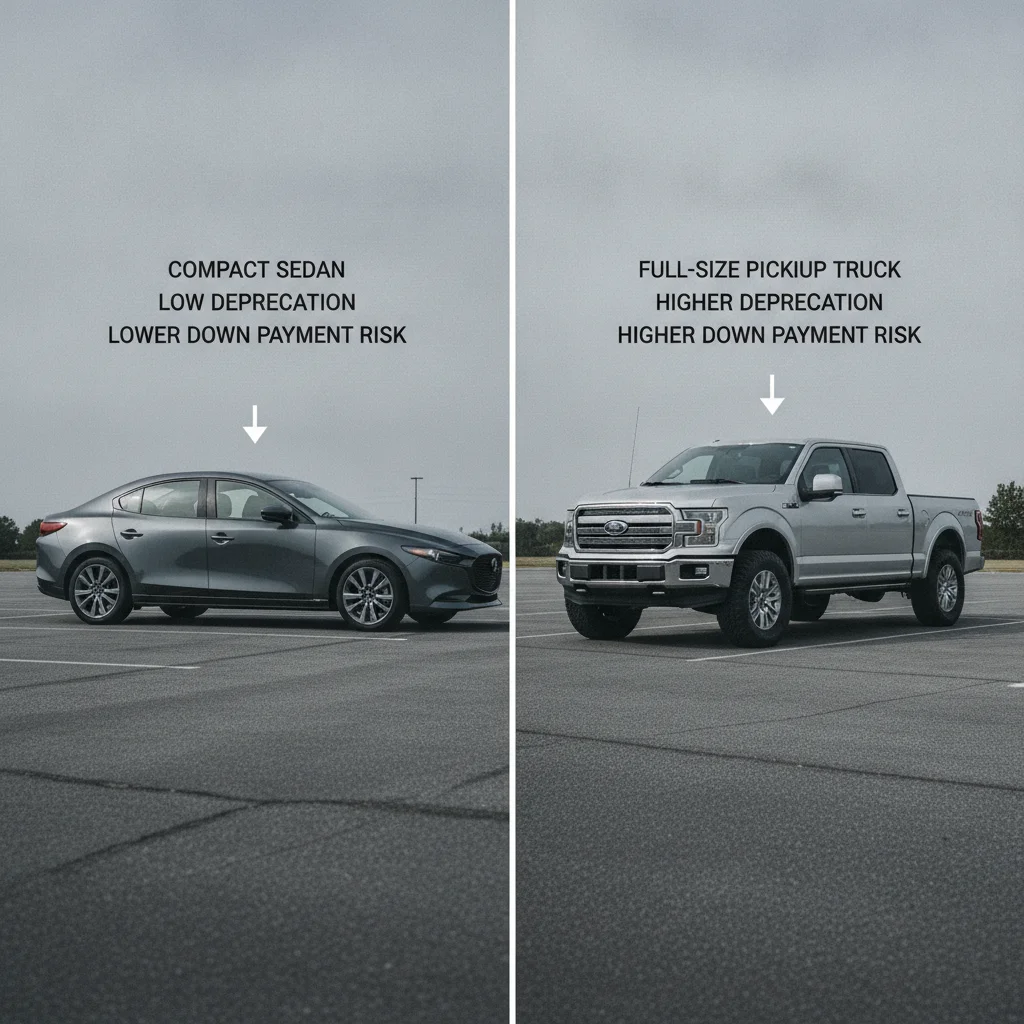
The risk of being underwater is compounded on fast-depreciating vehicles. A compact sedan might lose 20–25% of its value in year one. A full-size pickup might lose 12–15%. The down payment you need to stay above water on day one differs meaningfully between these two vehicle types — which is part of why the 20% benchmark exists in the first place.
For more on how a small down payment quietly extends your financial exposure, see how putting down too little inflates the cost of your car.
Side-by-Side: Total Cost Across a 60-Month Loan
Let's consolidate everything into a single scenario so the tradeoffs are clear. We'll use a $35,000 vehicle, a 60-month loan, and two rates — one reflecting better LTV treatment at 20% down, one reflecting the more typical rate at 10% down. These are illustrative figures based on common market conditions, not guarantees.
| Scenario | Down Payment | Loan Amount | APR | Monthly Payment | Total Interest Paid | Total Cost of Car |
|---|---|---|---|---|---|---|
| 10% Down | $3,500 | $31,500 | 7.25% | ~$629 | ~$6,240 | ~$41,240 |
| 20% Down | $7,000 | $28,000 | 6.75% | ~$550 | ~$5,010 | ~$40,010 |
The 20% down scenario saves roughly $1,230 in total interest and reduces the monthly payment by about $79. Over five years, that monthly difference adds up to nearly $4,740 in cash flow — though $3,500 of that was the extra down payment itself, leaving a net benefit of about $1,240 plus reduced financial risk.
The comparison shifts if you factor in what that extra $3,500 could earn elsewhere. Invested in an index fund averaging 8% annually, $3,500 grows to roughly $5,150 over five years. That potential gain exceeds the interest savings from the larger down payment — which is precisely why maximizing your down payment isn't always the optimal move. Read more about the cases where more down can work against you.
The 20% Rule: Where It Comes From and When to Ignore It
The 20% down payment recommendation isn't arbitrary — it comes from two practical realities. First, 20% down typically keeps you above water on depreciation from day one, even on vehicles that lose value quickly. Second, 20% is often the LTV threshold at which lenders stop requiring gap insurance or applying risk-based rate adjustments.
But the rule has real limitations:
- It ignores your savings cushion. If hitting 20% down means draining your emergency fund, the risk you introduce — a missed payment, an unexpected repair, a medical bill — may cost more than the interest you save.
- It assumes average depreciation. Trucks, SUVs, and certain luxury vehicles depreciate more slowly. A 10% down payment on a Toyota Tacoma carries far less equity risk than the same down payment on a Chevrolet Malibu.
- It doesn't account for rate environment. When rates are low across the board, the rate improvement from 20% vs. 10% down may be negligible. When rates are high (as they have been in recent years), the improvement matters more.
- It ignores loan term. A 48-month loan builds equity faster than a 72-month loan regardless of down payment. If you're choosing a shorter term, the equity protection from 20% down is less critical.
The 20% benchmark is a useful starting point, not a universal rule. Several common myths about down payments — including the idea that 20% is always optimal — deserve a closer look before you make a final decision.
There's also a direct contrast worth reading: see how no down payment compares to 20% down in real dollar terms to understand the full spectrum of risk.
Finally, understanding how APR works is essential context — because a low rate with a small down payment can sometimes beat a high rate with a large one, depending on loan term and the numbers involved.
Making the Call: A Framework for Your Situation
There's no formula that gives every buyer the same answer. But there is a clear decision framework:
- Step 1: Check your emergency fund first.
- Whatever you put down, you should have at least 2–3 months of expenses in liquid savings afterward. Don't cannibalize your financial safety net for a lower car payment.
- Step 2: Pull your credit score before deciding.
- If you're above 720–740, your rate may not improve much with a larger down payment. If you're in the 620–700 range, 20% down might meaningfully lower your rate — or even get you approved where you otherwise wouldn't be.
- Step 3: Research the vehicle's depreciation rate.
- Look up the vehicle's projected residual value at 12 and 24 months. If it loses more than 20% in year one, a 10% down payment leaves you underwater for a meaningful period. Factor that risk into your decision.
- Step 4: Model both scenarios with actual numbers.
- Use a loan calculator with the rates your lender is quoting — not hypothetical rates. Calculate total interest paid in both scenarios and decide if the interest savings justify the additional upfront cash.
- Step 5: Consider the loan term alongside the down payment.
- A shorter loan term with 10% down can sometimes produce better equity outcomes than a longer term with 20% down. They interact — don't optimize one without considering the other.
The bottom line: 10% down is workable for buyers with solid credit, stable income, and a vehicle that holds its value reasonably well. Twenty percent down is the safer, lower-cost path for buyers who can swing it without depleting their savings — particularly on depreciating vehicles or in higher-rate environments. Both are defensible. The worst outcome is choosing based on the monthly payment alone without running the full-cost numbers first.

All claims are backed by peer-reviewed research. Sources on request.