Key Takeaways
Our Verdict
For financed vehicles, putting money down is almost always a smart financial move — it reduces your loan balance, lowers total interest paid, and keeps you from going underwater. For leases, the calculus is very different: a cap cost reduction lowers your monthly payment but disappears instantly with no equity benefit, making a larger upfront payment a risky choice. Drivers who lease should keep upfront cash to a minimum and let the monthly payment do the work.
| Best for | Recommended |
|---|---|
| Buyers financing a vehicle and building long-term equity | Substantial down payment (15–20%) |
| Lessees who want lower monthly payments | Small cap cost reduction or zero down |
| Buyers with below-average credit seeking better loan terms | Larger financed down payment to offset risk |
| Lessees prioritizing maximum cash flexibility | Zero down — pay only drive-off fees |
Why Upfront Money Means Something Different in Each Scenario
When most people think about a down payment, they think of it as simply reducing what they owe. That intuition is correct for a financed vehicle — but it breaks down completely when applied to a lease. These two transactions are fundamentally different in structure, and the money you put down on day one follows a completely different path in each case.
When you finance a car, your down payment reduces the principal balance of your loan. You borrow less, so you pay less in interest, and you own a larger share of the asset from the start. If you sell the car or trade it in, any equity you've built — including that original down payment — comes back to you in the form of trade-in value or sale proceeds.
When you lease a car, there is no loan principal in the traditional sense. Instead, you're paying for the depreciation the car experiences during your lease term, plus a finance charge (called the money factor). A cash payment upfront — called a capitalized cost reduction, or cap cost reduction — trims the amount of depreciation you're financing, which lowers your monthly payment. But here's the critical difference: that money is gone the moment you hand it over. You never get it back, regardless of what happens to the vehicle.
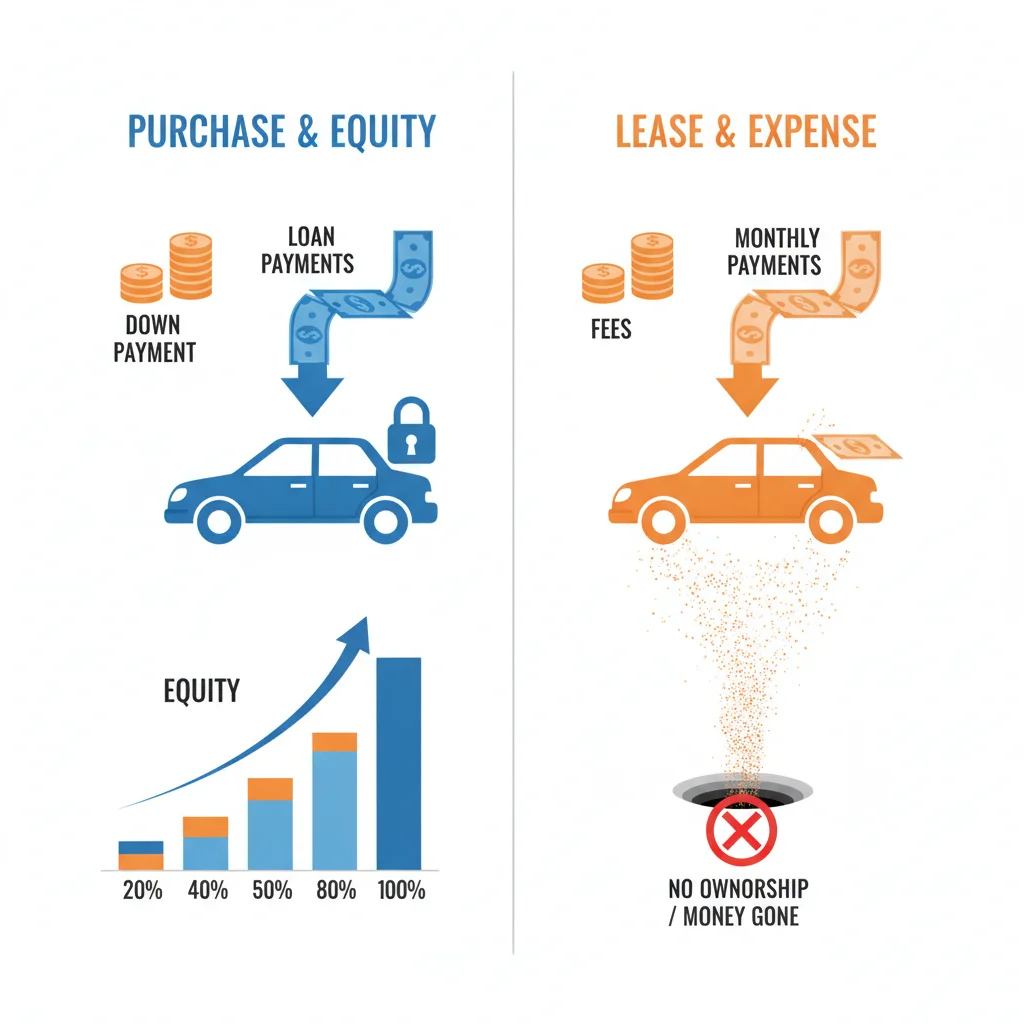
This distinction isn't just academic. It has real consequences for how much risk you're taking on and how efficiently your cash is working for you. See our full comparison of leasing vs. buying for the broader financial picture before deciding which path is right for you.
How Down Payments Work on Financed Vehicles
With a traditional auto loan, the mechanics of a down payment are straightforward. Suppose you're buying a $40,000 SUV. You put $8,000 down (20%), so your loan amount is $32,000. At a 7% APR over 60 months, your monthly payment is roughly $634, and your total interest paid over the life of the loan is about $6,040.
Now imagine you only put $2,000 down. Your loan balance rises to $38,000. At the same rate and term, your monthly payment jumps to $752, and you'll pay more than $7,100 in interest — over $1,000 more for the same car.
20%
Average new car value lost in year one
According to Carfax and industry depreciation data, most new vehicles lose 15–25% of their value within the first 12 months of ownership.
$1,000+
Extra interest from small vs. large down payment
On a $38,000 vs. $32,000 loan at 7% APR over 60 months, the smaller down payment costs over $1,000 more in total interest charges.
72 months
Average new car loan term in the U.S.
Experian's State of the Automotive Finance Market report shows the average new vehicle loan term has stretched to 72 months, amplifying down payment importance.
But the interest savings aren't the only benefit. A meaningful down payment also protects you against being upside down — owing more on the loan than the car is worth. New vehicles lose roughly 15–25% of their value in the first year alone. If you put nothing down on a $40,000 car and it drops to $30,000 in value after 12 months, you could owe $36,000 or more with a low-down-payment loan. At that point, you can't sell or trade without bringing cash to the table.
A 20% down payment isn't always achievable, but aiming for at least 10% gives you a meaningful buffer against early depreciation. If your credit score is below 680, lenders may also charge significantly higher interest rates — a situation where a larger down payment offsets some of that rate penalty by shrinking the balance they're financing.
Use the 20/4/10 Rule as a Baseline
A classic personal finance benchmark for auto purchases is the 20/4/10 rule: put 20% down, finance for no more than 4 years, and keep total vehicle expenses (payment + insurance) under 10% of your gross monthly income. While modern loan terms often stretch longer, this framework still provides a useful starting point for sizing your down payment on a financed vehicle.
Zero Down Isn't Always a Red Flag
If a manufacturer is offering 0% APR financing — common on slow-selling or end-of-model-year vehicles — putting money down may be less critical because you're not paying interest on the balance anyway. In these cases, you might consider investing that cash elsewhere rather than locking it into the vehicle. Always run the numbers both ways before deciding.
For a complete breakdown of how lenders evaluate your upfront contribution, see our complete guide to auto loan down payments. You may also want to understand how dealers and lenders view your down payment differently — their motivations don't always align.
How Cap Cost Reductions Work on Leases
In a lease, the equivalent of a down payment is called a capitalized cost reduction. It works by lowering the "cap cost" — the agreed purchase price of the vehicle for lease purposes. A lower cap cost means less depreciation to finance across the lease term, which directly lowers your monthly payment.
Here's a simple example. Say you're leasing a $45,000 sedan with a residual value of $27,000 after 36 months. You're financing $18,000 in depreciation, plus a money factor equivalent to about 5% APR. Your base payment might be around $530/month.
If you put $3,000 down as a cap cost reduction, you reduce the depreciation financed to $15,000. Your new monthly payment drops to roughly $445 — a $85/month reduction. Over 36 months, that adds up to $3,060 in savings. Looks like a wash, right? It's not, for one very important reason: you paid that $3,000 upfront and can never get it back.

Now consider what happens if the car is totaled or stolen in month three. Your insurer pays the lessor (who owns the vehicle) the car's market value. Your cap cost reduction? Gone. You have no claim to it. With a financed vehicle, the insurance payout reduces your loan balance — your down payment, in effect, was already protecting your equity position. On a lease, there is no equity position to protect.
Never Put a Large Sum Down on a Lease Without Gap Coverage
If your leased vehicle is totaled or stolen, the insurance payout goes to the lessor — not to you. Any cap cost reduction you paid is forfeited immediately. Without gap insurance, you could also owe the difference between what insurance pays and the remaining lease liability. Always confirm gap coverage is included (most leases from captive finance arms include it) before putting any significant cash down on a lease.
This is why most financial advisors recommend keeping lease money down as low as possible — ideally to just the first month's payment, acquisition fee, and applicable taxes at signing. Those are unavoidable drive-off costs. Everything beyond that is discretionary cash you're surrendering with no safety net.
To understand more about how depreciation shapes the lease equation, see our piece on leasing vs. buying when depreciation is in the equation.
Side-by-Side: The Core Differences
To make the comparison concrete, here's how the same upfront cash plays out across both transaction types. Note that the financial outcomes aren't just different in magnitude — they're different in kind.
| Criterion | Financed Vehicle (Down Payment) | Leased Vehicle (Cap Cost Reduction) | |
|---|---|---|---|
| Builds equity | Yes — reduces loan principal and ownership stake grows | No — no ownership stake exists | |
| Recoverable if car is totaled | Partially — insurance payout reduces remaining loan | No — money is permanently gone | |
| Reduces total interest paid | Yes — significantly over loan term | Marginally — only reduces money factor charges | |
| Protects against negative equity | Yes — key defense against going underwater | N/A — you never own the asset | |
| Effect on monthly payment | Lowers payment proportionally | Lowers payment proportionally | |
| Risk if you exit early | Equity can be recovered via sale or trade | All upfront money is forfeited with no recovery | |
| Recommended minimum | 10% of purchase price | First month's payment + fees only | |
| Recommended target | 15–20% of purchase price | Zero additional cash beyond drive-off costs |
The table above makes one thing clear: the purpose of upfront money is fundamentally different in each scenario. In a financed purchase, it's a wealth-building tool. In a lease, it's a payment-reduction tool — and a risky one at that.
One more variable worth noting is your loan preapproval position. When you arrive at a dealership with preapproval in hand, you have established leverage on the loan terms, which changes how much your down payment needs to work. A preapproved buyer at a competitive rate may need less down than someone negotiating blind.
When a Larger Down Payment Makes Sense — and When It Doesn't
The right down payment amount isn't one-size-fits-all. Here are the scenarios where putting more money down pays off — and where it doesn't.
Put more down when financing if:
- Your credit score is below 660. Subprime auto loans can carry APRs of 12–18% or higher. A larger down payment reduces the balance on which that punishing rate applies, saving hundreds or thousands in interest.
- You plan to keep the car for 5+ years. The longer you own it, the more each dollar of down payment benefits you through compounding interest savings.
- The vehicle has below-average residual value. Some models depreciate faster than others. A bigger cushion upfront keeps you from going underwater quickly.
- Your loan term is 72–84 months. Longer terms mean more total interest and slower equity build. A larger down payment counteracts both effects.
Keep lease money down low if:
- You change vehicles every 2–3 years. Repeatedly putting money into leases is a consistent cash drain with zero return.
- You don't carry gap insurance. If the car is totaled, you'll want to minimize the unrecoverable loss.
- Cash flow is tight. A higher monthly payment on a lease is a predictable, manageable cost. Surrendering a lump sum upfront is not.
- You're unsure about the lease term. If life circumstances might require you to exit the lease early, the money you put down is already lost.

If you're working on building up your upfront contribution for a financed vehicle, our guide on ways to increase your down payment before buying covers practical strategies — from selling current assets to timing your purchase around a tax refund or annual bonus.
The Hidden Cost of Zero Down on a Financed Vehicle
Zero-down financing offers are aggressively marketed — and for good reason. They lower the barrier to entry and move inventory quickly. But the math behind them often works against the buyer.
Consider a $35,000 vehicle financed over 72 months at 8.5% APR with zero down. Your monthly payment is about $614, and your total interest paid is roughly $9,208. In the first year, you'll pay about $2,900 in interest alone while the car potentially loses $6,000–$8,000 in value. That's a scenario where you could easily owe $33,000 on a car worth $27,000 — a $6,000 negative equity hole after just 12 months.
If you need to sell, trade in, or if the car is totaled without gap coverage, you're on the hook for that gap out of pocket. This is one of the most common financial traps in auto buying.
Use the 20/4/10 Rule as a Baseline
A classic personal finance benchmark for auto purchases is the 20/4/10 rule: put 20% down, finance for no more than 4 years, and keep total vehicle expenses (payment + insurance) under 10% of your gross monthly income. While modern loan terms often stretch longer, this framework still provides a useful starting point for sizing your down payment on a financed vehicle.
Zero Down Isn't Always a Red Flag
If a manufacturer is offering 0% APR financing — common on slow-selling or end-of-model-year vehicles — putting money down may be less critical because you're not paying interest on the balance anyway. In these cases, you might consider investing that cash elsewhere rather than locking it into the vehicle. Always run the numbers both ways before deciding.
Zero down isn't always disqualifying — if you're getting 0% APR financing on a certified pre-owned vehicle and plan to hold it long-term, the calculus changes. But for most buyers with market-rate financing on a depreciating asset, zero down is a setup for an underwater loan.
For new car buyers specifically, understanding depreciation exposure from the moment of purchase is essential. Our guide to buying new cars covers what else to evaluate before signing at the dealership.
Practical Down Payment Targets for Both Scenarios
So what numbers should you actually be targeting? Here are concrete benchmarks based on transaction type, credit profile, and vehicle type.
Financed Vehicle Targets
- Excellent credit (720+): 10–15% down is typically sufficient. You'll qualify for competitive rates, so the down payment's primary job is equity protection.
- Good credit (660–719): Aim for 15% down. Rates are moderate but not rock-bottom; a larger cushion helps control total interest.
- Fair/subprime credit (below 660): Target 20% or more. Your rate will be high — every dollar you don't borrow is a dollar that won't compound at 12–18% APR.
- Longer loan terms (72–84 months): Add 5% to whatever baseline you'd otherwise use. Long terms slow equity build dramatically.
Lease Targets
- Ideal target: Zero to one month's payment down. This covers the minimum drive-off costs without surrendering recoverable cash.
- Maximum comfortable amount: If you must reduce monthly payments further, limit additional cap cost reduction to $1,000–$2,000 and confirm you carry gap coverage.
- Never put more than 5% of MSRP down on a lease without a clear, calculated reason — and never without gap insurance.
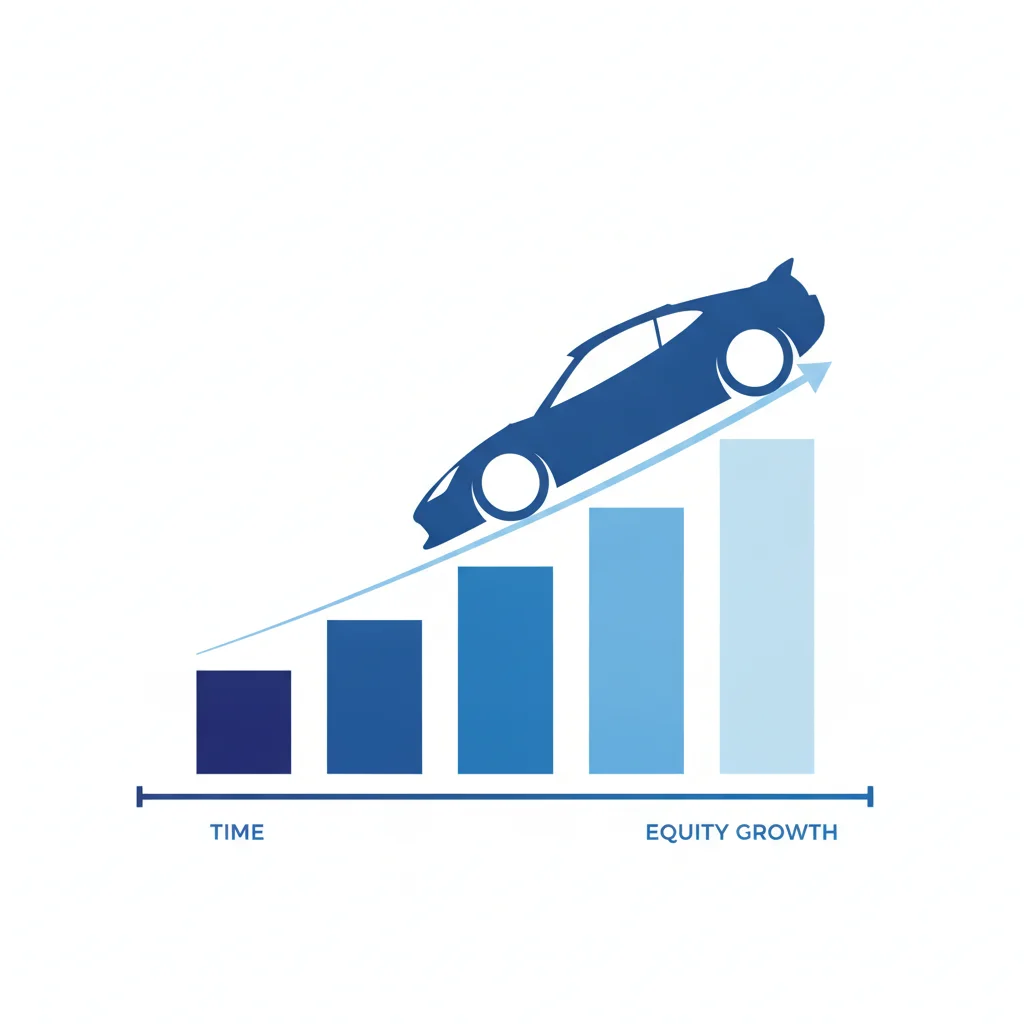
Ultimately, your upfront strategy in either scenario should start with a clear-eyed view of your credit position, your cash flow, and how long you plan to be in the vehicle. Upfront money is most powerful when it's protecting you from risk — and least powerful when it's simply disappearing into a transaction with no equity upside.

All claims are backed by peer-reviewed research. Sources on request.