
Key Takeaways
Why Gift Funds Work — and Why Lenders Care Where Your Down Payment Comes From
When a lender evaluates your auto loan application, they're not just looking at your credit score. They're also assessing risk — specifically, the risk that you'll default and they'll be left holding a vehicle worth less than the outstanding loan balance. A meaningful down payment reduces that risk in two concrete ways: it lowers the loan-to-value (LTV) ratio, and it signals that you have financial stake in the vehicle.
Gift funds accomplish both of those things just as effectively as money you saved yourself. A $5,000 family gift applied as a down payment on a $25,000 vehicle produces the same 20% LTV as $5,000 drawn from your savings account. The math is identical. The difference, from a lender's perspective, is verifiability — they need to confirm that the money is actually a gift, not a borrowed amount that will show up as a monthly debt obligation somewhere else on your balance sheet.
That's the core reason lenders ask for documentation. If the "gift" is really a personal loan from your parents that you'll repay at $200 a month, that's an undisclosed debt — and it changes your debt-to-income ratio in ways that affect your ability to repay the auto loan. Lenders aren't being bureaucratic for its own sake; they're protecting themselves (and, indirectly, you) from overleveraging.

The good news is that true gift funds — money given freely with no expectation of repayment — are accepted by the vast majority of mainstream auto lenders. You just need to know how to document them properly. See our complete down payment breakdown for a broader look at how lenders evaluate your full financial picture.
What you will need
If you're still building up your contribution beyond the gift, our guide on saving for a car down payment without derailing your budget walks through practical strategies for supplementing gift funds with your own savings.
The Financial Upside: How a Gift Down Payment Lowers Your Total Cost
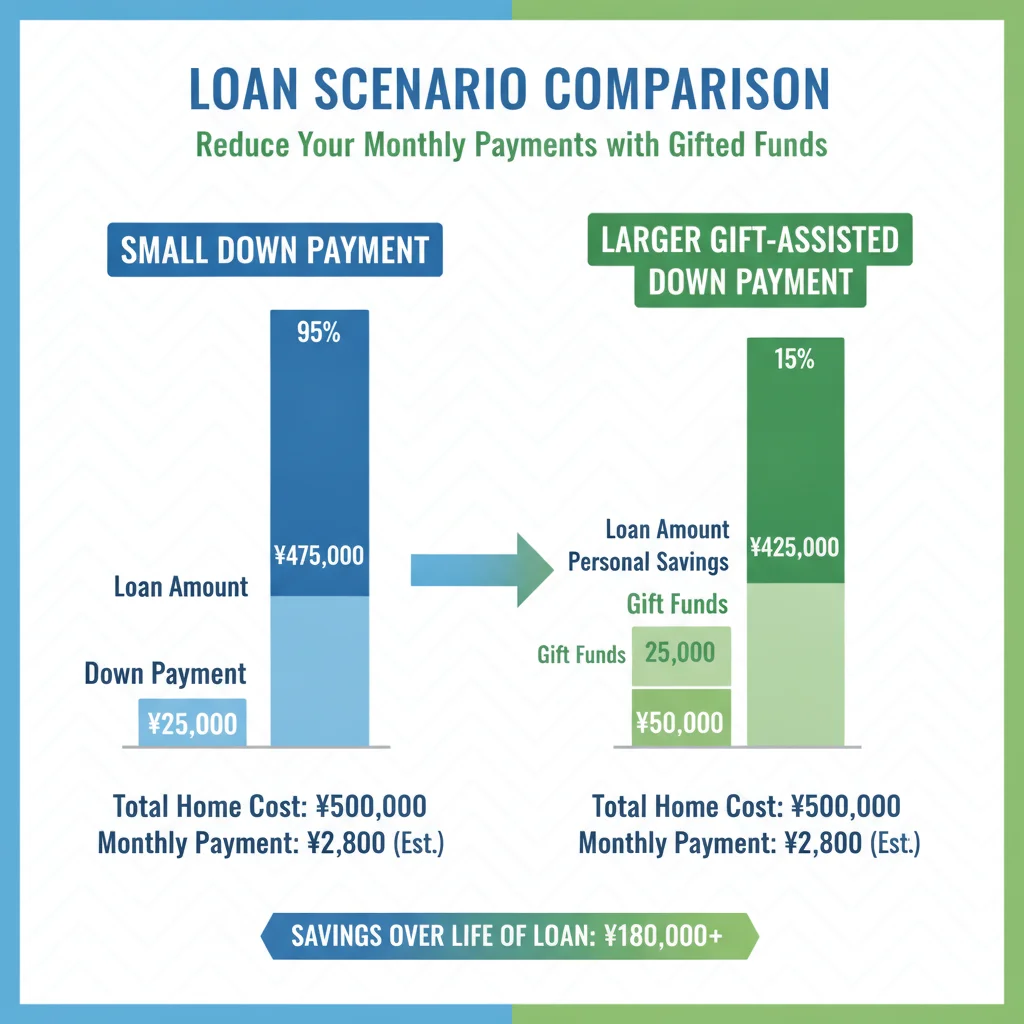
Let's look at the numbers directly. Suppose you're financing a $28,000 used vehicle. You have $1,500 saved, and a family member gives you $4,000 — bringing your total down payment to $5,500, or roughly 20%. Compare that to going in with only your $1,500 (about 5.4% down):
| Scenario | Down Payment | Loan Amount | APR | 60-Month Payment | Total Interest Paid |
|---|---|---|---|---|---|
| 5.4% down (no gift) | $1,500 | $26,500 | 7.5% | $531 | $5,367 |
| 20% down (with gift) | $5,500 | $22,500 | 6.8% | $442 | $4,022 |
In this example, the $4,000 gift saves you approximately $1,345 in interest and reduces your monthly payment by $89. That's a meaningful return on a family's generosity — and it illustrates exactly why getting as much money upfront as possible is almost always the right financial move.
Beyond interest savings, a larger down payment also reduces the risk of going "underwater" — owing more than the vehicle is worth. New cars can lose 15–25% of their value in the first year alone. A strong down payment buffer means that if you need to sell or trade in early, you're far less likely to face a shortfall.
Gift Letter Template
A signed written statement from the donor confirming the funds are a gift and not a loan — the core document most lenders require.
Bank Statement (2–3 months)
Shows the lender where the gift funds originated and confirms they have been deposited into your account.
Wire Transfer or Check Confirmation
Provides a paper trail proving the funds moved from the donor's account to yours on a specific date.
Donor's Bank Statement
Some lenders require proof that the donor actually had the funds available before transferring them.
Loan Pre-Approval Letter
Confirms your borrowing eligibility before you finalize the down payment amount, so you know exactly how much gift money to request.
Ask the Lender First, Then Accept the Gift
Before your family member transfers any money, call or email your prospective lender and ask directly: 'Do you accept gift funds for down payments, and what documentation will you need?' Getting the requirements in writing saves everyone confusion later and ensures the gift letter is drafted correctly on the first try.
A Bigger Down Payment Means Better Loan Terms
Every additional dollar applied upfront reduces your loan-to-value (LTV) ratio. A lower LTV often qualifies you for a lower interest rate, a shorter loan term, or both. On a $28,000 vehicle, moving from a 10% down payment to a 20% down payment can shave 0.5–1.0 percentage points off your rate at many lenders, saving hundreds in interest over the life of the loan.
Keep a Copy of Everything
Make digital copies of the signed gift letter, the bank transfer confirmation, and any correspondence with your lender about gift funds. Store them in a folder you can access quickly during the loan underwriting process. Lenders sometimes ask for re-verification at closing, and having documents on hand prevents last-minute scrambling.
If you receive unexpected money after the loan closes — a work bonus, a tax refund, or another gift — you can apply those funds directly to your loan principal instead. Our guide on applying windfalls to your auto loan explains how to time and direct those payments for maximum interest savings.
Step-by-Step: Using Gift Funds as Your Down Payment
The process of using gift funds involves a few more steps than simply handing over a check at the dealership, but none of them are complicated once you know what to expect. Follow the steps below in order — skipping ahead often creates documentation gaps that slow down underwriting.
Large Cash Deposits Raise Red Flags
If you deposit a large cash gift shortly before applying for a loan, underwriters may flag the transaction as unexplained. Lenders typically review two to three months of bank statements, and an unverified lump sum can delay or derail approval. Whenever possible, have the gift deposited at least 60 days before you apply, or be prepared to provide a complete paper trail.
Not All Lenders Treat Gift Funds Equally
Some lenders — particularly subprime or buy-here-pay-here dealerships — may not ask for documentation at all, while traditional banks and credit unions may require extensive verification. Always ask your specific lender what their policy is before assuming gift funds will be accepted without question.
Confirm the lender's gift fund policy
Before anything else, contact your lender — whether that's a bank, credit union, or the dealership's finance office — and ask explicitly whether they accept gift funds as part of a down payment. Request their specific documentation requirements in writing, either by email or a printed policy sheet.
Lender policies vary significantly. A federally chartered bank may require a formal gift letter plus donor bank statements, while a local credit union might accept a simple signed note. Knowing the exact requirements upfront prevents wasted effort and lets you give your family member precise instructions.
Determine how much gift money you need
Calculate your target down payment before asking for a specific amount. As a baseline, most financial advisors recommend putting down at least 10% on a used car and 20% on a new car to avoid being underwater on the loan from day one.
For example, on a $30,000 new vehicle, a 20% down payment is $6,000. If you have $3,500 in savings, you'd need $2,500 in gift funds to reach that target. Knowing the exact figure makes the ask easier and ensures you don't request more — or less — than you actually need.
See our complete guide to auto loan down payments for a full breakdown of how to calculate the right amount for your situation.
Draft a gift letter with the donor
The gift letter is the single most important document in this process. It must clearly state that the funds are a gift — not a loan — and that the donor expects no repayment. Most lenders will provide a template, but if yours doesn't, a compliant gift letter typically includes:
- The donor's full name, address, and phone number
- The recipient's full name (your name)
- The exact dollar amount being gifted
- The relationship between donor and recipient (e.g., parent, grandparent, sibling)
- A statement that the funds are a gift and no repayment is required or expected
- The donor's signature and the date
Both you and the donor should keep a signed copy. Some lenders also require the donor's signature to be notarized, so confirm this requirement before the letter is finalized.
Transfer the funds and create a paper trail
The cleanest transfer method is a direct bank-to-bank wire or an electronic transfer (ACH) from the donor's account to yours. This creates a timestamped digital record that lenders can verify. Avoid cash handoffs whenever possible — a pile of bills deposited at a teller window is far harder to trace back to the donor.
If the donor writes a personal check, make a photocopy of the check before depositing it, and keep the deposit receipt. Request a cleared-check image from your bank once it posts.
Ideally, complete this transfer at least 60 days before your loan application so the funds appear as a seasoned balance on your bank statements rather than a sudden unexplained deposit.
Gather and organize all supporting documents
Once the transfer is complete, compile the full documentation package your lender will need:
- Signed gift letter from the donor
- Your bank statements showing the deposit (typically the last 2–3 months)
- Wire transfer confirmation or cleared check image
- Donor's bank statement showing the funds leaving their account (if required)
Organize these into a single PDF or a clearly labeled folder — physical or digital. Lenders move fast once you're in underwriting, and being able to provide any of these documents within hours keeps the process on track.
For a broader look at which down payment sources lenders will and won't accept, see our reference guide on approved down payment fund sources.
Submit documentation during the loan application
When you complete the loan application — whether online or in person — disclose that a portion of your down payment comes from gift funds. Don't omit this detail hoping it won't come up. Underwriters review bank statements line by line, and they will see the deposit.
Attach your gift letter and supporting documents to the application at the outset. If you're applying through a dealership's finance office, hand the packet directly to the finance manager and ask them to note it in the file. If you're applying online, upload the documents in the document portal or email them to your loan officer with a clear subject line referencing your application number.
Apply the gift funds at the dealership closing
On the day you take delivery of the vehicle, the down payment — including any gift portion — is collected before you sign the financing contract. Bring a cashier's check or arrange a wire transfer for the exact amount. Personal checks may be accepted by some dealers but can delay the transaction if verification is required.
At signing, confirm that the amount listed as your down payment on the financing contract matches what you actually brought. A clerical error here affects your loan balance, monthly payment, and the total interest you'll pay over the life of the loan.
Once the loan is closed, the gift funds are fully absorbed into your down payment — the donor has no further financial connection to the vehicle or the loan.
What If My Credit Is Thin or My Lender Pushes Back?
If you have limited credit history or a lower credit score, gift funds become even more valuable — because they reduce the lender's exposure on a borrower they perceive as higher risk. A larger down payment can sometimes be the deciding factor in a borderline approval.
That said, some lenders that specialize in subprime lending may not follow conventional documentation practices. Buy-here-pay-here dealerships, in particular, often set their own rules and may accept gift funds with little documentation — or may not count them at all toward a "verified" down payment. If you're working with a non-traditional lender, ask the finance manager to walk you through exactly how your down payment will be recorded in the financing agreement.
Don't Disguise a Loan as a Gift
If the money you're receiving from a family member must be repaid — even informally — it is a loan, not a gift. Representing it as a gift on lender documents is considered misrepresentation and can result in loan denial or, in serious cases, fraud charges. Be honest with your lender about the nature of the funds. Some lenders do accept documented personal loans as part of the down payment picture, so ask before assuming you need to hide the arrangement.
Borrowers working through credit challenges can find lender options and strategies in our hub on bad credit auto loans. And if you're planning ahead, getting preapproved for an auto loan before you visit a dealership lets you know exactly what terms you qualify for — including whether gift funds will be accepted under that lender's specific guidelines.
For anyone curious about other ways to boost their upfront contribution beyond a family gift, our article on ways to increase your down payment covers options like selling assets, timing your purchase around a bonus, or leveraging a trade-in.
Gift funds, when handled correctly, are one of the cleanest and most impactful ways to reduce what you borrow. The documentation requirements exist to protect everyone involved — and once you've been through the process once, it becomes straightforward to repeat.

All claims are backed by peer-reviewed research. Sources on request.