

| Most common accepted source | Personal savings (checking/savings account) |
| Most common rejected source | Personal loans or credit card cash advances |
| Typical fund seasoning period | 30–60 days in your account |
| Gift fund documentation required | Signed gift letter from donor |
| Trade-in equity counted as | Net equity (trade value minus remaining loan balance) |
| 401(k) loan appearance on credit report | Does not appear as debt (varies by lender policy) |
| Early 401(k) withdrawal penalty | 10% plus income tax (before age 59½) (IRS Publication 590-B) |
| Manufacturer rebates as down payment | Accepted by many lenders; confirm policy in advance |
Why Lenders Care Where Your Down Payment Comes From
When you hand over a down payment, your lender isn't just counting dollars — they're evaluating risk. A borrower who saved $4,000 over eight months signals financial discipline. A borrower who borrowed $4,000 from a cash-advance app the week before signing tells a very different story. Both buyers bring $4,000 to the table, but only one of them reliably signals lower default risk.
That's why most auto lenders scrutinize the source of your down payment, not just the amount. Some lenders are informal about it — they accept whatever you bring in. Others, particularly credit unions, banks offering prime-rate loans, and manufacturer-captive lenders, have explicit policies on acceptable funds. Understanding those policies before you shop can prevent last-minute surprises at the dealership finance office.
There's also a practical financial reason to care: a genuine down payment reduces your loan-to-value (LTV) ratio. A lower LTV means less money at risk for the lender, which translates to better interest rates and more favorable terms for you. Borrowed down payment money doesn't truly lower LTV risk because you've simply shifted debt from one creditor to another.
| Most common accepted source | Personal savings (checking/savings account) |
| Most common rejected source | Personal loans or credit card cash advances |
| Typical fund seasoning period | 30–60 days in your account |
| Gift fund documentation required | Signed gift letter from donor |
| Trade-in equity counted as | Net equity (trade value minus remaining loan balance) |
| 401(k) loan appearance on credit report | Does not appear as debt (varies by lender policy) |
| Early 401(k) withdrawal penalty | 10% plus income tax (before age 59½) (IRS Publication 590-B) |
| Manufacturer rebates as down payment | Accepted by many lenders; confirm policy in advance |
For a broader foundation on how down payments work before diving into the source details, see our complete guide for first-time buyers.
Down Payment Sources Lenders Will Accept
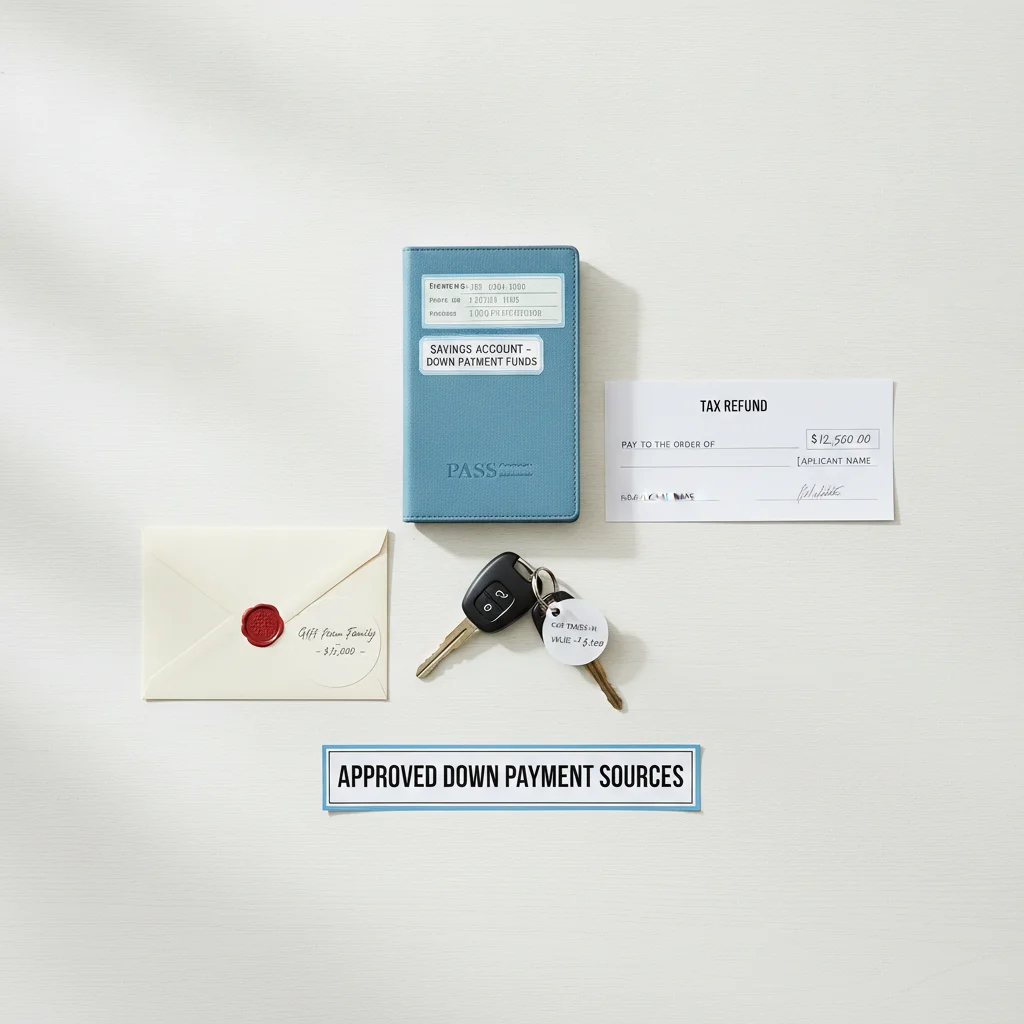
The following sources are widely accepted across the auto lending industry. That said, individual lenders can set their own rules, so always confirm with your specific institution before closing.
Personal Savings (Checking and Savings Accounts)
Cash sitting in your bank account is the gold standard. It demonstrates accumulated savings, costs you nothing in interest, and creates no new debt obligations. Most lenders require no documentation for this source unless the amount is unusually large. For very large deposits, some lenders may ask for recent bank statements to verify the funds have been in your account for at least 30–60 days — a process known as "seasoning."
Proceeds from the Sale of an Asset
If you sold a car, a piece of furniture, investment equipment, or other personal property and received cash, those proceeds are generally accepted. Be prepared to show documentation such as a bill of sale if the lender questions where a large deposit came from.
Trade-In Equity
When you trade in a vehicle you own outright — or one worth more than its remaining loan balance — the equity is applied directly to your purchase price. This is one of the cleanest forms of a down payment because the dealership handles the transfer. If your trade-in is worth $8,000 and you owe $3,000 on it, the $5,000 net equity reduces what you finance.
Insurance Settlement Proceeds
If your vehicle was totaled and you received an insurance payout that exceeds what you owed, those surplus funds are acceptable as a down payment. Lenders may request a copy of the settlement letter as documentation.
Gift Funds from Family Members
Money given to you as a gift — not a loan — by an immediate family member is accepted by most auto lenders. The critical distinction is that there must be no repayment obligation. Some lenders will require a gift letter signed by the donor confirming the funds are a genuine gift. For the full process, see our detailed article on using gift funds on an auto loan.
Tax Refunds
Federal and state tax refunds deposited into your account are treated identically to personal savings. There are no restrictions on using refund money for a down payment. If the refund comes in shortly before your purchase, the deposit will simply appear on your bank statement.
Employer Bonuses and Severance Payments
Lump-sum payments from your employer — bonuses, profit-sharing distributions, or severance — are accepted as long as they can be verified. A pay stub showing the bonus or a letter from your employer may be requested for large amounts.
Down Payment Sources Lenders Will NOT Accept
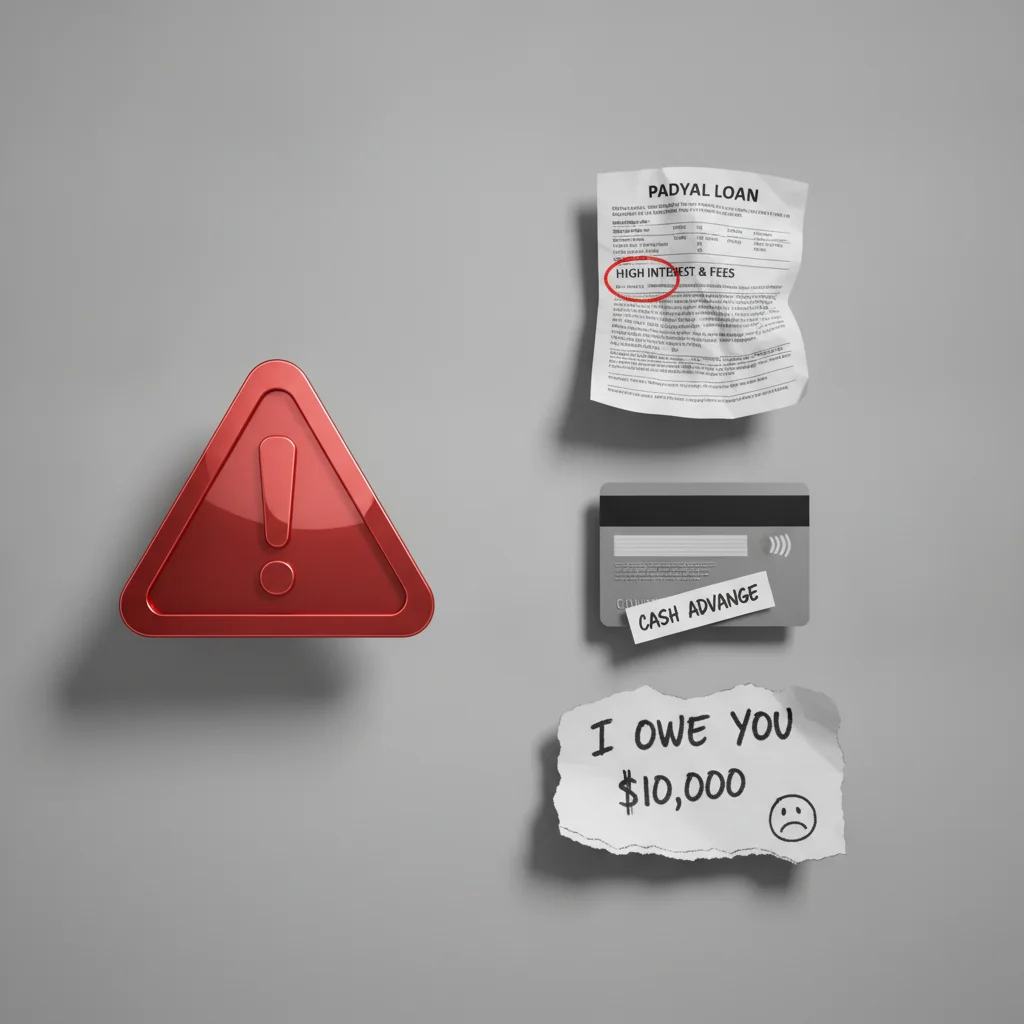
These sources raise red flags for lenders because they represent new debt, unverifiable cash, or inflated valuations — all of which undermine the risk-reduction purpose of a down payment.
Personal Loans and Cash Advances
Taking out a personal loan or a credit card cash advance specifically to fund a down payment is the most common disqualified source. Here's the math problem it creates: suppose you borrow $3,000 for a down payment on a $25,000 car. You now owe $3,000 to the personal lender plus $22,000 on your auto loan. Your total debt is $25,000 — identical to what you would have owed with no down payment at all. The lender's risk hasn't changed. Many lenders explicitly ask whether the down payment is borrowed, and misrepresenting this is considered loan fraud.
Payday Loans
Beyond being considered borrowed funds, payday loans carry annualized interest rates that can exceed 300%. Using one as a down payment source signals financial distress to underwriters. Virtually all conventional auto lenders will reject this source if discovered.
Dealer Cash-Back as a Down Payment
Some dealers structure deals where the manufacturer or dealer offers a cash rebate, then count it as your down payment without you actually bringing any money. Whether this is acceptable depends heavily on the lender. Many lenders allow manufacturer rebates to count toward the down payment; others require some portion of the down payment to come from the buyer directly. Confirm this with your lender before structuring the deal.
Borrowed Funds from Friends or Relatives (When Repayable)
A family loan — money you're expected to pay back, even informally — is treated differently from a gift. If there's any repayment arrangement, even a handshake agreement, it's debt. The lender is evaluating your total debt load, and a hidden informal debt to a family member that doesn't appear on your credit report can still affect your ability to repay the auto loan.
Cryptocurrency Converted at the Last Minute
Funds from selling cryptocurrency are not inherently disqualified, but timing matters. If you convert crypto to cash days before closing, the deposit may look like a large unexplained influx to an underwriter. Lenders looking for seasoned funds may question recent large deposits regardless of origin. Converting crypto well in advance and letting it sit in your account is the safer approach.
Proceeds from a Second Mortgage or HELOC (for Auto Purchases)
While this isn't universally prohibited, most auto lenders view a home equity line of credit (HELOC) draw used as an auto down payment as borrowed money — because it is. You're taking on secured debt against your home to buy a depreciating asset. Some lenders will accept it; others won't. This approach also carries significant risk: defaulting on an auto loan is painful, but putting your home equity behind a car purchase escalates that risk considerably.
Loan-to-Value (LTV) Ratio
The ratio of your loan amount to the vehicle's market value, expressed as a percentage. A lower LTV means you owe less relative to what the car is worth, which signals less risk to a lender and often results in better loan terms.
Seasoned Funds
Money that has been sitting in your bank account for a defined period — typically 30 to 60 days — without a large, unexplained deposit. Lenders prefer seasoned funds because they indicate stable savings rather than a last-minute loan or transfer.
Gift Letter
A written document signed by the person giving you money that confirms the funds are a gift — not a loan — and that no repayment is expected. Auto lenders may require this when gift funds are used toward a down payment.
Trade-In Equity
The difference between your vehicle's trade-in value and any remaining loan balance on that vehicle. Positive equity can be applied directly as a down payment on your next purchase.
Debt-to-Income (DTI) Ratio
Your total monthly debt payments divided by your gross monthly income. Lenders use this ratio to assess whether you can handle additional debt; a borrowed down payment increases your DTI and can hurt your approval chances.
HELOC (Home Equity Line of Credit)
A revolving credit line secured by your home's equity. While technically your own asset, drawing from a HELOC to fund a car down payment is treated as borrowed money by most auto lenders.
Gray Areas: Sources That Depend on the Lender
Not everything falls cleanly into "accepted" or "rejected." Several common sources land in a middle zone where lender policy, loan size, and borrower credit profile all influence the outcome.
10–20%
Typical recommended down payment range
Most auto financing experts recommend putting down at least 10% on a used vehicle and 20% on a new one to avoid being underwater on the loan.
1 in 5
New car buyers who put $0 down
According to Edmunds market data, roughly 20% of new vehicle buyers financed with no down payment in recent years, increasing their long-term interest costs.
$1,200+
Extra interest on a $25K loan with no down payment vs. 20% down
At a 7% APR over 60 months, financing $25,000 versus $20,000 adds over $1,200 in total interest paid across the loan term.
300%+
Annualized interest rate on payday loans
The Consumer Financial Protection Bureau (CFPB) notes payday loan APRs routinely exceed 300%, making them an extremely costly and lender-unfavorable down payment source.
Retirement Account Withdrawals (401(k), IRA)
Withdrawing from a retirement account is technically your own money, so it's generally accepted as a down payment source. However, early withdrawal penalties (typically 10% for withdrawals before age 59½) and the income tax owed reduce the net value significantly. A $5,000 withdrawal might net you only $3,500 after taxes and penalties. Some lenders also flag this as a sign of financial strain. Treat retirement funds as a last resort.
401(k) Loans
Borrowing from your own 401(k) creates an interesting technicality: you're technically repaying yourself, so it doesn't appear as debt on your credit report. Many auto lenders accept 401(k) loan proceeds as a down payment. However, the repayment comes from your paycheck, reducing your effective take-home income — which underwriters may factor into your debt-to-income calculation if they discover it.
Crowdfunded or Peer-Gifted Money
If multiple people contribute small amounts toward your down payment — through a platform like GoFundMe, for example — the resulting deposits can look like multiple unexplained small transfers to an underwriter. This isn't necessarily disqualifying, but expect documentation requests. Treat each contributor's portion as a gift and document accordingly.
Business Revenue for Self-Employed Buyers
If you're self-employed and draw from your business account for the down payment, most lenders want to see that you've already moved the money into your personal account. Business-account funds transferred immediately before closing can trigger verification requests and slow down approval.
If you're working with a limited credit history or lower credit score, knowing how your down payment source affects approval becomes even more important. Our article on how a large down payment affects approval with bad credit goes deeper on this dynamic.

Documentation Lenders May Request
Even for accepted sources, lenders sometimes require documentation to verify the origin of your funds. Here's what to have ready:
- Bank statements (2–3 months): Standard for verifying personal savings and showing the funds have been present over time.
- Gift letter: A signed statement from the donor confirming the amount, relationship to you, and that no repayment is expected. Each lender has a specific format; ask for their template.
- Bill of sale or asset sale documentation: Proof of a private vehicle or property sale explaining a large deposit.
- Insurance settlement letter: Documentation showing the source of insurance payout funds.
- Tax return or IRS transcript: Used to verify a tax refund or to document self-employment income used for the down payment.
- 401(k) loan documentation: A statement from your plan administrator confirming the loan amount and repayment terms.
Pro tip: If you've recently received any large deposit that isn't your regular paycheck, write yourself a brief note explaining its source. When you apply for the loan, you'll be able to answer the underwriter's questions quickly without scrambling for records.
Planning ahead on where your down payment will come from is half the battle. For practical strategies on actually building that fund without disrupting your monthly budget, see our guide on saving for a car down payment without derailing your budget.
Auto Loan Down Payments: The Complete Breakdown
An end-to-end resource covering down payment strategy, loan math, lender expectations, and pitfalls. Pairs directly with this source reference guide.
Gift Funds and Down Payments: Using Money From Family
Covers exactly what documentation you'll need when using family gift money as a down payment and how to structure the gift letter correctly.
Loan Preapproval Hub
Understand what lenders review during preapproval, including how your down payment source factors into underwriting decisions.
Saving for a Car Down Payment Without Derailing Your Budget
Practical month-by-month strategies for building a lender-approved down payment fund from personal savings without cutting essential expenses.
CFPB Auto Loan Shopping Sheet
The Consumer Financial Protection Bureau's free comparison tool helps you evaluate loan offers side by side and understand how down payment size changes your total cost.
Bad Credit Auto Loans Hub
If your credit score is limiting your options, this hub explains which lenders work with lower credit scores and how a larger down payment can compensate.
Putting It All Together: A Quick Reference
Before you finalize your down payment plan, run through this checklist:
- Identify your source(s). Match each source against the accepted and ineligible lists above. If you're in a gray area, call your lender before applying — not after.
- Season your funds. Whenever possible, have your down payment sitting in your personal checking or savings account for at least 60 days before you apply. This eliminates most sourcing questions automatically.
- Avoid borrowing to fund it. If you don't have the cash available, consider delaying your purchase, choosing a less expensive vehicle, or negotiating a smaller required down payment. Borrowing a down payment costs you more money and often doesn't improve your loan terms.
- Gather documentation proactively. If you've sold an asset, received a gift, or gotten a settlement, pull the paperwork together before you walk into the dealership's finance office.
- Confirm lender policy directly. Policies vary by lender, and this article reflects general industry norms rather than any specific institution's rules. Ask your lender: "Do you have any restrictions on where my down payment comes from?"
A well-sourced down payment does more than open the door to loan approval — it directly reduces how much interest you'll pay over the life of the loan. Every dollar of genuine equity you put in at signing is a dollar that doesn't compound against you at 7%, 9%, or 12% for the next 60 months. For a complete end-to-end look at down payment strategy and loan math, the auto loan down payments complete breakdown covers all the angles.
If you're ready to apply and want to understand how your down payment source affects your preapproval, explore our loan preapproval hub for what lenders review during underwriting.

All claims are backed by peer-reviewed research. Sources on request.