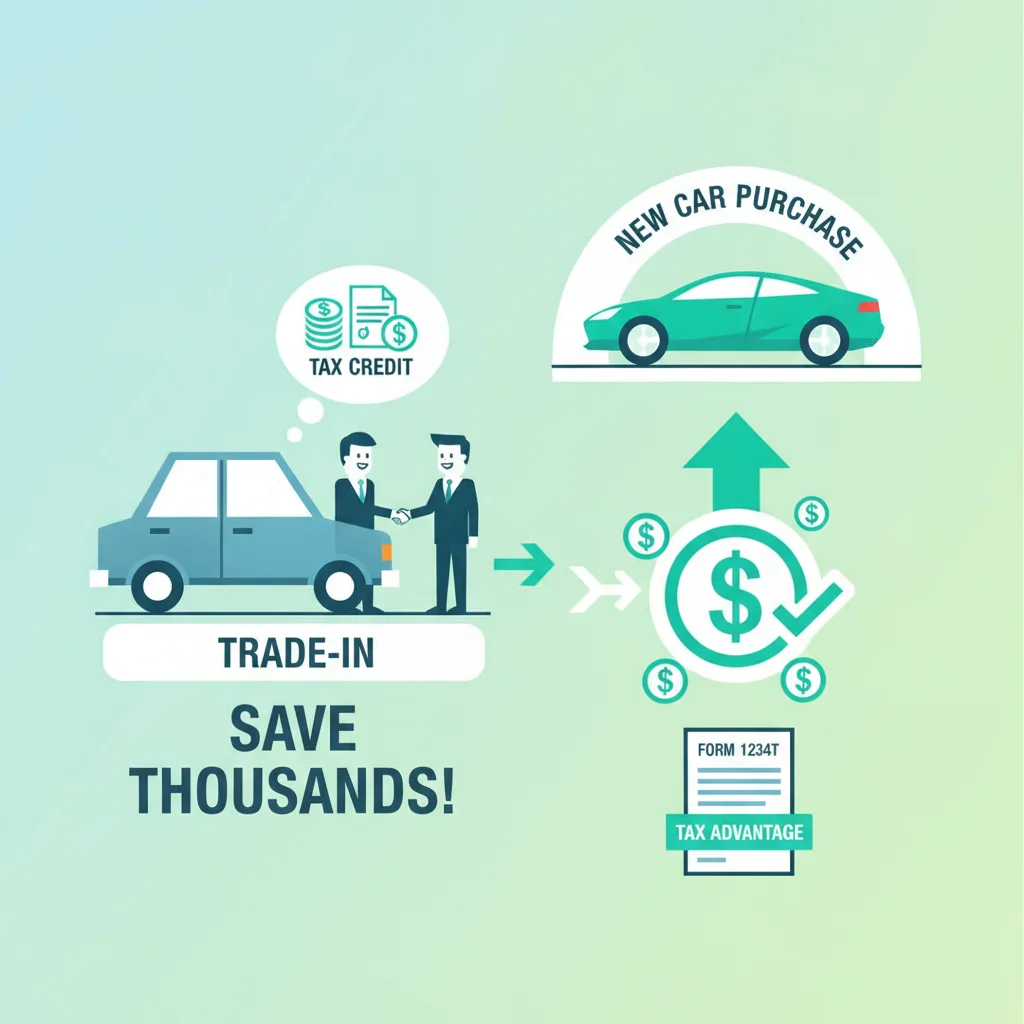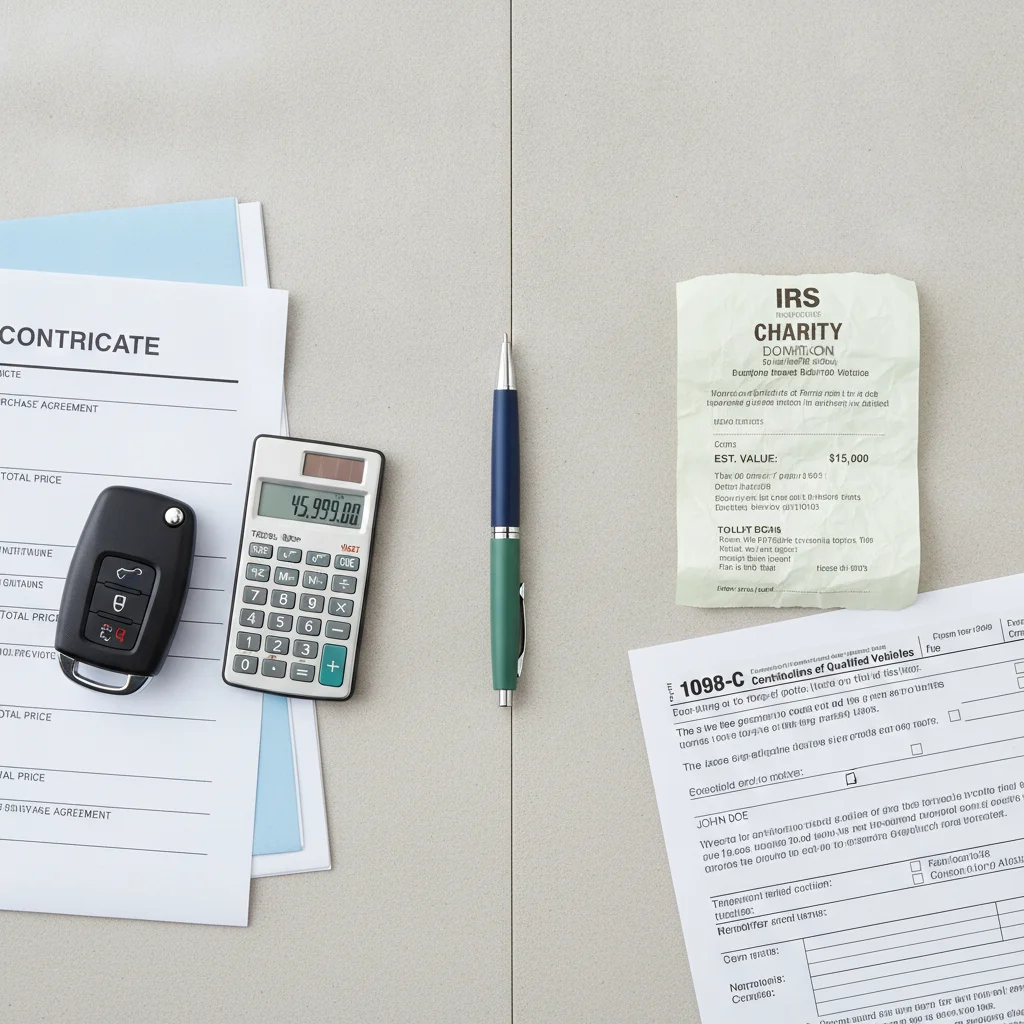
Key Takeaways
Our Verdict
For most car sellers, trading in delivers more tangible financial value than donating — especially once the sales tax offset on a new car purchase is factored in. Donation makes financial sense only for taxpayers who itemize deductions, are in a higher tax bracket (24% or above), and own a vehicle with legitimate fair market value that a charity will actually use rather than auction off cheap.
| Best for | Recommended |
|---|---|
| Buying a new car and wanting to reduce taxable purchase price | Trade-In |
| High-income itemizers seeking a meaningful tax deduction | Donation |
| Owners of low-value vehicles (under $3,000) wanting simplicity | Trade-In |
| Owners with vehicles in poor condition not worth selling privately | Donation (if itemizing) or Trade-In |
Why This Decision Is More Complex Than It Looks
Most people assume donating a car is a tax windfall and trading it in is just convenient. Neither assumption holds up under scrutiny. The right move depends on three variables that interact in ways that aren't obvious: your car's actual market value, whether you itemize deductions on your federal return, and whether you're buying a new vehicle at the same time.
The core tension is this: a trade-in gives you real money (or a reduction in what you owe on a new car), while a donation gives you a deduction — which is only worth something if you have taxable income to offset and you're itemizing. For the 90% of taxpayers who take the standard deduction since the 2017 Tax Cuts and Jobs Act, car donation produces zero tax benefit. None.
This article runs both scenarios through the actual numbers so you can see exactly where you come out ahead — and how to avoid leaving money on the table at the dealership in the process. For a broader look at how trade-in value stacks up against other exit strategies, see our dealer trade-in vs. private party sale comparison.

How the Trade-In Math Actually Works
When you trade in a vehicle at a dealership, the financial picture has two components that most sellers don't fully account for.
Component 1: The Trade-In Credit
The dealer subtracts your trade-in value from the purchase price of your new vehicle. If you're buying a $35,000 car and your trade-in is appraised at $8,000, you're financing or paying $27,000. Straightforward enough.
Component 2: The Sales Tax Offset
This is the part most buyers miss. In 43 states, sales tax is calculated on the difference between the new car price and your trade-in value — not the full sticker price. In the example above, you'd pay sales tax on $27,000, not $35,000. At a 7% tax rate, that's a $560 savings on top of the $8,000 credit. The higher your state's sales tax rate and the more valuable your trade-in, the bigger this benefit becomes.
Our detailed breakdown of how the trade-in tax offset works by state shows exactly which states apply this rule and how to calculate your specific savings.
| Trade-In | Donation (Standard Deduction) | Donation (Itemizing, 24% Bracket) | Donation (Itemizing, 32% Bracket) | |
|---|---|---|---|---|
| Immediate cash received | Yes — full trade-in value | None | None | None |
| Tax benefit | Sales tax offset on new car | Zero | Deduction × 24% rate | Deduction × 32% rate |
| Requires itemizing deductions | No | Irrelevant (no benefit) | Yes | Yes |
| Deduction based on | N/A | N/A | Charity's actual sale proceeds | Charity's actual sale proceeds |
| IRS documentation required | Bill of sale | None | Form 8283 + 1098-C | Form 8283 + 1098-C |
| Speed of transaction | Same day | Same day (receipt later) | Same day (1098-C in 30 days) | Same day (1098-C in 30 days) |
| Works without buying new car | Yes (no tax offset) | Yes | Yes | Yes |
| Best for high-mileage / rough condition | Dealer may lowball | Charity may still accept | Good if charity uses vehicle | Good if charity uses vehicle |
| Net value on $15,500 car (7% state tax) | ~$16,585 (with tax offset) | $0 | ~$2,880 (on $12K proceeds) | ~$3,840 (on $12K proceeds) |
What Dealers Won't Tell You About Trade-In Valuation
Dealers use your trade-in as a negotiating lever. They may inflate the trade-in offer while narrowing their discount on the new car — or vice versa. Always negotiate the new car price separately before disclosing you have a trade-in. Get at least three appraisals (CarMax, a competing dealer, and the selling dealer) before accepting an offer. A fair trade-in should land within 10–15% of a private sale price for a vehicle in clean condition. Anything more than 20% below private sale value and you're being lowballed — walk away or sell privately instead.
Trade-in value vs. private sale price is a key comparison to make before you decide which exit strategy fits your situation.
90%
Taxpayers taking standard deduction
Following the 2017 Tax Cuts and Jobs Act, roughly 90% of U.S. filers take the standard deduction, eliminating any tax benefit from car donation.
$560+
Average sales tax saved via trade-in offset
In a state with 7% sales tax, trading in an $8,000 vehicle reduces the taxable purchase price and saves over $560 in taxes on a $35,000 new car.
30–40%
Typical auction discount vs. private sale
Charity vehicle auctions often yield 30–40% less than private sale value, directly reducing the deductible amount on Form 1098-C.
$2,000–$3,500
Private sale premium over trade-in
On vehicles in the $10,000–$20,000 range, private party sales typically net $2,000–$3,500 more than dealer trade-in offers, per Edmunds transaction data.
How the Donation Math Actually Works
Car donation sounds simple — hand over the keys, get a receipt, deduct it on your taxes. The reality involves IRS rules that significantly limit what most donors can actually claim.
The IRS Rules on Vehicle Donations (Form 1098-C)
Under IRS Publication 4303, your deduction for a donated vehicle worth more than $500 is generally limited to the gross proceeds the charity receives when it sells the car — not the Kelley Blue Book value, not the price you paid, not what you think it's worth.
- If the charity sells the car at auction for $2,800, your deduction is $2,800 — even if KBB says it's worth $6,000.
- The charity must send you a Form 1098-C within 30 days of the sale showing the actual proceeds.
- Exception: If the charity uses the vehicle directly in its programs (e.g., a food bank delivery vehicle), you may deduct fair market value — but this is uncommon.
- If the vehicle sells for $500 or less, you can deduct the greater of $500 or fair market value up to $500 — but not more.
The Standard Deduction Trap
For 2024, the standard deduction is $14,600 for single filers and $29,200 for married filing jointly. Unless your total itemized deductions — mortgage interest, state and local taxes (capped at $10,000), charitable contributions, and medical expenses — exceed these thresholds, your donation deduction is worth exactly $0 in tax savings.
The majority of American taxpayers take the standard deduction. If that's you, stop reading the donation pitch from the charity's website and trade your car in or sell it privately.

For Itemizers: Calculate the Real After-Tax Value
If you do itemize, your tax savings from a donation equals the deductible amount multiplied by your marginal tax rate. A $5,000 deductible donation saves a 22% bracket taxpayer $1,100. The same car traded in for $5,000 puts the full $5,000 in your pocket (plus the sales tax offset if you're buying new). Unless your marginal rate is extremely high and the charity retains full fair market value, the donation rarely wins on dollars alone.
Maximize Donation Value: Choose the Right Charity
If you're set on donating, seek out charities that use vehicles directly in their programs rather than organizations that immediately auction them off through a third-party processor. Vehicles used for program purposes (not sold) allow you to deduct fair market value — not just auction proceeds. Call the charity directly and ask specifically whether they will use the vehicle or sell it.
Lock in Competing Offers Before the Negotiation
Print out your CarMax or Carvana offer and bring it to the dealership. This single step is worth $500–$1,500 in additional trade-in value in a typical negotiation. Dealers know these platforms set a transparent floor, and most won't risk losing a sale over $600 when you've demonstrated you've done your homework.
Side-by-Side Scenarios: Running the Real Numbers
Let's use a concrete example: a 2018 Honda CR-V with 78,000 miles, clean condition, private sale value of $18,000 and trade-in value of $15,500.
Scenario A: Trade-In While Buying a New Car
- New car price: $38,000
- Trade-in credit: $15,500
- Net amount financed or paid: $22,500
- Sales tax (at 7%) on $22,500: $1,575
- Sales tax without trade-in (7% on $38,000): $2,660
- Tax savings from trade-in offset: $1,085
- Total financial benefit: $15,500 + $1,085 = $16,585
Scenario B: Donation (Itemizing, 24% Tax Bracket)
- Charity sells car at auction for $12,000 (typical auction haircut from private sale value)
- Deductible amount: $12,000
- Tax savings at 24%: $2,880
- Total financial benefit: $2,880
Scenario C: Donation (Itemizing, 32% Tax Bracket)
- Same $12,000 auction proceeds
- Tax savings at 32%: $3,840
- Total financial benefit: $3,840
Even at the 32% bracket, the donation nets less than a quarter of what the trade-in produces. The only scenarios where donation closes the gap meaningfully: very high-value vehicles (over $40,000), high earners in the 37% bracket, and charities that use vehicles directly at full fair market value rather than auctioning them.
Also worth considering: the trade-in tax advantage can be layered on top of a strong negotiated trade-in offer, compounding your savings further when you're buying simultaneously.
What About Vehicles Worth Under $5,000?
For older, higher-mileage vehicles, the math shifts. A car with a private sale value of $3,500 might get a $2,200 trade-in offer — especially if it needs work. If you can itemize and the charity retains the vehicle for program use, you might deduct $3,200 in fair market value, saving $704 at 22% vs. the $2,200 trade-in cash. Here the trade-in still wins, but the margin narrows. The bigger variable is how bad the dealer lowball is. If you're offered $1,500 on a $3,500 car, selling privately or donating both look better.
Don't Rely on Charity's Stated 'Fair Market Value'
Many donation processing organizations advertise that you can deduct 'fair market value' — but IRS rules generally limit your deduction to actual sale proceeds when a charity sells the vehicle. If the charity's 1098-C shows they sold your $9,000 car for $4,200 at auction, your deduction is $4,200. Assuming otherwise can trigger an IRS audit and penalties.
Blank Title Signatures Are a Liability Risk
Never sign your title and leave the buyer section blank — whether for a charity or a dealer. If the receiving party doesn't complete the transfer promptly, any accident, ticket, or toll violation in that vehicle can land on your record. Insist on completing title transfer in person or through certified mail with a tracking number.
Non-Financial Factors That Shift the Equation
Dollars aren't the only consideration. A few practical factors legitimately favor donation in specific situations.
When Donation Makes Practical Sense
- The car won't pass inspection and a dealer will offer you scrap value. Some charities will take non-running vehicles, and if you itemize, you can still deduct the proceeds they receive.
- You're not buying another car, so the sales tax offset doesn't apply and the trade-in's compound advantage disappears.
- You want to support a specific charity and the difference in after-tax value is acceptable to you as a personal choice.
- The car is in a remote location making a private sale or dealer visit logistically difficult — many charities offer free towing pickup.
When Trade-In Has Hidden Value
- Speed: A trade-in closes in one transaction. No waiting for a charity to sell the car and mail a 1098-C.
- Liability ends immediately: Once the dealer takes the title, you're done. With donation, confirm title transfer is complete before the charity drives the car — some take weeks to process paperwork.
- The sales tax offset stacks: If you're financing the new car, that lower taxable price also reduces your loan amount, which compounds over the loan term. See our analysis of how trade-in value reduces your loan vs. a cash down payment.
Tactics to Avoid Getting Lowballed on a Trade-In
The biggest threat to the trade-in's financial advantage is an underpaid appraisal. Here's how to protect yourself.
Get Competing Offers Before You Walk into a Dealership
Use CarMax, Carvana, and KBB Instant Cash Offer to establish a floor before you negotiate. These offers are typically good for 7 days and serve as leverage. If a dealer comes in 20% below CarMax, show them the competing offer. Many will match or come close.
Don't Mention the Trade-In Until You've Negotiated the New Car Price
This is the single most effective tactic. Dealers bundle new car price, trade-in value, and financing into a monthly payment to obscure where money is moving. Negotiate the out-of-pocket price on the new car to your satisfaction before any mention of a trade-in. Then introduce it separately.
Know Your Car's Condition Grade Before You Arrive
Dealers use condition grading (Clean, Average, Rough) to justify lower appraisals. Check what Edmunds and KBB show for your specific mileage and condition. If minor reconditioning costs are being used to discount your offer, ask for an itemized breakdown. Dealers often estimate $800–1,200 in reconditioning on cars that need $200 of work.

Understand That Donation Isn't Your Only Alternative to a Bad Offer
If a dealer lowballs you badly, don't default to donation just to avoid the hassle of selling privately. A private sale on a $12,000 car takes 1–3 weeks of effort but typically nets $2,000–3,500 more than a dealer trade-in. Our full breakdown of trade-in strategies walks through every lever you have to push back on a lowball offer.
Maximize Donation Value: Choose the Right Charity
If you're set on donating, seek out charities that use vehicles directly in their programs rather than organizations that immediately auction them off through a third-party processor. Vehicles used for program purposes (not sold) allow you to deduct fair market value — not just auction proceeds. Call the charity directly and ask specifically whether they will use the vehicle or sell it.
Lock in Competing Offers Before the Negotiation
Print out your CarMax or Carvana offer and bring it to the dealership. This single step is worth $500–$1,500 in additional trade-in value in a typical negotiation. Dealers know these platforms set a transparent floor, and most won't risk losing a sale over $600 when you've demonstrated you've done your homework.
Compliance and Documentation: What You Need Either Way
Whichever route you choose, the paperwork matters — both for your protection and for any tax claim.
For Trade-Ins
- Get the trade-in value stated separately on the purchase agreement — not just absorbed into a monthly payment figure.
- Make sure the title transfer is completed at the dealership and the dealer assumes liability from that date.
- Keep a copy of the bill of sale showing the trade-in credit amount, especially if your state requires documentation for the sales tax offset.
- Notify your insurer the same day — you don't want to keep paying insurance on a car you no longer own.
For Donations
- Confirm the charity is a qualified 501(c)(3) organization — search the IRS Tax Exempt Organization Search database before you hand over keys.
- For vehicles valued over $500, you need Form 8283 attached to your return and the charity's Form 1098-C showing actual sale proceeds.
- For deductions over $5,000, an independent qualified appraisal is required by the IRS.
- Never let the charity fill out your title for you — sign the title and let them complete the buyer section. Signing a blank title exposes you to liability if paperwork is delayed.
Don't Rely on Charity's Stated 'Fair Market Value'
Many donation processing organizations advertise that you can deduct 'fair market value' — but IRS rules generally limit your deduction to actual sale proceeds when a charity sells the vehicle. If the charity's 1098-C shows they sold your $9,000 car for $4,200 at auction, your deduction is $4,200. Assuming otherwise can trigger an IRS audit and penalties.
Blank Title Signatures Are a Liability Risk
Never sign your title and leave the buyer section blank — whether for a charity or a dealer. If the receiving party doesn't complete the transfer promptly, any accident, ticket, or toll violation in that vehicle can land on your record. Insist on completing title transfer in person or through certified mail with a tracking number.

All claims are backed by peer-reviewed research. Sources on request.