
Key Takeaways
Lender Underwriting Criteria
Underwriting criteria are the complete set of financial factors a lender examines before approving your auto loan and deciding what interest rate to charge. While your credit score is the most visible number, lenders also weigh your income, existing debt obligations, down payment, the vehicle itself, and the length of the loan you're requesting. Each factor interacts with the others — a strong score can be offset by too much existing debt, and a modest score can be partly compensated by a large down payment.
Lenders typically use a risk-based pricing model, meaning every underwriting variable contributes to a composite risk score that maps to a rate tier. Changing one variable — say, shortening your loan term — can shift you into a lower-rate tier even if your credit score stays the same.
Why Your Credit Score Is Only the First Filter
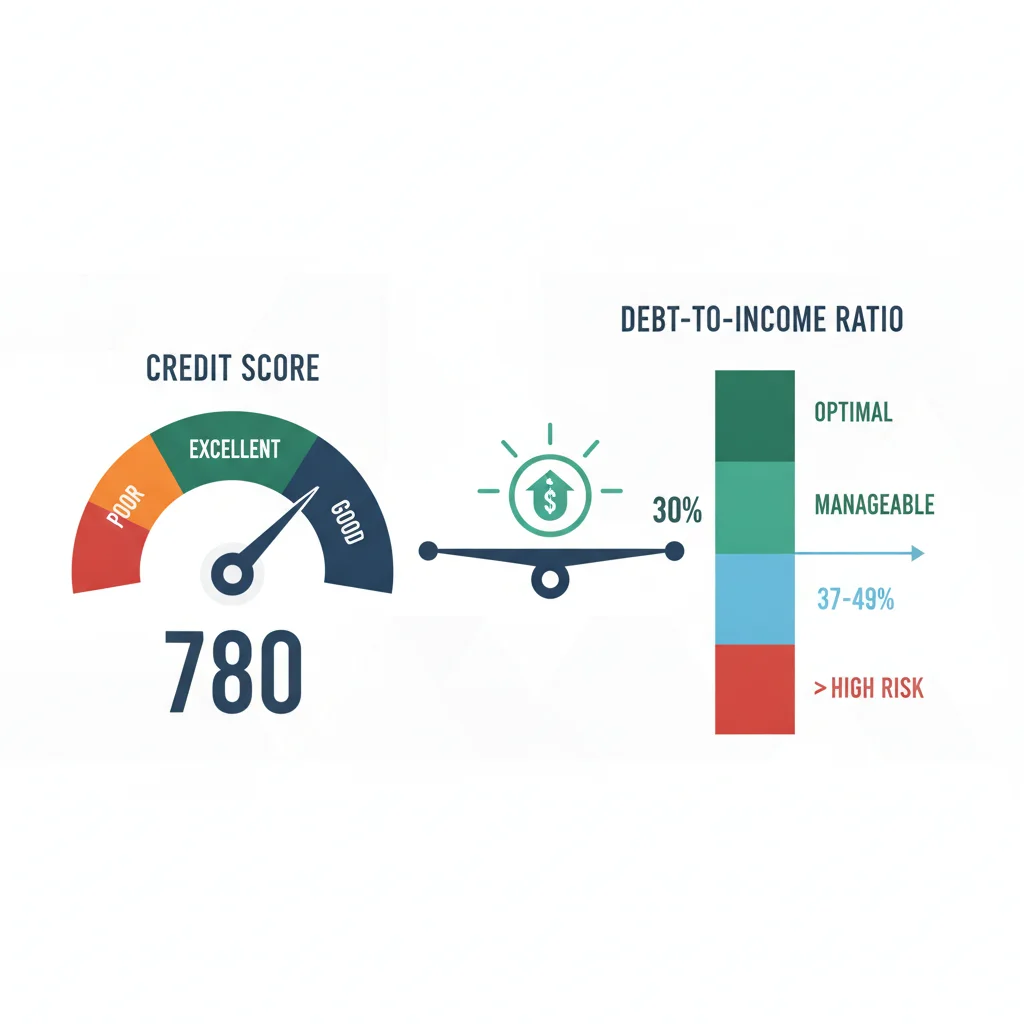
Walk into any dealership and the first thing the finance office does is pull your credit. That number — whether it's 580 or 780 — determines which lenders will even look at your application and what rate tier you start in. But calling the credit score the whole story is like calling a job applicant's GPA their entire qualification. It matters a lot, and it matters first, but it doesn't end the conversation.
Lenders are fundamentally trying to answer one question: if we give this person money to buy a car, will we get it back with interest? Your credit score gives them a quick probability estimate based on past behavior. Everything else in the underwriting process fills in the context that the score alone can't capture.
What different credit score ranges mean for your loan terms is a useful starting point. But once you know where your score lands, the factors below are what push your rate up or down within — and sometimes across — those tiers.

Income and Employment: Ability to Pay
Lenders want to verify that you have enough reliable income to cover a new monthly payment without straining your budget to the breaking point. This sounds obvious, but the mechanics matter.
What counts as qualifying income:
- W-2 wages from a full-time employer (easiest to verify)
- Self-employment income — typically averaged over two years of tax returns
- Social Security, disability, and pension income
- Rental income (usually at 75% of gross to account for vacancies)
- Part-time income, if it has a consistent two-year history
Most lenders want to see that your gross monthly income is at least 1.5–2x your total monthly debt obligations, including the proposed car payment. Some set minimum income thresholds — commonly $1,500–$2,000 per month — below which they won't approve regardless of credit score.
Employment stability also matters. A borrower who has held the same job for three years looks significantly safer than someone who changed employers two months ago, even if the new salary is higher. A 90-day probationary period at a new job is enough to make some lenders pause — or add a rate premium.
Hard Inquiries and Rate Shopping
When lenders pull your credit to evaluate a loan application, it generates a hard inquiry, which can temporarily lower your score by a few points. The good news: the major credit bureaus treat multiple auto loan inquiries within a 14–45 day window as a single inquiry for scoring purposes, recognizing that consumers shop rates. Apply to multiple lenders within a short window rather than spreading applications over several months.
Refinancing Uses the Same Criteria
If you took a loan at a higher rate and your financial picture has since improved — score increased, debts paid down, stable income established — refinancing can capture a significantly better rate. Lenders evaluating a refinance application look at all the same factors described in this article, plus your payment history on the existing loan. <a href="/auto-loans/refinancing-and-payoff/when-to-refinance/what-lenders-look-at-before-approving-an-auto-refinance">What lenders evaluate before approving an auto refinance</a> covers what changes and what doesn't.
If your income comes from multiple sources or you're self-employed, gather your last two years of tax returns, recent bank statements, and any 1099s before applying. Lenders who can't verify your income cleanly will either deny you or charge a higher rate to compensate for the documentation risk.
Debt-to-Income Ratio: The Number That Can Override Your Score
Your debt-to-income (DTI) ratio is the percentage of your gross monthly income that goes toward debt payments. It's calculated by adding up all your monthly debt obligations — mortgage or rent, credit cards, student loans, existing car payments, and the proposed new payment — then dividing by your gross monthly income.
Here's why it matters so much: a borrower with a 720 credit score and a 55% DTI is a worse lending risk than a borrower with a 660 credit score and a 28% DTI. The 720-score borrower is already stretched thin. One unexpected expense and that car payment gets skipped.
43%
DTI threshold where most lenders begin adding rate premiums
Industry underwriting guidelines from major auto lenders consistently identify 43% as the inflection point where risk-based pricing adjustments become standard.
1–2%
Typical APR advantage of credit union vs. dealer financing
According to the National Credit Union Administration, credit unions historically offer auto loan rates 1–2 percentage points below the national bank average for comparable borrowers.
$2,800
Extra interest paid on a 72-month vs. 48-month loan
On a $30,000 loan at a 1-point rate premium for the longer term, a borrower choosing 72 months over 48 months pays roughly $2,800 more in total interest, based on standard amortization calculations.
10%
Minimum down payment that typically shifts LTV risk tier
Most lenders price a meaningful improvement in terms when LTV drops below 90%, making a 10% down payment a practical benchmark for rate optimization.
100K miles
Mileage threshold where standard loan terms often change
Many lenders apply rate adjustments or reduce maximum loan terms for vehicles crossing the 100,000-mile mark, based on increased collateral depreciation risk.
In practical terms, this is where a lot of buyers get surprised. They've spent years building a solid credit score, they walk in expecting prime rates, and the finance manager comes back with a rate bump because their existing obligations are eating too much of their income. This is exactly the dynamic that how lenders balance DTI and credit score unpacks in detail.
DTI thresholds most lenders use:
| DTI Range | Lender Reaction |
|---|---|
| Under 36% | Generally considered healthy; best rates available |
| 36%–43% | Acceptable to most lenders; minor rate adjustments possible |
| 43%–50% | Elevated risk; expect higher rates or tighter loan limits |
| Above 50% | Most lenders decline; subprime options with steep rates remain |
The most direct way to improve your DTI before applying is to pay down high-balance revolving debt — credit cards especially. Reducing a $10,000 credit card balance by $5,000 doesn't just lower your utilization ratio (which helps your credit score), it also reduces your minimum monthly payment, which directly improves your DTI calculation.
Reduce DTI Before You Apply
If your DTI is close to a lender's threshold, paying down one or two credit card balances in the 60–90 days before applying can make a measurable difference. Focus on balances with the highest minimum payments relative to their balance — eliminating a $200/month minimum payment reduces your DTI by the same amount as a $200/month income increase. This also tends to improve your credit utilization ratio and can lift your score simultaneously.
Choose Your Loan Term Strategically
Before defaulting to a 72-month loan because the payment looks manageable, run the total interest calculation for both 48 and 60 months. If you can absorb the higher monthly payment, the shorter term pays off in two ways: a lower APR and fewer months of paying interest on the outstanding balance. Many credit union and bank loan officers will model multiple term options for you at no cost during the preapproval process.
Down Payment and Loan-to-Value Ratio
When you put money down on a vehicle, you're doing two things: reducing the dollar amount you're borrowing, and reducing the lender's risk if you default and they have to repossess and sell the car.
The loan-to-value (LTV) ratio is the loan balance divided by the vehicle's value. A $25,000 car with a $5,000 down payment results in a $20,000 loan — an 80% LTV. A zero-down loan on the same car is 100% LTV, which means the lender is exposed if the car depreciates below the loan balance the moment it leaves the lot.
Lenders price this risk into the rate. Many have explicit LTV tiers: loans below 80% LTV might qualify for their best rate; loans between 80%–100% LTV sit in a middle tier; loans above 100% LTV (which happens when fees are rolled in or when financing a vehicle that's already underwater) get a rate premium or outright denial.
Even a 10% down payment on a $30,000 vehicle — just $3,000 — can move you into a better pricing tier and eliminate the risk of being immediately upside-down on the loan. Why down payment size matters and how it shapes your loan structure is worth reading before you decide how much to put down.
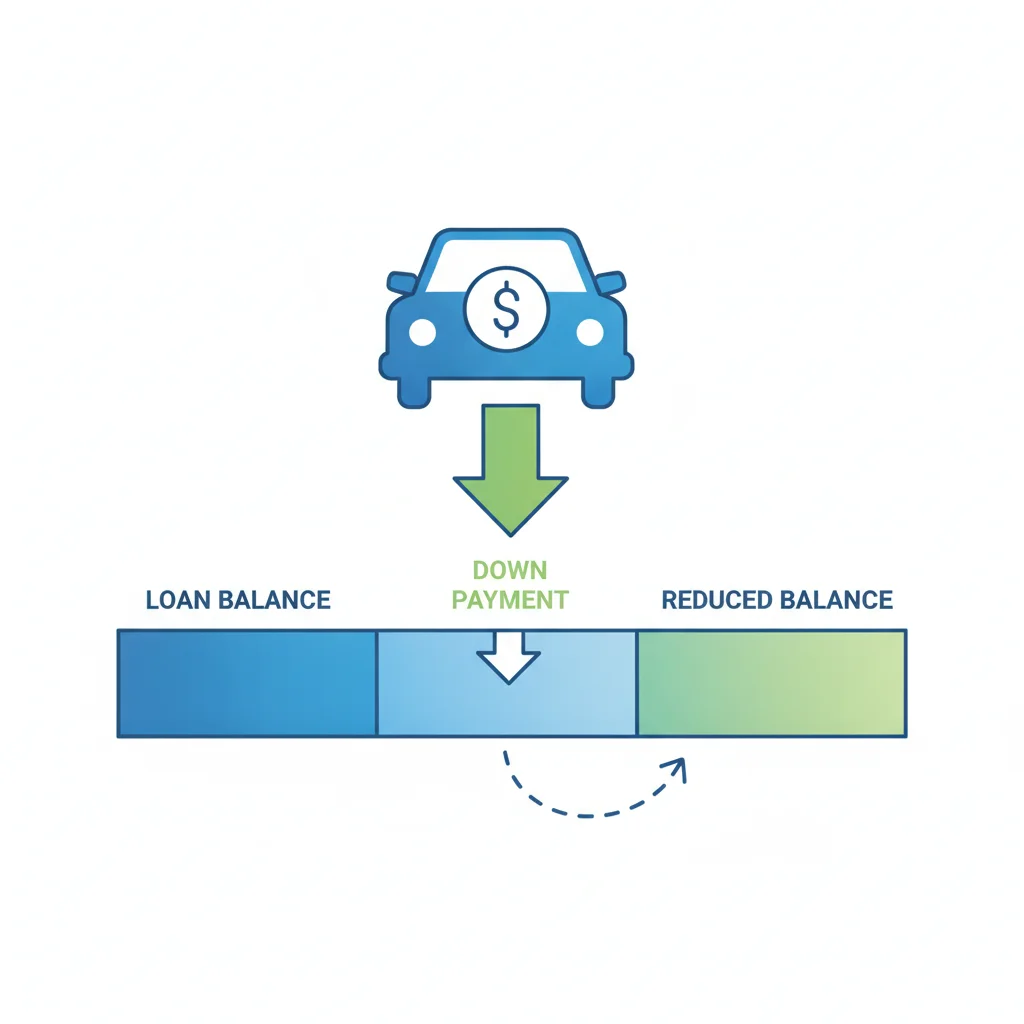
One common mistake: rolling the sales tax, dealer fees, and an extended warranty into the financed amount. That can push a 90% LTV deal to 110% LTV, and lenders will either add a rate premium or cap the loan amount — forcing you to come up with cash anyway or walk away from the deal.
The Vehicle Itself: Age, Mileage, and Collateral Risk
The car you're buying is the collateral for the loan. If you stop making payments, the lender repossesses it, auctions it, and recovers what they can. This means the vehicle's condition, age, and resale value directly affect how much risk the lender is taking on.
How vehicle characteristics affect loan terms:
- Age: Most lenders impose rate premiums on vehicles older than 5–7 years. Vehicles over 10 years old are frequently ineligible for standard auto loans and must be financed through personal loans at higher rates.
- Mileage: High mileage signals faster depreciation and higher breakdown risk. Vehicles over 75,000–100,000 miles often trigger rate adjustments or loan caps.
- Make and model: Brands with strong resale values — trucks from major manufacturers, certain luxury SUVs — are safer collateral, which is one reason loan terms on these vehicles can be slightly more favorable.
- New vs. used: New vehicles typically qualify for the lowest advertised rates because depreciation is predictable and warranty coverage reduces breakdown risk during the loan term. Used vehicles carry a small rate premium on average.
This is also why manufacturer financing deals — 0% APR for 60 months on a new model — are only ever available on new vehicles. The manufacturer is subsidizing the rate as a sales incentive, and the subsidized cost only makes sense on a high-value, high-margin product.
Loan Term: How Length Affects Your Rate
The number of months you choose to repay your loan isn't just a monthly-payment calculation — it's a risk variable that lenders price directly into the APR.
Here's the logic: a 72-month loan means the lender is exposed to your financial situation for six years. A lot can change in six years — job loss, divorce, medical expenses. A 36-month loan is over in three years, dramatically reducing the probability that something will go wrong before the debt is repaid. Lenders reward shorter terms with lower rates.
“Lenders don't just look at your score — they look at your whole financial story. A borrower who's managing twelve different debt obligations with a 700 score is a very different risk from a borrower with one mortgage and a 700 score.”
— Melinda Zabritski, Senior Director of Automotive Financial Solutions, Experian
In real-world terms, the rate difference between a 48-month and a 72-month loan on the same credit profile is typically 0.5 to 1.5 percentage points. On a $30,000 loan, that spread at 1 percentage point means paying roughly $900–$1,000 more in interest over the life of the longer loan — before you even account for the fact that you're borrowing for two additional years.
The temptation of a 72- or 84-month loan is a lower monthly payment, but that math cuts against you twice: higher rate and more months of paying it. What loan length, monthly payments, and total cost actually mean for borrowers breaks down how to model this before you commit to a term.
Reduce DTI Before You Apply
If your DTI is close to a lender's threshold, paying down one or two credit card balances in the 60–90 days before applying can make a measurable difference. Focus on balances with the highest minimum payments relative to their balance — eliminating a $200/month minimum payment reduces your DTI by the same amount as a $200/month income increase. This also tends to improve your credit utilization ratio and can lift your score simultaneously.
Choose Your Loan Term Strategically
Before defaulting to a 72-month loan because the payment looks manageable, run the total interest calculation for both 48 and 60 months. If you can absorb the higher monthly payment, the shorter term pays off in two ways: a lower APR and fewer months of paying interest on the outstanding balance. Many credit union and bank loan officers will model multiple term options for you at no cost during the preapproval process.
Lender Type: Where You Finance Is as Important as How You Qualify
Same credit score. Same income. Same car. Different lender — potentially a 2+ percentage point rate difference.
Dealership-arranged financing runs through a process called dealer reserve, where the dealer submits your application to multiple lenders and earns a markup on whatever rate they bring back. A lender might approve you at 5.9% and the dealer marks it up to 7.4%, pocketing the difference as profit. This is entirely legal, and most buyers never know it happened.
Credit unions consistently offer some of the lowest auto loan rates available — often 1–2 percentage points below what a dealership arranges for the same applicant. Community banks and regional banks fall in between. Online lenders (LightStream, Capital One Auto Finance, etc.) can be competitive and give you a firm preapproval to bring to the dealer as leverage.
The practical move: Get preapproved at a credit union or bank before you set foot on a lot. Walk in with a rate in hand. If the dealer can beat it, great. If not, you use your preapproval. This one step can save a buyer with average credit $1,500–$3,000 over a 60-month loan. For the full picture on what that preapproval process involves, see what lenders check before issuing a preapproval.
If your credit or DTI is making approval difficult, a co-signer is another lever worth understanding. How a co-signer can change the loan rate your score would have locked in explains exactly how lenders factor in a co-signer's profile and what the arrangement actually accomplishes in practice.

For the complete view of how all these variables interact — credit score, term, down payment, vehicle age, and lender type — everything that shapes your auto loan rate is the reference article that ties it all together.
All claims are backed by peer-reviewed research. Sources on request.