Key Takeaways
Why Credit Score Myths Cost Car Buyers Real Money
I spent years on the finance side of dealerships. What surprised me most wasn't how sophisticated buyers were — it was how many smart, educated people walked into the F&I office carrying completely wrong beliefs about their credit. Those beliefs cost them. Not a little — sometimes thousands of dollars over the life of a loan.
Credit scores sit at the intersection of everything in auto financing: the rate you get, the term you're offered, whether you need a cosigner, and how much leverage you have at the table. Misunderstand how scores work, and you're negotiating blind.
This article busts the myths I saw damage buyers repeatedly. Each one has a real dollar cost attached. Understanding the truth won't just protect you — it'll put you in a stronger position than most people who walk onto a lot.

For context on how these credit dynamics interact with dealer tactics more broadly, see our piece on common car dealer negotiation myths — the two topics reinforce each other.
The Myths, Corrected
These aren't obscure edge cases. Every myth below is something I heard buyers repeat — sometimes confidently — right before it worked against them. Let's go through them one by one.
Myth
Checking my credit score will lower it, so I avoid looking at it before applying for a car loan.
Fact
Checking your own credit is a soft inquiry and has zero effect on your score — ever.
This myth keeps buyers in the dark about their own financial position, which is exactly the worst place to be walking into an F&I office. There are two types of credit inquiries: hard and soft. Hard inquiries happen when a lender pulls your report to make a credit decision. Soft inquiries happen when you check your own report, when a lender does a pre-screening, or when an employer runs a background check.
Only hard inquiries affect your score, and typically only by 2–5 points per inquiry — a small and temporary dip. Soft inquiries don't appear on reports that lenders see and don't affect scoring at all.
Services like Credit Karma, Experian, and your bank's credit monitoring tool all use soft pulls. You can check your score daily for a year and not lose a single point. Not knowing your score before applying is like negotiating salary without knowing your market rate — you're operating without information the other side already has.
Myth
Shopping around for the best auto loan rate will hammer my credit score with multiple hard inquiries.
Fact
FICO and VantageScore both treat multiple auto loan inquiries within a short window as a single inquiry for scoring purposes.
This myth stops buyers from doing exactly what they should do: get competing offers. The credit scoring models understand that smart borrowers shop around, so they built in rate-shopping protection.
Under FICO's most common scoring models, all auto loan inquiries made within a 14-day window count as one inquiry. Some newer FICO versions extend this to 45 days. VantageScore uses a 14-day window as well. The net effect on your score from one inquiry is typically 2–5 points — and often nothing at all if your score is strong.
What this means practically: apply to your bank, your credit union, and one or two online lenders like LightStream or PenFed, all within the same two-week period. You'll have real competing offers, and your score will see it as a single event. Walking into a dealership with a preapproval rate in hand is one of the single most powerful negotiating positions you can have. Read more about how this works in our preapproval myths article.
Myth
The credit score I see on Credit Karma or my bank app is the same number the dealer sees.
Fact
Dealers and auto lenders typically pull a specialized Auto Industry Option score, which can differ meaningfully from the consumer score you see.
This one catches people off guard because it's counterintuitive. There's a whole ecosystem of FICO score versions, and auto lenders typically use FICO Auto Score 8 or FICO Auto Score 9 — specialized models that weight your auto loan payment history more heavily than general-purpose scores.
What does that mean in practice? If you've missed payments on a previous car loan, your Auto Score will likely be lower than your general FICO 8. Conversely, if you have a perfect auto loan repayment history, your Auto Score might be slightly higher.
Dealers typically pull all three bureaus (Equifax, Experian, TransUnion) using these auto-specific models, then use the middle score for rate determination. Your Credit Karma score is a VantageScore 3.0 — a different model entirely. It gives you a directional read, but the specific number can vary by 20–40 points in either direction. Useful for monitoring trends; not a precise predictor of what a lender will see.
Myth
You need a credit score of at least 700 to get approved for a car loan.
Fact
Car loans are available across the full credit spectrum — people with scores in the 500s get approved regularly, though at much higher rates.
Auto lending is one of the more accessible credit categories specifically because the loan is secured by the vehicle. If you stop paying, the lender repossesses the collateral. That security allows lenders to extend credit to borrowers they'd never give an unsecured personal loan to.
Subprime auto lenders routinely approve borrowers with scores in the 520–619 range. Deep subprime lenders go lower. Buy-here-pay-here dealers operate almost entirely outside the traditional credit system. The approval threshold is low — the cost of borrowing is where the pain lives.
A buyer with a 540 score financing $25,000 over 60 months at 22% APR will pay about $14,200 in interest. The same loan at 8% APR costs about $5,400 in interest. Same car, same term, same down payment — $8,800 difference. That's not a myth; that's math. The question isn't whether you can get approved — it's whether the rate attached to that approval makes the purchase financially sensible right now, or whether 60–90 days of credit work first would change the outcome dramatically.
Myth
Paying off all my debt before applying will guarantee me the best loan rate.
Fact
Eliminating all debt doesn't necessarily maximize your score — the composition and age of your accounts matters as much as the balances.
This myth comes from a logical place: less debt sounds better. But credit scoring models reward having credit and managing it well, not having no credit at all. A few things that can actually go wrong when you aggressively pay off accounts:
- Closing old credit card accounts shortens your average account age and increases your overall utilization ratio — both can lower your score.
- Paying off an installment loan in full removes a positive tradeline. Active, on-time accounts do more for your score than closed ones.
- Leaving yourself with no open revolving credit can hurt your credit mix, which accounts for about 10% of your FICO score.
The optimal move is targeted, not total: pay revolving balances down to under 30% of their limits (under 10% is better), keep accounts open, and don't close anything right before applying. Your utilization ratio is the most responsive lever you have — it recalculates every billing cycle. See our detailed breakdown on credit utilization and car loans for specific strategies.
Myth
If a dealer offers me 0% financing, my credit score doesn't matter.
Fact
0% APR offers are typically reserved for Tier 1 borrowers with scores of 720 or higher — your credit score matters more, not less.
Manufacturer financing promotions — the 0% for 60 months you see in ads — are real, but they're not available to everyone. The fine print in those ads almost always specifies "well-qualified buyers," which in the lending world means Tier 1 credit, usually 720+ and sometimes 740+, depending on the automaker's captive finance arm.
If you walk in with a 660 score expecting 0% and the finance manager tells you that you qualify for 6.9%, that's not bait-and-switch — that's the rate your credit tier earned. The 0% was always conditional.
There's a secondary issue: 0% financing deals sometimes come at the cost of manufacturer cash-back rebates. If you have strong credit and take the 0%, you might be foregoing $2,000–$3,000 in rebates. Whether the zero-interest deal or the cash-back-plus-low-rate deal is better depends on the loan amount and term. Always run both scenarios before deciding. That calculation is covered in more depth in our auto loan APR myths article.
Myth
Once I'm approved for a loan, the dealer can't change the rate after I drive off the lot.
Fact
Spot delivery agreements allow dealers to change or cancel your financing terms after you've taken the car home — sometimes weeks later.
This is one of the most financially dangerous myths on the list because buyers don't just lose money — they can lose the car. "Spot delivery" means a dealer lets you take delivery of a vehicle before the financing is finalized, typically because the deal is contingent on the lender's final approval.
If the lender declines the original terms, the dealer calls you back and presents revised terms: higher rate, larger down payment, or a requirement to add a cosigner. At this point you've already been driving the car. The psychological pressure to accept the new terms is enormous.
The best protection: make sure any financing agreement you sign is final and not conditional before driving away. Ask directly: "Is this financing fully approved and funded, or is it contingent?" If it's contingent, either wait for final approval or arrive with a preapproval from your own lender that doesn't have that vulnerability. A fully approved preapproval from a bank or credit union eliminates this risk entirely — your rate is locked before you walk in the door.
Myth
My income is high enough that my credit score won't matter much to a lender.
Fact
Income confirms you can afford payments; credit score predicts whether you will pay them — lenders care about both, and credit score often carries more weight.
Lenders look at income primarily to confirm debt-to-income ratio — they want to see that your total monthly debt obligations, including the new car payment, don't exceed roughly 43–50% of your gross monthly income. But income doesn't tell them anything about your payment behavior history, which is exactly what the credit score is built to measure.
A buyer earning $200,000 per year with a 580 credit score due to a history of late payments will face subprime rates or denial from prime lenders — because that score tells a story about reliability, not capacity. Meanwhile, a buyer earning $60,000 with a 760 score will get Tier 1 offers from multiple lenders.
I've seen this dynamic play out in the finance office more times than I can count. High earners who've never needed to care about credit are often the most surprised. The fix is the same regardless of income: build the payment history, manage the utilization, dispute the errors. Income won't paper over a damaged score at most prime and super-prime lenders.
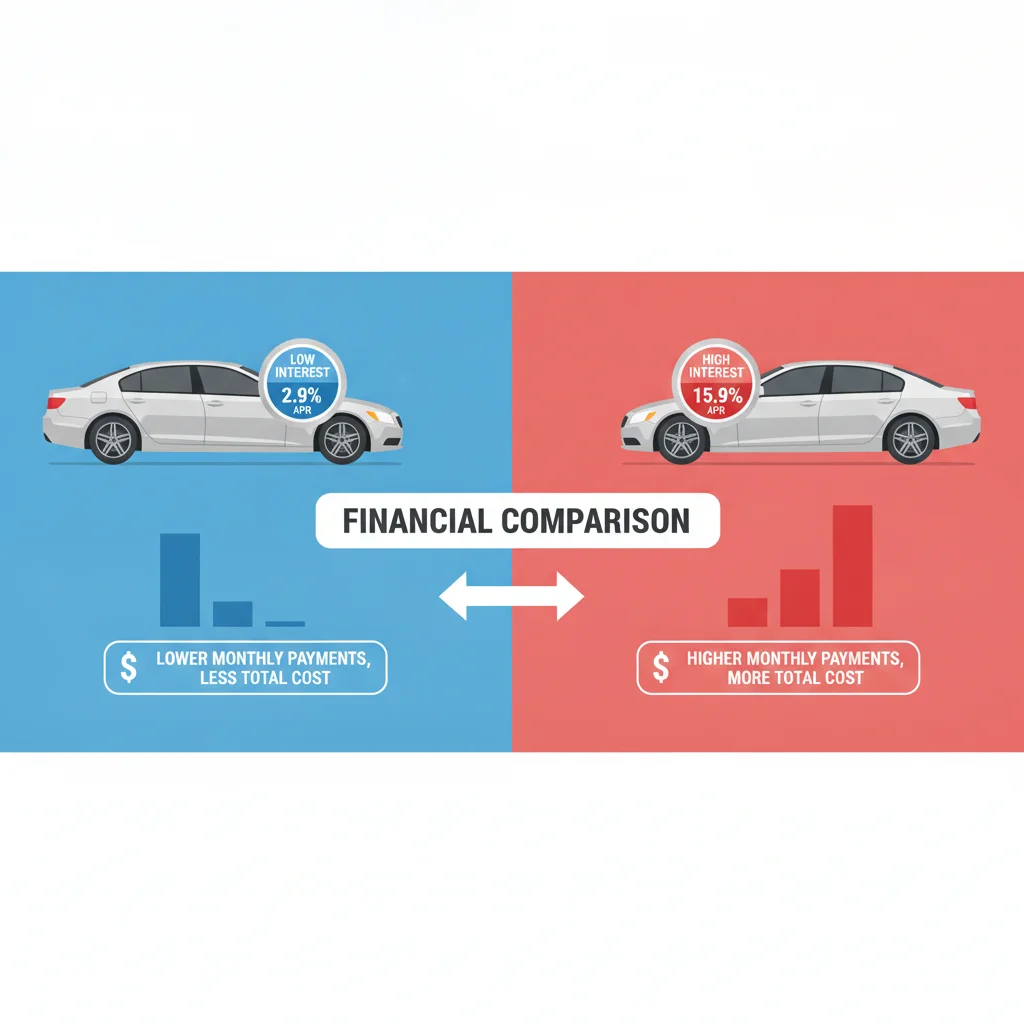
Understanding how your score affects the actual rate you're quoted is the fastest way to see why these myths matter. A buyer at 620 vs. 720 might be looking at loans that differ by $80–$120 per month on a $30,000 vehicle. Over 60 months, that's $4,800–$7,200 in extra interest — a number that should motivate anyone to get their credit facts straight.
~5%
Score impact of a single hard inquiry
FICO reports that one new hard inquiry typically lowers a score by less than 5 points, and often has no effect at all on scores above 750.
$8,800+
Extra interest: 540 vs. 740 score on $25K loan
Calculated on a 60-month $25,000 loan comparing a 22% subprime rate against an 8% prime rate — the same car, radically different cost.
720+
Score typically required for 0% APR deals
Most manufacturer captive lenders (Ford Motor Credit, GMAC, Toyota Financial) reserve promotional 0% offers for Tier 1 borrowers with scores of 720 or higher.
30%
Credit utilization threshold to stay under
FICO data indicates that borrowers using more than 30% of their revolving credit limit see measurable score penalties; under 10% produces the best results.
14 days
Safe rate-shopping window for auto loans
FICO's standard scoring models treat all auto loan hard inquiries within a 14-day window as a single inquiry, protecting buyers who comparison-shop lenders.
If you're concerned about errors dragging down your score before you apply, read why credit report errors inflate your car loan rate. Disputing inaccuracies before you shop is one of the highest-ROI things you can do.
What Your Score Range Actually Means for Your Rate
Lenders don't experience your score as a single number — they bucket it into tiers, and each tier has a rate range attached. Here's roughly how that plays out in the current market for a 60-month new-car loan:
| Credit Score Range | Typical Tier Label | Approximate APR Range |
|---|---|---|
| 750+ | Tier 1 / Super Prime | 5.0% – 7.5% |
| 700–749 | Tier 2 / Prime | 7.5% – 10.5% |
| 660–699 | Tier 3 / Near Prime | 10.5% – 14.0% |
| 620–659 | Tier 4 / Subprime | 14.0% – 18.5% |
| Below 620 | Tier 5 / Deep Subprime | 18.5% – 25%+ |
Note: These ranges vary by lender, loan term, vehicle type, and market conditions. Rates shift with the federal funds rate environment. Use these as relative benchmarks, not guarantees.
The most impactful tier boundary is between Tier 3 and Tier 2 — the jump from the 650s to the 700s. That crossing alone typically saves 3–5 percentage points. On a $35,000 loan over 60 months, moving from 14% to 10% APR saves roughly $3,800 in total interest.
Don't Close Old Accounts Before Applying
Closing a credit card account before applying for a car loan can lower your score in two ways simultaneously: it shortens your average account age and reduces your total available credit, which raises your utilization ratio. Even if you've paid off a card and don't plan to use it, leave it open in the months surrounding a major loan application.
Conditional Financing Is Not Final Financing
Many buyers assume signing papers at the dealer means the deal is done. If the finance manager uses words like 'pending,' 'contingent,' or 'subject to lender approval,' your deal is not final. Push for confirmation that the loan has been funded before you take delivery. If you're unsure, sleep on it — don't drive a car home on a contingent deal.
Beware of 'Managing' Inquiries by Letting Dealers Shop Your Rate
Some dealers offer to 'shop your deal' across multiple lenders internally, framing it as a service that protects your credit. In reality, they're submitting your application to whoever gives them the best dealer markup opportunity, not whoever gives you the best rate. You lose visibility and control. Do your own preapproval shopping before setting foot in the dealership.
If your score is near a tier boundary, it's worth spending 60–90 days optimizing before you apply. The two levers with the fastest impact are credit utilization and removing errors. Our article on credit utilization and car loans explains exactly how balances affect your score in the weeks before application.
Already have a loan at a high rate? Don't assume you're stuck. Many buyers who financed at a high rate when their credit was weak can now qualify for a significantly lower rate. See refinancing myths that make borrowers wait too long — you may have more options than you think.
Building the Strongest Position Before You Apply
Knowing the myths clears the path. Here's the affirmative playbook — what to actually do in the 60–90 days before you walk onto a lot:
- Pull your own reports first. Go to AnnualCreditReport.com and pull all three bureaus. You're not hurting your score. Look for errors — wrong balances, duplicate accounts, accounts that aren't yours. Dispute anything inaccurate. This is free and high-leverage.
- Target your utilization ratio. Get your revolving balances below 30% of their limits, ideally below 10% if you're within striking distance of a tier boundary. Pay down cards, not just the loan balance.
- Get preapproved before you shop. A bank or credit union preapproval gives you a rate benchmark and removes your dependence on dealer financing. When the F&I manager quotes you a rate, you can compare it against something real. Read our full breakdown of preapproval myths that cost buyers money.
- Cluster your loan applications. Do all your rate shopping within a 14-day window. FICO consolidates inquiries in a 45-day window for mortgages, and 14 days is the safer assumption for auto loans depending on the scoring model version being used.
- Don't open any new credit accounts. New accounts lower your average account age and can knock 5–10 points off temporarily. Avoid store cards, new credit cards, or any other financing in the 60 days before applying.

On the down payment front, there's a related set of myths worth reviewing. Putting money down affects your loan-to-value ratio, which some lenders factor into rate tiers alongside credit score. See common myths about car down payments for a clear-eyed look at how much you actually need.
The broader lesson: dealers are professionals who do this every day. Your best counter is preparation — knowing your score, knowing your rate tier, and arriving with competing offers in hand. The new car buying myths article pairs well here, because the same information asymmetry that hurts buyers on credit also shows up in negotiation, timing, and pricing.
The Bottom Line
Credit score myths aren't harmless misunderstandings. Each one hands the dealership's finance office an advantage that comes directly out of your pocket. The buyer who thinks checking their score hurts it never monitors their credit. The buyer who thinks all inquiries count separately never rate-shops. The buyer who thinks they need a perfect score delays buying when they could qualify at a decent tier right now.
None of these mistakes require bad intentions on the dealer's part. Information asymmetry does the work on its own.
Spot Delivery Can Unwind Your Deal
If a dealer lets you drive home before financing is fully approved and funded, you may be called back days or weeks later to renegotiate terms — at a higher rate, with a larger down payment required, or with a cosigner demand. This is legal in most states and is a known pressure tactic. Always confirm in writing whether your financing is final before taking delivery. A preapproval from your own lender eliminates this risk entirely.
The Tier Boundary Is Where Real Money Moves
The difference between a 659 and a 661 credit score might seem trivial — but if one puts you in Tier 4 and the other in Tier 3, the rate difference on a $30,000 loan over 60 months can exceed $4,000 in total interest paid. Know which tier you're in, know the boundary above you, and calculate whether 60–90 days of credit work is worth delaying the purchase.
The fix is straightforward: pull your reports, understand your tier, get preapproved, and shop your rate. You don't need a 800 score to get a fair loan. You need to know where you actually stand and use that information strategically.
If you're shopping used cars and wonder how credit interacts with those transactions differently, see used car myths that cost buyers money. And if APR calculations themselves still feel fuzzy, our auto loan APR myths article will give you the mechanical clarity to evaluate any quote you receive.
All claims are backed by peer-reviewed research. Sources on request.