Key Takeaways
Why Most Sellers Leave Money on the Table
Most people treat instant offer platforms the way they treat airline booking sites — they visit one, get a price, and accept it. That's the single biggest mistake a seller can make. These platforms are businesses that buy cars to resell them at a profit. Their algorithms are calibrated to offer you the least the market will bear, not the most you deserve.
I spent years inside dealership finance offices watching exactly how these tools got used — sometimes to lowball trade-in customers who came in already softened by a CarMax or Carvana quote. The sellers who came in with multiple offers and a clean, well-documented vehicle? They consistently left with more money. This article is about replicating that outcome every time.
To understand the mechanics driving every quote you receive, read how instant offer platforms actually work. Knowing what feeds the algorithm puts you in a better position to influence it.
Compete the Offers: Never Accept the First Number
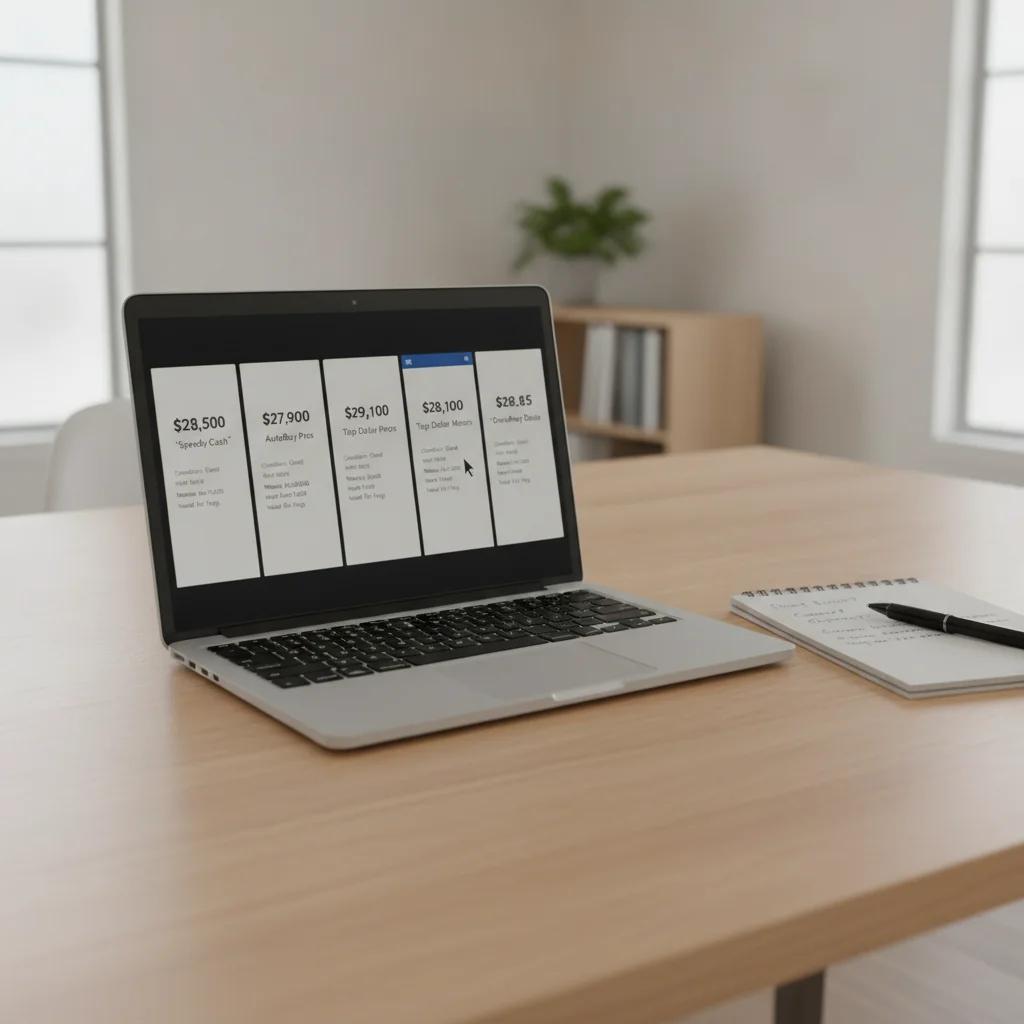
Instant offer platforms all claim to be the highest-paying option, but none of them consistently beat the others across all vehicle types and markets. The spread between the lowest and highest offer on the same car, submitted on the same day, can easily run $500 to $2,000 — sometimes more on late-model trucks and SUVs.
Run your vehicle through at least three platforms simultaneously. The major players — CarMax, Carvana, Vroom, Driveway, and dealer-backed tools like Kelley Blue Book Instant Cash Offer — each use different pricing inputs and inventory appetites. A truck-heavy dealer group may quote your pickup significantly higher than a general aggregator would.
Submit your vehicle to at least three competing instant offer platforms on the same day.
Offer algorithms vary significantly by platform and by region — what CarMax prices conservatively, Carvana or a dealer-backed tool may price aggressively depending on their current inventory gaps. Running offers simultaneously gives you a true market range and creates negotiating leverage with any single buyer.
Use the highest competing written offer to request a match from your preferred platform.
Several major platforms, including CarMax, have informal policies of matching or exceeding documented competitor quotes when presented within the offer validity window. This is not widely publicized but is a standard retention tactic in the industry.
Sell before crossing major mileage thresholds whenever possible.
Wholesale pricing tiers are often structured around round-number mileage markers — 60K, 75K, 100K. Crossing these thresholds can push a vehicle into a lower value band, sometimes reducing offers by $500 or more regardless of the car's actual condition.
Disclose all known cosmetic and mechanical issues upfront in the platform's condition questionnaire.
Condition items discovered during physical inspection that were not disclosed online almost always trigger a lower revised offer — and the adjustment is typically larger than it would have been had the issue been disclosed initially. Inspectors must price for uncertainty when they find surprises.
Invest in a professional interior and exterior detail before your in-person inspection.
Reconditioning cost estimates are a key component of how platforms calculate their margin on each vehicle. A visibly clean car signals lower recon investment, which leaves more room in their offer. The ROI on a detail is consistently positive.
Resolve any active diagnostic trouble codes before the inspection appointment.
A check engine light triggers an automatic worst-case-scenario cost estimate from most platform inspectors, because they cannot determine severity without a shop diagnosis. The deduction applied almost always exceeds the actual repair cost.
Once you have multiple offers, use them as leverage. Some platforms, particularly CarMax, will match or beat a competitor's written offer if you bring it in during the same week. That's not widely advertised, but it works more often than sellers realize.
For a curated breakdown of which platforms pay best by vehicle type, see instant offer platforms ranked by payout, speed, and seller experience.
Time Your Sale to Match Demand Cycles
Instant offer pricing isn't static — it moves with wholesale auction markets, regional inventory needs, and seasonal retail demand. The platforms buying your car have to resell it within 30 to 60 days. If consumer demand for your vehicle type is soft when they'd be retailing it, their offer to you will reflect that.
$1,500+
Typical spread between lowest and highest competing offer
Industry data from automotive valuation analysts consistently shows offer spreads of $500–$2,000 on the same vehicle submitted to multiple platforms simultaneously.
8–15%
Dealer margin built into instant offer pricing
Automotive remarketing research estimates that instant-offer platforms typically buy vehicles at 8–15% below their eventual retail listing price to cover reconditioning, logistics, and profit.
30–60 days
Average platform resale window driving offer pricing
Most major instant-offer buyers are structured to resell acquired vehicles within 30 to 60 days, meaning seasonal retail demand directly shapes their acquisition price offers.
Convertibles and sports cars peak in spring. Four-wheel-drive trucks and SUVs command stronger wholesale prices heading into fall and early winter. Fuel-efficient sedans and hybrids spike when gas prices rise. Selling against your vehicle's seasonal demand cycle can cost you several hundred dollars in offer value.
The same logic applies to your car's depreciation curve. A vehicle approaching a major mileage threshold — say 59,000 miles sitting close to 60,000 — will receive a noticeably lower offer once it crosses that marker. If you're within a few hundred miles of a round-number threshold, it's worth timing your listing accordingly.

For a broader look at how calendar timing affects car transaction values, timing your purchase offers useful context even from the buyer's side of the table.
Check Seasonal Timing Before You List
Before submitting your vehicle to any platform, spend five minutes researching current retail demand for your vehicle type. A quick look at local dealer inventory and national listing sites shows whether supply is tight — which means platforms are buying more aggressively. Selling into a demand spike can add several hundred dollars to your offer without any other changes.
Prepare Your Vehicle to Survive the Inspection
Here's what most sellers don't understand: the online quote is not the final price. Every platform reserves the right to adjust the offer after a physical inspection of the vehicle. That adjustment is almost always downward, and it is almost always justified by condition items the seller either didn't disclose or didn't notice.
Your goal is to close the gap between the online estimate and the in-person payout. The way to do that is to inspect the vehicle yourself before anyone else does.
Walk around the car in direct sunlight and photograph every scratch, dent, chip, or scuff you find. Minor cosmetic damage is generally absorbed into the offer without adjustment — but only if it's disclosed upfront. Discovering damage during the inspection that wasn't mentioned is what triggers a revised (lower) offer, because it creates doubt about what else might be hidden.
Mechanically, address anything that triggers a warning light. A check engine light almost always prompts a deduction disproportionate to the actual repair cost, because inspectors have to price for the worst-case scenario when a code is unresolved. A $150 oxygen sensor repair can prevent a $400 deduction.
Offer Validity Windows Vary by Platform
Most instant offers are valid for 7 days from issuance, but some platforms extend to 30 days while others expire in as few as 3 business days. Check the expiration terms before running competing offers so you can use all of them within the same window. Letting one expire before you've compared it to others eliminates your leverage.
Instant Offers Don't Replace Private Sale Value
Even the highest instant offer you receive will likely sit below what a motivated private buyer would pay. The gap on a well-maintained vehicle is typically 8–12% of market value. That's the cost of speed, safety, and simplicity — and it's a reasonable trade-off for many sellers, but it should be a conscious choice, not a default assumption that you got market price.
Reconditioning doesn't need to be expensive. A professional detail ($100–$200) routinely returns more in offer value than it costs, particularly on vehicles with heavily soiled interiors. Tire inflation, a car wash, and removing personal items round out what should be a 30-minute preparation routine.
Disclose Strategically — But Disclose Everything
There's a right way and a wrong way to share information with an instant offer platform. The wrong way is to omit known issues hoping they won't be found. The right way is to lead with strengths and frame condition items accurately before the inspector does it for you at a higher cost.
When filling out the vehicle description form, be accurate about condition but use the platform's own language. Most platforms offer condition tiers like "Good," "Very Good," and "Like New." Understand where your car realistically sits and select accordingly. Overshooting the condition to get a higher quote only delays the inevitable deduction at inspection.
“The difference between the first offer and the best offer is almost always preparation — a clean car with a service history and no surprises at inspection is simply a better business deal for the buyer, and they price it accordingly.”
— Desmond Kimathi, Former dealership finance manager and auto financing advocate
Service records are a genuine offer-booster that most sellers forget to mention. A documented service history — especially for major items like timing belt replacement, transmission service, or brake work — reassures the resale team that the vehicle is retail-ready. Mentioning recent maintenance during the appraisal can shift an offer meaningfully, because the platform's reconditioning cost estimate drops.
If your car has aftermarket modifications, research whether they add or subtract value for that platform's buyer demographic before disclosing them. A lift kit on a truck may be neutral-to-positive. Non-OEM wheels on a luxury sedan may prompt a deduction for returning the car to stock appearance.
For a full walkthrough of the selling process from first quote to title transfer, selling your car online covers every step.
Know the Real Cost of Convenience Before You Commit
Instant offer platforms earn their margin by buying below retail and selling at or above it. That spread — typically 8% to 15% of the vehicle's market value — is the cost of the convenience they're selling you. On a $25,000 car, that's $2,000 to $3,750 you're leaving on the table relative to a private party sale.
That doesn't make instant offers the wrong choice. If you need funds quickly, can't manage a private sale safely, or are bundling the transaction with a new car purchase, the time and risk savings can justify the gap. But you should go in knowing exactly what convenience costs you, not discovering it after you've already handed over the keys.

For a detailed breakdown of what you actually net after fees, taxes, and time costs on both sides of the equation, the real cost of convenience when selling to an instant buyer quantifies the gap clearly.
If you're selling in conjunction with buying another vehicle, the trade-in angle adds another layer. A well-timed instant offer gives you a floor price to negotiate from at the dealership, preventing the dealer from rolling your trade equity into an inflated purchase price. See trade-in strategies for how to use that leverage effectively.
The complete strategic picture — from platform selection through final payment — is covered in selling to an instant offer platform: the complete guide.
Offer Validity Windows Vary by Platform
Most instant offers are valid for 7 days from issuance, but some platforms extend to 30 days while others expire in as few as 3 business days. Check the expiration terms before running competing offers so you can use all of them within the same window. Letting one expire before you've compared it to others eliminates your leverage.
Instant Offers Don't Replace Private Sale Value
Even the highest instant offer you receive will likely sit below what a motivated private buyer would pay. The gap on a well-maintained vehicle is typically 8–12% of market value. That's the cost of speed, safety, and simplicity — and it's a reasonable trade-off for many sellers, but it should be a conscious choice, not a default assumption that you got market price.

All claims are backed by peer-reviewed research. Sources on request.