Key Takeaways
Before you visit CarMax or schedule a Carvana pickup, run your VIN through at least two other platforms online — this takes 20 minutes and costs nothing, but gives you a real number to compare against rather than guessing.
Competing offers are your only real negotiating tool with instant offer platforms. Without them, you have no way to know if the offer you received is at the high or low end of the market for your vehicle.
Call your lender and request a 10-day payoff statement before your inspection appointment — not an estimate, an official written statement. The platform needs this exact number to process the sale.
Sellers who show up without this document cause delays that sometimes push the transaction past the offer expiration window, leading to a revised (and often lower) final offer.
If a platform's appraiser cites a specific deduction at inspection — say, a cracked windshield at $350 — ask them directly whether fixing it before handoff would restore the full offer amount.
Some platforms allow a same-day or short-window fix that removes the deduction. Others apply it regardless. Asking the question costs nothing and occasionally recovers a few hundred dollars.
What Instant Offer Platforms Actually Are
Instant offer platforms are technology-driven car-buying services that provide sellers with a cash quote — often within minutes — in exchange for the vehicle. Names like Carvana, CarMax, Vroom, Peddle, and Shift have become mainstream alternatives to trading in at a dealership or listing privately. At their core, these businesses are wholesale or retail remarketing operations that make money on the spread between what they pay you and what they ultimately sell your car for.
That framing matters. These aren't charities or neutral market-makers. Every dollar of convenience they offer you has a corresponding cost built into their offer price. Understanding this doesn't mean you should avoid them — it means you should walk in knowing exactly what you're trading off.

The mechanics differ slightly across platforms. Some, like CarMax, operate physical auction and retail lots and want vehicles they can resell directly through their stores. Others, like Carvana, operate primarily online and move inventory through their own e-commerce pipelines. Still others, like Peddle or Wheelzy, are aggregators that flip vehicles to regional dealers and auctions. Each model has a different appetite for vehicle condition, age, and mileage — which directly affects how competitive their offers will be for your specific car.
Aggregators vs. Direct Buyers: A Key Distinction
Platforms like Peddle, Wheelzy, and similar services are aggregators — they collect your information and sell it to regional dealers or auction networks rather than buying directly. This means your 'offer' is actually a bid from a third party, and the pickup experience may be handled by a local wholesaler rather than the platform itself. The process feels similar on the surface but the backend is quite different from a direct buyer like CarMax or Carvana.
How the Process Works, Step by Step
The end-to-end process is more standardized than most sellers realize. Here's what actually happens from the moment you enter your VIN to the moment you receive payment.
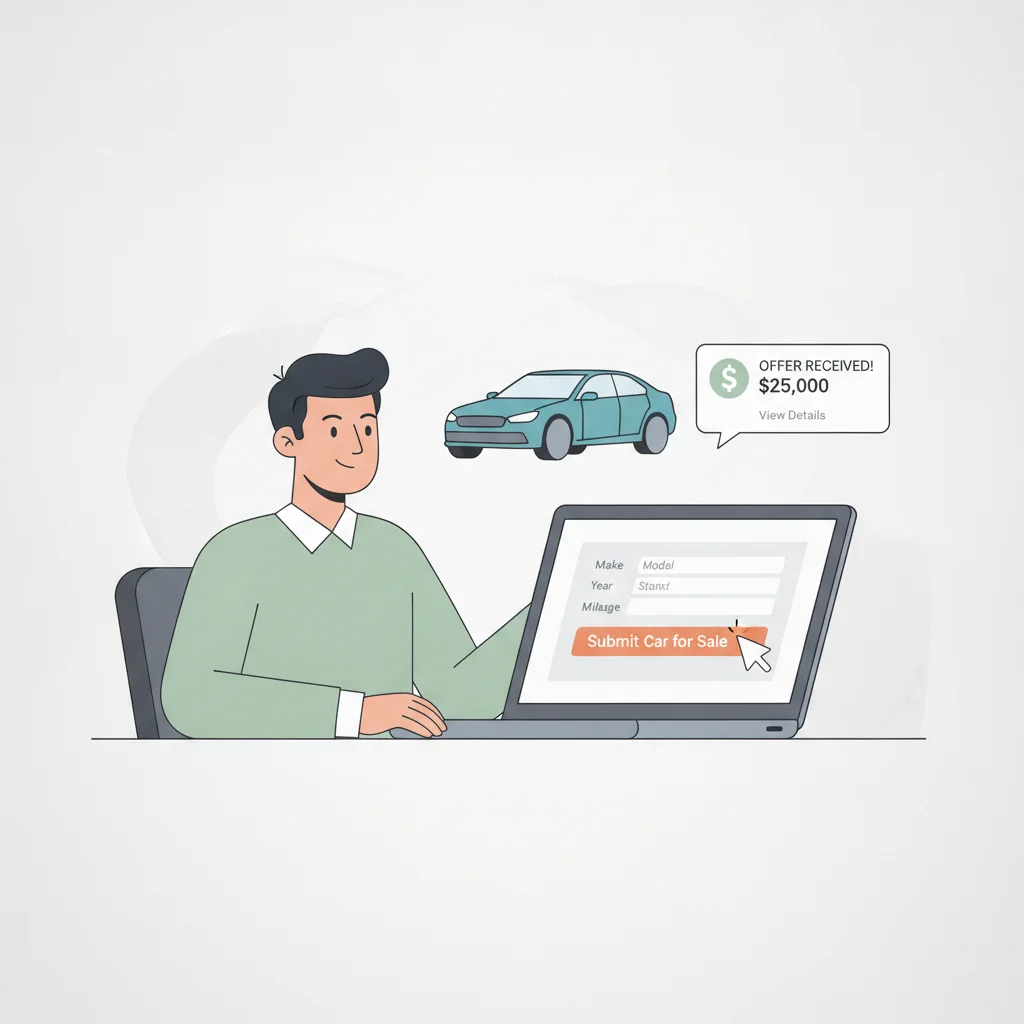
Step 1: Enter Your Vehicle Information
Every platform starts with your VIN (Vehicle Identification Number) or license plate. This pulls trim level, factory options, and build data automatically. You'll then be asked to self-report mileage, condition, accident history, and any known mechanical issues. Be accurate here — inflating condition or hiding damage doesn't get you a better offer; it gets your offer revised downward at inspection, wasting everyone's time.
Step 2: Receive an Algorithmic Quote
The number you see on screen is generated by a pricing algorithm that factors in local market demand, comparable auction data, days-to-sell estimates, and reconditioning cost assumptions. This is not your final offer — it's a conditional estimate. Treat it as a starting point, not a contract.
Step 3: Schedule Inspection
Most major platforms require a physical or virtual inspection before the offer is confirmed. CarMax requires an in-store visit. Carvana offers both in-store and mobile pickup options in many markets. At inspection, a trained appraiser reconciles your self-reported condition against actual findings. Undisclosed damage, worn tires, a cracked windshield, or a warning light will all result in deductions.
Before you visit CarMax or schedule a Carvana pickup, run your VIN through at least two other platforms online — this takes 20 minutes and costs nothing, but gives you a real number to compare against rather than guessing.
Competing offers are your only real negotiating tool with instant offer platforms. Without them, you have no way to know if the offer you received is at the high or low end of the market for your vehicle.
Call your lender and request a 10-day payoff statement before your inspection appointment — not an estimate, an official written statement. The platform needs this exact number to process the sale.
Sellers who show up without this document cause delays that sometimes push the transaction past the offer expiration window, leading to a revised (and often lower) final offer.
If a platform's appraiser cites a specific deduction at inspection — say, a cracked windshield at $350 — ask them directly whether fixing it before handoff would restore the full offer amount.
Some platforms allow a same-day or short-window fix that removes the deduction. Others apply it regardless. Asking the question costs nothing and occasionally recovers a few hundred dollars.
Step 4: Receive Your Final, Binding Offer
After inspection, you'll get a revised (or confirmed) offer in writing. This is now a binding quote, typically valid for 7 days. You're under no obligation to accept it on the spot. Use this window strategically — we'll cover that below.
Step 5: Accept and Complete Paperwork
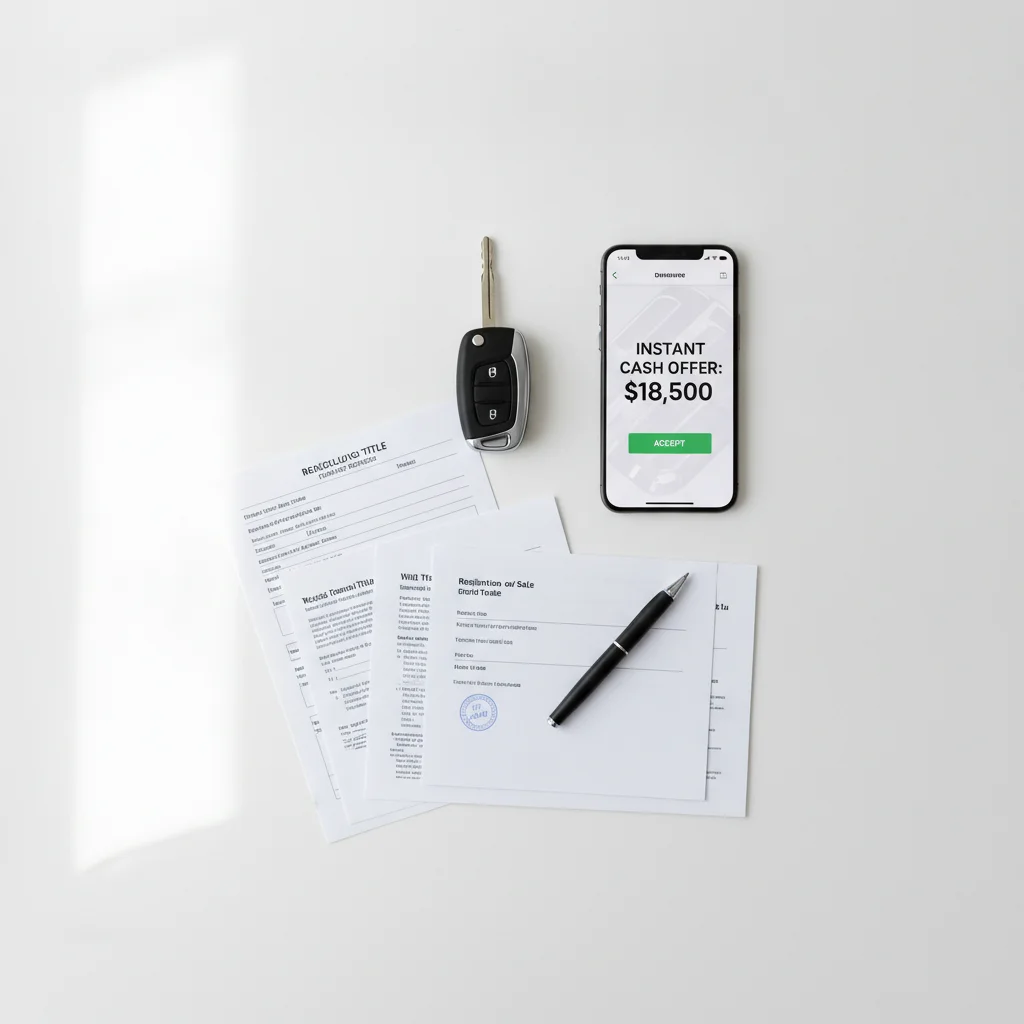
If you accept, you'll sign a bill of sale and title transfer documents. If you have an outstanding loan, the platform coordinates payoff directly with your lender. If you have positive equity, the difference is paid to you by check or direct deposit. If you're underwater, you pay the gap before the deal closes.
Step 6: Get Paid
Payment speed varies. CarMax typically issues a check on the spot. Carvana processes payment within one to two business days for most sellers. Some platforms take up to five business days, particularly for vehicles with outstanding loans that need payoff confirmation.

What You'll Typically Be Paid — and Why
Here's the number sellers fixate on, and rightfully so. The short answer: instant offer platforms consistently pay below private party value and typically at or slightly above trade-in value at a dealership — though that gap has narrowed as competition between platforms has increased.
10–20%
Typical discount vs. private party value
Industry data and seller reports consistently show instant offers landing 10–20% below what a private buyer would pay for the same vehicle.
7 days
Typical offer validity window
Most major platforms including Carvana and CarMax guarantee their post-inspection offer for approximately 7 days before it may be revised.
$1,500–$4,000
Average gap vs. top private sale price
Analysis of comparable sales across channels shows mid-market vehicles ($15,000–$35,000 range) typically leave this much on the table with instant offers versus a successful private listing.
3–4
Quotes needed to find the offer ceiling
Sellers who submitted to three or more platforms before accepting consistently received 6–12% more than those who accepted the first offer, based on community surveys on automotive forums.
48 hrs
Average time from submission to payment
For vehicles with clear titles and no outstanding loans, major platforms like CarMax and Carvana typically complete payment within 24–48 hours of offer acceptance.
The longer answer requires understanding why the spread exists. When a platform buys your car, they are assuming all downstream costs: reconditioning (detailing, mechanical repairs, paint correction), storage, marketing, auction fees if the car doesn't sell retail, and their own margin. The more risk they carry, the less they pay you upfront.
Vehicles in excellent condition — low mileage, clean history, high-demand segments like crossovers and trucks — tend to get offers closer to private party value because the platform's reconditioning costs are low and their sell-through rate is high. High-mileage sedans, older vehicles with accident history, or rare/modified cars get hammered because the platform's risk profile spikes.
“The used car market is brutally efficient. When you sell to an instant offer platform, you're not selling to a buyer who loves your car — you're selling to a business that needs a margin. Understanding that distinction is the beginning of negotiating from a position of knowledge.”
— Desmond Kimathi, Former dealership finance manager and auto financing advisor
The practical implication: the offer you receive is not a fixed truth about your car's worth. It's a business calculation by one buyer. Getting quotes from three or four platforms simultaneously — before accepting any of them — is the most reliable way to find the top of that range. See our rankings of the top instant offer platforms by payout to know which services consistently pay the most for vehicles like yours.
Who Instant Offers Are Actually Best For
Speed and simplicity have a price tag, but for certain sellers, that price is absolutely worth it. Here's an honest breakdown of who benefits most from this channel.
Sellers in Time-Constrained Situations
Relocation, divorce, financial hardship, or a death in the family — these situations call for fast resolution, not maximum return. If you need the car sold in the next week, instant offers are likely your best path. Private sales can drag on for 30 to 60 days, and dealership trade-ins only benefit you if you're buying something in return.
Sellers With Vehicles in the Sweet Spot
Platforms like Carvana and CarMax are most competitive on vehicles that are 1–8 years old, under 100,000 miles, with clean titles and no significant accident history. If your car fits this profile, the delta between an instant offer and a private sale may be smaller than you think — especially once you factor in the time and cost of listing, fielding inquiries, and managing test drives.
Sellers Who Don't Want to Deal With Strangers
The safety and hassle factor of private sales is real. Meeting unknown buyers, managing no-shows, handling lowball offers and tire-kickers — many sellers value the elimination of that friction more than the additional dollars. That's a completely valid trade-off.
Instant Offers Work Best Without a Trade-In Agenda
If you're using an instant offer to exit a vehicle you're not replacing, the math is cleanest. You get a defined number, you close the deal, and you're done. When a trade-in enters the picture — especially at a dealership — the negotiation becomes four-dimensional (sale price, trade value, financing rate, and add-ons) and sellers routinely lose ground on multiple fronts simultaneously.
Sellers With Equity Who Aren't Buying Again
If you have clear title or positive equity and you're not replacing the vehicle with a dealer purchase, instant offers are one of the cleanest exits available. You get cash, you get out, and you're done. Contrast this with selling privately, which can generate more money but requires substantially more effort.
The Hidden Costs and Trade-Offs
Convenience is never free, and instant offer platforms embed costs in ways that aren't always obvious at the point of submission. Know these before you commit.
The Condition Adjustment Gap
The most common complaint from sellers is this: the online quote was $14,000, but after inspection it came back at $12,200. That $1,800 gap isn't the platform being dishonest — it's the difference between your self-assessment and a professional appraiser's eyes. Reconditioning estimates and risk premiums compress the number. Platforms build this in by design: a strong online quote gets you in the door.
Condition Gaps Between Quote and Inspection Are Expected — Not a Bait-and-Switch
Every major platform's online quote comes with fine print stating it's conditional on inspection. The gap between your online quote and final offer is nearly always a function of condition reporting accuracy, not dishonesty. That said, if deductions seem excessive or undocumented, ask the appraiser to walk through each line item with you. You have the right to understand exactly what drove any revisions before you decide whether to accept.
Don't Sign Over the Title Until Payment Is Confirmed
The title is your legal leverage. Once it's signed and transferred, the transaction is done regardless of whether your check has cleared. For check payments, confirm with your bank that the check has cleared before considering the deal final. For ACH transfers, wait for the funds to appear in your account. Reputable platforms rarely have issues, but this is a basic financial protection worth maintaining.
Offer Expiration Risk
Most offers are valid for 7 days. If your vehicle is in a segment experiencing rapid depreciation — or if used car market conditions shift quickly as they did post-2022 — that window can matter. In a falling market, extending your decision timeline costs you money. In a rising market, a competing offer from another platform may do better than an expired one.
No Negotiation on Final Numbers (Usually)
Unlike a private buyer or even a dealer, most instant offer platforms treat their post-inspection offer as final. There's limited room to negotiate, though it's not zero. Understanding where negotiation leverage actually exists with these platforms can help you recover a few hundred dollars in some scenarios — but it requires the right approach.
The Negative Equity Trap
If you owe more than the car is worth, an instant offer doesn't solve that problem — it surfaces it. You'll need to pay the gap out of pocket at closing. Some sellers don't have that cash available and end up rolling the deficit into a new loan, which creates compounding debt. Know your payoff amount before you get any quote.
Never Disclose Negative Equity to the Buying Platform Before Getting Your Quote
Your loan balance is irrelevant to what the vehicle is worth — platforms should be quoting based on market value, not your financial situation. If you reveal upfront that you're underwater, some platforms may use that information to anchor a lower offer knowing you have fewer options. Get the quote first, then disclose the payoff situation during closing paperwork.
Watch Out for Market Condition Shifts During Your Offer Window
Used vehicle prices can shift meaningfully in 7 days during volatile market periods. If wholesale auction prices drop sharply — as they did in late 2022 and 2023 — some platforms reserve the right to revise offers on vehicles with outstanding loans that haven't been fully processed. Read the terms of your specific offer carefully and don't delay closing unnecessarily.
How to Maximize Your Payout Before You Submit
There's a ceiling on how much you can move an instant offer, but there are concrete steps that prevent leaving money on the table. I've watched sellers walk in having done nothing to prepare their vehicle and walk out with $800 to $1,200 less than they should have gotten.
Pull Your Own Market Data First
Before you submit to any platform, spend 20 minutes on Kelley Blue Book and Edmunds entering your vehicle's exact specs and condition. Get the private party range and the trade-in range. This gives you a calibrated expectation and a benchmark to compare each platform's offer against. Accepting below trade-in value when a competitor would have offered more is a preventable mistake.
Address the Easy Stuff
Platforms deduct for things appraisers can measure: warning lights, worn tires, cracked windshields, and dirty interiors. A $20 oil change that clears a maintenance reminder or a $150 detail can recover $300–600 in offer value. Fix anything that costs less to repair than it'll cost you in deductions. Our pre-sale checklist covers every item worth addressing before you click submit.
Before you visit CarMax or schedule a Carvana pickup, run your VIN through at least two other platforms online — this takes 20 minutes and costs nothing, but gives you a real number to compare against rather than guessing.
Competing offers are your only real negotiating tool with instant offer platforms. Without them, you have no way to know if the offer you received is at the high or low end of the market for your vehicle.
Call your lender and request a 10-day payoff statement before your inspection appointment — not an estimate, an official written statement. The platform needs this exact number to process the sale.
Sellers who show up without this document cause delays that sometimes push the transaction past the offer expiration window, leading to a revised (and often lower) final offer.
If a platform's appraiser cites a specific deduction at inspection — say, a cracked windshield at $350 — ask them directly whether fixing it before handoff would restore the full offer amount.
Some platforms allow a same-day or short-window fix that removes the deduction. Others apply it regardless. Asking the question costs nothing and occasionally recovers a few hundred dollars.
Get at Least Three Quotes Simultaneously
CarMax, Carvana, and at least one market-specific aggregator should all see your vehicle before you make a decision. Do this within the same 48-hour window so you're comparing apples to apples under consistent market conditions. The range between high and low offers on the same vehicle is commonly $500–2,000.
Don't Disclose More Than Asked
There's a difference between honest and volunteering every minor ding. Answer the questions asked. If the form asks about accident history, disclose accurately — platforms run Carfax or AutoCheck regardless. But you don't need to write an essay about the scratch on the rear bumper. Let the inspector find it; they may not deduct for minor cosmetic items the same way a worst-case self-disclosure might suggest.
Comparing Instant Offers Against Your Other Options
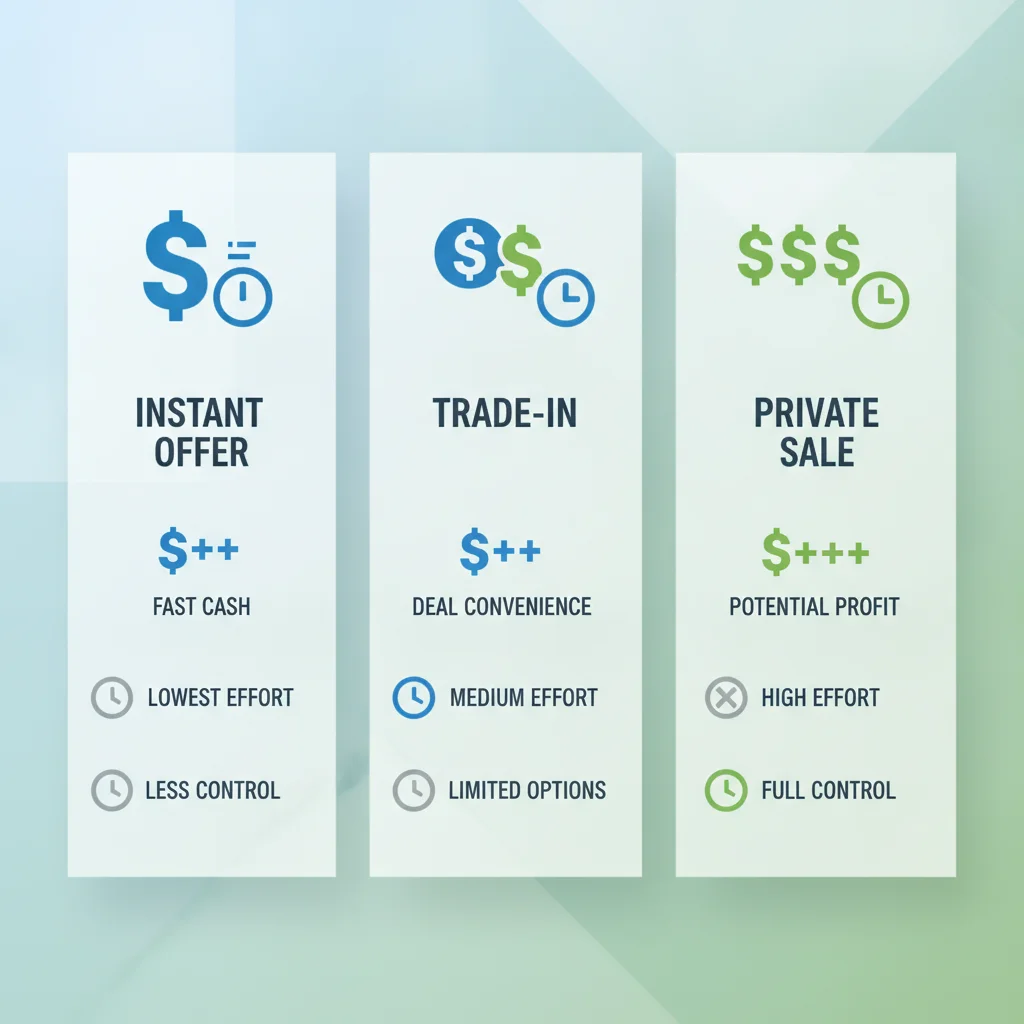
Instant offers exist on a spectrum alongside other sale channels. The right choice depends on your priorities. Here's an honest side-by-side view.
| Channel | Time to Sell | Typical Payout vs. Market | Hassle Level | Best For |
|---|---|---|---|---|
| Instant Offer Platform | 1–7 days | 85–93% of private party | Low | Speed, simplicity, no loan remaining |
| Dealership Trade-In | Same day | 75–88% of private party | Very Low | Convenience when buying a replacement |
| Private Party Sale | 2–8 weeks | 95–105% of market value | High | Maximum return on a desirable vehicle |
| Auction/Wholesale | 3–10 days | 70–82% of private party | Low–Medium | High-mileage, damaged, or specialty vehicles |
If maximizing dollars is the priority and you have a desirable vehicle with time to spare, the private party route consistently wins on payout. The gap is real — often $1,500 to $4,000 on a mid-market vehicle. The question is whether your time, safety, and patience are worth that premium. For many sellers in many situations, they're not.
If you're simultaneously buying another vehicle from a dealer, be careful about conflating trade-in value with an instant offer. Dealers routinely absorb your trade at a low number while appearing generous on the new car price. Getting an independent instant offer first — and telling the dealer you have an outside offer — gives you actual leverage. See where private sellers list successfully if you want to test the market before committing to an instant sale.
Closing the Deal: What Happens at Handoff
Once you've accepted an offer, the closing process is largely administrative — but there are details that trip sellers up and can delay payment or create legal exposure.
What You Need to Bring
- Clean title: If your title has a lien (you still owe on the loan), the platform handles payoff coordination, but you need your lender's 10-day payoff amount in writing.
- Valid government-issued ID: Both parties will be verified.
- All keys and remotes: Missing a key fob can result in a deduction — platforms know replacement costs.
- Maintenance records (optional but useful): Documentation of service history can support condition claims and occasionally recover a small offer adjustment.
- Personal items removed: Sounds obvious, but check under seats, in the trunk, and in seat-back pockets before handoff.
Title Transfer
The platform handles the bulk of the paperwork, but you need to sign the title over correctly. If the title is in multiple names (e.g., joint ownership), all parties on the title must sign. If you've lost the title, you'll need to obtain a duplicate from your state DMV before the sale can close — factor in that timeline.
Condition Gaps Between Quote and Inspection Are Expected — Not a Bait-and-Switch
Every major platform's online quote comes with fine print stating it's conditional on inspection. The gap between your online quote and final offer is nearly always a function of condition reporting accuracy, not dishonesty. That said, if deductions seem excessive or undocumented, ask the appraiser to walk through each line item with you. You have the right to understand exactly what drove any revisions before you decide whether to accept.
Don't Sign Over the Title Until Payment Is Confirmed
The title is your legal leverage. Once it's signed and transferred, the transaction is done regardless of whether your check has cleared. For check payments, confirm with your bank that the check has cleared before considering the deal final. For ACH transfers, wait for the funds to appear in your account. Reputable platforms rarely have issues, but this is a basic financial protection worth maintaining.
Notify Your Insurance and Registration
The moment ownership transfers, you're no longer responsible for the vehicle — but your insurer doesn't know that automatically. Cancel or transfer your coverage the same day. In most states, you should also notify the DMV of the sale to protect yourself from liability if the vehicle is involved in an incident before the new owner registers it.
What Happens If the Offer Changes at Inspection
This is the scenario that frustrates sellers most. If the post-inspection offer is meaningfully lower than the online quote, you are under no obligation to accept it. Walk away, take that inspection report (note any deductions cited), and use it to prep competing bids. Some sellers find that submitting to a second platform with known deduction areas already addressed yields a better net result. Others accept the revised number because it's still the fastest path out. Either response is rational — just don't let time pressure force a decision that costs you more than it saves.
Instant Offer Platforms Ranked by Payout, Speed, and Seller Experience
A detailed comparison of the top instant car-buying services — evaluated on the criteria that actually affect your wallet and your experience. Use this before submitting anywhere.
Pre-Sale Checklist for Instant Offer Submissions
A step-by-step checklist covering everything you should verify, fix, and document before submitting your vehicle to any instant offer platform. Designed to maximize your offer and avoid inspection surprises.
Negotiating With Instant Offer Platforms
Instant offers feel non-negotiable, but there's more flexibility than most sellers realize. This guide covers exactly where leverage exists and how to use it without blowing up the deal.
Kelley Blue Book Instant Cash Offer
Enter your VIN and vehicle details to get a KBB-powered instant cash offer redeemable at participating dealers — useful as a benchmark even if you don't plan to use it.
Private Party Sales Hub
If you're weighing instant offers against selling directly, this hub covers every stage of the private sale process — listing, pricing, negotiating, and closing safely.

All claims are backed by peer-reviewed research. Sources on request.