
Key Takeaways
Trade-In Offer Variance
Trade-in offer variance is the difference in dollar amounts that different dealerships will pay for the exact same vehicle. Two dealers evaluating an identical car on the same day can legitimately offer prices that are $500 to $3,000 apart — or more. This gap isn't random; it's driven by each dealer's inventory needs, franchise type, regional demand, and internal cost assumptions.
Dealers typically price trade-ins against local wholesale auction data and their own reconditioning cost estimates — both of which vary by market and rooftop, creating structural price dispersion even for identical vehicles.
The Dealer's Offer Is Not Based on Your Car Alone
Most sellers walk into a dealership assuming the trade-in offer is mostly a function of their car's condition, mileage, and age. Those things matter — but they're only part of the equation. The bigger driver of what a dealer will actually write on that offer sheet is what that dealer needs on their lot right now.
Think of it this way: if a Ford dealer already has eight used Honda Civics sitting on the lot and the average days-to-sell for those Civics is climbing past 60 days, they have zero urgency to add a ninth. They'll give you a number that hedges every risk and bakes in a fat margin — or they'll just try to wholesale it. Flip to a Honda dealer across town who's been selling used Civics in 12 days and is currently sitting at two units, and that same car suddenly looks like an asset. That urgency shows up in the offer.

This is why the advice to "get multiple offers" isn't just a tactic — it's the only way to discover your car's real market value. One offer tells you almost nothing about what your car is actually worth to buyers. Three offers start to define a real range. See how to collect competing trade-in offers efficiently before you set foot in a showroom.
$1,000–$3,000
Typical spread between lowest and highest trade-in offers
Based on consumer experience data and industry appraisal practices; spread can exceed $5,000 for in-demand models in tight markets.
30 days
Days supply threshold that triggers aggressive dealer buying
Industry analysts at Edmunds note that dealers actively compete for used inventory when market days supply falls below 30 days for a given model.
7 days
Binding period for most instant offer platform quotes
CarMax, Carvana, and KBB Instant Cash Offer typically honor written quotes for 7 days, giving sellers a usable floor price for dealer negotiations.
2x–3x
Return on minor pre-appraisal cosmetic repairs
Dealers routinely deduct 2–3x the actual repair cost from trade-in offers for visible defects; fixing them before appraisal captures that margin back.
$500–$1,500
Premium paid by franchise-matched dealers over off-brand dealers
Franchise-aligned dealers can CPO certify matching-brand trade-ins, justifying a meaningful premium over dealers who would need to wholesale the vehicle.
Five Specific Reasons Offers Diverge
Breaking down the mechanics helps you anticipate where the biggest gaps will appear — and which dealers are worth approaching first.
1. Lot Inventory and Days Supply
Dealers track "market days supply" — how many days it would take to sell through current inventory at the current sales pace. When days supply for your vehicle type drops below 30, dealers compete aggressively to acquire more stock. When it climbs past 60, they pull back. You can check Edmunds or CarGurus to see regional days-supply data for your specific model before you shop it around.
2. Franchise Brand Alignment
A franchised dealer has a built-in advantage when retailing a used car that matches their new-car brand: they can certify it as CPO, market it to their existing customer base, and service it in-house. That alignment is worth real money — typically $500 to $1,500 more than what an off-brand dealer would offer for the same car, since that off-brand dealer knows they'll probably have to wholesale it at auction and eat the fees. Your Toyota Camry is most valuable at a Toyota dealer. Your RAM 1500 will bring the most at a Stellantis-brand store.
CPO Certification Changes the Math
Certified Pre-Owned programs are brand-specific — only a franchised dealer can certify a vehicle under that manufacturer's CPO banner. A Toyota dealer who buys your used Camry can list it as a Toyota CPO vehicle, justifying a retail price premium of $1,500 to $3,000 over a comparable non-certified unit. That retail premium is partly what allows them to pay more at acquisition. Off-brand dealers simply don't have that option, so their offer ceiling is lower by default.
3. Reconditioning Cost Estimates
Every dealer mentally deducts estimated reconditioning costs from your trade-in offer before they name a number. The problem: those estimates vary enormously. One dealer's service department might quote $800 to do the recon work internally. Another dealer who doesn't have the bandwidth or in-house capacity might budget $1,400 for the same car because they'll farm it out. Both deductions come directly out of your offer. Understanding the hidden math behind dealer trade-in offers helps you see exactly how these costs erode your number.
4. Regional and Seasonal Demand
A four-wheel-drive pickup truck in Montana in November commands a different premium than it does in coastal Florida in June. Convertibles spike in warm-weather markets heading into spring. Fuel-efficient compacts see demand surge when gas prices climb. If your car is a strong regional fit for the dealer you're visiting, that dealer can price it to retail — and they'll pay more to get it. If it's a poor fit, they're mentally pricing it to wholesale before you've said a word.
5. Auction Access and Wholesale Relationships
Dealers who have strong relationships with regional wholesale auctions — or who move high volumes through platforms like Manheim or ADESA — have a more accurate read on what your car will actually fetch in the wholesale channel. A smaller, independent dealer with less auction activity may lowball conservatively because they're less certain of their exit strategy. A high-volume dealer with active auction accounts may be willing to pay closer to wholesale because they know they can move the car quickly if retail doesn't work out.
Check Days Supply Before You Shop
Before visiting any dealer, look up your vehicle's "market days supply" on CarGurus or Edmunds using your zip code. A days supply under 30 means dealers are actively hunting for your car and will pay more to get it. A days supply over 60 means you're walking into a buyer's market — expect lowball offers and plan to shop more aggressively across more dealers.
Fix Small Cosmetic Issues Before Appraisal
Dealers deduct estimated repair costs from trade-in offers at a rate that often exceeds the actual cost by 2x or more. A $150 professional detail and $200 in paint chip or door-ding repairs can realistically recover $500 to $800 in offer value. Do this before your first appraisal — you can't undo a low first impression.
What This Means in Practice: A Real Scenario
Here's how the variance plays out in a real transaction. Take a 2020 Toyota RAV4 XLE with 42,000 miles, clean title, and average condition. On the same Tuesday afternoon, you visit three dealers:
- Toyota franchise dealer (15 miles away): They have two used RAV4s in stock, both over 55,000 miles. They want a fresher, lower-mileage unit they can CPO certify. Offer: $23,400.
- Honda franchise dealer (8 miles away): They'll retail it as a non-CPO used vehicle alongside their Hondas. They estimate $600 in recon. Offer: $21,800.
- Independent used-car superstore (22 miles away): They're well-stocked with compact crossovers and days supply is high. They're pricing it to wholesale. Offer: $20,200.
Same car. Same day. $3,200 spread between lowest and highest. If you had walked into the Honda dealer first and taken the offer, you'd have left $1,600 on the table without knowing it. If you'd gone only to the independent store, you'd have left $3,200.
This isn't an edge case — it's the normal range you should expect. The framework for evaluating whether a trade-in offer is fair will help you set a realistic target range before you start shopping.
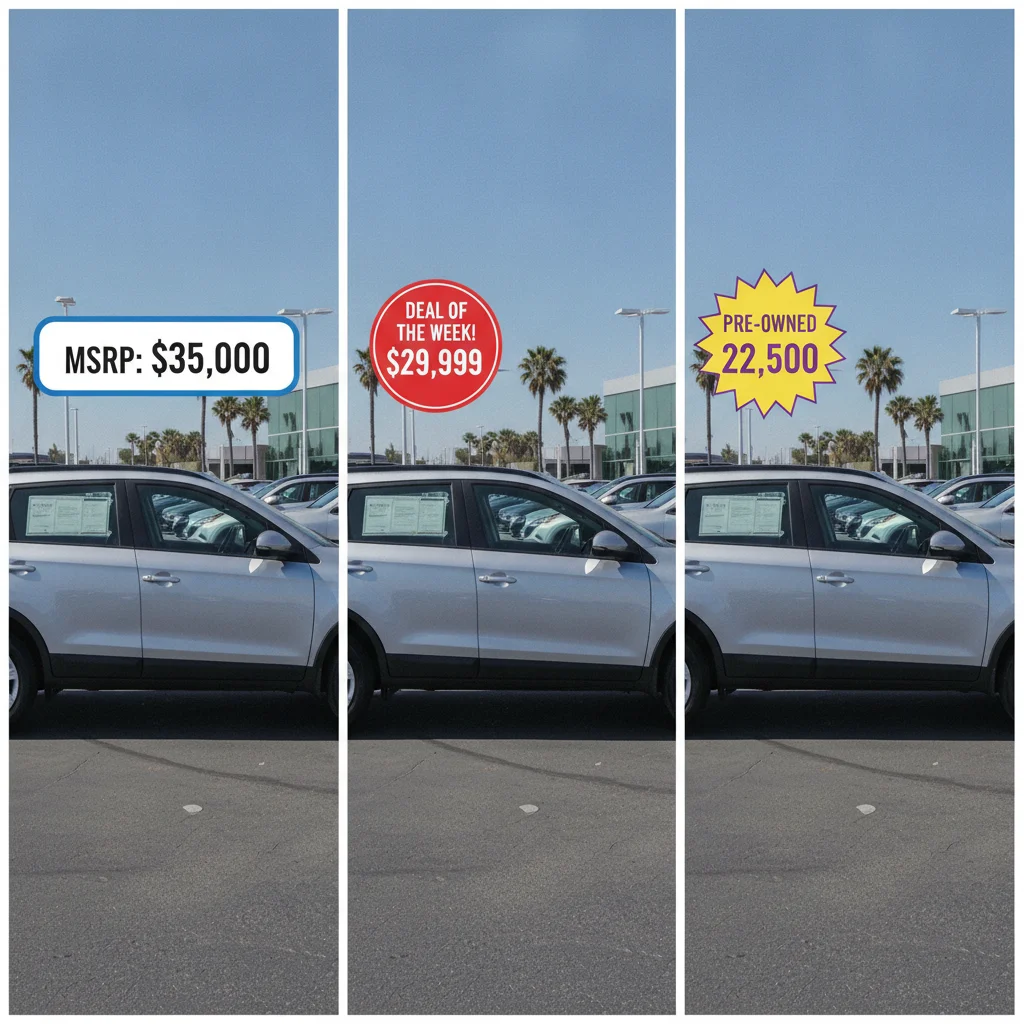
Using Instant Offer Platforms as a Price Floor
Before visiting any dealer, get at least one written offer from an instant-offer platform — CarMax, Carvana, or KBB Instant Cash Offer are the most common. These offers have three strategic advantages:
- They're binding for a set period (usually 7 days), giving you a real number to work from.
- They're brand-agnostic, so they're not discounting your car because it doesn't match their franchise.
- They're useful leverage in dealer negotiations. Show a dealer a written CarMax offer and ask if they can beat it. Many will, because keeping the trade-in deal also means keeping the new-car sale.
That said, instant offer platforms are not always the highest-paying option — they're buying at scale and have their own margin requirements. Think of their number as a floor, not a ceiling. The comparison of dealer trade-ins vs. instant offer platforms breaks down the payout dynamics of each channel so you can decide which route makes more sense for your situation.
“A trade-in offer tells you more about what a dealer needs than what your car is worth. The seller's job is to find the buyer who needs it most.”
— Ira Sacks, Former franchise dealer principal and automotive consultant
It's also worth noting that two instant offer platforms can themselves diverge significantly on price — so don't assume one online quote settles the question.
The Negotiation Tactics That Actually Work
Armed with competing offers and an understanding of why prices vary, here's the approach that consistently produces better outcomes:
Separate the Trade from the New Car Deal
Always negotiate these as two distinct transactions. Bundling them is the dealer's preferred approach because it obscures the math. Get agreement on the new car price first, then introduce the trade. Or better yet, sell the trade separately to whoever pays the most — CarMax, Carvana, or a franchise dealer — and buy the new car independently. You lose the convenience of a one-stop deal, but you almost always come out ahead financially.
Target the Right Franchise First
Based on your car's brand, go to that franchise's dealer first. They have the structural incentive to pay more. If your car is a Jeep, try multiple Stellantis-brand dealers (Dodge, Chrysler, RAM, Jeep) — they all share the same CPO program and can certify your vehicle.
Time Your Visit Strategically
End of month, when dealers are chasing volume targets, tends to produce slightly more aggressive trade offers. It won't move the needle by thousands, but $200 to $400 of incremental value costs you nothing but a few days of patience.
Know Your Recon Exposure
Dealers will mentally penalize your car for every visible defect. Get a pre-sale detail done ($150 to $250) and fix any sub-$200 cosmetic issues before you start shopping it. The ROI on minor touch-up work ahead of trade-in appraisals is consistently positive. A chip repair or a door-ding fix typically returns 2x to 3x its cost in a higher offer.
For a full playbook on converting competing offers into a better final number, see how to use competing offers to negotiate a better trade-in and the fundamentals of dealer negotiation.
Check Days Supply Before You Shop
Before visiting any dealer, look up your vehicle's "market days supply" on CarGurus or Edmunds using your zip code. A days supply under 30 means dealers are actively hunting for your car and will pay more to get it. A days supply over 60 means you're walking into a buyer's market — expect lowball offers and plan to shop more aggressively across more dealers.
Fix Small Cosmetic Issues Before Appraisal
Dealers deduct estimated repair costs from trade-in offers at a rate that often exceeds the actual cost by 2x or more. A $150 professional detail and $200 in paint chip or door-ding repairs can realistically recover $500 to $800 in offer value. Do this before your first appraisal — you can't undo a low first impression.
The Bottom Line on Trade-In Variance
The trade-in process rewards sellers who treat it like a competitive auction rather than a single-stop transaction. The variance between dealers is real, structural, and predictable once you understand the mechanics. Franchise alignment, lot inventory, reconditioning assumptions, regional demand, and auction relationships all push offers in different directions — none of which has anything to do with how well you've maintained your car.
The practical implication: never accept the first offer. Never assume one dealer's number represents market value. Get a minimum of three written offers before you negotiate. Use the highest as your target and the instant-offer platform number as your floor. Walk away from any dealer who won't engage with a competing offer — there are others who will.
If you want to structure this process efficiently before your next purchase, the trade-in strategies hub is the right place to start.

All claims are backed by peer-reviewed research. Sources on request.