
Key Takeaways
Why New Car Negotiation Feels Unfair — And How to Fix That
Dealerships negotiate car sales hundreds of times a month. You do it once every few years. That experience gap is real, and dealers are trained to exploit it — not maliciously, but systematically. Every F&I manager, every sales consultant, and every floor manager has scripts designed to keep you focused on the wrong numbers.
The good news: this is a solvable problem. The dealer's edge isn't intelligence — it's information asymmetry and time pressure. Remove both, and you're negotiating on close to equal footing. This guide walks you through exactly how to do that, step by step, before you ever sit down across from a salesperson.
If you're heading into your first negotiation, our first-timer's dealership prep guide covers what to expect from the moment you walk in through the moment you sign. This article focuses specifically on the price negotiation itself — the numbers, the tactics, and the language that gets you a better deal.

One more framing point: negotiating a new car is different from negotiating a used one. New cars have publicly available pricing data, manufacturer incentives, and regional market adjustments that don't exist in the used market. For a comparison of how those dynamics differ, see negotiating a used car price. For now, let's focus on new.
What You Need Before You Step into Any Showroom
Preparation isn't optional — it's the entire game. Buyers who show up without research are handing the dealer a 10–15% advantage before a single word is spoken. Here's what you need in place before your first in-person visit.
What you will need
Beyond those baseline requirements, you'll also want to gather the following data points for every vehicle you're seriously considering:
- Invoice price: What the dealer theoretically paid for the car. Sites like Edmunds and TrueCar publish this. It's not the dealer's actual cost — holdback and dealer cash exist — but it's a far better anchor than MSRP.
- Manufacturer incentives: Check the automaker's website directly. Cash-back offers, special APR financing, and lease deals are updated monthly and may not be volunteered by the salesperson.
- Regional market adjustments (RMAs): Some high-demand vehicles carry dealer-added markups. Know this before you negotiate so you're not surprised by a number above MSRP.
- Competing quotes: Email at least three dealers with a specific vehicle configuration and request their best out-the-door price in writing. Using competing dealer quotes as a negotiation tool is one of the highest-leverage moves available to any buyer.
Edmunds or TrueCar
Look up invoice price, market value, and current dealer incentives for your target vehicle.
Pre-approval letter from a bank or credit union
Establishes a financing baseline the dealer must beat and prevents payment-focused manipulation.
Automaker's official website
Check current cash-back offers, APR specials, and lease deals that dealers may not volunteer.
CarMax or Carvana appraisal
Provides an independent, written trade-in offer you can use as leverage at the dealership.
Spreadsheet or note-taking app
Track competing quotes, OTD price breakdowns, and incentive amounts across multiple dealers.
Calculator
Verify monthly payment math on the spot using your agreed purchase price, rate, and term.
Step-by-Step: How to Negotiate the Price of a New Car
These steps are sequenced intentionally. Skipping ahead or reordering them gives up leverage at each stage. Follow the sequence, and you'll arrive at signing with a number you actually understood and agreed to — not one that was assembled around you.
Lock In Your Target Price Before Any Dealer Contact
Identify the invoice price for your exact configuration — base vehicle plus every option you want. This is your negotiation anchor. MSRP is a marketing number; invoice is where real conversations begin. For most mainstream models, a fair deal lands somewhere between invoice and MSRP, often 1–3% below invoice when incentives and dealer cash are factored in.
Write this number down. You'll be using it in every email and conversation that follows.
Get Pre-Approved for Financing First
Contact your bank or credit union before you contact any dealer. Apply for a pre-approval on an auto loan at the highest amount you're realistically considering. The approval letter gives you two things: a rate you can use to evaluate the dealer's financing offer, and proof that you're a serious, qualified buyer.
When a dealer knows you have outside financing, their finance department has to compete — they can't simply assume you'll take whatever rate they offer. Even if you ultimately use dealer financing, the pre-approval is the benchmark.
Email Three or More Dealers with a Specific Quote Request
Contact the internet sales department — not the general sales line — at three or more dealers who have your target vehicle in stock. Use this exact type of message:
"I'm ready to purchase a [Year] [Make] [Model] [Trim] in [Color] with [specific options]. I'm contacting several dealers and will make a decision this week. Please send me your best out-the-door price including all fees and taxes."
Out-the-door (OTD) means the total you'll hand over — vehicle price, destination charge, dealer fees, sales tax, title, and registration. It's the only number that matters for comparison purposes.
Compare Quotes and Use the Best as Your In-Person Anchor
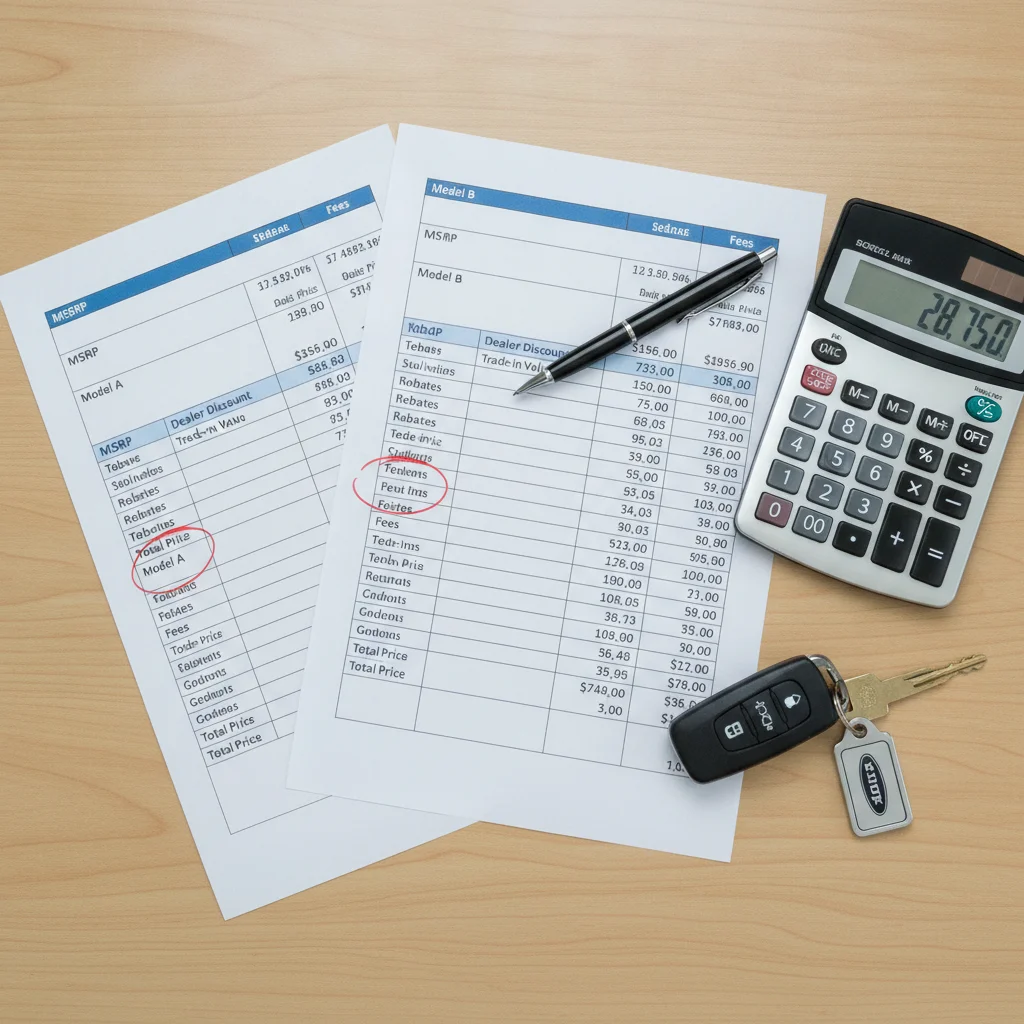
Once you have written quotes, put them side by side in a spreadsheet. Look at OTD price — not vehicle price alone, since doc fees and add-ons vary widely by dealer. A $500 lower vehicle price can easily be erased by a $700 doc fee difference.
Take the best OTD quote to your preferred dealer (ideally the one with the vehicle you actually want) and give them the opportunity to match or beat it. You're not bluffing — you have a real number in writing.
Negotiate the Vehicle Price — Separate from Everything Else
When you sit down, open with the purchase price. Not the payment, not the trade, not financing. Just the number for the car itself. Use your competing OTD quote as your opening position: "I have a written offer from [Dealer X] for $[OTD amount]. Can you match or beat that?"
From there, counter-offer in small increments and ask the dealer to justify any number that's higher than your best quote. Make them work down to your number, not the other way around.
Introduce the Trade-In Only After the Purchase Price Is Agreed
Once you have a signed or firm written agreement on the purchase price, tell them you have a trade. Present your independent appraisals from CarMax and/or Carvana. Tell them: "I have a written offer for $[X] for my trade. Can you beat that?"
If the dealer comes in below your independent offer, you're generally better off selling the car separately — unless the difference is small enough that the tax offset from a trade-in (in most states, you only pay sales tax on the difference between new car price and trade value) closes the gap.
Evaluate the Dealer's Financing Offer Against Your Pre-Approval
Only after price and trade are settled should you discuss financing. Show the dealer your pre-approval rate and ask: "Can you beat this?" Dealers often can, especially if the manufacturer is offering subsidized financing (e.g., 2.9% APR for 60 months on select models). But they can only beat it if they know what they're competing against.
If dealer financing is better, use it. If not, use your pre-approval. Either way, negotiate the term — shorter terms mean less total interest paid even at the same rate.
Review the Final Paperwork Line by Line
Before signing anything, request the buyer's order and read every line. Look for added products you didn't agree to: VIN etching, nitrogen in tires, paint sealant, security system add-ons. These are almost always dealer-profit items added after negotiation. Ask for them to be removed if you didn't specifically agree to them.
Confirm the OTD total matches what was agreed. If anything changed — even by a small amount — ask for an explanation before signing. Errors and intentional additions both happen at this stage.
Once you've locked in the vehicle price and financing, the F&I office will attempt to sell you add-ons: extended warranties, paint protection, GAP insurance, tire-and-wheel coverage, and more. Each of these has a markup. None of them need to be decided on the spot. Ask for itemized pricing on anything you want and tell them you'll follow up — dealers almost always accommodate this to close the car deal itself.
F&I Add-Ons Are Where Profit Hides
The finance and insurance office is where many dealers recoup concessions made on price. Extended warranties, GAP insurance, and protection packages can add $1,500–$4,000 to the deal if accepted without scrutiny. GAP insurance in particular can often be purchased from your insurance company at a fraction of the dealer price. Never decide on F&I products the same day without comparison pricing.
Don't Confuse a Lower Payment With a Better Deal
A monthly payment can be lowered by extending the loan term from 60 to 72 or 84 months — but the total interest paid increases significantly. On a $35,000 loan at 7% APR, extending from 60 to 84 months drops the payment by roughly $100/month but costs over $2,800 more in total interest. Always compare total cost of the loan, not just the payment.
Common Dealer Tactics and How to Counter Them
Even well-prepared buyers get thrown off by certain in-dealership moves. Here are the most common ones and exactly what to say when you encounter them.
The Four-Square Worksheet
Many dealerships use a worksheet divided into four quadrants: purchase price, trade-in value, down payment, and monthly payment. The goal is to keep you focused on one box at a time so adjustments in one quadrant obscure changes in another. Response: Decline to work from the four-square. Say, "I'd like to agree on the out-the-door purchase price first, and we can discuss financing separately."
The Monthly Payment Pivot
"What monthly payment are you comfortable with?" is one of the most profitable questions a salesperson can ask. Once you answer it, they have a target to work backward from — and they can hit that number by extending the loan term rather than lowering the price. Why dealers prefer to negotiate monthly payments explains this in full. Response: "I'm focused on the vehicle price and total cost of the loan. I'll worry about the payment after we agree on price."
The Manager's Approval Stall
A salesperson who needs to "check with my manager" on every counter is using a delay tactic designed to wear you down. It also manufactures the appearance of concessions being hard-won. Response: Set a time boundary. "I have about an hour here today. If we can't get to a number that works, I'll follow up by email." Then actually be willing to leave.
The Trade-In Bundle
Dealers frequently offer an inflated trade-in value while simultaneously raising the vehicle price — or vice versa. The net result looks like a deal but isn't. Response: Negotiate the new car price to a final agreed number before introducing your trade. If you have a trade, use competing trade-in offers to establish its value before you walk in.
Email Gives You a Paper Trail
Any price a dealer commits to verbally can disappear the moment you sit down. Confirm every agreed number via email or text before driving in — something as simple as 'To confirm, your OTD price for the [Vehicle] is $[X]. I'll see you Thursday at 10am.' A written confirmation eliminates later 'that's not what we said' situations.
Ask for the Dealer Doc Fee Upfront
Documentation fees (doc fees) are partially or fully capped by state law in many states, but the cap varies widely — from under $100 in some states to $700+ in others. Ask the dealer's doc fee on your first call. It's a legitimate line item, but knowing it early prevents sticker shock in the finance office.
End-of-Month Timing Works
Sales quotas reset monthly at most dealerships. During the last three to five days of the month, salespeople and managers are often motivated to close deals to hit their numbers. You won't get a car for free, but this timing consistently produces more willingness to close on your terms rather than theirs.
The Lowball Trade-In
Even when you negotiate separately, dealers will often come in 15–25% below what an independent buyer or CarMax would pay for your trade. Know your car's actual market value from at least three sources — Carmax, KBB Instant Cash Offer, and Carvana — before accepting any dealer number. The dealer trade-in hub has more on how appraisals work and what affects them.
Negotiating Online vs. In Person: Choosing Your Arena
Most of the steps in this guide are built around an in-person negotiation, but a significant portion of the prep work — and sometimes the entire deal — can be done via email. Email negotiation gives you a paper trail, removes time pressure, and lets you compare offers side by side without a salesperson in your peripheral vision.
Email negotiation vs. in-person negotiation covers the trade-offs in depth. The short version: email works best when you've already identified the exact vehicle and trim, and when multiple dealers have that configuration in stock. In-person becomes necessary when you need to see, test, and confirm the specific unit before committing.
A hybrid approach works well for most buyers: use email to get three written OTD quotes, then visit the single dealer with the best number to finalize. At that point, you're not negotiating from scratch — you're verifying and closing.

If you're weighing whether to skip the dealership entirely and use an online retailer like Carvana or a buying service like Costco Auto, that's a different trade-off. Negotiating at the dealership vs. buying online breaks down what each approach costs and saves in real dollar terms.
Never Reveal Your Budget to a Salesperson
The moment you say 'I'm looking to spend around $40,000,' the dealer's target becomes $40,000 — regardless of what the car is actually worth. Your budget is irrelevant to the negotiation; the vehicle's market value is what matters. If asked directly, say: 'I'm focused on getting a fair price for this car, and I'll figure out how it fits my budget from there.'
Out-the-Door Price Is the Only Number That Matters
Vehicle price, trade-in allowance, monthly payment, and down payment are all components that dealers can shift to obscure the real cost. The out-the-door price — the total amount you actually pay — is the only number that enables honest comparison between dealers and between financing scenarios. Refuse to negotiate in any other frame.
When to Walk Away — and What Usually Happens Next
Walking away isn't a bluff. It's the most underused tool in a buyer's kit, and it works precisely because it's rare. Most buyers don't walk — they negotiate until they're exhausted and sign something they're not entirely comfortable with. When you actually leave, you signal that you have alternatives and a real price floor.
Walking away from a dealership as a strategy is detailed in its own guide, but the core principle applies here: walk when negotiations have stalled and you've made your best offer clear. Don't storm out — leave politely and leave the door open.
In practice, about 40–60% of buyers who leave a dealership after a serious negotiation get a follow-up call within 24–48 hours. Sometimes the offer is better. Sometimes it's the same. Either way, you've tested the floor. If they don't call, you move on to the next dealer with better information than you had before.

One final note: the best time to buy is generally the last few days of the month, when salespeople are working against quota. Year-end clearance events in November and December also produce real discounts — not manufactured urgency, but actual inventory pressure. Timing isn't everything, but it's worth a few hundred dollars when layered on top of everything else in this guide.
Never Reveal Your Budget to a Salesperson
The moment you say 'I'm looking to spend around $40,000,' the dealer's target becomes $40,000 — regardless of what the car is actually worth. Your budget is irrelevant to the negotiation; the vehicle's market value is what matters. If asked directly, say: 'I'm focused on getting a fair price for this car, and I'll figure out how it fits my budget from there.'
Out-the-Door Price Is the Only Number That Matters
Vehicle price, trade-in allowance, monthly payment, and down payment are all components that dealers can shift to obscure the real cost. The out-the-door price — the total amount you actually pay — is the only number that enables honest comparison between dealers and between financing scenarios. Refuse to negotiate in any other frame.
All claims are backed by peer-reviewed research. Sources on request.