Key Takeaways
Simplifies the transaction into one visit
Trading in handles your current vehicle and your next purchase in one place, avoiding the time and complexity of a parallel private sale. For buyers with time constraints or a car that's difficult to sell privately, this convenience has real value.
Eliminates the need to manage a private-party loan payoff
When you have a loan on the car, selling privately requires coordinating with your lender, potentially getting a title released temporarily, and managing the payoff timing with the buyer. A dealer handles all of this directly with your lender.
Lets you move out of a high-maintenance vehicle now
If your current car is becoming unreliable or expensive to maintain, waiting to sell privately while it racks up repair bills can cost more than rolling over a modest negative equity balance.
May qualify for sales tax offset in many states
In most U.S. states, you only pay sales tax on the difference between the new vehicle's price and your trade-in allowance — not the full purchase price. This can save hundreds to over a thousand dollars depending on your state and the trade-in value.
Keeps your timeline on track for the new purchase
If you need a new vehicle for work, family, or reliability reasons, a trade-in lets you move quickly without waiting weeks or months for a private buyer to materialize.
Rolled-over debt means you start underwater again
Financing your negative equity into a new loan means you owe more than the new car's value from the moment you drive off the lot. If you need to sell or trade within the next 12–24 months, you'll face the same problem — likely worse.
Dealers may lowball your trade to widen the gap
Without competing offers in hand, you have no leverage to push back on a below-market appraisal. A $2,000 undervaluation on your trade-in adds $2,000 directly to the negative equity you're rolling over.
Interest accrues on the rolled balance for years
A $4,000 negative equity rollover at 7% APR over 60 months costs roughly $750 in additional interest — money you're paying on debt from a car you no longer own.
Obscures total cost in bundled dealer math
Dealers routinely bury the rolled-over balance in the total amount financed, making it easy to miss on the contract. If you're focused on monthly payment rather than total loan amount, you may not catch it until after signing.
Gap insurance may not cover rolled-over equity
Standard GAP insurance covers the difference between your loan balance and the car's ACV (actual cash value) in a total loss — but some policies exclude previously rolled-over negative equity. Read the policy terms carefully before assuming you're protected.
High-rate financing amplifies the damage
If you're financing the new vehicle at 9–12% APR (common for buyers with credit challenges), the cost of carrying a rolled-over balance becomes significantly more expensive over a 60–72 month term.
Our Verdict
Trading in a car with negative equity isn't a dead end, but it is a financial transaction you need to enter with your eyes open. Done carefully — with multiple competing offers in hand and a clear understanding of what the rollover will cost you — it's manageable. Done carelessly, it compounds debt and leaves you even more upside-down on your next loan.
Best for buyers who have a concrete plan to minimize the shortfall, are financing a reliable, lower-cost vehicle, and have shopped at least three trade-in quotes before stepping into a dealership.
What Negative Equity Actually Means in a Trade-In
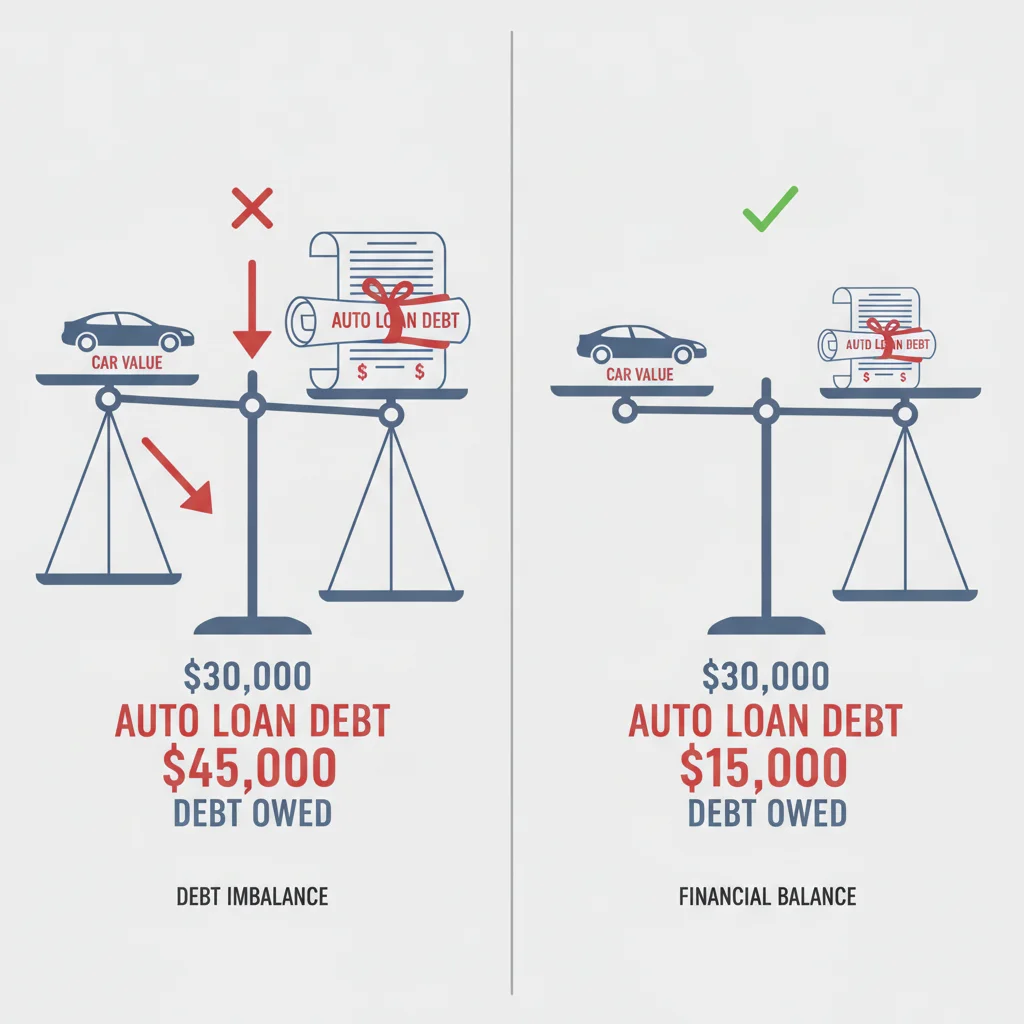
Negative equity — also called being "upside-down" or "underwater" — means your loan payoff balance is higher than what the car is actually worth on the market. For example, if you owe $18,000 on a vehicle a dealer appraises at $13,500, you have $4,500 in negative equity. That gap doesn't disappear when you trade in. It follows you.
The most common reason buyers end up here: they financed with a small or zero down payment, chose a long loan term (72 or 84 months), or bought a vehicle that depreciated faster than their loan amortized. Sometimes all three. New vehicles lose roughly 15–25% of their value in the first year alone, and if your loan isn't structured to keep pace with that drop, you're underwater almost immediately.
Understanding the mechanics of the upside-down car loan before you trade is critical — because whatever shortfall exists, you're going to pay it one way or another. The only question is how, and at what cost.
How Dealers Handle the Shortfall
When you trade in a vehicle with negative equity, dealers have one standard move: roll the difference into your new loan. If you're $4,500 upside-down and you're buying a $28,000 car, the dealer effectively finances $32,500 instead of $28,000 — often without making that math obvious on the paperwork.
This matters for several reasons. First, you're borrowing more than the new car's value from day one, which means you start underwater on the second vehicle too. Second, interest accrues on that rolled-over balance, so a $4,500 shortfall can cost you $600–$1,000 more in interest over a typical 60-month loan at 7% APR. Third, if you need to sell or trade again before paying down the new loan substantially, the problem multiplies.
How Dealers Disclose the Rollover
Federal law requires dealers to disclose the total amount financed on your contract, which will include the rolled-over balance. However, it's rarely broken out as a separate line item labeled 'negative equity.' Look at the total amount financed on the retail installment contract and compare it to the agreed new vehicle price plus taxes and fees. If it's higher, the difference is your rolled-over shortfall. Always verify this before signing.
Check Your GAP Coverage Terms
If you're rolling over negative equity into a new loan, GAP insurance becomes especially important — but also more complicated. Some policies cap coverage at 125% of the vehicle's ACV, which may not fully cover a large rolled-over balance. If you already have GAP through your current lender, it doesn't carry over to the new loan. Purchase new GAP coverage through your insurer rather than the dealer F&I office; it's typically 30–50% cheaper that way.
See the full breakdown of what this looks like paperwork-side in our guide on trading in a car with existing financing, which covers how dealers handle the payoff process and what to watch for in the contract.
~32%
U.S. trade-ins with negative equity
According to Edmunds data, roughly one in three trade-ins involves the owner owing more than the vehicle's market value.
$6,054
Average negative equity per upside-down trade
Edmunds reported the average shortfall on underwater trade-ins reached over $6,000 in recent quarters, a record high driven by pandemic-era financing.
15–25%
New car depreciation in year one
Most new vehicles lose 15 to 25 percent of their value in the first 12 months, outpacing early loan amortization for buyers who financed with little or no down payment.
10–20%
Private sale premium over dealer trade-in
Consistently across vehicle segments, private party sale prices run 10 to 20 percent higher than what dealers offer at trade-in, per Kelley Blue Book market data.
Tactics to Avoid Getting Lowballed on the Trade
The single biggest mistake sellers make is walking into a dealership without knowing what their car is actually worth. Dealers know most people don't. That information gap is where lowball offers happen — and when you're already underwater, a below-market appraisal makes your gap even worse.
Get at least three competing offers before you negotiate
Use Carmax, Carvana, and a regional dealer franchise to get written quotes on your car before you set foot in a sales negotiation. These are real cash offers with a short validity window (usually 7 days). Bring them with you. A dealer who sees you have a $13,500 offer from Carvana isn't going to open with $11,800 and expect you to accept it.
Separate the trade-in negotiation from the purchase negotiation
Dealers are expert at bundling your trade-in value, your new car price, your financing rate, and your monthly payment into one blurry number. Don't let them. Negotiate your trade-in value as a standalone figure first, get it committed in writing, then move to the new vehicle price, and finally discuss financing. This prevents the dealer from quietly reducing your trade-in offer while appearing to give you a deal on the purchase price.
Know your payoff amount before you walk in
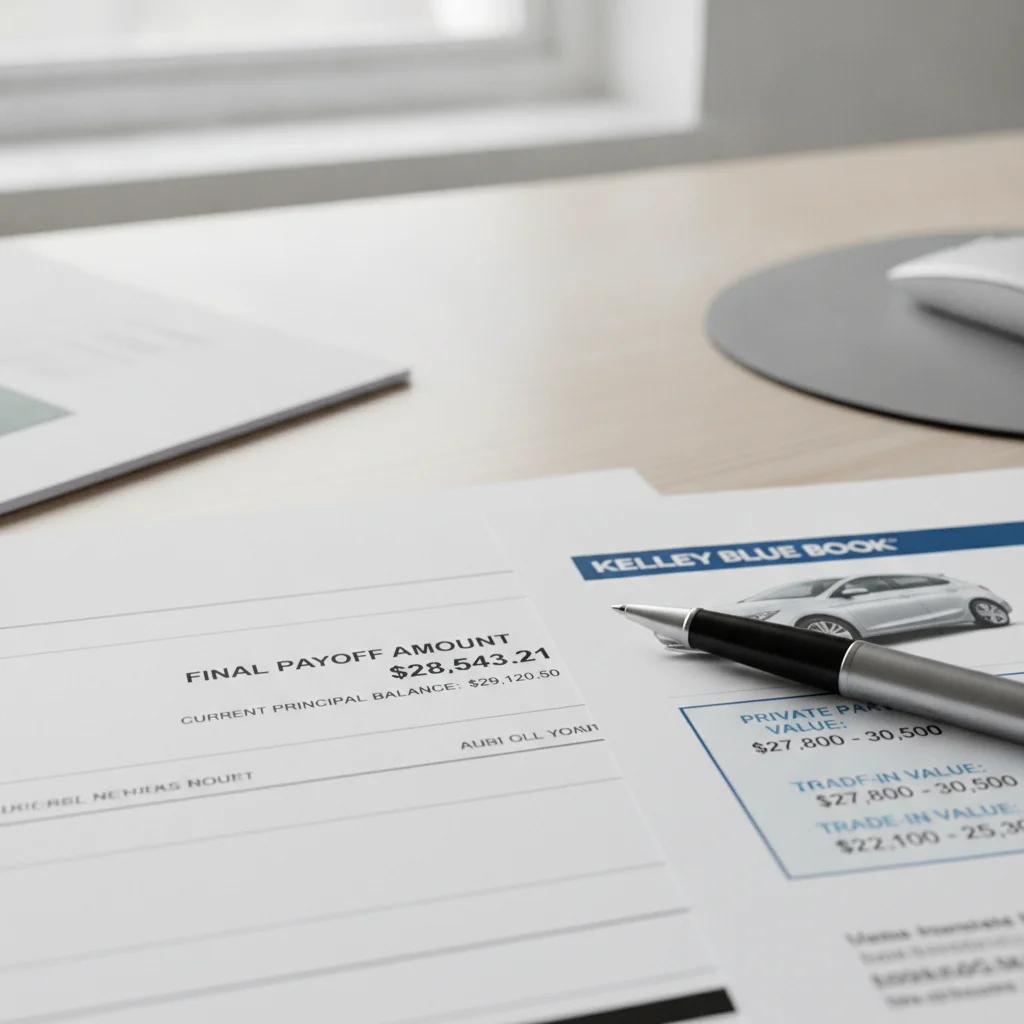
Call your lender the morning of your appointment and get a 10-day payoff quote — not a balance quote. Payoff includes any accrued interest through the payoff date. This is the number that matters. The difference between this and your best trade-in offer is your true negative equity figure.

For broader negotiation strategy with dealers, the dealer negotiation hub covers the full playbook, including how to handle financing pressure and add-on upsells.
Pros of Trading In With Negative Equity
There are legitimate reasons to proceed with a trade-in even when you're upside-down. The key is knowing what you're trading off against the convenience.
Simplifies the transaction into one visit
Trading in handles your current vehicle and your next purchase in one place, avoiding the time and complexity of a parallel private sale. For buyers with time constraints or a car that's difficult to sell privately, this convenience has real value.
Eliminates the need to manage a private-party loan payoff
When you have a loan on the car, selling privately requires coordinating with your lender, potentially getting a title released temporarily, and managing the payoff timing with the buyer. A dealer handles all of this directly with your lender.
Lets you move out of a high-maintenance vehicle now
If your current car is becoming unreliable or expensive to maintain, waiting to sell privately while it racks up repair bills can cost more than rolling over a modest negative equity balance.
May qualify for sales tax offset in many states
In most U.S. states, you only pay sales tax on the difference between the new vehicle's price and your trade-in allowance — not the full purchase price. This can save hundreds to over a thousand dollars depending on your state and the trade-in value.
Keeps your timeline on track for the new purchase
If you need a new vehicle for work, family, or reliability reasons, a trade-in lets you move quickly without waiting weeks or months for a private buyer to materialize.
Cons of Trading In With Negative Equity
The risks here are real and quantifiable. Before signing anything, you need to understand exactly what rolling over negative equity costs you in concrete dollar terms.
Rolled-over debt means you start underwater again
Financing your negative equity into a new loan means you owe more than the new car's value from the moment you drive off the lot. If you need to sell or trade within the next 12–24 months, you'll face the same problem — likely worse.
Dealers may lowball your trade to widen the gap
Without competing offers in hand, you have no leverage to push back on a below-market appraisal. A $2,000 undervaluation on your trade-in adds $2,000 directly to the negative equity you're rolling over.
Interest accrues on the rolled balance for years
A $4,000 negative equity rollover at 7% APR over 60 months costs roughly $750 in additional interest — money you're paying on debt from a car you no longer own.
Obscures total cost in bundled dealer math
Dealers routinely bury the rolled-over balance in the total amount financed, making it easy to miss on the contract. If you're focused on monthly payment rather than total loan amount, you may not catch it until after signing.
Gap insurance may not cover rolled-over equity
Standard GAP insurance covers the difference between your loan balance and the car's ACV (actual cash value) in a total loss — but some policies exclude previously rolled-over negative equity. Read the policy terms carefully before assuming you're protected.
High-rate financing amplifies the damage
If you're financing the new vehicle at 9–12% APR (common for buyers with credit challenges), the cost of carrying a rolled-over balance becomes significantly more expensive over a 60–72 month term.
Alternatives Worth Considering First
A trade-in with negative equity isn't always the right move. Before you commit, run through these alternatives and decide if one makes more financial sense for your situation.
Sell privately to eliminate the gap faster
Private party sales consistently return 10–20% more than dealer trade-in offers. On a $13,500 vehicle, that could mean $15,000–$16,200 from a private buyer, meaningfully narrowing or eliminating your negative equity gap. The tradeoff is time, effort, and the complexity of managing a loan payoff with a private sale — your lender will need to be involved since the title isn't free and clear.
Make a lump-sum payment to bring the loan closer to par
If you have savings or can access cash, applying even $1,500–$2,000 to your principal before trading in reduces the negative equity you'd otherwise roll over. That directly lowers your new loan amount and the interest you'll pay on it.
Wait and pay down the loan on an accelerated schedule
Adding $100–$200 per month to your principal payment can move you from upside-down to break-even faster than you'd expect — particularly in years 3–4 of a 60-month loan, when depreciation slows and amortization catches up. This works best if your current vehicle is reliable and you don't urgently need to switch.
If your vehicle is actually a lease, the calculation changes significantly. The leased car trade-in guide explains residual value, equity checks, and early termination fees that apply in that scenario.
If early payoff is your primary goal, see how paying off early while underwater changes your strategy, especially if rates have shifted since you originally financed.

When a Trade-In With Negative Equity Actually Makes Sense
There are situations where proceeding with the trade-in, despite negative equity, is the rational call:
- Your current vehicle is unreliable and repair costs are climbing. If you're facing a $2,800 transmission repair on a car with $3,500 in negative equity, rolling over the shortfall may be cheaper than the alternative — especially if the car's reliability will only worsen.
- Your negative equity gap is small — under $2,000. A modest shortfall rolled into a well-priced vehicle at a reasonable rate adds limited risk. The math is manageable.
- You're moving to a significantly cheaper vehicle. Trading a $35,000 SUV (with a large loan) for a $18,000 sedan means your new loan, even with rolled-over equity, could be lower than your current payment.
- You've secured a low APR on the new loan. At 3–4% APR, the interest cost of a rolled-over $3,000 balance is far less painful than at 9–10% APR.
The full suite of trade-in strategies covers how to maximize value across different scenarios — not just negative equity situations.
The reverse is also true: if your gap is large (over $5,000), your new vehicle is expensive, your rate is high, or you're early in a long loan term on the new car, the compounding risk makes the trade-in a poor financial move. In that case, one of the alternatives above will serve you better.
How Dealers Disclose the Rollover
Federal law requires dealers to disclose the total amount financed on your contract, which will include the rolled-over balance. However, it's rarely broken out as a separate line item labeled 'negative equity.' Look at the total amount financed on the retail installment contract and compare it to the agreed new vehicle price plus taxes and fees. If it's higher, the difference is your rolled-over shortfall. Always verify this before signing.
Check Your GAP Coverage Terms
If you're rolling over negative equity into a new loan, GAP insurance becomes especially important — but also more complicated. Some policies cap coverage at 125% of the vehicle's ACV, which may not fully cover a large rolled-over balance. If you already have GAP through your current lender, it doesn't carry over to the new loan. Purchase new GAP coverage through your insurer rather than the dealer F&I office; it's typically 30–50% cheaper that way.

All claims are backed by peer-reviewed research. Sources on request.