
| Most common loan terms | 48, 60, 72, and 84 months (Experian State of the Automotive Finance Market, 2024) |
| Average new car loan term | 68.5 months (Experian State of the Automotive Finance Market, Q1 2024) |
| Allowable dealer rate markup (typical cap) | 1–3 percentage points above buy rate (CFPB dealer markup guidance) |
| Loan type used in most auto loans | Simple interest, fixed rate |
| Federal disclosure required before signing | Truth in Lending Act (TILA) disclosure (15 U.S.C. § 1601 et seq.) |
| Down payment recommended (new car) | 20% or more (Consumer financial planning standard) |
Why Loan Vocabulary Matters Before You Sign
Most car buyers spend more time researching trim levels than reading their loan contracts. That's understandable — loan paperwork is dense, and dealership finance offices aren't always eager to slow down and explain every line. But the terms buried in that contract directly determine how much you pay, for how long, and what happens if circumstances change.
This glossary covers 25 terms you'll encounter in virtually any auto loan situation — whether you're shopping for a preapproval offer, sitting in the finance office, or considering early payoff. Each definition is written in plain language, with context about why the term matters to your bottom line.
If you want a deeper look at how these concepts interact inside an actual loan agreement, see Auto Loan Terms, Decoded. For a complete introduction to how auto loans are structured from start to finish, Everything You Need to Know Before Signing an Auto Loan is a strong companion read.
| Most common loan terms | 48, 60, 72, and 84 months (Experian State of the Automotive Finance Market, 2024) |
| Average new car loan term | 68.5 months (Experian State of the Automotive Finance Market, Q1 2024) |
| Allowable dealer rate markup (typical cap) | 1–3 percentage points above buy rate (CFPB dealer markup guidance) |
| Loan type used in most auto loans | Simple interest, fixed rate |
| Federal disclosure required before signing | Truth in Lending Act (TILA) disclosure (15 U.S.C. § 1601 et seq.) |
| Down payment recommended (new car) | 20% or more (Consumer financial planning standard) |
Core Loan Structure Terms (1–8)
These are the foundational terms that define what you're borrowing and what it will cost. Every other term in your contract builds on these concepts.

1. Principal
The principal is the base amount you borrow — not counting interest or fees. If you finance $28,000 to buy a car, your principal is $28,000. Over time, your payments chip away at the principal balance. Early in the loan, a larger share of each payment goes toward interest; later, more goes toward principal. This is called amortization (see term 3).
2. Annual Percentage Rate (APR)
APR expresses the true annual cost of your loan as a percentage. It includes the interest rate plus most fees, so it gives a more complete picture of loan cost than the interest rate alone. A loan advertised at 6.9% interest might have an APR of 7.1% once fees are folded in. Always compare APRs — not just interest rates — when shopping lenders. For a plain-language breakdown of how APR works, see Auto Loan Interest: A Plain-English Glossary.
3. Amortization
Amortization is the process of paying off a loan through scheduled payments over time. Each payment covers both interest and a portion of principal, but the split changes. In a fully amortized loan, your last payment zeroes out the balance exactly. An amortization schedule is a table showing exactly how each payment is divided across the life of the loan — ask your lender for one before you sign.
4. Loan Term
The loan term is the length of time you have to repay the loan, expressed in months. Common auto loan terms are 36, 48, 60, 72, and 84 months. A longer term reduces your monthly payment but significantly increases total interest paid. A shorter term costs more per month but builds equity faster and reduces overall expense. Term length is one of the most consequential decisions you'll make — and one of the most underestimated.
68.5 months
Average new car loan term in the U.S.
According to Experian's State of the Automotive Finance Market report, Q1 2024.
$23,000+
Extra interest paid on 84-month vs. 48-month loan
Illustrative calculation on a $35,000 loan at 7% APR comparing a 48-month term to an 84-month term.
38%
Share of new car trade-ins with negative equity
Reported by Edmunds Q4 2023 industry analysis of financed trade-in transactions.
1–3%
Typical dealer rate markup above buy rate
Based on CFPB guidance on dealer reserve and rate markup practices in indirect auto lending.
5. Monthly Payment
Your monthly payment is the fixed amount due each month, determined by the principal, APR, and loan term. It does not change in a fixed-rate loan. Dealers frequently structure deals around monthly payment rather than total cost — a tactic that can lead buyers to accept longer terms or higher prices. Always work from total cost first, then monthly payment.
6. Finance Charge
The finance charge is the total dollar amount the loan costs you in interest and fees over its full term. If you borrow $25,000 at 7% for 60 months, your finance charge is roughly $4,680. This number appears on your Truth in Lending Act (TILA) disclosure — a federal document lenders are required to provide. Review it carefully.
7. Down Payment
A down payment is cash (or trade-in equity) you put toward the purchase upfront, reducing the amount you need to finance. A larger down payment lowers your principal, reduces interest paid, and protects you against being underwater on the loan. Most lenders recommend at least 10% down on a used car and 20% on a new one.
8. Capitalized Cost
More commonly used in lease agreements, capitalized cost (or "cap cost") is the total agreed-upon value of the vehicle being financed or leased. In a loan context, it's effectively the selling price before subtracting your down payment. Reducing the cap cost through negotiation or a larger down payment lowers your financed amount.
Interest and Rate Terms (9–15)
Interest is where lenders make their money — and where borrowers can lose the most if they're not paying attention. These terms govern exactly how interest accumulates and what you're locked into.

9. Simple Interest
Most auto loans use simple interest, which means interest accrues daily on your current outstanding principal balance. The formula: Principal × Daily Rate × Days Since Last Payment. If you pay early, less interest has accrued and more of your payment goes to principal. If you pay late, you've accumulated extra interest. Paying consistently on time — or even a few days early — benefits you meaningfully over a 60- or 72-month loan.
10. Precomputed Interest
In a precomputed interest loan, the total interest is calculated upfront and added to the loan balance before you begin making payments. This matters enormously if you plan to pay off the loan early. Because the interest is already baked in, you don't automatically save on interest by paying ahead — unless the lender applies a "Rule of 78s" or actuarial refund method. Always ask whether your loan uses simple or precomputed interest. See Auto Loan Early Payoff Terms for a full breakdown of why this distinction matters.
11. Fixed Interest Rate
A fixed rate stays the same for the entire loan term. Your APR, monthly payment, and amortization schedule are set at origination and do not change. Almost all auto loans are fixed-rate, which makes budgeting predictable. If rates drop after you originate, refinancing may be worth exploring.
12. Variable Interest Rate
A variable (or adjustable) rate can change over time based on a benchmark rate like the prime rate. Variable-rate auto loans are rare but do exist. They introduce uncertainty — your payment could increase — and are generally worth avoiding unless the initial rate discount is substantial and the loan term is short.
13. Buy Rate
The buy rate is the interest rate a lender offers to a dealer for a borrower with a given credit profile. Dealers are typically allowed to mark it up — often by 1–3 percentage points — and pocket the difference as compensation. The rate you're quoted in the finance office is often higher than the buy rate. Getting a competing preapproval from a bank or credit union before visiting the dealer gives you leverage to push back.
14. Dealer Markup
Dealer markup (also called dealer reserve) is the difference between the buy rate and the rate the dealer charges you. Regulations vary by state, and some lenders cap the allowable markup. Knowing this term helps you understand that the rate on your contract is negotiable — not just the price of the car. Reference Preapproval Terms Defined for more on how preapproval protects you here.
15. Effective Interest Rate
The effective interest rate accounts for compounding — how often interest is calculated and added to the balance. In most simple-interest auto loans, this closely mirrors the nominal rate, but it's worth confirming. In products with fees or compounding, the effective rate can be notably higher than the stated rate.
Simple vs. Precomputed: Ask Before You Sign
The type of interest your loan uses — simple or precomputed — has a significant impact on the value of paying early. Simple interest loans reward early payment because less interest has accrued. Precomputed loans may not, depending on the refund method used. This distinction is rarely volunteered in the finance office. Ask your lender directly and request written confirmation of which method applies.
TILA Disclosure: Your Comparison Tool
The Truth in Lending Act (TILA) requires every lender to give you a standardized disclosure before you sign. It shows APR, total finance charge, amount financed, and total repayment amount. If you have preapproval offers from multiple lenders, compare them using TILA disclosures side by side — it's the clearest apples-to-apples view available. Never agree to financing without reviewing this document first.
Dealer Financing vs. Direct Lending
When you finance through a dealership, the dealer acts as a middleman between you and the lender. This convenience can come at a cost — dealers may mark up the interest rate and earn what's called dealer reserve. Getting a preapproval directly from a bank or credit union before your dealership visit gives you a baseline rate to compare against. Visit our <a href="/auto-loans/credit-and-approval/loan-preapproval">Loan Preapproval hub</a> for guidance on how to secure one.
Vehicle Value and Equity Terms (16–20)
Auto loans are secured by the vehicle itself, which means the car's value relative to what you owe has direct financial consequences. These terms explain that relationship.
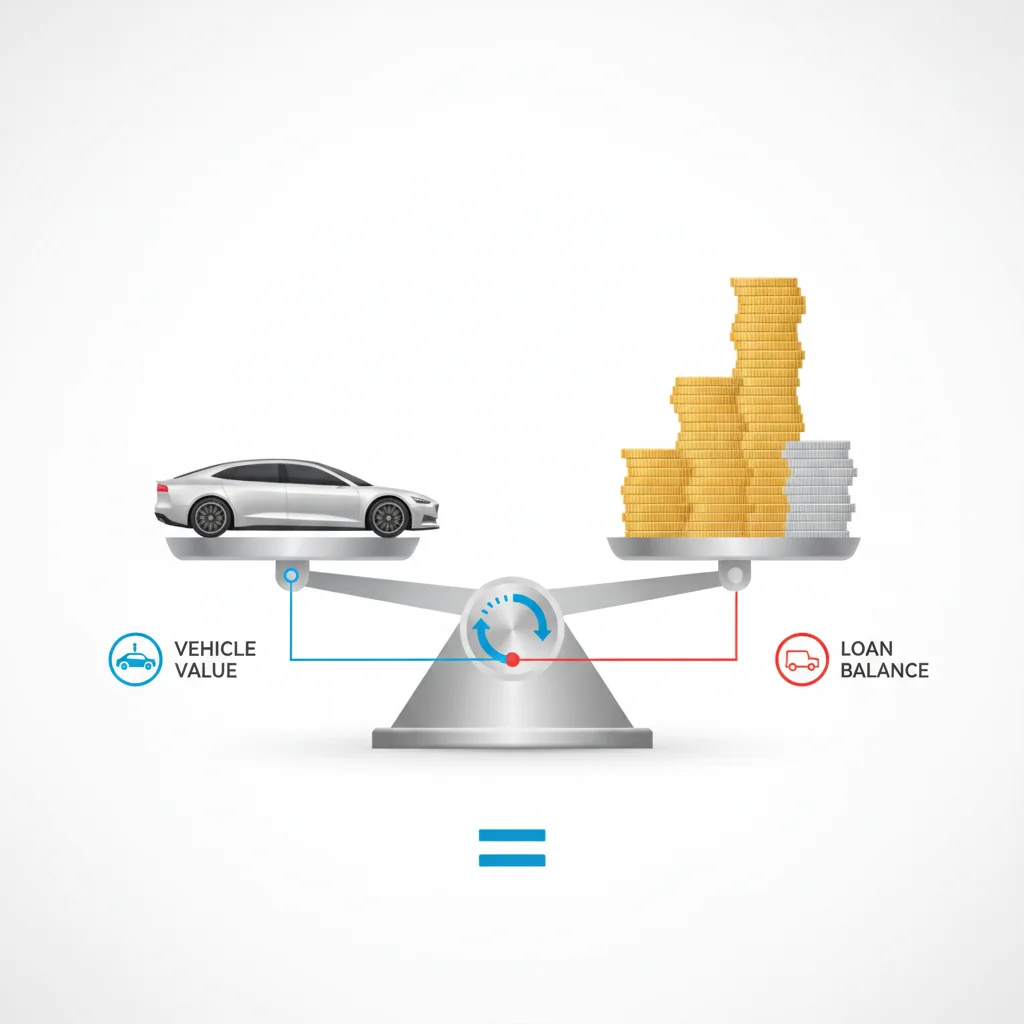
16. Loan-to-Value Ratio (LTV)
LTV is the ratio of your loan balance to the vehicle's market value. If you owe $22,000 on a car worth $20,000, your LTV is 110%. Lenders set maximum LTV thresholds — often 100–125% depending on credit and loan type. High LTV signals risk. It typically leads to a higher interest rate and makes refinancing harder. For context on how valuation is assessed, see Car Valuation Terminology.
17. Equity
Equity is the portion of the vehicle's value that you own outright — market value minus loan balance. Positive equity means the car is worth more than you owe. Negative equity (being "underwater") means the opposite. New cars depreciate fastest in the first two years, which is why buyers with small down payments often end up underwater early in the loan.
18. Negative Equity (Upside Down)
You're upside down on a loan when you owe more than the car is worth. This becomes a serious problem if you need to sell, trade in, or total the vehicle — you'd still owe the remaining balance above what the car's value covers. Dealers sometimes offer to "roll" negative equity from your current car into a new loan, increasing your starting principal. Be cautious with this approach; it compounds the problem.
19. GAP Coverage (Guaranteed Asset Protection)
GAP coverage is an add-on product that pays the difference between your loan payoff amount and your insurance settlement if your car is totaled or stolen. It's most relevant when your LTV is high and depreciation would leave you owing more than the payout. GAP is often sold in the finance office — compare the dealer's price against what your auto insurer charges for the same coverage, as the insurer's version is almost always cheaper.
20. Residual Value
Residual value is the estimated market value of a vehicle at the end of a lease or loan term. In leasing, the residual value determines your buyout price and monthly payment. In loan contexts, it's useful for understanding depreciation exposure. Vehicles with high residual values (like certain trucks and luxury crossovers) retain value better, which reduces underwater risk.
Contract and Closing Terms (21–25)
Once you've agreed on a price and rate, the paperwork begins. These five terms cover what you'll sign — and what the fine print means.
Principal
The original loan amount borrowed, excluding interest and fees. Monthly payments gradually reduce the principal balance over the life of the loan.
APR (Annual Percentage Rate)
The annualized cost of borrowing, including the interest rate and most lender fees. APR is the most accurate figure for comparing loan offers from different lenders.
Amortization
The schedule by which loan payments are split between interest and principal over time. Early payments are interest-heavy; later payments reduce principal more aggressively.
Loan-to-Value Ratio (LTV)
The ratio of your outstanding loan balance to the vehicle's current market value. High LTV means you owe close to — or more than — what the car is worth.
Negative Equity
A situation where you owe more on a loan than the vehicle is currently worth. Also called being "upside down" or "underwater" on the loan.
Precomputed Interest
A loan structure where total interest is calculated at origination and built into the balance before payments begin. Early payoff does not automatically reduce interest unless a refund method is applied.
GAP Coverage
Guaranteed Asset Protection — an insurance product that covers the difference between your loan payoff and an insurance settlement if your car is totaled or stolen.
Deficiency Balance
The amount still owed on a loan after a repossessed vehicle is sold at auction for less than the outstanding balance. Borrowers remain legally liable for this amount.
RISC (Retail Installment Sales Contract)
The primary legal document signed in a dealership finance office. It contains all terms of the vehicle sale and financing agreement.
Buy Rate
The interest rate a lender offers to the dealer for a specific borrower. Dealers may mark this up before presenting the rate to the buyer.
Finance Charge
The total dollar cost of the loan in interest and fees over the full repayment period. Disclosed on the TILA form before signing.
Balloon Payment
A large lump-sum payment due at the end of a loan term, following a series of smaller monthly installments. Common in non-standard loan structures.
21. Retail Installment Sales Contract (RISC)
The RISC is the primary legal document for a financed vehicle purchase. It outlines the vehicle details, selling price, down payment, financed amount, APR, loan term, payment schedule, and all lender rights. This is the contract you sign in the finance office — not a simple loan note. When shopping at a dealership, the RISC replaces the traditional bank loan agreement. Read every line. Any verbal promise not in the RISC is unenforceable. For a guided walkthrough of dealership paperwork, visit the Paperwork & Contracts hub.
22. Prepayment Penalty
Some loans charge a fee if you pay off the balance early — to compensate the lender for lost interest. Prepayment penalties are more common in precomputed interest loans. Federal law restricts them on certain loan types, but they do appear in auto lending. Before signing, explicitly ask: "Does this loan have a prepayment penalty?" If the answer is yes, get the amount in writing and factor it into any early payoff calculations.
23. Balloon Payment
A balloon payment is a large lump-sum payment due at the end of a loan — typically after a series of smaller monthly payments. Some buyers use balloon loans to reduce monthly costs, planning to refinance or sell before the balloon is due. This strategy carries real risk: if the car has depreciated significantly or your credit has weakened, refinancing may not be possible at a favorable rate.
24. Truth in Lending Act (TILA) Disclosure
TILA is a federal law requiring lenders to clearly disclose the APR, finance charge, amount financed, and total of all payments before you sign. This disclosure is your baseline tool for comparison shopping. If you have preapproval offers from multiple lenders, line up their TILA disclosures side by side — it's the most apples-to-apples comparison you can make.
25. Deficiency Balance
If your vehicle is repossessed and sold at auction for less than what you owe, the remaining balance is called a deficiency. You are still legally responsible for that amount. For example: you owe $18,000, the car sells for $13,500, and your deficiency is $4,500. Lenders can and do pursue collections on deficiency balances. This is another reason why negative equity and high LTV ratios carry real financial risk.
For a complete look at how these terms work together when you're reviewing an actual loan offer, see Auto Loan Terms, Decoded. And if you're approaching the signing stage, Everything You Need to Know Before Signing gives you a checklist of what to verify before you put pen to paper.
Auto Loan Early Payoff: Terms and Concepts Every Borrower Should Know
Covers the vocabulary tied to paying off your car loan ahead of schedule — including prepayment penalties, payoff quotes, and precomputed interest refunds.
Preapproval Terms Defined: APR, Loan Term, Principal, and More
A focused glossary of terms you'll encounter in a preapproval offer, with plain-language explanations designed to help you compare lenders confidently.
Auto Loan Interest: A Plain-English Glossary
Defines APR, finance charge, simple interest, and amortization in plain language — ideal for anyone who wants to understand exactly how interest works on their loan.
Loan Preapproval Hub
A comprehensive resource explaining what preapproval means, how to get it, and how it gives you negotiating power in the dealership finance office.
Car Valuation Terminology Every Seller Should Know
Explains trade-in value, private party value, dealer retail, and instant cash offer — essential vocabulary for understanding how your current car's value factors into a new purchase.
CFPB Auto Loans Resource Center
The Consumer Financial Protection Bureau's official guidance on auto loans, including your rights as a borrower, how to compare offers, and how to spot predatory lending practices.

All claims are backed by peer-reviewed research. Sources on request.