Key Takeaways
Why Car Selling Timing Myths Spread and Stick
Timing advice for car sellers gets passed around like it's gospel — neighbor to neighbor, forum post to forum post, until it hardens into conventional wisdom nobody questions. The problem is that a lot of it is either half-true, outdated, or borrowed from the buyer side of the transaction where it doesn't apply the same way.
I've watched sellers sit on perfectly good cars for months waiting for the "right" season, only to lose more in depreciation than any timing bump would have recovered. I've also seen people panic-sell in January convinced they'd missed their window, leaving real money on the table.
The myths below cost sellers real dollars. Knowing which ones to ignore — and what actually drives buyer demand — is worth understanding before you put up that listing. For the broader picture on how timing interacts with market conditions, check out Market Timing for Car Sellers: Everything You Need to Know.

The Myths, Debunked
These are the timing beliefs I hear most often from sellers — and the ones that do the most financial damage when people act on them uncritically.
Myth
Spring is always the best time to sell any car. List in March or April and you'll get top dollar no matter what.
Fact
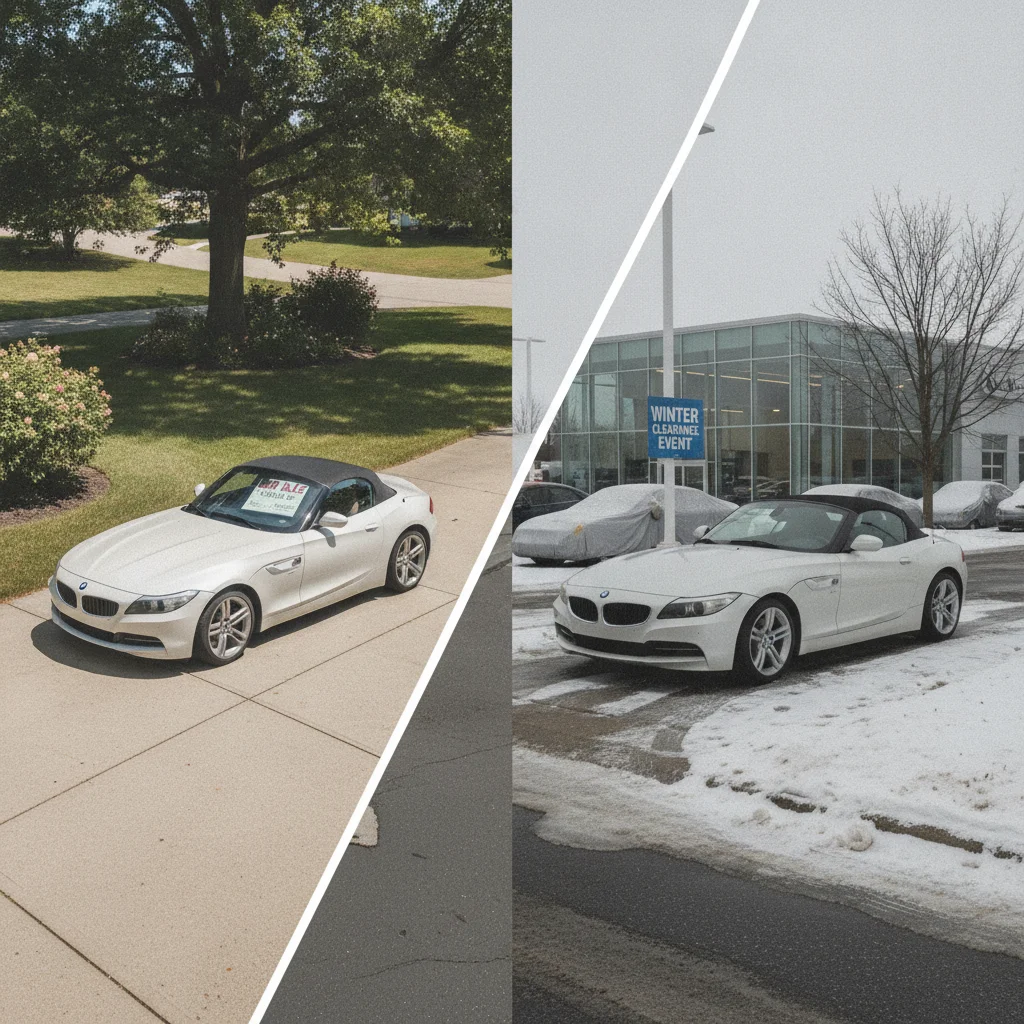
Spring lifts demand for specific vehicle types — convertibles, sports cars, certain SUVs — but has little effect on sedans, minivans, and fuel-efficient commuters.
The spring selling season is real, but it's heavily vehicle-dependent. Ragtops, performance cars, and recreational vehicles all see genuine demand spikes as weather warms. If that's what you're selling, spring timing is worth planning around.
But if you're selling a Honda Accord, a Toyota Camry, or a Chrysler Pacifica, spring doesn't move the needle much. These are year-round purchase decisions driven by life events — job changes, family growth, relocations — not by sunshine. Waiting until April to sell a four-door family sedan you could have listed in January just costs you three months of depreciation for no return.
Before you plan around the calendar, ask yourself: does my vehicle have a clear seasonal use case? If the answer is no, the season you list in matters far less than your pricing and condition.
Myth
End of month is the best time to list a car because dealers are desperate to hit quotas and will pay more.
Fact
End-of-month quota pressure applies to dealers trying to move new inventory — it rarely improves what a dealer will offer you on a trade-in or private purchase.
This one gets borrowed from the buyer's playbook and applied backwards. It's true that buying a new car at the end of the month can sometimes yield better pricing because salespeople are chasing volume targets. But that dynamic doesn't flip into generosity when a dealer is appraising your trade-in.
Dealer used-car buyers work off market data — auction values, local comparable listings, wholesale books — not off month-end emotion. They're not going to pay above market for your trade-in because they need to hit a sales number. If anything, a busy end-of-month floor means your trade-in gets less attention, not more.
For private buyers, there's no quota mechanism at all. A private buyer looking at your listing on the 28th versus the 3rd of the month is making the same financial calculation either way. Myths About When to Buy a Car That Keep Costing Shoppers Money explains which end-of-month beliefs hold up for buyers — and which ones don't even hold up there.
Myth
Wait for the used car market to heat up again before you sell. Hold out for another inventory shortage like 2021–2022.
Fact
Waiting for a repeat of pandemic-era used car prices is a losing strategy. Those conditions were extraordinary and unlikely to recur on the same scale.
The 2021–2022 used car boom was driven by a perfect storm: new car production shutdowns, rental fleet liquidations, stimulus-fueled buyer demand, and rock-bottom inventory across the board. Used car prices hit levels that hadn't existed in decades. Sellers who happened to be in market during that window did very well.
But depreciation doesn't pause while you wait. If your vehicle is losing $200–$400 per month in value (modest for most mid-range vehicles), waiting six months for a market that may never return costs you $1,200–$2,400 in real terms before you sell a single ad.
The smarter move is to sell in the current market at a fair price rather than speculate on a macro environment you can't control. Why Sellers Overestimate How Long a 'Hot Market' Will Last breaks down exactly why sellers keep misjudging how long favorable conditions last.
[in_content_images:3]Myth
Tax refund season (February–April) creates a huge surge in buyers that makes it worth holding your car until then.
Fact
Tax refund season does stimulate demand, but mainly for vehicles priced under $15,000 — it has minimal effect on mid-range or higher-priced vehicles.
There's a real phenomenon here, but it's limited to a specific market segment. Buyers using tax refunds as a down payment or outright purchase are typically working with $3,000–$8,000. That buying pool is active and real in the under-$15k segment during February through April.
If you're selling a five-year-old pickup truck at $32,000 or a recent-model luxury SUV at $45,000, the tax refund buyer isn't your customer. Waiting until March to list that vehicle won't bring you a materially better offer than listing in November would have. You'll have simply lost four months of depreciation.
Know your buyer. The tax refund timing play is worth considering only if your vehicle falls naturally into the budget range those dollars typically reach.
Myth
Never sell a car in December — no one is buying and you'll be forced to accept a lowball offer.
Fact
December sees lower transaction volume overall, but serious buyers in the market during the holidays tend to be motivated and less likely to lowball excessively.
Yes, fewer people are actively shopping for used cars in December. But the ones who are tend to have a real reason — a car just died, they're relocating in January, they need a vehicle for a new job starting after the holidays. Motivated buyers don't lowball as aggressively as casual shoppers do.
Additionally, dealer inventory is often leaner in December, which can reduce the competition your private listing faces. Less supply with stable demand is a favorable seller position.
The actual financial risk of selling in December is smaller than the myth suggests, and the opportunity cost of waiting until spring — more months of insurance, depreciation, and potential maintenance — is very real. Run the numbers before you assume holding pays off.
Myth
Your car will sell faster and for more money right after you make repairs and upgrades.
Fact
Many repairs recover their cost at sale, but upgrades almost never do — and timing a sale around completed work often delays listing past optimal windows.
Fixing a known mechanical issue before listing is usually the right call. Buyers will either demand a discount for the problem or walk away entirely once they learn about it, so addressing clear deficiencies protects your asking price.
But discretionary upgrades — new stereo, aftermarket wheels, fresh tint, even a new set of tires beyond what the car needs — almost never return dollar for dollar at sale. Buyers don't pay a premium for the seller's taste. And every week you spend waiting for a shop to finish an upgrade is a week of depreciation and a potential shift in market conditions.
The practical rule: fix what's broken, disclose what you can't fix, and sell without waiting on optional improvements. A clean, honest listing in the right seasonal window beats a perfectly detailed car listed two months too late.
~$200–$400
Average monthly depreciation on a mid-range used vehicle
iSeeCars and Edmunds depreciation data consistently show most five- to eight-year-old vehicles lose roughly this amount per month, meaning waiting three months costs $600–$1,200 before the first offer arrives.
17%
Used vehicle price premium at the height of the 2022 market
Cox Automotive reported used vehicle retail prices peaked roughly 17% above pre-pandemic norms in early 2022 — a condition driven by extraordinary supply constraints that have since substantially reversed.
$15,000
Typical ceiling for tax-refund-driven used car purchases
NADA and independent dealer surveys consistently find that tax-season buyer activity concentrates in the under-$15k segment, where a $3,000–$6,000 refund meaningfully covers a down payment or full purchase.
8–12%
Drop in perceived value when crossing 100k miles
Analysis from iSeeCars found that used vehicles listed just above 100,000 miles sell for measurably less and sit longer than comparable vehicles listed below that threshold, reflecting strong buyer psychology around the milestone.
What Actually Moves the Needle on Sale Price
Once you clear away the myths, the real drivers of sale price come into focus. Timing matters — just not in the oversimplified ways most sellers assume.
Vehicle Type Is the Real Seasonal Variable
Convertibles and sports cars genuinely do sell better in spring and summer. Four-wheel-drive trucks and SUVs see demand spikes before winter in snow-belt states. Fuel-efficient compacts tick up when gas prices spike, regardless of the month. The calendar is downstream of the type of vehicle you're selling. If you have a Jeep Wrangler, spring timing matters. If you're selling a Prius, watch the gas price chart more than the calendar.

Mileage Thresholds Are More Predictable Than Seasons
Buyers have psychological cutoffs — 30k, 60k, 100k miles are all inflection points where perceived risk jumps. If your car is sitting at 98,000 miles and you're putting another 3,000 on it waiting for spring, you've just crossed a threshold that can cost you $1,500 or more in perceived value. That's a worse trade than selling in February.
Don't Cross a Mileage Threshold Waiting for 'Better' Timing
If your odometer is sitting at 97,000–99,000 miles, waiting another month to list could push you past 100,000 miles — a threshold that meaningfully affects perceived value and buyer psychology. The same applies to 30k and 60k milestones. Check your current mileage against these thresholds before deciding to delay a listing, even by a few weeks.
Holding Costs Are Real — Run the Math First
Every additional month you own the vehicle before selling means another month of insurance premiums, potential maintenance costs, and continued depreciation. If you're delaying a sale to wait for a seasonal bump, calculate what that delay actually costs you in holding expenses. A $500 seasonal pricing advantage evaporates quickly against $150/month in insurance and $300/month in depreciation.
Local Supply and Demand Beats National Trends
National data on seasonal used car pricing is real, but it gets diluted fast when you zoom into a specific ZIP code. Check active listings on the major private-sale platforms for your exact make, model, trim, and mileage range. If there are six identical vehicles listed near you already, you're in a crowded market regardless of the month. If there are none, you have leverage regardless of the season.
Market Windows Can Close Faster Than Sellers Expect
Used car demand can shift in weeks, not months — especially when inventory conditions or interest rates change. If you're in a favorable market right now, acting quickly often beats speculative waiting. Why Sellers Overestimate How Long a 'Hot Market' Will Last covers exactly how fast those windows can close and what sellers miss by hesitating.
For a structured way to weigh acting now versus waiting for a future peak, Short-Term vs. Long-Term Timing Strategies for Maximizing Sale Price breaks down the tradeoffs clearly.
Depreciation Doesn't Pause While You Wait for the Right Season
This is the single most expensive mistake I see sellers make. They're convinced a better month is coming and they hold the car, putting more miles on it, paying insurance, and watching value quietly erode. By the time spring or tax season or whatever window they were waiting for arrives, the gains are already eaten. Sell in a reasonable window at a well-researched price. Don't let the myth of a perfect season cost you the money you already have.
Practical Steps Before You List
Timing the market is only one lever. The things below are in your direct control and often matter more than which week of the year you post the listing.
- Pull your own comps first. Search your exact vehicle on multiple platforms — private sale and dealer listings. Set a realistic price anchor based on what's actually selling, not what people are asking.
- Check your mileage position. If you're within 2,000–3,000 miles of a major threshold, think hard about whether it makes sense to delay the sale.
- Assess local inventory. Thin supply in your area is worth more than any seasonal advantage. Post immediately if your vehicle is scarce locally.
- Know your channel options. Private sale, dealer trade-in, and instant-offer services have different timing sensitivities. Private Sale Myths That Cost Sellers Time and Money covers which beliefs about private listings are actually costing sellers.
- Don't conflate buyer timing with seller timing. The logic that applies to getting a deal when buying a new car doesn't automatically flip for sellers. For contrast, see New Car Buying Myths That Cost People Real Money.

The bottom line: there's no universally perfect month to sell. There's only the best available window for your specific vehicle in your specific market — and holding out for an imaginary ideal season is one of the most expensive habits a seller can have.

All claims are backed by peer-reviewed research. Sources on request.