Key Takeaways
Bill of Sale (Vehicle)
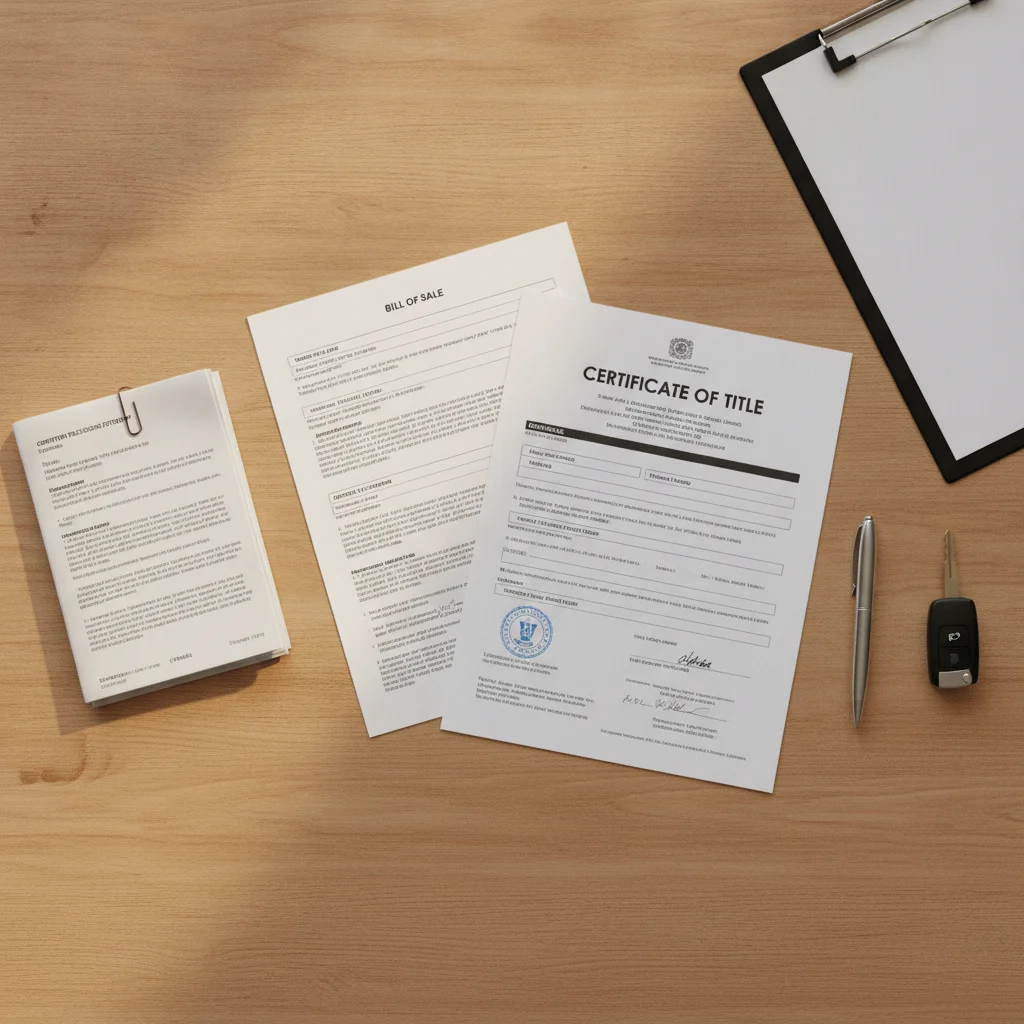
A bill of sale is a written document that records the transfer of ownership of a vehicle from a seller to a buyer. It captures the key terms of the transaction — the agreed price, the date of sale, and both parties' identifying information. Think of it as the paper handshake that makes a private car sale official and legally traceable.
In many states, a bill of sale is a legally required document for title registration purposes and may also serve as a taxable event record for your state's DMV.
Why a Bill of Sale Is More Than a Receipt
Most people treat a bill of sale like a store receipt — evidence that money changed hands. That's a costly oversimplification. A vehicle bill of sale is a legal instrument that transfers documented responsibility from one party to another. The date on that document is the precise moment your legal exposure ends as a seller and the buyer's begins.
Here's the scenario that clarifies why this matters: You sell your car on a Saturday. The buyer drives off, but doesn't transfer the title for three weeks. On day ten, the buyer runs a red light and the plate is photographed. Because the vehicle is still registered in your name, you get the violation notice. Without a signed bill of sale dated to the day of sale, you have no clean way to prove when you relinquished the vehicle.
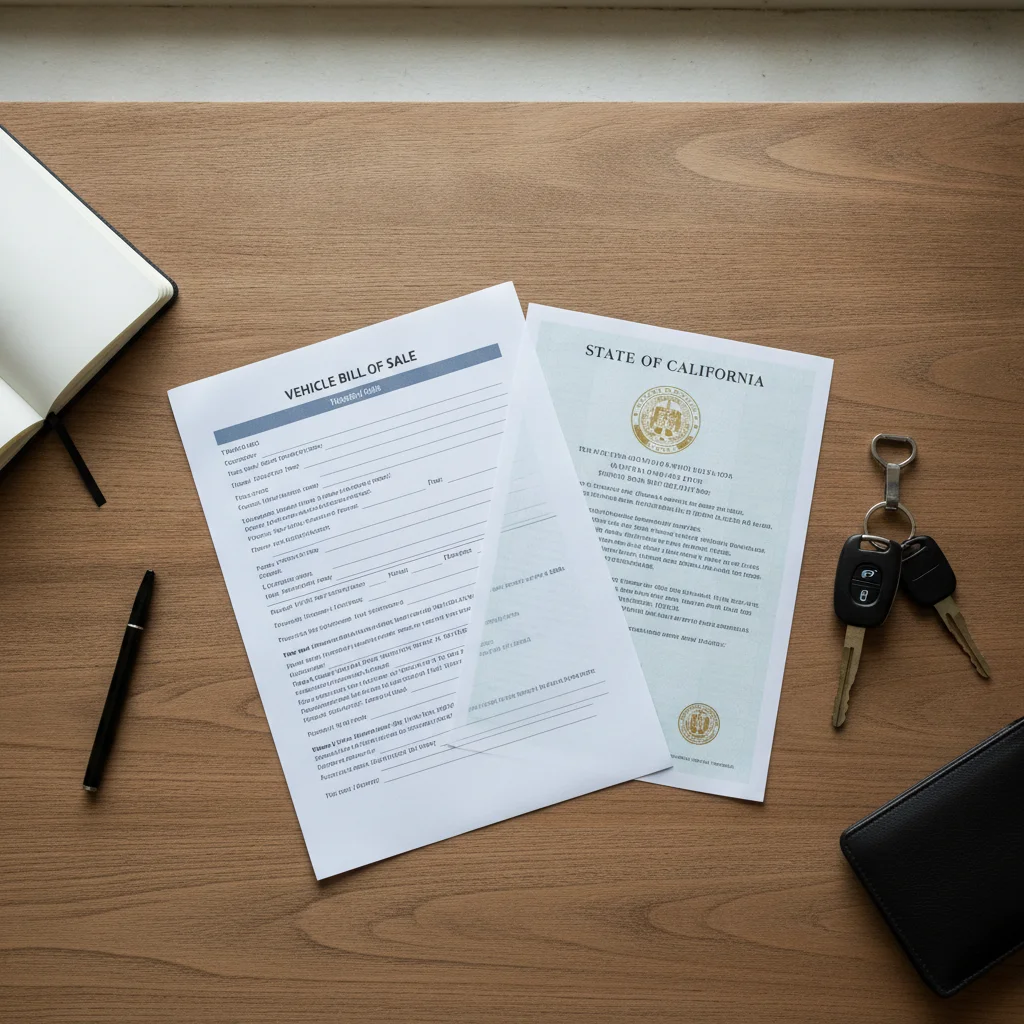
A bill of sale solves that problem. It establishes a time-stamped paper trail that protects both sides of the transaction. For sellers, it's liability insulation. For buyers, it's documented proof they paid a specific price — useful for registration, tax, and insurance purposes. See the full paperwork and contracts overview for context on how this document fits into the broader car buying process.
Bill of Sale vs. Title: They're Not the Same
Buyers sometimes assume a signed bill of sale gives them ownership of the vehicle. It doesn't. The certificate of title is the legal ownership document issued by the state. The bill of sale records the private transaction but must be used alongside the title — not instead of it. Always complete both documents at the time of sale.
Notify Your DMV After the Sale
Many states allow — or require — sellers to file a Notice of Transfer or Release of Liability with the DMV after a private sale. This formally removes you from the vehicle's registration record, providing an additional layer of protection beyond the bill of sale. Check your state DMV's website for the specific form and filing window.
What a Valid Bill of Sale Must Include
There is no single national standard for vehicle bills of sale, but there is a reliable set of fields that every competent document should contain. Missing any of these can render the document useless in a dispute or unacceptable to your state's DMV.
Required Information
- Vehicle Identification Number (VIN): This 17-character code uniquely identifies the vehicle. It must match the title exactly.
- Sale price: The exact dollar amount agreed upon. States use this to calculate sales tax owed by the buyer.
- Date of sale: The specific date ownership transferred — not when the deal was agreed, but when keys and documents were exchanged.
- Odometer reading: Federal law (the Truth in Mileage Act) requires odometer disclosure for most vehicles under ten years old. Many states require this on the bill of sale itself.
- Vehicle description: Year, make, model, body style, and color.
- Seller's full name and address: Must match the name on the title.
- Buyer's full name and address: Required for registration and title transfer.
- Signatures of both parties: Both buyer and seller must sign. Some states require a witness signature or notarization.
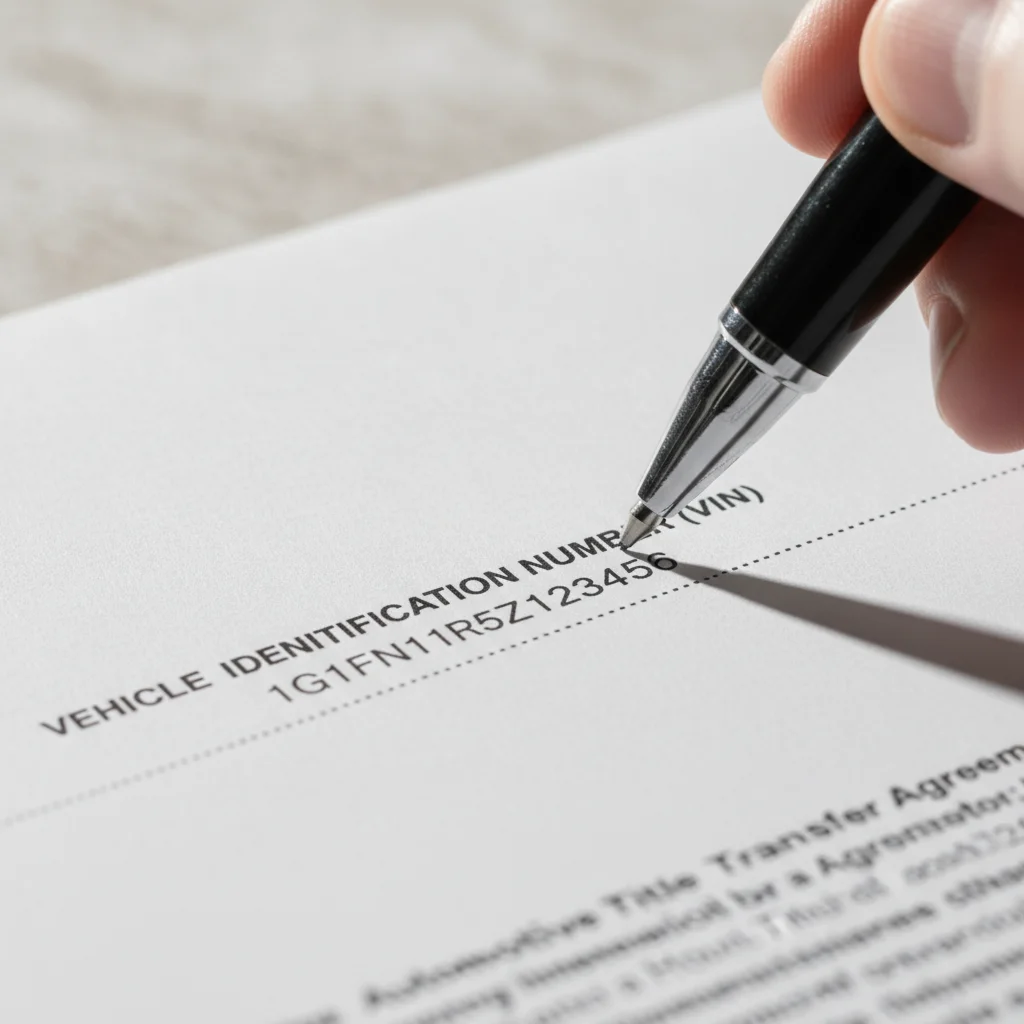
If the vehicle is sold "as-is" — meaning no warranties are implied — that language should also appear explicitly in the document. This protects the seller from post-sale claims about mechanical issues. For a deeper look at how to structure this language correctly, see our guide on what a bill of sale must include to protect both parties.
7
U.S. states requiring a bill of sale by law
At least seven states — including Louisiana, Maryland, and West Virginia — mandate a bill of sale before the DMV will process a title transfer or registration.
10–30 days
Typical title transfer window after a private sale
Most states require buyers to transfer the title within 10 to 30 days of purchase, during which the seller remains on the registration record.
17
Characters in a VIN — required on every bill of sale
The Vehicle Identification Number uniquely identifies the car and must appear on the bill of sale to ensure it matches the title.
5 years
Recommended minimum retention period for your copy
Most civil statute of limitations periods fall within five years, making this the standard recommended storage window for sale documents.
~40%
Of private sellers who skip a formal bill of sale
Industry estimates suggest a significant share of informal private transactions go undocumented, leaving both parties exposed to preventable liability.
Use Your State's Official DMV Form When Available
Many states publish a free, pre-formatted bill of sale template on their DMV website. Using the official form ensures all state-required fields are present and that it will be accepted at the counter without question. Even if your state doesn't require a bill of sale, using the official template adds credibility and completeness to your transaction.
Complete the Document Before You Hand Over the Keys
Fill out the bill of sale in full before keys and payment are exchanged. Never hand over the vehicle expecting to finish the paperwork later — circumstances change, people become difficult to reach, and memories of agreed terms fade. Five minutes of paperwork at the point of sale can prevent months of legal headache.
States Where a Bill of Sale Is Required by Law
Most states treat a bill of sale as strongly recommended but not strictly mandatory. A subset of states, however, will not register a vehicle to a new owner without one. Knowing where your state falls isn't optional — it's the difference between a smooth title transfer and a trip back to the DMV.
States with a Mandatory Bill of Sale Requirement
The following states require a bill of sale as part of the title transfer or registration process:
- Louisiana — Requires a notarized bill of sale
- Maryland — Must include the sale price for tax assessment
- Montana — Requires notarization in most cases
- Nebraska — Required for registration
- New Hampshire — Required alongside title transfer
- West Virginia — Required at the DMV counter
- Wyoming — Required when title is absent or delayed
Even in states not on this list, the bill of sale may be required in specific circumstances — for example, when the title is being mailed, when the vehicle is older and the title format is unusual, or when a lienholder is involved.
For a full breakdown by state including odometer disclosure rules and title transfer timelines, see our state-by-state private sale paperwork overview.
“The bill of sale is the document that answers 'what did you both agree to and when?' Without it, you're relying on memory — which is never enough in a legal dispute.”
— Dara Flemming, Consumer Finance Journalist and Auto Documentation Specialist
How the Bill of Sale Relates to the Title
These two documents do different jobs and neither replaces the other. Buyers sometimes assume a bill of sale is enough to prove they own the car. It isn't. The title — officially called the certificate of title — is the government-issued document that establishes legal ownership. The bill of sale is the private record of how and when the title changed hands.
The Correct Order of Events
- Seller signs the back of the title over to the buyer, filling in the buyer's name, sale price, odometer, and date.
- Both parties sign the bill of sale, retaining a copy each.
- Buyer takes both documents to the DMV within the state's required window (commonly 10–30 days) to transfer the title into their name.
- Buyer registers the vehicle and pays any applicable sales tax, calculated using the sale price from the bill of sale.
If the title is lost, the bill of sale becomes even more important. Some DMVs will use it as supporting evidence when issuing a replacement title, though they'll typically also require additional verification steps.

It's also worth noting that if a lien exists on the vehicle — meaning the seller still has a loan — the lienholder's name will appear on the title. That lien must be satisfied and released before a clean title can be transferred. The bill of sale doesn't resolve that; only the lender's lien release does.
When Sellers Can't Afford to Skip the Bill of Sale
There are certain situations where skipping a bill of sale goes from inadvisable to genuinely dangerous for the seller. Know these scenarios before you hand over keys.
Title Delays
Sometimes a buyer can't get to the DMV immediately, or a title transfer takes several weeks to process. During that gap, the vehicle is still technically in the seller's name in the state's records. A dated bill of sale is your proof that legal responsibility transferred on a specific day.
As-Is Sales with Known Issues
If the vehicle has a mechanical problem you disclosed — or even one you didn't know about — and the buyer claims you misrepresented the car, a bill of sale with explicit "as-is" language is your first line of defense. Without it, the dispute becomes a he-said-she-said situation.
Sales Across State Lines
When a car crosses state lines, both states may require documentation. The buyer's state DMV may need to see a bill of sale to assess taxes and confirm the transaction date. Sellers who don't provide one may find the buyer calling them weeks later needing documentation they should have prepared at the time of sale.
Older Vehicles Without Clean Title History
For vehicles with salvage titles, rebuilt titles, or a gap in ownership history, a bill of sale provides context that helps buyers navigate the registration process. It also helps sellers demonstrate they acted in good faith and made proper disclosures.
For a broader look at what sellers need to prepare before any listing goes live, see every document you need before listing your car for sale.
Private Party Sales: Structuring the Document Correctly
Most private party sellers aren't lawyers, and that's fine — a bill of sale doesn't need to read like a contract to be legally effective. What it needs is completeness and clarity. Ambiguity is your enemy.
Use Plain Language, Not Legal Boilerplate
You don't need Latin phrases or complex conditional clauses. A sentence like "Seller warrants that they hold clear title to this vehicle free of any liens" is perfectly sufficient. So is "Vehicle is sold in as-is condition. Seller makes no warranties, express or implied, regarding the vehicle's condition or fitness for any particular purpose."
Create Two Identical Copies
Both buyer and seller should sign both copies, and each party walks away with a signed original. Don't use carbon copies or rely on a photo of the document — both parties should have an ink-signed copy.
Don't Leave Blanks
Every field should be completed. If something doesn't apply, write "N/A." A document with blank fields can be challenged more easily and may be rejected by the DMV.
For a complete template and clause-by-clause explanation of what belongs in a private party contract, see our companion article on private party car sale contracts.
Use Your State's Official DMV Form When Available
Many states publish a free, pre-formatted bill of sale template on their DMV website. Using the official form ensures all state-required fields are present and that it will be accepted at the counter without question. Even if your state doesn't require a bill of sale, using the official template adds credibility and completeness to your transaction.
Complete the Document Before You Hand Over the Keys
Fill out the bill of sale in full before keys and payment are exchanged. Never hand over the vehicle expecting to finish the paperwork later — circumstances change, people become difficult to reach, and memories of agreed terms fade. Five minutes of paperwork at the point of sale can prevent months of legal headache.
After the Sale: Why Your Copy Still Matters
Handing over the keys doesn't end your responsibility to the paperwork. Your signed copy of the bill of sale should be stored somewhere accessible — not in the glove box of a car you no longer own, and not on a phone that might be replaced or lost.
Here's what your copy protects you from after the fact:
- Toll violations and tickets: If a plate camera captures your former vehicle committing an infraction before the title transfers, your bill of sale proves when you sold it.
- Insurance claims: If the vehicle is involved in an accident after the sale date, your bill of sale documents that you were no longer the owner.
- Tax disputes: Some states assess use tax based on declared sale price. Your copy confirms the amount you reported.
- Title disputes: If the buyer later claims they overpaid or disputes the terms, your signed copy is the authoritative record.
The general rule: keep your bill of sale for at least five years. Most civil dispute statutes of limitations fall within that window. For a full post-sale checklist covering what to keep, how long to retain it, and how to formally notify your DMV of the sale, see the paper trail that protects you after the sale is done.
Bill of Sale vs. Title: They're Not the Same
Buyers sometimes assume a signed bill of sale gives them ownership of the vehicle. It doesn't. The certificate of title is the legal ownership document issued by the state. The bill of sale records the private transaction but must be used alongside the title — not instead of it. Always complete both documents at the time of sale.
Notify Your DMV After the Sale
Many states allow — or require — sellers to file a Notice of Transfer or Release of Liability with the DMV after a private sale. This formally removes you from the vehicle's registration record, providing an additional layer of protection beyond the bill of sale. Check your state DMV's website for the specific form and filing window.

All claims are backed by peer-reviewed research. Sources on request.