Key Takeaways
Vehicle Bill of Sale
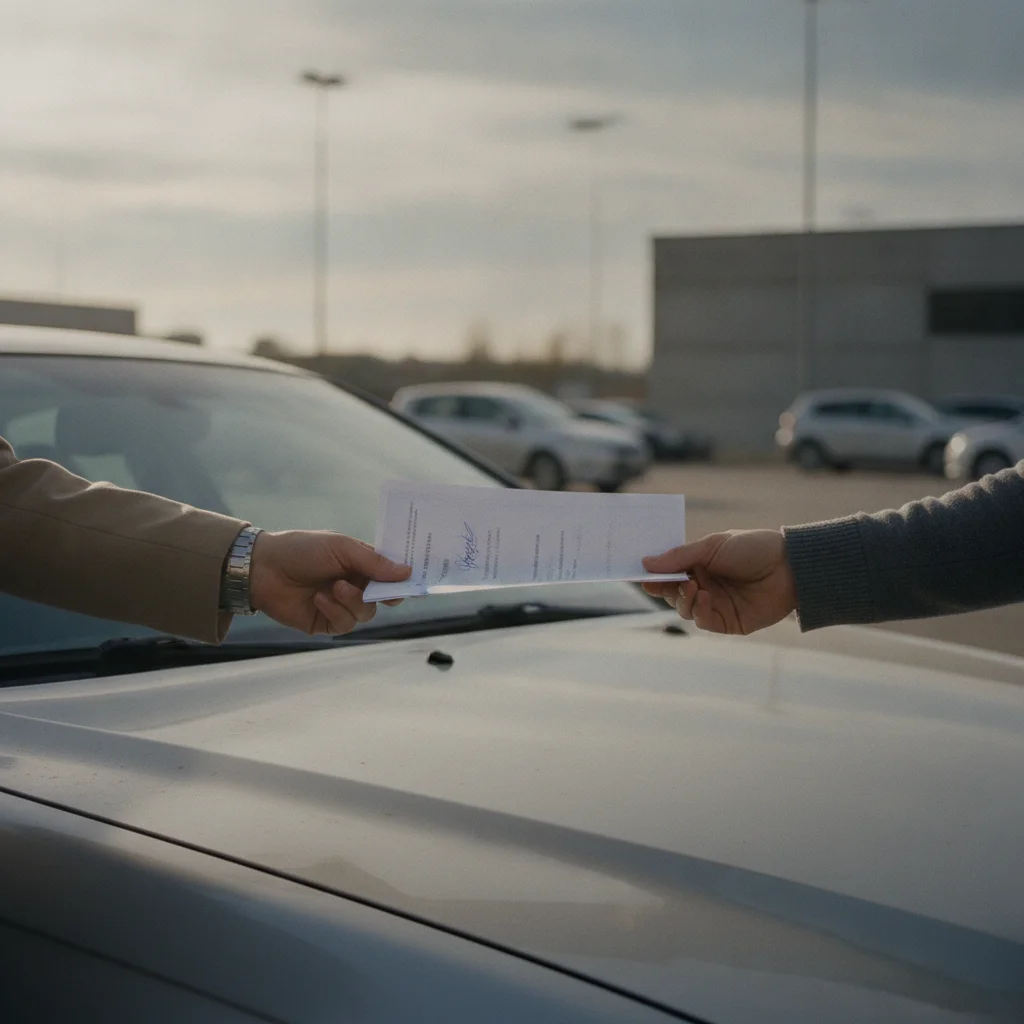
A bill of sale is a written record that documents the transfer of a vehicle from one party to another. It captures who sold the car, who bought it, how much was paid, and when the transaction occurred. For private party sales, it functions as the primary legal receipt and establishes a clear ownership trail independent of the title.
In many states, a bill of sale is distinct from the title — the title transfers ownership, while the bill of sale documents the terms under which that transfer happened. Some states accept a bill of sale as a substitute for a missing title only under specific conditions.
Why the Bill of Sale Is More Than a Receipt
A title transfer moves legal ownership. The bill of sale explains the terms under which that transfer happened. Those are two different things, and you need both.
Think of the bill of sale as your insurance policy against post-sale disputes. Once you hand over the keys and the buyer drives away, your word against theirs is worth almost nothing. A signed, dated document that specifies exactly what was sold, for how much, and in what condition is what protects you when the buyer calls three weeks later claiming the engine was leaking when you sold it.
A bill of sale does much more than act as a receipt — it establishes the legal moment of transfer, documents agreed-upon conditions, and creates a paper trail that's difficult to dispute in court or at the DMV. For sellers especially, it's the single document that removes you from liability the moment ink hits paper.
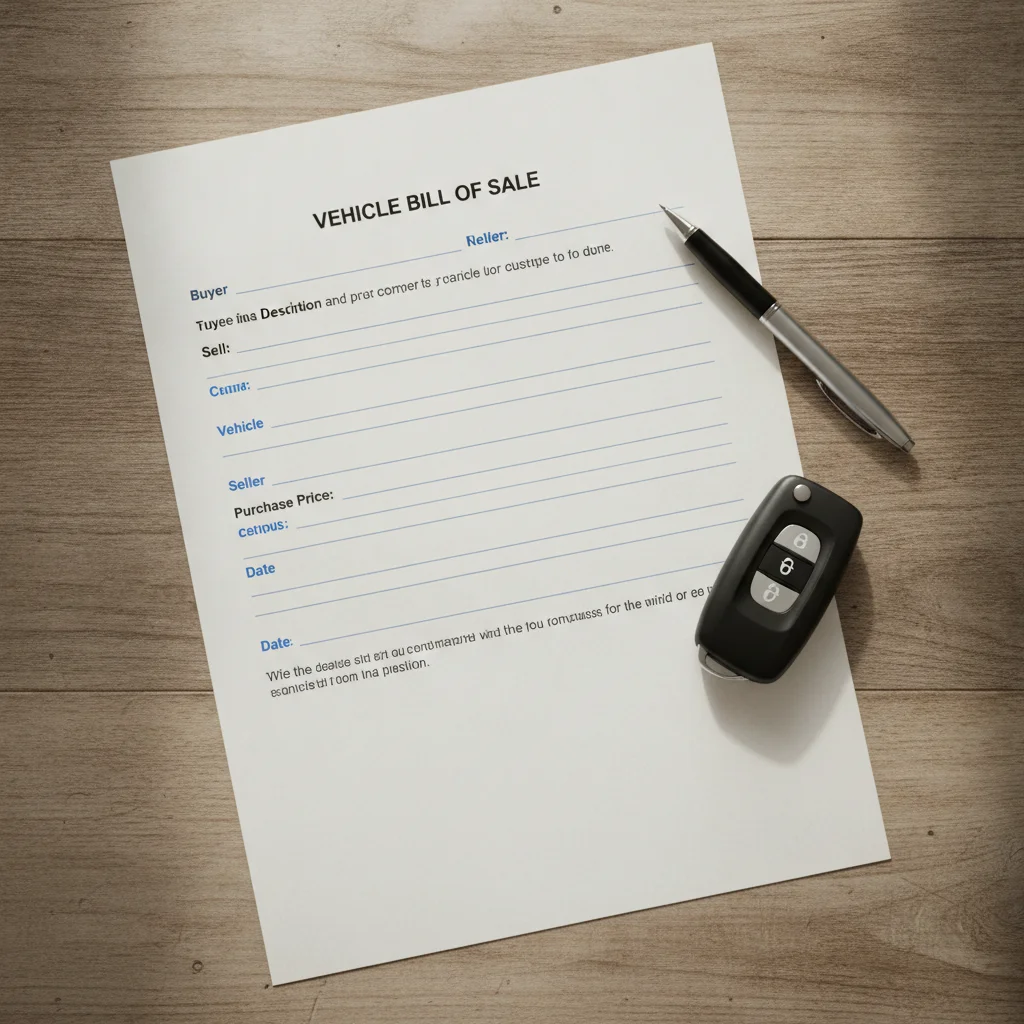
It also matters on the buyer's side. Without a bill of sale, a buyer has no written proof of what they paid, making it harder to register the vehicle if there's a discrepancy in paperwork or a lien that surfaces later. Both parties benefit from getting this right — but sellers carry more risk when it's missing.
The Core Fields Every Bill of Sale Must Contain
There's no universal federal template, but every legally sound vehicle bill of sale shares the same essential components. Leave any of these out and you're creating gaps a dispute can slip through.
1. Full Legal Names and Addresses — Both Parties
Use full legal names as they appear on driver's licenses — not nicknames, not just first names. Include current mailing addresses for both the seller and the buyer. If the vehicle is being sold on behalf of an estate or a business entity, name that entity explicitly and include the representative's name and authority (e.g., executor, authorized signatory).
2. Vehicle Identification Number (VIN)
The VIN is the fingerprint of the vehicle. It must match the title exactly. A single transposed digit creates a mismatch that can freeze the registration process. Physically verify the VIN on the dashboard (visible through the windshield) and on the title before writing anything down.
3. Year, Make, Model, and Color
These descriptors confirm you're documenting the right vehicle. Add the license plate number and state as an additional cross-reference, especially useful if the title is being processed and the plate temporarily remains on the car.
4. Odometer Reading at Time of Sale
Federal law (the Truth in Mileage Act) requires an odometer disclosure for most vehicles under ten years old. Record the exact mileage at the time of sale. If the odometer is broken or known to be inaccurate, state that explicitly. Misrepresenting mileage exposes sellers to federal penalties.
5. Sale Price — or Clear Statement of Gift
Write the agreed sale price in both numerals and words (e.g., "$8,500 — eight thousand five hundred dollars"). This prevents any dispute about the number. If the vehicle is being gifted, write "$0 — Gift" and note your relationship to the recipient. Some states require this distinction for tax purposes.
6. Payment Method
Note how payment was made — cash, cashier's check, bank wire. If it was a cashier's check, record the check number and issuing bank. This is relevant if a payment dispute arises later.
7. Date of Sale
The date the transaction was completed — not the date you listed the car, not the date of the test drive. This establishes when ownership legally changed hands.
8. As-Is Clause
This is non-negotiable for private sellers. Include a statement that reads something like: "This vehicle is sold as-is, with no warranties expressed or implied. The seller makes no representations about the vehicle's condition beyond what is stated in this document." This language closes the door on claims that you guaranteed the car was defect-free.
9. Signatures of Both Parties
Both the seller and buyer must sign and date the document. A bill of sale signed only by the seller is weaker than a mutual agreement. Print names alongside signatures for clarity.
Optional Clauses That Add Real Protection
The core fields get you legally covered. These additions give you a stronger position if things go sideways.
~40%
Of private car sales end in some form of post-sale dispute
Industry estimates suggest a significant share of private transactions result in disagreements about condition, price, or terms — most of which a properly drafted bill of sale can resolve quickly.
5 states
Require notarized vehicle bills of sale
Louisiana, Maryland, Montana, Nebraska, and West Virginia mandate notarization; sellers in these states must plan accordingly before the transaction date.
$500–$10,000
Federal penalty range for odometer fraud
Under the federal Truth in Mileage Act, knowingly misrepresenting a vehicle's mileage on any sale document — including a bill of sale — carries civil penalties up to $10,000 per violation.
5 years
Recommended document retention period for sellers
Most state statutes of limitations for contract disputes run three to five years, making five-year retention the safe minimum for bill of sale records.
Known Defects Disclosure
If you know about a specific issue — a transmission that slips under load, an AC compressor that's marginal, a check engine light you've been ignoring — put it in writing. Some sellers resist this because they worry it will kill the deal. The smarter view: documenting known defects at the time of sale is what protects you from a fraud claim later. Buyers who are informed can't credibly claim they were deceived.
Deposit Terms
If the buyer put down a deposit to hold the vehicle, note the amount, the date received, and whether it's refundable or non-refundable. If non-refundable, state the condition under which the seller retains it (e.g., buyer fails to complete purchase within X days).
Lien Status Confirmation
Include a line confirming the vehicle is free and clear of liens at the time of sale — or, if a lien exists, name the lienholder and how it will be resolved. Selling a car with an undisclosed lien is a fast track to fraud allegations.
Warranty Language (if applicable)
If you're voluntarily offering any warranty — say, you'll pay for repairs to a specific known issue within 30 days — define it precisely. Vague verbal promises are the source of most post-sale arguments. Written, limited warranties with a clear scope and expiration prevent that.
“The time to document known defects is before the sale, not after a lawsuit. A seller who discloses a problem in writing is far better positioned than one who stayed silent and hoped the buyer wouldn't notice.”
— Dean Merritt, Private party vehicle transaction specialist
Test Drive and Inspection Acknowledgment
A simple line stating the buyer inspected the vehicle and had the opportunity to conduct a pre-purchase inspection before completing the sale reinforces the as-is sale and eliminates "I never got to check it out" as a defense in a dispute.
State-Specific Requirements You Can't Ignore
Bills of sale are governed at the state level, and requirements vary more than most sellers expect. The baseline fields above apply everywhere, but several states impose additional requirements.
State-by-state requirements for private sale paperwork differ significantly — what's optional in Texas may be mandatory in Louisiana. Key variations include:
- Notarization: Louisiana, Maryland, Montana, Nebraska, and West Virginia require notarized bills of sale for vehicle transfers. A handful of other states require notarization only in specific circumstances (e.g., gifted vehicles, out-of-state transfers).
- State-issued forms: Some states — including New York, New Jersey, and Idaho — have an official bill of sale form that must be used, or at minimum provide a template that satisfies DMV requirements. Check your state's DMV website before drafting anything.
- Odometer disclosure on a separate form: Several states require a federally compliant odometer disclosure statement as a standalone form rather than embedded in the bill of sale.
- Sales tax reporting: The stated sale price on the bill of sale directly affects the sales tax the buyer pays at registration. Some states cross-check declared prices against book values and may assess tax on the higher figure if the sale price appears artificially low.
Before finalizing your document, look up your state's DMV requirements. Spending ten minutes on their website can prevent a registration rejection that costs both parties time and money.
Use Your State's Official DMV Template
Many states publish a vehicle bill of sale template on the DMV website that already satisfies local legal requirements. Starting from that template — rather than a generic online form — reduces the risk of missing a state-mandated field. Search "[your state] DMV bill of sale" to find it.
Verify the VIN Before You Write Anything
Check the VIN in three places: the dashboard plate (visible through the windshield), the driver's door jamb sticker, and the title. All three should match exactly. A single character discrepancy can halt a title transfer at the DMV and create a paper trail that suggests fraud, even when it's just a typo.
How to Execute the Bill of Sale Correctly
Writing the right content is half the job. Executing it correctly is the other half.
Prepare in Advance
Don't try to fill out the bill of sale at the handover while the buyer is standing in your driveway eager to leave. Prepare a draft beforehand with everything except the final odometer reading and date. Fill those in at the moment of transfer when the numbers are confirmed.
Print Two Copies — Minimum
Both parties should leave with a signed original. If you're printing a single copy and one party photographs it, that's not the same as a signed document. Two copies, two signatures. Your paper trail after the sale matters long after the handover is done — a physical copy you can produce quickly is worth far more than a photo on your phone.
Verify Identity Before Signing
Ask to see the buyer's driver's license. Confirm the name matches what they've written on the bill of sale. This sounds overly cautious, but it takes fifteen seconds and prevents a situation where a bill of sale references a name that can't be traced to a real person.
Sign in the Presence of Each Other
Both parties should be present when signatures are applied. Remote sales where one party signs and mails the document create authentication problems. If the buyer is remote, consider using a notary on both ends.
Scan and Store Digitally
Right after the sale, photograph or scan your signed copy and store it somewhere you can access independently of your phone (email it to yourself, save to cloud storage). Physical documents get lost. A digital backup has saved more than a few sellers when disputes surfaced a year later.
Bills of Sale in Non-Standard Sales
Most of the guidance above applies to a straightforward private party sale. A few common situations require additional handling.
Gifted Vehicles
When a vehicle is transferred as a gift — often between family members — the bill of sale must clearly state the sale price as $0 and identify the transaction as a gift. Some states require a separate gift affidavit. Without this documentation, the recipient may be assessed sales tax based on the vehicle's fair market value at registration.
Inherited Vehicles
Selling a vehicle you inherited involves additional layers. The estate may need to go through probate before the title can be transferred, depending on the state and the estate's value. Selling an inherited vehicle requires specific documentation beyond the standard bill of sale, including letters testamentary or small estate affidavits.
Vehicles with Outstanding Loans
If there's a lien on the vehicle, the lienholder's name appears on the title and must be addressed before transfer. The bill of sale should note the lien payoff process — typically, proceeds from the sale pay off the loan, and the lender releases the title. Never complete a bill of sale and hand over keys until the lien resolution path is confirmed in writing.
Out-of-State Sales
When the buyer will register the vehicle in a different state, both the seller's state requirements and the buyer's state registration requirements apply. The bill of sale may need to reflect specific language or notarization that satisfies the buyer's home state. Clarify this before the sale date.
For a complete picture of everything a seller needs before listing, see every document you need before listing your car. And if you're approaching this from the buyer's side, private party car sale contracts covers the full documentation picture from that angle.


All claims are backed by peer-reviewed research. Sources on request.