Key Takeaways
Why the Sale Isn't Really Over When the Keys Change Hands
Most private sellers assume that once the buyer drives away, the transaction is complete. It isn't. In the eyes of the law — and often your insurance company — you remain connected to that vehicle until the paperwork is correctly filed and confirmed. That means parking tickets, red-light camera citations, toll violations, and even accident liability can follow you long after you've spent the money.
This article is a seller's guide to the documentation trail that protects you after the sale. We'll walk through which documents to retain, how to properly transfer liability, what state-specific filings you shouldn't skip, and how long to hold onto copies. If you want a complete picture of every document involved from start to finish, the comprehensive private sale guide covers the full process in detail.
The goal here is narrower and more urgent: your post-handoff checklist.

The Title Transfer: Your Single Most Important Step
The vehicle title is the legal document that establishes ownership. When you sell a car, properly signing over and recording that title is the foundation of your liability protection. Getting this wrong — even slightly — can have serious consequences.
What the seller must do on the title
- Sign the back of the title in the designated seller's signature line. Do not sign anywhere else on the document.
- Print your name exactly as it appears on the front of the title.
- Fill in the sale date and agreed sale price accurately.
- Complete the odometer disclosure section on the title itself if your state requires it there (many do).
- Do not use correction fluid or cross out errors. A title with white-out is typically rejected by the DMV. If you make a mistake, request a duplicate title before proceeding.
Notarization requirements by state
Some states — including Louisiana, Maryland, Montana, Nebraska, New Hampshire, West Virginia, and Wyoming — require notarization of the title transfer. Others do not. Confirm your state's requirements before the buyer arrives, because arranging notarization after the fact is inconvenient and can delay the transfer filing.
See our state-by-state reference at Private Sale Paperwork: A State-by-State Overview for a detailed breakdown of what each state requires at title transfer.
Title Errors Cannot Be Corrected with White-Out
If you make a mistake on the title — wrong name spelling, incorrect sale date, or an error in the odometer reading — do not attempt to correct it with correction fluid or by crossing out and rewriting. Most DMVs will reject a corrected title as potentially fraudulent. Instead, apply for a duplicate title from your state DMV before completing the transfer. It adds a day or two to the process, but it protects the legal validity of the entire transaction.
As-Is Sales Don't Eliminate All Disclosure Obligations
Selling a vehicle "as-is" means the buyer accepts the vehicle in its current condition without a warranty — but it does not exempt you from mandatory disclosures required by state law. Salvage title history, known flood damage, lemon law buyback status, and odometer accuracy must still be disclosed even in as-is transactions. An "as-is" clause in your bill of sale protects you from claims about unknown defects, not known ones you concealed.
After the buyer takes the title: notify your DMV
Signing over the title to the buyer is necessary — but not sufficient. In most states, you are also required to submit a Notice of Transfer and Release of Liability (or your state's equivalent) to your DMV, typically within 5 to 10 days of the sale. This filing officially removes your name from the vehicle's registration record and is your clearest protection if the new owner gets into an accident, racks up tolls, or commits a moving violation before they re-register.
Many states offer online submission of these notices. Keep your confirmation number or submission receipt — it's proof the notification was made.
43 states
States requiring sellers to file a release of liability
According to AAMVA (American Association of Motor Vehicle Administrators) state-by-state compliance tracking, the majority of U.S. states require some form of post-sale notification to remove seller liability.
10 days
Typical window to file release of liability after sale
Most states impose a 5-to-10-day deadline for sellers to submit transfer notifications; missing this window leaves sellers exposed to liability for the new owner's violations.
Under 10 years
Vehicle age threshold for federal odometer disclosure
The federal Truth in Mileage Act requires written odometer disclosure for most passenger vehicles under ten model years old at the time of private sale.
The Bill of Sale: Why You Need Your Own Copy
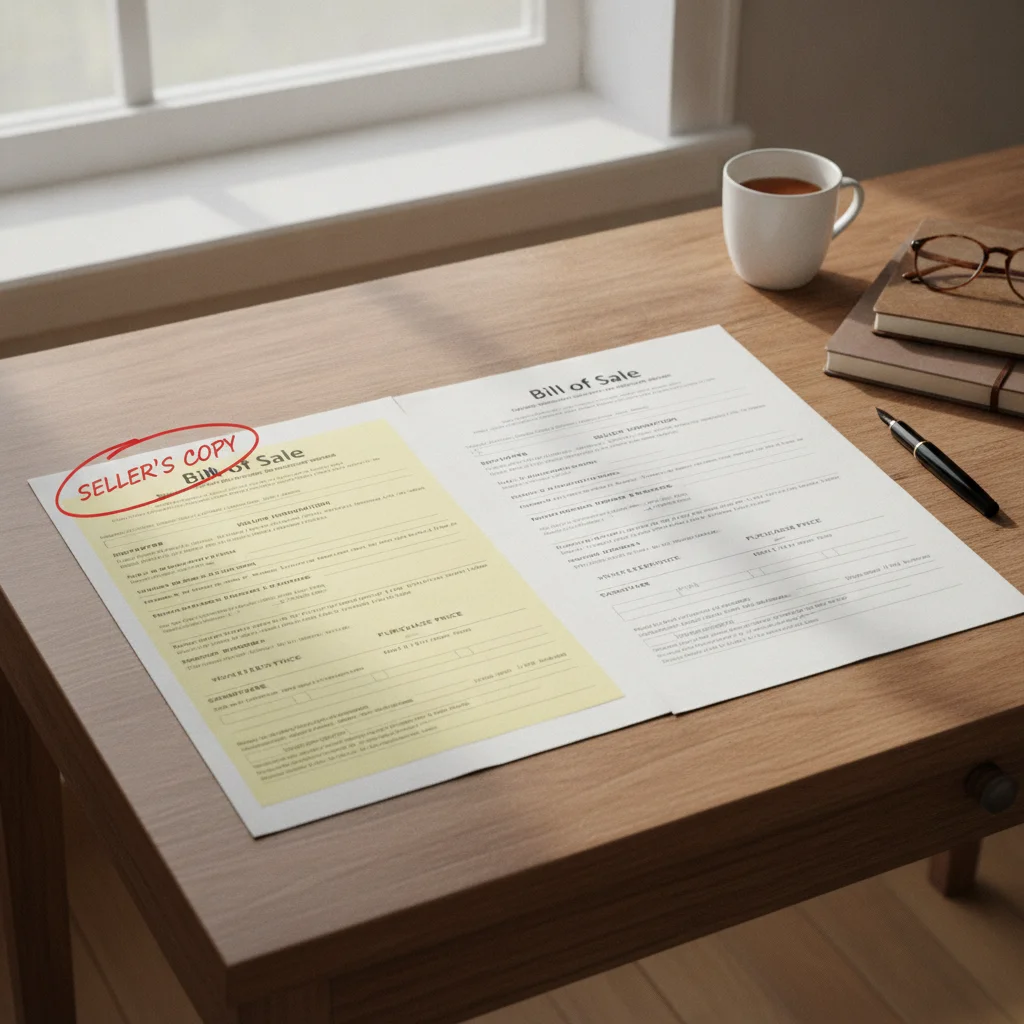
Most sellers think of the bill of sale as something for the buyer. In reality, your copy of this document may be the most important piece of paper you retain after a private sale. It documents the terms agreed upon, the condition disclosed, and the moment ownership formally changed hands.
For guidance on what a proper bill of sale must include, see our detailed breakdown at The Bill of Sale: What It Must Include to Protect Both Parties.
What your retained copy protects you from
- Buyer claims the car was misrepresented: A signed bill of sale with an "as-is" clause documents that the buyer accepted the vehicle's condition.
- Disputes over the sale price: If a buyer later claims they paid more than agreed, the signed document settles it.
- Odometer fraud accusations: The stated mileage on the bill of sale, when it matches your odometer disclosure form, shows you reported accurately.
- Post-sale liability: If the buyer receives a citation before re-registering and contests who owned the car at the time, your bill of sale with the exact sale date and time is evidence.
How long to retain it
Keep your copy of the bill of sale for a minimum of three years. If the vehicle was relatively new or high-value, five years is more prudent. Some liability claims or title disputes can surface well after the sale date, and having documentation ready is far easier than reconstructing it.
Use a Timestamped Photo as Additional Evidence
Before handing over the keys, take a timestamped photo of the odometer reading and the buyer standing next to the vehicle. This simple step creates a visual record of the handoff moment that corroborates your bill of sale date, your disclosed mileage, and the vehicle's general condition at transfer. Most smartphones embed date and time metadata automatically — back the photo up to cloud storage so it's preserved long-term.
Store Digital Copies in Two Separate Locations
A single digital copy is better than no copy, but it's not truly safe. Store scanned documents both in your email (by sending them to yourself) and in a cloud service like Google Drive or iCloud. If your hard drive fails or your email account is compromised, the second copy ensures you still have access. Label files with the vehicle's VIN for easy searching later.
Odometer Disclosure: Federal Law, Not Just State Preference
The federal Truth in Mileage Act requires sellers to disclose accurate odometer readings on most passenger vehicles under ten model years old. The disclosure must be made in writing, and it must be signed by both the seller and the buyer. On many modern titles, the odometer disclosure is embedded directly into the title document. On older vehicles or in states that use separate forms, you'll complete a standalone odometer disclosure statement.
What you must record
- The exact odometer reading at the time of sale
- A certification that the reading is accurate to the best of your knowledge
- Whether the odometer has been replaced or has exceeded its mechanical limit
Falsifying an odometer disclosure is a federal offense carrying significant fines and potential criminal liability. Even innocent-sounding mistakes — like recording a mileage you recall from the last oil change rather than reading the dashboard at the point of sale — can create complications. Always read the odometer at the moment of handoff and record that number.
“The odometer disclosure isn't paperwork for the buyer's benefit — it's your sworn statement to the federal government. Treat it with the same care you'd give a tax form, because the penalties for errors are in the same league.”
— Dara Flemming, Consumer Finance Journalist and Auto Loan Specialist
Your copy matters here too
If you complete a separate odometer disclosure form (not embedded in the title), keep a photocopy. If the buyer later disputes the mileage or a title issue arises downstream, your signed copy proves what was disclosed and acknowledged.
Service Records: What to Hand Over and What to Copy First
Handing over service records adds value for the buyer and builds trust. But before you transfer any original documents, make photocopies or photograph each one. Service records contain your ownership history, which can be relevant if a tax question, warranty dispute, or recall inquiry surfaces after the sale.
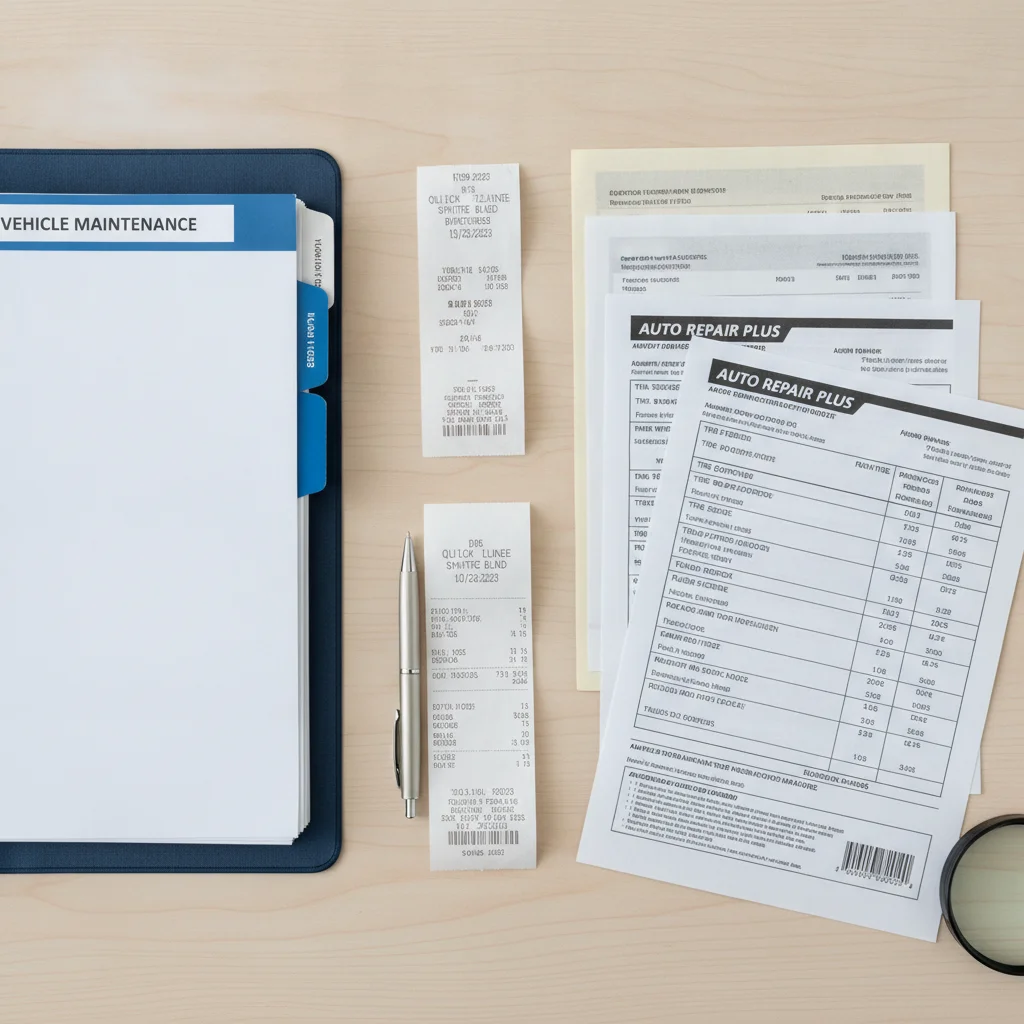
What to retain copies of
- Oil change and routine maintenance records
- Repair invoices showing any significant mechanical work
- Emissions and inspection certificates (particularly if the vehicle failed and was repaired)
- Any documentation of accident repairs or bodywork
- Recall completion notices from the manufacturer
The buyer is entitled to know the vehicle's history — and you should want them to have that information to avoid future disputes. But your copies serve a different purpose: they document what was disclosed, when, and in what detail.
If you're buying rather than selling and want to know what records you should be receiving, see The Paper Trail That Should Come With Every Used Car for a buyer-focused breakdown.
Photocopy every document before you hand it to the buyer
Original documents handed to the buyer are gone. If a dispute, tax question, or liability claim surfaces months later, you'll need proof of what you disclosed and what was agreed. Copies cost nothing but protect everything.
Submit your release of liability to your state DMV the same day as the sale
Every day your name remains on the vehicle registration is a day you can be cited for the new owner's violations or implicated in an accident. Most states allow online submission in minutes. Doing it same-day eliminates the risk window.
Write known defects into the bill of sale and have the buyer sign acknowledging them
Verbal disclosures are nearly impossible to prove. Writing defects directly into the signed bill of sale converts your disclosure into documented evidence that the buyer accepted the vehicle knowing its condition.
Read the odometer at the exact moment of handoff and record that number
Odometer readings must reflect the vehicle's mileage at the point of sale, not a recent estimate. Even a small discrepancy between your disclosure and actual mileage can be used to challenge your credibility if a dispute arises.
Keep all sale-related documents in a single labeled folder for at least five years
Disorganized records become inaccessible records. A dedicated folder — digital or physical — means you can respond to any post-sale inquiry within minutes rather than scrambling through old paperwork or email threads.
Confirm your state's notarization and plate rules before the day of sale
Discovering that your state requires notarized title signatures on the day of the sale — when the buyer is standing in your driveway — creates unnecessary stress and can delay the legal transfer. Research these requirements at least a week in advance.
Disclosure Requirements: What Sellers Are Legally Required to Reveal
Beyond mileage, sellers in many states have affirmative disclosure obligations — meaning you must proactively reveal certain defects or history even if the buyer doesn't ask. Failing to disclose when required isn't just a moral issue; it can expose you to fraud liability after the sale.
Commonly required disclosures
- Salvage or rebuilt title status
- If the vehicle was ever declared a total loss and issued a salvage title, this must be disclosed in most states. Even if you rebuilt it and it now carries a rebuilt or reconstructed title, that history must be transparent.
- Known mechanical defects
- Many states require disclosure of known material defects — issues that would meaningfully affect the vehicle's value or safety. "I didn't know" is a valid defense only if you genuinely didn't know.
- Flood damage
- Several states specifically require sellers to disclose flood damage history, even if the damage was repaired and the title doesn't reflect it.
- Lemon law buyback history
- If the vehicle was previously repurchased under a lemon law claim, disclosure is required in most jurisdictions.
The safest approach is to write your known disclosures into the bill of sale itself, have the buyer sign acknowledging them, and keep your copy. This converts an oral disclosure into documented evidence.
Title Errors Cannot Be Corrected with White-Out
If you make a mistake on the title — wrong name spelling, incorrect sale date, or an error in the odometer reading — do not attempt to correct it with correction fluid or by crossing out and rewriting. Most DMVs will reject a corrected title as potentially fraudulent. Instead, apply for a duplicate title from your state DMV before completing the transfer. It adds a day or two to the process, but it protects the legal validity of the entire transaction.
As-Is Sales Don't Eliminate All Disclosure Obligations
Selling a vehicle "as-is" means the buyer accepts the vehicle in its current condition without a warranty — but it does not exempt you from mandatory disclosures required by state law. Salvage title history, known flood damage, lemon law buyback status, and odometer accuracy must still be disclosed even in as-is transactions. An "as-is" clause in your bill of sale protects you from claims about unknown defects, not known ones you concealed.
Canceling Your Insurance and Registration: Timing Matters
One of the most common post-sale mistakes sellers make is canceling their insurance too quickly — or not quickly enough. The right timing depends on your state and your situation.
Don't cancel before the title transfers
If the buyer drives the vehicle off your property before the title is formally transferred (which happens in some states where buyers re-register themselves), you may want a brief overlap of coverage. If they're in an accident on that test drive or the trip to the DMV and your name is still on the title, a lapse in coverage is the worst-case scenario. Confirm with your insurer the exact moment you are no longer exposed.
Cancel your registration plates (where applicable)
In most states, license plates stay with the vehicle when sold. But in several — including New Jersey, New York, and parts of the Northeast — plates belong to the owner, not the car. If you leave your plates on a vehicle and the buyer uses them (whether accidentally or intentionally), citations issued to those plates become your problem until resolved.
Return your plates to the DMV after the sale and get a receipt. That receipt is another document worth keeping for at least two years.
Request a pro-rated insurance refund
If you've prepaid your annual premium, canceling your policy on the date of sale entitles you to a pro-rated refund in most cases. Contact your insurer the day of the sale — don't wait. Delays reduce your refund window and can create gaps in your records if a post-sale insurance question arises.

Building Your Seller's File: What Goes In, How Long to Keep It
The concept is simple: create a dedicated folder — physical or digital — that you label with the vehicle's year, make, model, and VIN. Everything related to the sale goes in it. Store it somewhere accessible and don't purge it prematurely.
What belongs in your seller's file
| Document | Recommended Retention |
|---|---|
| Signed bill of sale (your copy) | 5 years minimum |
| Odometer disclosure form (if separate) | 5 years minimum |
| Title transfer confirmation / DMV release of liability receipt | Permanent |
| Copies of service records handed to buyer | 3 years |
| License plate return receipt | 2 years |
| Insurance cancellation confirmation | 2 years |
| Any written disclosures signed by buyer | 5 years minimum |
If you sold the vehicle and later receive a citation, a lien inquiry, or a title dispute, your seller's file is your first line of response. It transforms what might otherwise be a confusing he-said-she-said situation into a documented timeline with signatures.
For a full picture of how buyer-side paperwork works in parallel — from initial quote through final title — see Your Car Buying Paperwork, From First Quote to Final Title. Understanding what the buyer is filing helps you anticipate what they may need from you down the line.
Use a Timestamped Photo as Additional Evidence
Before handing over the keys, take a timestamped photo of the odometer reading and the buyer standing next to the vehicle. This simple step creates a visual record of the handoff moment that corroborates your bill of sale date, your disclosed mileage, and the vehicle's general condition at transfer. Most smartphones embed date and time metadata automatically — back the photo up to cloud storage so it's preserved long-term.
Store Digital Copies in Two Separate Locations
A single digital copy is better than no copy, but it's not truly safe. Store scanned documents both in your email (by sending them to yourself) and in a cloud service like Google Drive or iCloud. If your hard drive fails or your email account is compromised, the second copy ensures you still have access. Label files with the vehicle's VIN for easy searching later.
The sale ends when the keys change hands. Your responsibility to your own protection ends only when every document is filed, every copy is stored, and every notification has been sent. Build that file before the buyer leaves your driveway — not a week later when details blur and papers wander.

All claims are backed by peer-reviewed research. Sources on request.