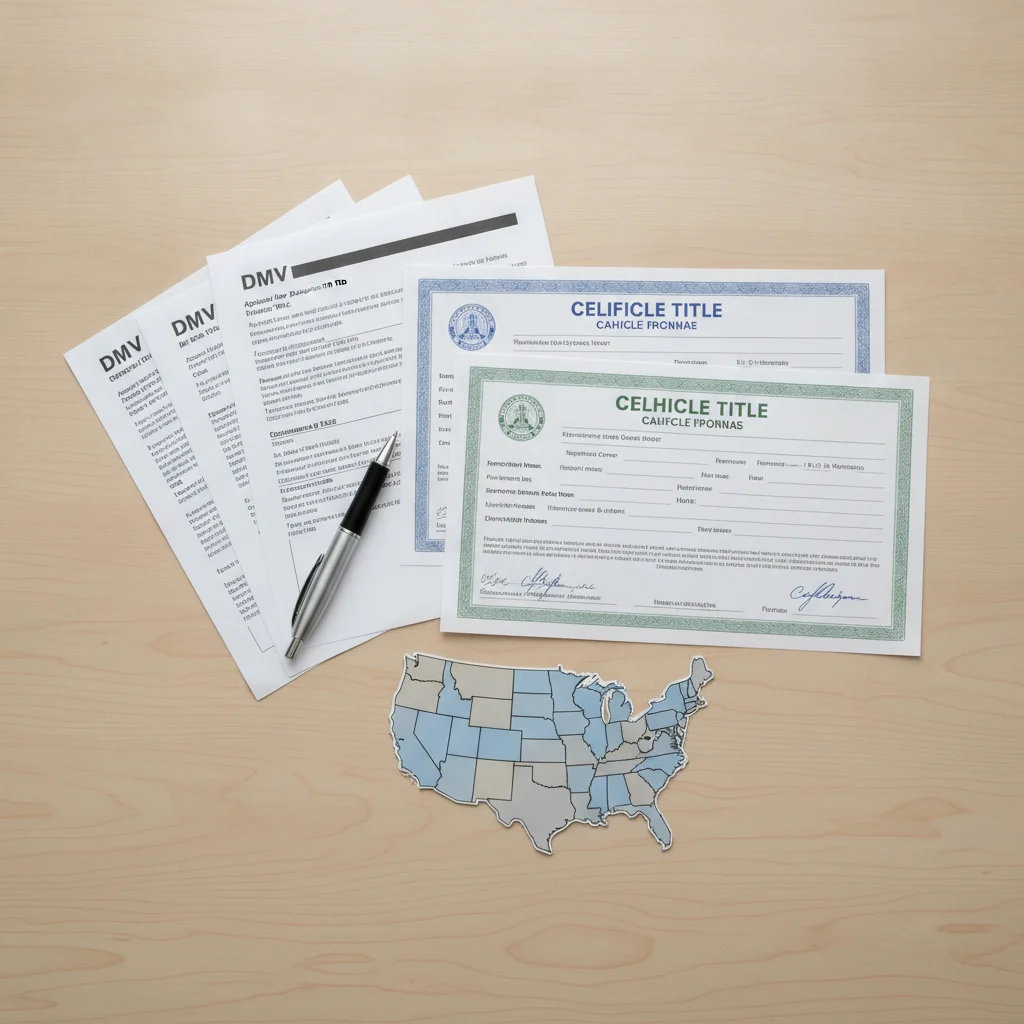
| States with mandatory title notarization | Approximately 6–10 states (varies by transaction type) (State DMV records, 2024) |
| States where notarization is never required | Majority of U.S. states for standard private sales |
| Strictest notarization state | Louisiana (requires notary + two witnesses) (Louisiana Office of Motor Vehicles) |
| States allowing Remote Online Notarization (RON) | Over 40 states (vehicle title acceptance varies) (National Notary Association, 2024) |
| Typical notary fee | $5–$15 per signature |
| Duplicate title processing time | 1–3 weeks in most states |
| Federal odometer disclosure requirement | Required for vehicles under 10 years old (Federal Truth in Mileage Act) |
| Common notary locations | Banks, UPS Store, libraries, AAA offices |
Why Notarization Matters for Car Title Transfers
When you sell or buy a used vehicle in a private party transaction, the title is the legal document that proves ownership changed hands. In some states, simply signing the back of the title is enough. In others, a licensed notary public must witness and authenticate those signatures before the transfer is valid. Skip that step where it's required, and the buyer could be stuck — unable to register the car, obtain insurance, or prove legal ownership.
Notarization serves as a fraud deterrent. A notary verifies the identity of the signer, confirms they're signing voluntarily, and stamps the document as witnessed. States that require it are typically guarding against forged signatures or coerced title transfers, which have historically been used in vehicle theft schemes.
The challenge is that notarization requirements are set at the state level, and they change. Some states require it only for certain transaction types (such as odometer disclosure statements rather than the title itself). Others require notarization only when the title is lost and a duplicate is being requested. Knowing your state's exact rules before you sit down at a private sale prevents costly delays.
For a full overview of what else changes across state lines, see State-by-State Title Transfer Requirements which covers fees, deadlines, and forms for all 50 states. If you want to understand how signing differs from completing a transfer, The Difference Between Signing Over a Title and Completing a Transfer explains why the DMV filing step is critical.
Notarization
The process by which a licensed notary public witnesses the signing of a document, verifies the signer's identity, and applies an official seal. Notarization is used to deter fraud and authenticate legal documents.
Title Assignment
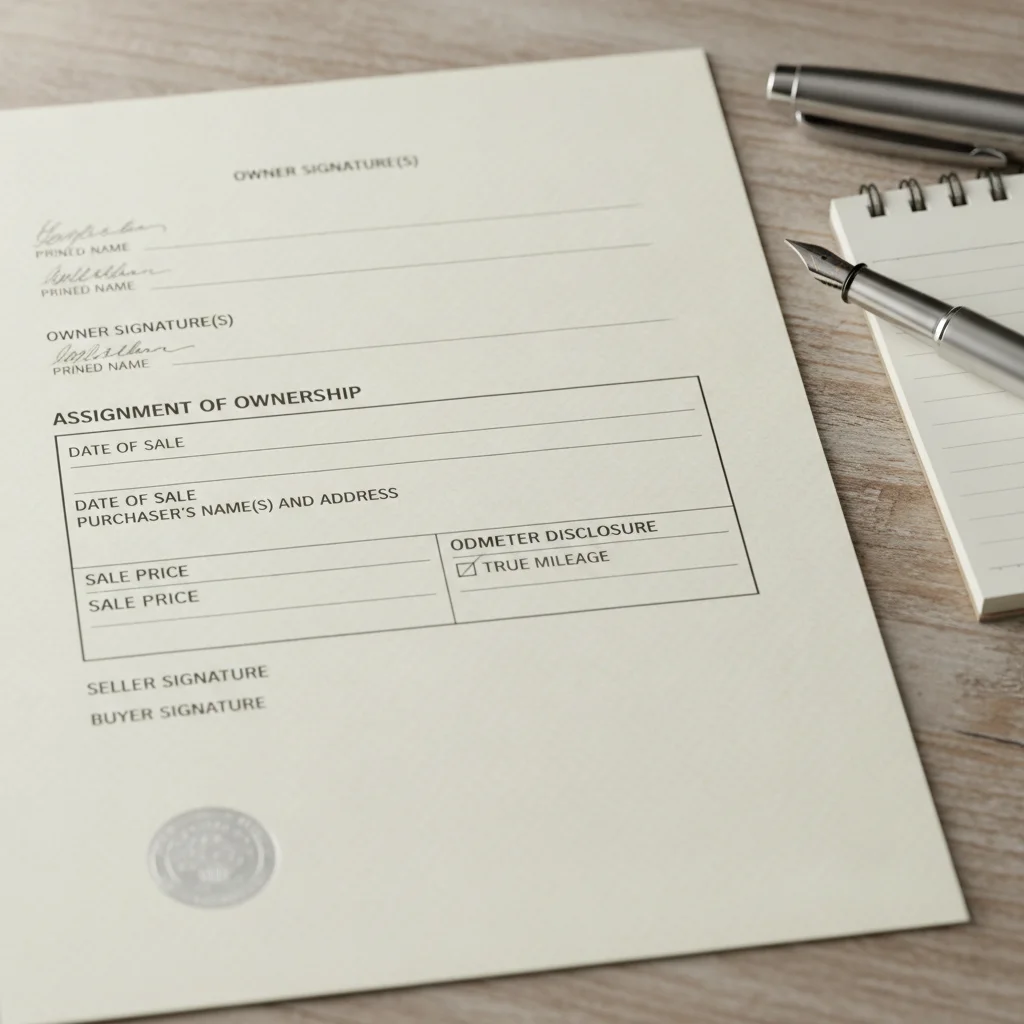
The section of a vehicle title — typically on the back — where the seller signs over ownership to the buyer. In states requiring notarization, this section must be signed in front of a notary.
Odometer Disclosure Statement
A federally required statement in which the seller certifies the vehicle's mileage at the time of sale. It may be included on the title itself or on a separate form, and in some states must be notarized independently.
Duplicate Title
A replacement title issued by the state DMV when the original is lost, stolen, or destroyed. Applying for a duplicate typically requires a notarized application and can take one to several weeks.
Lien Release
A document from a lender confirming that a vehicle loan has been paid off and the lender no longer has a financial claim on the vehicle. Required before a clean title can be transferred to a new owner.
Remote Online Notarization (RON)
A form of notarization conducted via webcam where the signer and notary are in different physical locations. Accepted in many states for various documents, but not universally accepted for vehicle titles.
Bill of Sale
A written record of the transaction between buyer and seller that includes the sale price, vehicle description, VIN, and date. Required by many states and sometimes must be notarized.
Release of Liability
A notice filed with the state DMV by the seller after a vehicle is sold, documenting the date of the transaction and releasing the seller from future responsibility for the vehicle.
States That Require Notarization on the Title
The following states require notarization as part of the standard vehicle title transfer process. This typically means both the seller and buyer must sign the title in the presence of a notary, or that the notary must witness and stamp the assignment section on the title document itself.
| States with mandatory title notarization | Approximately 6–10 states (varies by transaction type) (State DMV records, 2024) |
| States where notarization is never required | Majority of U.S. states for standard private sales |
| Strictest notarization state | Louisiana (requires notary + two witnesses) (Louisiana Office of Motor Vehicles) |
| States allowing Remote Online Notarization (RON) | Over 40 states (vehicle title acceptance varies) (National Notary Association, 2024) |
| Typical notary fee | $5–$15 per signature |
| Duplicate title processing time | 1–3 weeks in most states |
| Federal odometer disclosure requirement | Required for vehicles under 10 years old (Federal Truth in Mileage Act) |
| Common notary locations | Banks, UPS Store, libraries, AAA offices |
In Louisiana, notarization is among the most strictly enforced in the country. Both the act of sale and the title assignment require notarial authentication. Louisiana also requires two witnesses in many situations, reflecting its civil law heritage. In Montana, the title must be notarized when the seller signs over ownership, and this requirement applies to both residents and out-of-state vehicles being brought into the state.
Nebraska and Maryland both require a notary to witness the seller's signature on the title. North Dakota requires notarization of the title assignment, and the state DMV's title form includes a dedicated notary acknowledgment block. West Virginia similarly mandates a notarized signature from the seller.
Ohio has historically required notarization on title assignments, though buyers should confirm current requirements with the Ohio BMV since minor rule changes can occur between legislative sessions. New Hampshire requires a notary for the odometer disclosure statement when the statement is separate from the title, and notarization may apply to the title depending on transaction type.
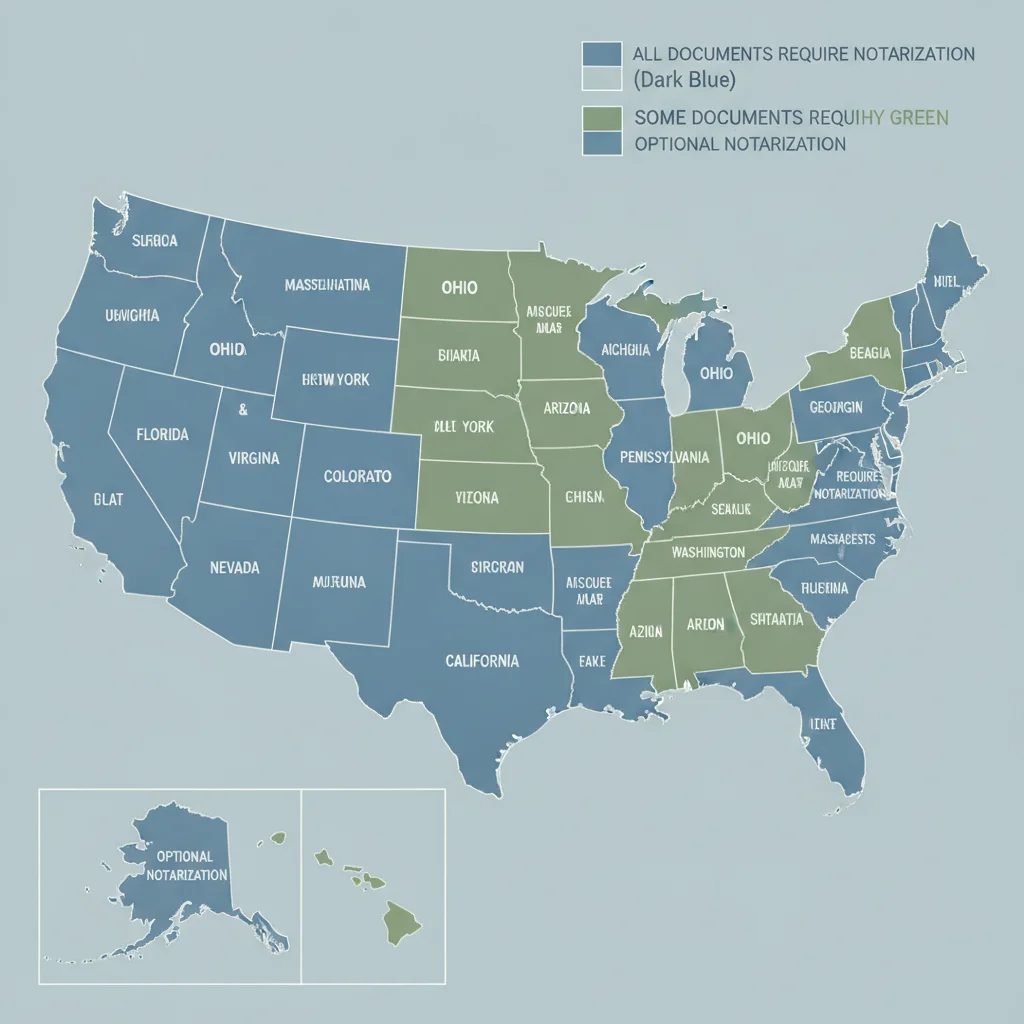
A few states fall into a conditional category — they require notarization only under specific circumstances. For example, Arizona does not require it for standard private sales but does require it when applying for a bonded title or a duplicate. Pennsylvania requires notarization on specific forms, particularly when a lien release is involved. Always verify with your state's DMV directly or through their official website before a transaction.
For a step-by-step breakdown of how to handle the signing and filing process from start to finish, see the guide to transferring a title in a private party sale.
States That Do Not Require Notarization
The majority of U.S. states do not require notarization for a standard private party vehicle title transfer. In these states, the seller signs the designated assignment section on the back of the title, the buyer fills in their information, and the signed title is then submitted to the DMV (usually by the buyer) to complete the registration transfer.
~40
States not requiring notarization for standard private car sales
The majority of U.S. states rely on other anti-fraud mechanisms such as secure title paper and digital verification instead of mandatory notarization.
40+
U.S. states authorizing Remote Online Notarization (RON)
According to the National Notary Association (2024), over 40 states have passed RON legislation, though acceptance for vehicle titles varies.
1–3 weeks
Typical wait time for a duplicate title
Most state DMVs require a notarized duplicate title application and process requests within one to three weeks depending on the state.
$5–$15
Average notary fee per signature
Notary fees are regulated by state law in many jurisdictions and are typically modest, with free options available at banks and some libraries.
Among the largest states with no notarization requirement: California, Texas, Florida, New York, Illinois, and Georgia all handle title transfers without requiring a notary. These states rely on their own fraud-prevention mechanisms, including odometer disclosure requirements, anti-tampering title paper stock, and digital title verification systems.
In Texas, for example, both the buyer and seller fill out Application for Texas Title (Form 130-U) at the county tax assessor-collector's office, and notarization is not part of that process. California uses a multi-part title (the pink slip) where signatures are self-certified. Florida requires both parties to sign the title but no notarization is needed for a standard sale.
That said, not requiring notarization doesn't mean paperwork is minimal. Most no-notarization states still require a bill of sale, odometer disclosure, and potentially emissions or safety inspection certificates depending on the county. See Private Sale Paperwork: A State-by-State Overview for a broader look at what documents you'll still need to have ready.
Requirements Can Change — Always Verify
State notarization rules for vehicle titles are set by legislature and enforced by individual DMV offices. Requirements can shift with new legislation, and third-party summaries — including this article — may not reflect the most recent changes. Always confirm the current requirements with your state's official DMV website or by calling their title division directly before completing a transaction.
Gift Transfers May Require Extra Steps
Even in states that don't require notarization for standard sales, transferring a vehicle as a gift to a family member may involve a separate notarized affidavit. This document confirms the vehicle was given as a gift — not sold — so the recipient can claim a tax exemption. Check with your state DMV whether a gift affidavit is required and whether it must be notarized.
Online Notarization Is Not Universally Accepted for Car Titles
Remote Online Notarization (RON) is legal in more than 40 states, but not every state DMV accepts RON-authenticated vehicle titles. Some states require in-person notarization specifically for title documents even when RON is available for other uses. Confirm with your DMV before scheduling an online notary session for a car title.
How to Get a Title Notarized and What to Bring
If you're in a state that requires notarization, the process itself is straightforward — but you need to be prepared. Here's what to expect and how to avoid delays.
Where to Find a Notary
- Your bank or credit union — Most offer free notary services to account holders during business hours.
- UPS Store, FedEx Office, and shipping centers — Available walk-in, usually for a small fee ($5–$15 per signature).
- Public libraries — Many offer free or low-cost notary appointments.
- Online notary services — States like Virginia, Florida, and Texas allow remote online notarization (RON) for many document types. Not all states accept RON for vehicle titles yet, so confirm before using this route.
- AAA offices — Members can typically access free notary services at AAA branches.
What to Bring to the Notary
- The original vehicle title (not a photocopy)
- Government-issued photo ID for every signer (driver's license or passport)
- The odometer disclosure statement if it's a separate form in your state
- The bill of sale if your state requires it to also be notarized
Do not sign the title before you arrive at the notary. The notary must witness the signature in person. A pre-signed title can be rejected, forcing you to restart the process with a duplicate title application — which takes time and costs money.

What the Notary Does
The notary will check your ID, watch you sign, and then apply their seal and signature to the document. They may also record the transaction in a notary log. They do not verify the accuracy of the sale price, the vehicle's condition, or the title's authenticity — that's not their role. Their only job is to confirm you are who you say you are and that you signed willingly.
Once notarized, the title should not be altered. Any correction fluid, cross-outs, or unauthorized changes to a notarized title can void it. If a mistake is made, contact your DMV about the correction process before attempting any changes.
For a complete list of documents you'll need beyond the title itself, review Documents You Need to Register a Car in Any State.
Special Situations That May Trigger Notarization
Even in states that don't typically require notarization for a standard private sale, certain situations can trigger that requirement. Being aware of these edge cases can save you a last-minute scramble.
Duplicate or Replacement Titles
If the original title is lost, stolen, or destroyed, the seller must apply for a duplicate title before transferring ownership. Nearly every state requires a notarized application to obtain a duplicate. This adds time to the transaction — often one to three weeks — so sellers should apply early if they suspect the title is missing.
Out-of-State Title Transfers
Bringing a vehicle into a new state sometimes involves additional paperwork, and some states require notarization of the out-of-state title or a separate affidavit when registering a vehicle that was titled elsewhere. Louisiana is particularly strict in this regard.
Estate and Inherited Vehicles
When a vehicle is transferred through an estate — because the registered owner has died — most states require notarized documentation from the executor or heir, regardless of their normal notarization rules. This may include a notarized affidavit of heirship or a court-issued document.
Gift Transfers and Family Transfers
Some states treat gift transfers or transfers between family members differently and may require a notarized gift affidavit to qualify for tax exemption on the transaction.
Requirements Can Change — Always Verify
State notarization rules for vehicle titles are set by legislature and enforced by individual DMV offices. Requirements can shift with new legislation, and third-party summaries — including this article — may not reflect the most recent changes. Always confirm the current requirements with your state's official DMV website or by calling their title division directly before completing a transaction.
Gift Transfers May Require Extra Steps
Even in states that don't require notarization for standard sales, transferring a vehicle as a gift to a family member may involve a separate notarized affidavit. This document confirms the vehicle was given as a gift — not sold — so the recipient can claim a tax exemption. Check with your state DMV whether a gift affidavit is required and whether it must be notarized.
Online Notarization Is Not Universally Accepted for Car Titles
Remote Online Notarization (RON) is legal in more than 40 states, but not every state DMV accepts RON-authenticated vehicle titles. Some states require in-person notarization specifically for title documents even when RON is available for other uses. Confirm with your DMV before scheduling an online notary session for a car title.
Lien Releases
If the vehicle being sold still has a loan attached to it, the lienholder must release the lien before or during the transfer. Many states require a notarized lien release document. The lender typically provides this — but verify with your state's DMV whether it needs to be notarized to be accepted.
For a detailed walkthrough of what to prepare when a title transfer involves multiple complications, see Transferring a Used Car Title: State Rules, Common Delays, and What to Bring.
Final Checklist Before Completing Your Title Transfer
Before you hand over a signed (and potentially notarized) title, run through this checklist to make sure everything is in order. A small omission now can create weeks of headaches for the buyer — and potentially keep you legally tied to the vehicle longer than intended.
- Confirm your state's notarization requirement — Check your state DMV's official website or call their title division directly. Requirements can change, and online information from third-party sites is not always current.
- Don't pre-sign the title — If notarization is required, sign only in front of the notary. If not required, still wait until you're with the buyer so they witness the signing.
- Fill in all blanks on the title — Leave nothing blank. Blank fields can be filled in fraudulently after the fact. Use "N/A" where a field doesn't apply.
- Record the odometer correctly — The odometer reading must match what's on the car at the time of sale. Federal law requires accurate odometer disclosure for vehicles under ten years old.
- Get a copy of everything — Keep a copy of the signed title, the bill of sale, and any notarized documents for your own records. If questions arise later, you'll want documentation.
- Notify your state's DMV — Some states allow or require sellers to file a notice of sale or release of liability. This protects you if the buyer doesn't promptly transfer the title and a parking ticket or accident occurs after the sale.
- Cancel or transfer insurance — Don't cancel your policy until the title is signed over and the buyer has their own coverage in place.
For a broader understanding of the private sale paperwork process as a whole, the Private Sale Paperwork state-by-state overview and the Paperwork & Contracts hub are both good starting points. Once the title is transferred, you'll also want to understand Registration & Taxes obligations in the buyer's state.
State DMV Finder (USA.gov)
Quickly find the official DMV website for any U.S. state to verify current title transfer and notarization requirements directly from the source.
National Notary Association — Find a Notary
Use the NNA's search tool to locate a licensed notary public near you, including mobile notaries who can come to your location.
Private Sale Paperwork: A State-by-State Overview
A comprehensive reference covering title transfer rules, bill of sale requirements, and odometer disclosures for private party vehicle sales in all 50 states.
Transferring a Used Car Title: State Rules, Common Delays, and What to Bring
Covers what documents buyers and sellers need at the DMV, common title transfer mistakes, and how to avoid registration delays.
Federal Truth in Mileage Act Overview (NHTSA)
The official federal resource explaining odometer disclosure requirements, penalties for mileage fraud, and which vehicles are exempt from disclosure rules.
Documents You Need to Register a Car in Any State
A practical checklist of every document typically required to register a newly purchased vehicle, from proof of insurance to lien releases and emissions certificates.

All claims are backed by peer-reviewed research. Sources on request.