Key Takeaways
Why Private Party Title Transfers Require Extra Attention
When you buy a car from a dealership, their finance office handles nearly all the title paperwork. They know what forms to use, which fields to complete, and how to file with your state. In a private party sale, that expertise disappears — and the responsibility shifts entirely to the seller and buyer.
That's not a minor difference. A botched title transfer can leave a seller legally tied to a car they no longer own, expose a buyer to registration delays, or — in the worst cases — result in a vehicle with an unmarketable title that can't be registered in the new owner's name at all. Understanding what a title transfer actually involves is the first step to making sure yours goes smoothly.
This guide walks sellers through every step: from pulling the title out of the drawer and checking it for accuracy, to signing it correctly, preparing the required documentation, exchanging payment safely, and filing the paperwork with the state. For a broader look at the full scope of legal requirements in a private transaction, see everything involved in a legal private car sale.

The steps below assume you hold a clear title — meaning there's no existing lien on the vehicle. If a lender's name appears on your title, resolve that first. Everything else in this process depends on having a clean, lien-free title in your name before you sit down with the buyer.
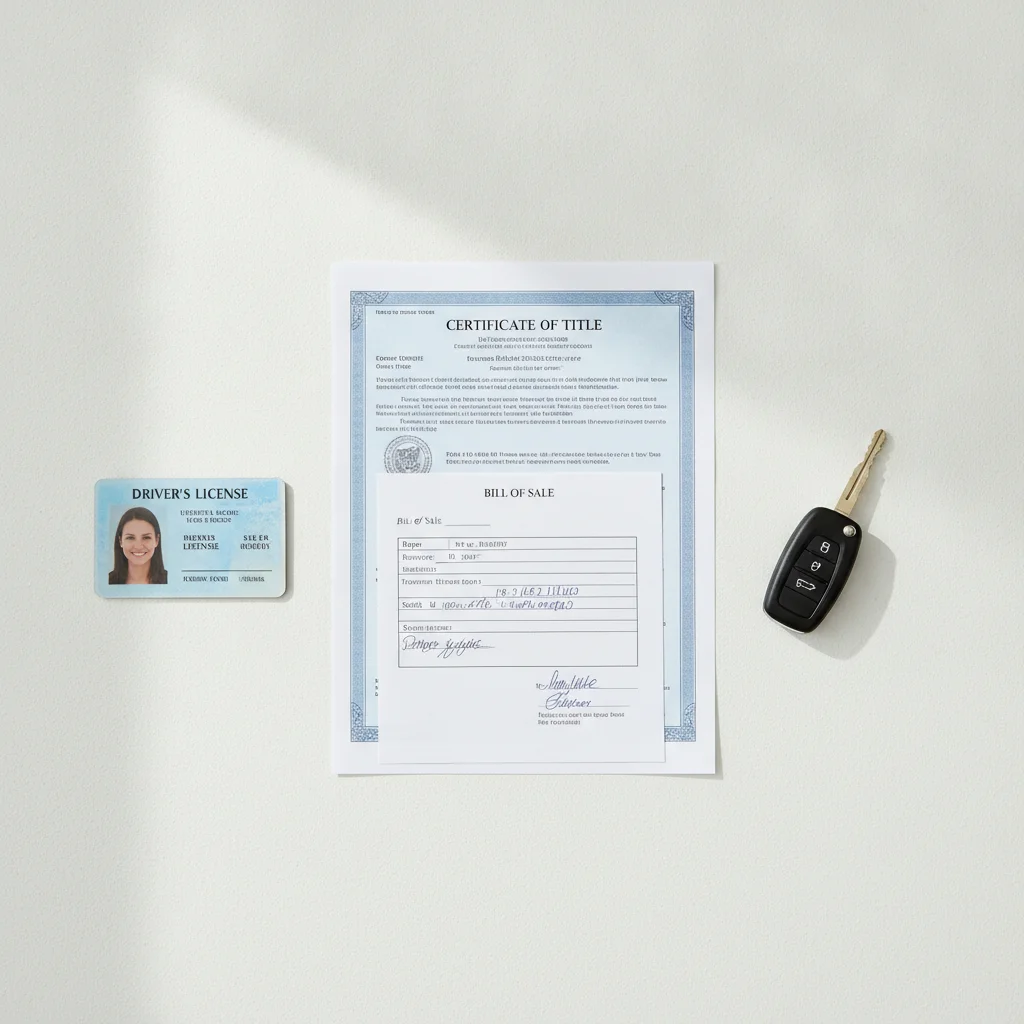
What you will need
Have those items ready? Then let's walk through the process step by step.
Locate and verify the title before the sale
Before you schedule a meetup with the buyer, pull out the physical title and examine it carefully. Confirm that the name printed on the front matches your legal name exactly, that the VIN on the title matches the VIN on the vehicle's dashboard and door jamb, and that there are no existing signatures in the seller's assignment section on the back. If any previous owner signed the title but the transfer was never completed, you may be holding what's called a jumped title — a serious problem that can derail your sale.
If you financed the vehicle and recently paid it off, your lender may still be listed as the lienholder. In that case, you'll need the original title back from the lender along with a lien release letter before you can legally sign it over. Some lenders mail the title directly to you; others report the release electronically to your state DMV and you must request a clean title. Either way, do not attempt to sell the vehicle until your name appears as the sole owner with no lienholders listed.
Check your state's specific transfer requirements
Title transfer rules vary significantly by state. Before the transaction, visit your state's DMV website or reference a state-by-state overview of private sale paperwork requirements to confirm exactly what your state demands. Key variables to look up include:
- Notarization: States like Louisiana, Montana, Nebraska, New Hampshire, New York, North Dakota, Ohio, and Wyoming require a notary public to witness the seller's signature on the title.
- Bill of sale: Some states (including Hawaii, Louisiana, Maryland, Montana, Nebraska, New Hampshire, West Virginia, and Wyoming) legally require a bill of sale. Even if yours doesn't, you should still use one.
- Smog or emissions certification: California requires a smog certificate from the seller before completing a private sale. Several other states have similar rules.
- Separate odometer disclosure form: While federal law requires odometer disclosure for vehicles under 10 model years old, some states have their own additional form separate from the title.
Missing one of these state-specific steps is the most common reason private sales get tangled up at the DMV. Do your research before the day of the transaction, not after.
Complete the odometer disclosure
Federal law under the Truth in Mileage Act requires sellers to disclose the accurate odometer reading at the time of sale for any vehicle under 10 model years old. On most titles, this disclosure is built into the seller's assignment section on the back of the title. You'll see a field labeled something like "Odometer Reading at Time of Transfer."
Write the exact mileage shown on the odometer at the time you sign. Do not round up, estimate, or fill this in ahead of time — the mileage should reflect the reading at the moment of the actual transaction. If the odometer is known to be broken or has rolled over (exceeded its maximum reading), indicate this clearly using the appropriate checkbox on the form. Misrepresenting mileage, even unintentionally, is a federal violation that can expose you to civil liability.
Sign the back of the title correctly
The back of the title contains the seller's assignment section — the section you sign to legally release ownership. This is where precision matters most. Sign exactly as your name appears on the front of the title. If the title reads "Jonathan R. Harmon" and you sign "Jon Harmon," the DMV may reject the transfer.
If there are two owners listed on the title, pay close attention to whether their names are joined by "and" or "or." If the title reads "and," both owners must sign. If it reads "or," only one signature is required. This one distinction trips up a surprising number of sellers.
Do not use correction fluid (white-out), cross out entries, or write over existing text on the title. Any correction — no matter how minor — can cause the DMV to reject the document. If you make a mistake, you'll likely need to apply for a corrected or duplicate title before the sale can proceed.
[in_content_images:0]Prepare and sign a bill of sale
A bill of sale is a written record of the transaction between you and the buyer. Even in states that don't legally require one, it serves as critical protection for both parties. The document should include:
- Full legal names and addresses of both the seller and buyer
- Date of the transaction
- Vehicle year, make, model, and color
- VIN (Vehicle Identification Number)
- Agreed sale price
- Odometer reading at time of sale
- A statement of whether the vehicle is sold "as-is"
- Signatures of both parties
The "as-is" clause is particularly important for private sellers. Unlike a dealership, a private seller generally isn't required to offer any warranty, and an as-is statement makes that explicit. See our complete guide to documents needed for a private car sale for a full bill of sale template and checklist. Both parties should keep a signed copy of the bill of sale for their records.
Hand over the title and collect payment
Once the title is signed, the odometer disclosure is complete, and the bill of sale is executed, you can exchange the title for payment. The order matters: do not hand over the title until payment has cleared or is verified in hand.
For cash transactions, count the bills in person. For cashier's checks, verify the check is from a legitimate bank — call the bank directly using a number you look up independently, not one printed on the check itself. Many sellers have been defrauded by counterfeit cashier's checks. Personal checks should generally be avoided unless you are willing to wait for the check to clear before handing over the title and keys.
If you financed the transaction and the buyer is taking over payments or taking out their own loan, the lender's process may supersede the direct exchange described here. In most cases, the lender will manage the title directly.
Notify your state DMV of the sale
Signing over the title transfers ownership contractually, but it does not automatically update your state's vehicle registration records. In many states, sellers are required — or at minimum strongly advised — to submit a Notice of Transfer (sometimes called a Release of Liability) to the DMV. This filing officially notifies the state that you are no longer the vehicle's owner.
Why does this matter? If the buyer delays filing their own registration, drives the car with a suspended plate, or gets a parking ticket before their paperwork is processed, the state's records still show you as the registered owner. That can mean fines, toll violations, or worse arriving in your mailbox long after the sale. Many states allow you to submit this notice online within a few days of the sale. Check your state's DMV website for the specific form and submission window. For more on what happens after you sign and why DMV filing is the step that truly closes the loop, see the difference between signing over a title and completing a transfer.
Cancel or transfer your insurance and remove your plates
Before the buyer drives away, remove your license plates if your state requires it. In most states, plates belong to the registered owner — not the vehicle — and you'll need them to get a refund on unused registration fees or to transfer them to your next car. States like California are an exception: in California, plates typically stay with the vehicle.
Contact your insurance provider immediately after the sale to cancel or update your policy. Do not wait until the end of the month. If the buyer gets into an accident the day after the sale while your policy is still technically active on that vehicle, you could face a claim even though you no longer own it. Your insurer can advise you on the proper timing for removal. If you're replacing the sold vehicle with a new one, you may be able to transfer the existing policy.
Tools and Documents You'll Need
The following tools and documents are what you'll need to gather before your transfer meeting. Missing even one can send the buyer away without a deal — or worse, allow the transaction to proceed in a legally incomplete state.
Original Vehicle Title
The primary legal document that must be signed over from seller to buyer to initiate ownership transfer.
Bill of Sale
Documents the agreed sale price, date, vehicle details, and identities of both parties — required in many states and essential for tax and liability purposes.
Odometer Disclosure Statement
Records the vehicle's mileage at the time of sale, as required by federal law for vehicles under 10 years old.
Lien Release Letter
Confirms that any prior auto loan on the vehicle has been fully paid and the lender no longer has a legal claim to the title.
Notary Public
Required in certain states to witness and authenticate the seller's signature on the title document.
Emissions or Smog Certificate
Proof that the vehicle passed a state-mandated emissions inspection, required before title transfer in states like California.
State DMV Transfer Form
A supplemental form some states require in addition to the signed title to formally record the ownership change.
For a comprehensive breakdown of every document that should accompany a private vehicle sale in your state, see our private car sale document checklist. Requirements vary meaningfully across states, and what's optional in one may be mandatory in another.
Common Mistakes That Derail Title Transfers
Even well-prepared sellers make avoidable errors. Here are the most common problems that cause private party title transfers to get rejected or delayed at the DMV:
Signing with the wrong name
Your signature on the title must match the name printed on the front exactly. If your legal name has changed since the title was issued — due to marriage, divorce, or a legal name change — you'll need supporting documentation (such as a marriage certificate or court order) or a corrected title before you can sign it over.
White-out or crossed-out entries
Any correction on a title document raises a red flag for the DMV. If you write the wrong odometer reading, cross it out, and write the correct one, many states will reject the title. If you make a mistake, apply for a corrected title rather than trying to fix it in pen.
Forgetting to get a lien release
If you recently paid off an auto loan, the lender's name may still appear on your title as a lienholder. Some lenders take weeks to mail the released title or report the release to the state. Check your title — if a lienholder is listed, don't start the sale process until you have the lien release in hand.
Not checking whether both owners must sign
On co-owned vehicles, the conjunction on the title determines whether one or both signatures are required. "And" means both must sign. "Or" means either can sign alone. Showing up to the DMV with only one signature when two are required stops the transfer entirely.
Skipping the seller's notice of transfer
Many sellers hand over the signed title and consider the deal done. But until you file a Notice of Transfer (or Release of Liability) with your state DMV, you remain the registered owner in the state's records. Don't skip this step — it's what truly closes your obligation. Learn more in our article on the difference between signing over a title and completing a transfer.
Beware of Buyers Who Want a Blank Title
If a buyer asks you to sign the title without filling in their name — so they can "fill it in later" or sell the car quickly to someone else — walk away. This is called title jumping and it is illegal in every U.S. state. It creates a chain of ownership that bypasses registration and can expose you to significant legal liability. A legitimate buyer has no reason to make this request.
Don't Let the Buyer Take the Car Before the Title Is Signed
Some buyers may ask to take the car for an extended test drive or offer to return with the money the next day. Do not hand over the keys without completing the full title transfer and collecting verified payment simultaneously. Once the vehicle leaves your possession without a signed title exchange, reclaiming it or resolving a dispute becomes extremely difficult.
Understanding title transfer fees is also part of completing a sale cleanly. Who pays what can vary significantly. Our guide to title transfer fees — what sellers pay, what buyers pay, and who decides breaks down the standard cost allocation and how to negotiate it upfront, so there are no surprises at the DMV window.
Do a Dry Run Before the Sale Day
A few days before meeting the buyer, sit down with the actual title and walk through every field that needs to be completed. Make sure you know exactly where to sign, where to write the odometer reading, and which sections the buyer fills in. If your state requires notarization, locate a nearby notary (most banks, UPS stores, and credit unions offer this service) and confirm they can be available on the day of the sale.
Use Your State DMV's Own Forms When Available
For bill of sale, odometer disclosure, and transfer notices, check whether your state DMV publishes official forms. Using the exact forms your state DMV recognizes eliminates any risk of a rejection due to missing fields or formatting differences. Most are free to download and print from your state's DMV website.
After the Sale: What Still Needs to Happen
Once you've signed the title, collected payment, and handed over the keys, the immediate transaction is complete. But there are a few loose ends every seller needs to tie up in the days that follow.
File your release of liability with the DMV
As covered in Step 7, this protects you from any legal or financial liability tied to the vehicle after the sale. File online if your state allows it — most do, and it takes less than five minutes.
Keep your paperwork
Retain your copy of the bill of sale, the odometer disclosure, and any DMV filing confirmation for at least three to five years. If a dispute arises later — a buyer claiming the car's mileage was misrepresented, for example, or a toll or tax authority claiming you still owe on the vehicle — your documentation is your defense.
Handle your plates and registration
In most states, unused registration time can be refunded when you surrender your plates. Contact your state DMV or motor vehicle office to understand the process for your specific situation. And don't forget to contact your insurance company: cancel the policy on the sold vehicle or transfer it to your next car.
What the buyer still needs to do
Remind the buyer — ideally in writing — that they are responsible for titling and registering the vehicle in their own name, typically within 30 days of purchase (though the window varies by state). Until they do, your signed title is their proof of ownership, but it is not yet a completed legal transfer in the eyes of the state. For a buyer-focused breakdown of what comes next, our article on transferring a used car title — state rules, common delays, and what to bring covers exactly what the buyer faces at the DMV.
A Signed Title Is Not a Completed Transfer
Many sellers believe that once they sign the back of the title and hand it to the buyer, their obligation ends. It does not. Until the buyer files the title and registration with their state DMV — and until you file a Notice of Transfer with your state — the vehicle can still be legally tied to your name in the state's records. Parking tickets, toll violations, and even accidents involving the vehicle can potentially come back to you. File your release of liability the same day as the sale, without exception.
The private sale process, done correctly, is not particularly complicated — but it does require attention to detail at every step. Sellers who treat the title paperwork as an afterthought are the ones who end up on the hook for parking tickets on a car they sold six months ago, or fielding calls from a buyer whose DMV registration was rejected. Follow this process and that won't be you.

All claims are backed by peer-reviewed research. Sources on request.