
Key Takeaways
Signing Over vs. Completing a Title Transfer
Signing over a title means the seller endorses (signs) the back of the vehicle's certificate of title, releasing their ownership claim. Completing a title transfer means the buyer takes that signed document to the DMV, pays the required fees, and receives a new title issued in their own name. These are two separate steps, and only the second one legally changes who owns the vehicle in the eyes of the state.
Until a new title is issued by the state DMV, the original registered owner remains on record — meaning the seller can still be held liable for parking tickets, accidents, or other incidents involving that vehicle.
Why the Distinction Matters More Than Most Sellers Realize
Most private car sellers treat the handshake and the signed title as the finish line. Hand over the keys, sign the back of the title, collect the money — done. But that mental model leaves a dangerous gap between what feels complete and what is legally complete.
The signed title is evidence of consent. The DMV filing is the legal act. Confusing the two is one of the most common — and costly — mistakes sellers make in a private vehicle transaction.
Consider what happens in between: a buyer drives off with a signed title in hand but never registers the vehicle. Weeks pass. The car gets a parking ticket, is involved in a fender-bender, or accumulates unpaid tolls. Every one of those incidents traces back to the last name on the state's registration record — yours.
Many sellers believe the handshake is enough, or assume the buyer automatically handles everything. This article clarifies exactly where each party's responsibility begins and ends — and what you can do to protect yourself the moment the keys leave your hand.
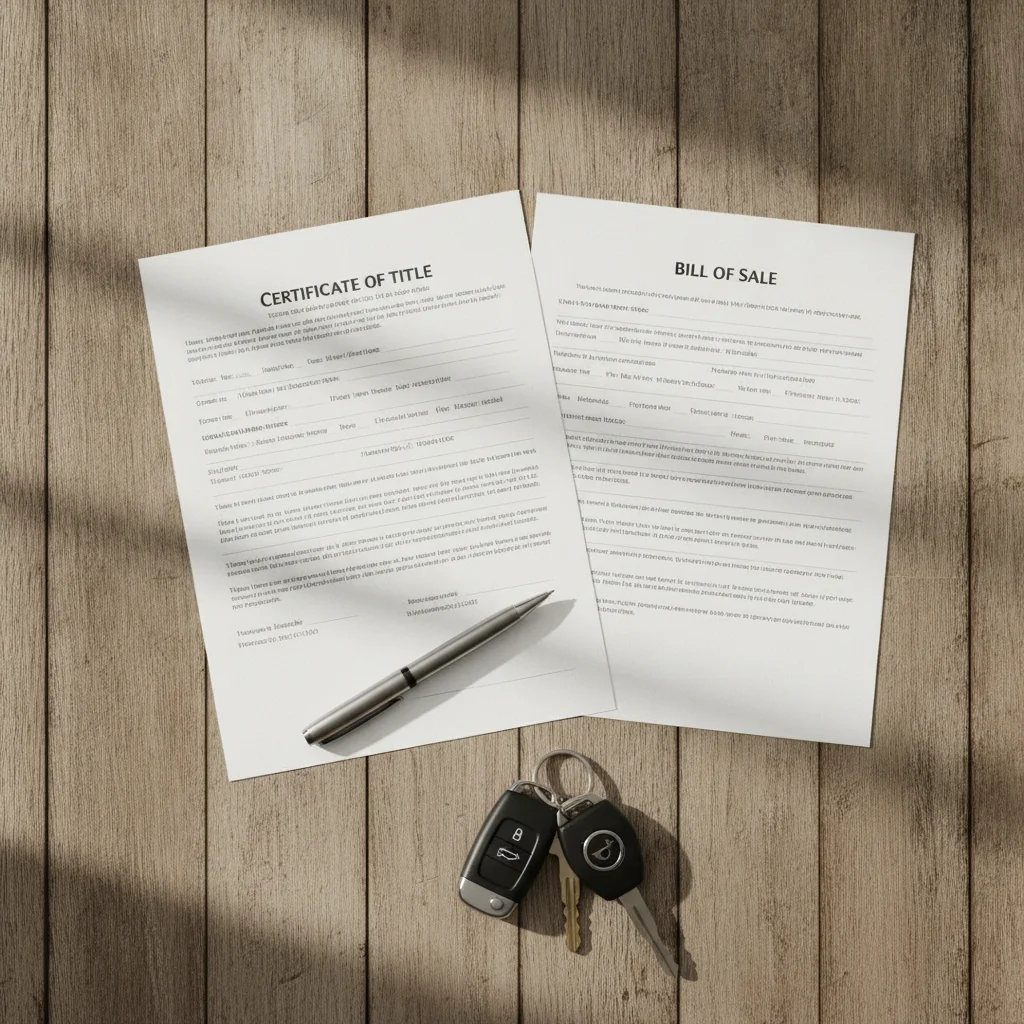
What "Signing Over" a Title Actually Means
The back of every vehicle title has a section specifically designed for ownership transfer. It typically includes fields for the seller's signature, the odometer reading at time of sale, the sale price, the buyer's name and address, and sometimes a notarization requirement depending on the state.
When a seller fills out these fields and signs, they are doing one thing: releasing their ownership claim. The legal term for this is an endorsement of title. Think of it like signing the back of a check — you're authorizing the transfer, but the money doesn't move until the check is deposited and processed.
What the seller's signature does NOT do:
- It does not remove your name from the state's motor vehicle records.
- It does not cancel your registration obligation in some states.
- It does not end your potential liability for what happens with that vehicle.
- It does not update insurance or lien records automatically.
The signed title is a necessary document, but it is not the destination. It is the input the DMV needs to process the actual transfer.
Title Errors Can Stall the Entire Process
If you make a mistake filling out the back of the title — a crossed-out entry, correction fluid, or misspelled name — most DMVs will reject the document. Sellers must then apply for a corrected or duplicate title before the buyer can complete the transfer. Take a moment to review every field carefully before signing. When in doubt, contact your state DMV before making any marks on the document.
Dealer Sales Handle This Differently
When you buy or trade in a vehicle at a dealership, the dealer manages the DMV filing on your behalf as part of the transaction. The fees you pay at the dealer often include title transfer and registration costs. This service is one of the key differences between dealer and private-party transactions — in a private sale, the responsibility falls entirely on the buyer and seller to manage the paperwork correctly.
One critical detail sellers often overlook: if you make a mistake on the title — an incorrect odometer reading, a misspelled name, or a crossed-out field — many states will require you to obtain a corrected title before the transfer can be processed. That means delays and more paperwork. Take your time filling out the title accurately.
What "Completing a Transfer" Actually Means
Completing a title transfer is the buyer's filing step. Once the buyer has the signed title in hand, they must take it — along with the required fees, proof of insurance, and any supporting documents — to the state DMV and apply for a new title issued in their own name.
When the DMV processes that application and issues a new certificate of title, the transfer is complete. The state's records now reflect the buyer as the legal owner. That's the finish line.
What the buyer typically submits to the DMV:
- The signed certificate of title (endorsed by the seller)
- A completed title transfer application (state-specific form)
- Proof of current auto insurance
- Payment for title transfer fees and any applicable sales tax
- A bill of sale (required or strongly recommended in most states)
- Odometer disclosure statement (federally required for vehicles under 10 years old)
10–30 days
Typical state deadline to complete title transfer
Most U.S. states require buyers to file a title transfer application within 10 to 30 days of the vehicle purchase date to avoid late fees.
6 states
States requiring notarized title signatures
Louisiana, Maryland, Montana, Nebraska, New Hampshire, and West Virginia require a notary's stamp on the seller's title signature before a transfer can be processed.
$0–$15
Typical cost of a Notice of Sale filing
Most states allow sellers to file a release of liability or notice of sale online for free or a nominal fee, providing immediate legal protection after the transaction.
10 years
Federal odometer disclosure threshold
Under federal law, sellers must provide a written odometer disclosure for any vehicle under 10 model years old at the time of sale.
The timeline matters. Most states require the buyer to complete this filing within 10 to 30 days of the purchase date. Delays beyond that window often trigger late fees, and in some states, the buyer may need to obtain a bonded title if the paperwork becomes too old or is lost.
For a full breakdown of what documents move with a vehicle at sale, see what transfers when you buy a car.
The Legal Gap Between the Two Steps
Here is the precise legal reality: from the moment the seller signs the title to the moment the DMV issues a new one, there is a period of ambiguity. The seller has released their claim. The buyer hasn't yet established theirs in the state's records. During this window, the original owner's name is still on the books.
“The legal reality is that a signed title is an authorization, not a completion. Until the DMV processes the paperwork and issues a new certificate, the state has no record that ownership changed hands — and someone has to be responsible in the interim.”
— National Consumer Law Center, Consumer advocacy organization focused on vehicle title and registration law
This gap is not hypothetical. It creates real-world problems for sellers in several scenarios:
- Traffic violations: If the buyer gets a ticket during this period, the notice may come to the seller's address. Disputing it requires proof of the sale.
- At-fault accidents: Injured parties may pursue the registered owner — still legally you — if the buyer hasn't completed the transfer.
- Lapsed insurance: Some states allow insurers to cancel policies once a vehicle is sold. If the buyer drives uninsured during the gap and causes an accident, sellers have faced legal exposure.
- Unpaid tolls and impound situations: These trace to the registered owner on file.
File Your Notice of Sale Immediately
Don't wait until the next day. Most states allow sellers to file a Notice of Sale or Release of Liability online within minutes of completing the transaction. This single step creates a legal record that your ownership ended on the date of sale and protects you from tickets, tolls, and liability that arise after the handover. Search your state DMV's website for 'Notice of Sale' or 'Release of Liability' to find the filing portal.
Always Keep a Copy of the Signed Title
Before handing the signed title to the buyer, take a clear photo or photocopy of both sides. If the buyer loses the title before filing, or if a dispute arises later about the sale terms, your copy is critical evidence. Store it with your bill of sale in a secure location for at least a year after the sale date.
The moment you hand over the signed title, your best defensive move is to file a Notice of Sale or Release of Liability with your state DMV. Most states allow this online and it typically costs nothing. This filing doesn't complete the transfer — that's still the buyer's job — but it timestamps your release of the vehicle and protects you from post-sale liability.
Skipping the title transfer doesn't end your liability — and that risk sits heaviest on the seller until the DMV records are updated.

State-by-State Variations You Need to Know
Title transfer rules are not uniform across the United States. Every state has its own requirements for who must be present, what documents are needed, whether notarization is required, and how long the buyer has to complete the filing. Sellers moving between states — or selling to an out-of-state buyer — face additional layers of complexity.
Key variables by state:
| Requirement | States That Require It | States Where It's Optional |
|---|---|---|
| Notarized title signature | Louisiana, Maryland, Montana, Nebraska, New Hampshire, West Virginia | Most other states |
| Seller's release of liability filing | California, Florida, Texas (recommended) | Varies widely |
| Emissions or safety inspection before transfer | Illinois, New York, Pennsylvania, others | Many states |
| Odometer disclosure required | All states (federal law, vehicles under 10 years) | Older vehicles may be exempt |
If you are selling to a buyer in a different state, the buyer will need to title the vehicle in their home state using your signed title. They may also need additional documentation like a VIN inspection. Always confirm the destination state's requirements before the transaction closes.
Title Errors Can Stall the Entire Process
If you make a mistake filling out the back of the title — a crossed-out entry, correction fluid, or misspelled name — most DMVs will reject the document. Sellers must then apply for a corrected or duplicate title before the buyer can complete the transfer. Take a moment to review every field carefully before signing. When in doubt, contact your state DMV before making any marks on the document.
Dealer Sales Handle This Differently
When you buy or trade in a vehicle at a dealership, the dealer manages the DMV filing on your behalf as part of the transaction. The fees you pay at the dealer often include title transfer and registration costs. This service is one of the key differences between dealer and private-party transactions — in a private sale, the responsibility falls entirely on the buyer and seller to manage the paperwork correctly.
For dealership transactions, the dealer typically handles the DMV filing as part of the sale process — one reason dealer paperwork takes longer but provides more protection. In a private sale, neither party has a professional intermediary managing the filing. That's why understanding these steps yourself is essential.
What Sellers Should Do Before and After the Transaction
Protecting yourself as a seller isn't complicated, but it does require a deliberate checklist. Here is a practical sequence to follow:
Before you sign the title:
- Locate the original title. If you can't find it, apply for a duplicate before listing the vehicle. Selling without a title creates problems for both parties.
- Check for liens. If you still owe money on the vehicle, contact your lender before agreeing to sell. The lien must be resolved before a clean title can be issued to the buyer.
- Review your state's requirements. Check your DMV's website for any notarization, disclosure, or inspection requirements specific to your state.
- Prepare a bill of sale. Even in states that don't require it, a bill of sale documents the sale price, date, vehicle identification, and both parties' information.
When you sign the title:
- Fill out every field completely and accurately — especially the odometer reading and sale date.
- Use the exact legal name of the buyer as it will appear on their new title.
- Keep a photocopy or photo of the signed title for your records before handing it over.
After you hand over the keys:
- File a Notice of Sale or Release of Liability with your state DMV that same day if possible.
- Cancel or transfer your insurance only after the notice of sale is filed.
- Remove the vehicle from your records — notify your insurer in writing of the sale date.
- Follow up with the buyer within a few weeks to confirm the title transfer was completed.
File Your Notice of Sale Immediately
Don't wait until the next day. Most states allow sellers to file a Notice of Sale or Release of Liability online within minutes of completing the transaction. This single step creates a legal record that your ownership ended on the date of sale and protects you from tickets, tolls, and liability that arise after the handover. Search your state DMV's website for 'Notice of Sale' or 'Release of Liability' to find the filing portal.
Always Keep a Copy of the Signed Title
Before handing the signed title to the buyer, take a clear photo or photocopy of both sides. If the buyer loses the title before filing, or if a dispute arises later about the sale terms, your copy is critical evidence. Store it with your bill of sale in a secure location for at least a year after the sale date.
For a complete look at the paperwork ecosystem surrounding a vehicle sale, the Paperwork & Contracts hub walks through each document type and what it accomplishes at each stage of the transaction.
When Something Goes Wrong: Common Problem Scenarios
Even when sellers do everything right, situations arise. Here's how to handle the most common complications:
The buyer loses the signed title before filing
If the buyer loses the signed title before submitting it to the DMV, you may need to assist in obtaining a duplicate. This process varies by state — some states allow the buyer to apply for a bonded title or duplicate using a bill of sale, while others require the seller's involvement. This is another reason to keep a copy of the signed title.
The buyer never completes the transfer
This is the seller's nightmare scenario. If you've already filed a Notice of Sale, your exposure is significantly reduced. If you haven't, contact your state DMV immediately. Some states allow sellers to report the vehicle as sold and request removal from their records. If the buyer is unresponsive, consult a consumer law attorney — especially if you're receiving tickets or notices tied to the vehicle.
The title has an error or is marked up
Crossed-out words, correction fluid, or incorrect information on the title may cause the DMV to reject it. In this case, the seller may need to apply for a corrected or duplicate title from the state before the buyer can complete the transfer. This takes time, so catching errors before the sale is always better.
The vehicle has an outstanding lien
If a lender holds the title because you financed the vehicle, you cannot sign over a clean title until the loan is paid off and the lien is released. Options include paying off the loan before the sale, facilitating a transaction where the buyer's funds pay off the loan at closing, or working through a dealership that handles these payoff transactions routinely.


All claims are backed by peer-reviewed research. Sources on request.