
| Where sellers write on the title | The assignment section on the back of the document |
| Pen type required | Black or blue ballpoint only — no gel pens, markers, or pencils |
| Federal odometer law applies to | Vehicles under 20 years old (extended from 10 years in 2021) (NHTSA / Truth in Mileage Act amendment, 2021) |
| States requiring notarization | Approximately 8–10 states including LA, MD, MT, NE, NV, NH, OK, WV |
| White-out policy | Never permitted on any title field — request a duplicate title instead |
| Co-owner signature rule | Both owners must typically sign if title reads "AND"; one may suffice for "OR" |
| Sale price field purpose | Used by buyer's state to calculate sales or use tax at registration |
Why Getting the Title Right Matters More Than You Think
The certificate of title is the single most legally significant document in any private car sale. It proves ownership, records the odometer at the time of transfer, and — once signed — initiates the legal handoff from seller to buyer. Fill it out incorrectly, and the buyer can't register the car. Fill it out with an erasure or a correction, and many states will refuse it outright.
Unlike a bill of sale, which you can reprint and resign, a title is issued by the state. If you make it unusable, getting a replacement takes time, money, and DMV visits — for both parties. That's why understanding each field before you put pen to paper is not a formality. It's how you protect yourself and close the deal cleanly.
This guide walks through each section of a standard title's seller-facing fields — the ones you'll fill out on the back of the document — explaining what goes there, what form it must take, and what mistakes to avoid. For a broader look at the full paperwork picture, see the complete car paperwork guide that covers every document from first quote to final title.
| Where sellers write on the title | The assignment section on the back of the document |
| Pen type required | Black or blue ballpoint only — no gel pens, markers, or pencils |
| Federal odometer law applies to | Vehicles under 20 years old (extended from 10 years in 2021) (NHTSA / Truth in Mileage Act amendment, 2021) |
| States requiring notarization | Approximately 8–10 states including LA, MD, MT, NE, NV, NH, OK, WV |
| White-out policy | Never permitted on any title field — request a duplicate title instead |
| Co-owner signature rule | Both owners must typically sign if title reads "AND"; one may suffice for "OR" |
| Sale price field purpose | Used by buyer's state to calculate sales or use tax at registration |
The Back of the Title: Where Sellers Actually Write
Most people are surprised to learn that sellers don't fill in the front of the title — that section was completed by the DMV when the vehicle was first registered. Your job as the seller is to complete the assignment section on the back. This section typically includes the following fields:
- Odometer disclosure
- Sale price (sometimes called "selling price" or "purchase price")
- Buyer's name and address
- Date of sale
- Seller's signature(s)
- Notarization (required in some states)
Each state formats its title slightly differently, but these fields are nearly universal. Some states also include a lienholder release section — if you've paid off your loan but the lender's name is still printed on the front, that section must be addressed before you can assign the title at all.
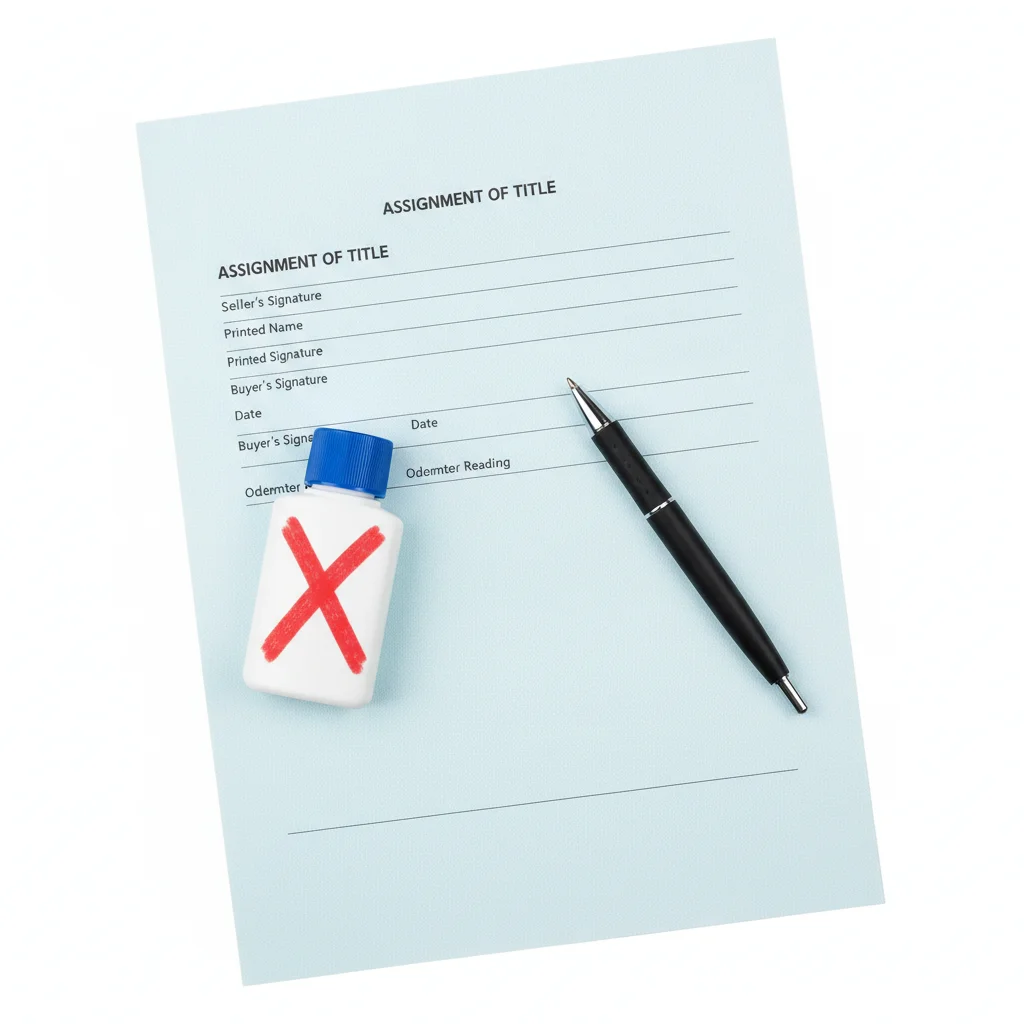
Before you write a single character, do two things: read all the instructions printed on the title itself (usually in small type along the edges), and use a black or blue ballpoint pen only. Gel pens, markers, and pencils are all grounds for rejection at many DMVs. And never use white-out — if you make a mistake, stop writing and contact your DMV about getting a corrected or duplicate title.
For a detailed look at what errors most commonly void a title, review the common title errors guide before you sit down to sign.
Field-by-Field Breakdown: What to Write and Where
1. Odometer Disclosure
Federal law requires an odometer disclosure on most vehicle transfers for vehicles under 10 years old (as of 2021 rules, extended to 20 years in some states). You must write the exact mileage shown on the odometer at the time of sale — not an estimate, not a rounded number.
The field typically includes three checkboxes:
- "Reflects actual mileage" — use this in almost all cases
- "Exceeds mechanical limits" — use if the odometer has rolled over (e.g., past 999,999 miles on an older mechanical unit)
- "Not the actual mileage" — use only if the odometer is known to be broken or has been replaced and doesn't reflect true mileage
Write the number in the spaces provided, one digit per box if indicated. Do not add commas. Do not write "approx." Mileage disclosures are federally regulated under the Truth in Mileage Act, and intentional falsification is fraud.
2. Sale Price
Not every state requires a sale price on the title itself — some put this on a separate bill of sale. But if the field exists on your title, fill it in accurately. The sale price is used by the buyer's state to calculate use tax or sales tax when they register the vehicle.
Write the agreed cash price in numerals. If the car was a gift, write "gift" in the field — many states have a reduced or waived tax rate for gifted vehicles. If you're unsure whether your state requires this field, check with your DMV or refer to the state-by-state private sale paperwork overview.
3. Buyer's Name
Write the buyer's full legal name exactly as it appears on their government-issued ID. This is not the place for nicknames, initials, or abbreviations. If two people are buying the vehicle together, the field may say "AND" or "OR" between names — this distinction matters legally:
- AND means both owners must sign any future title transfer
- OR means either owner can act independently
Ask the buyer how they want to hold title and write it accordingly. If the buyer is a business entity, write the full legal business name as registered.
4. Buyer's Address
Write the buyer's current mailing address: street number and name, city, state, and ZIP code. Some titles have separate lines for each component; others have a single line. The address must match what the buyer will use for DMV registration. A PO Box is sometimes acceptable but not always — when in doubt, use a physical street address.
5. Date of Sale
Write the month, day, and year in the format specified on the title (some say MM/DD/YYYY; others spell out the month). The date should reflect the actual day the vehicle changes hands and money is exchanged — not a future date, not a backdated date. Some states are strict about this field matching any bill of sale you also sign.
6. Seller's Printed Name and Signature
Print your name exactly as it appears on the front of the title. Then sign in the signature field. If two people are listed as owners on the front of the title — even a spouse — both parties typically need to sign the assignment section. A title held as "AND" between two owners almost always requires both signatures; a title held as "OR" may require only one, depending on state law.
Do not sign until you've confirmed all other fields are correctly filled in. Signatures lock in what's already written — they don't fix mistakes made before them.

7. Notarization (State-Dependent)
Some states — including Louisiana, Maryland, Montana, Nebraska, Nevada, New Hampshire, Oklahoma, and West Virginia — require a notary public to witness the seller's signature on the title. If your state requires notarization, do not sign until you are in front of the notary. Signing beforehand makes the notarization invalid.
Notaries can often be found at banks, UPS stores, libraries, and AAA offices. Some states allow remote online notarization (RON) — check with your DMV for current rules.
Assignment section
The portion of a vehicle title — usually on the reverse side — where the seller completes the transfer fields, including buyer information, odometer reading, and seller signature. This is the section that legally moves ownership from seller to buyer.
Odometer disclosure
A federally mandated statement, usually on the title itself, certifying the vehicle's mileage at the time of sale. It must be exact and truthful — falsification is a federal crime under the Truth in Mileage Act.
Lienholder
A financial institution or individual with a legal claim on the vehicle because they provided a loan to purchase it. A lien must be released before a seller can transfer a clean title to a buyer.
Lien release
Written confirmation from a lender that the vehicle loan has been paid in full and the lender's claim on the title is removed. This may be a signed paper document or an electronic update to the state DMV's records.
Notarization
A formal verification process in which a licensed notary public witnesses signatures and confirms the identity of the signers. Some states require notarization on title assignments to prevent fraud.
Bill of sale
A separate written document recording the terms of a vehicle sale, including the parties, sale price, date, and vehicle details. Some states require it; others treat it as optional but strongly recommended.
Duplicate title
A replacement title issued by the DMV when the original is lost, damaged, or filled out incorrectly. Sellers must apply for a duplicate before transferring ownership if the original title becomes unusable.
Electronic lien state
A state in which lenders electronically report and release vehicle liens directly to the DMV, eliminating the need for a paper lien release letter. In these states, a clean title is often mailed to the owner automatically after payoff.
Lienholder Releases and Co-Owner Complications
If you financed your vehicle and still owe money — or recently paid it off — the lender (lienholder) is listed on the front of your title. Before you can transfer the title to a buyer, that lien must be formally released. Here's how it typically works:
- You pay off the loan in full.
- The lender sends you either a lien release letter or a clear title (a title with the lienholder removed).
- In some states, the lender releases the lien electronically with the DMV and you receive a new title automatically.
- In other states, the lender signs the lienholder release section on the back of your physical title.
If you're selling a car you've already paid off but haven't received a clean title, contact the lender. Processing times vary from a few days to several weeks. Do not attempt to sell the car until you have proof of lien release in hand — a buyer who pays you for a car with an unresolved lien can face serious registration problems.
If your title lists a co-owner, the same general rule applies: both parties must typically sign the assignment section. Coordinate with your co-owner before you set a sale date so there's no scramble at the last minute.
When You Can't Locate the Original Title
If your title is lost, damaged, or was never sent to you after payoff, apply for a duplicate title through your state DMV before scheduling a sale. Most states charge $10–$25 for a duplicate and require 1–4 weeks of processing time. You cannot legally transfer a vehicle without a valid title in hand, so start this process early.
Gifted Vehicles Have Different Rules
If you're transferring a vehicle as a gift rather than a sale, write 'gift' in the sale price field — never write $0 or $1, as some states treat these as taxable transactions and may assess fair market value tax anyway. Several states also require a signed gift affidavit alongside the title to qualify for the tax exemption. Confirm your state's gift transfer rules with the DMV before signing.
Selling to a Dealer Is Different
When selling to a dealership rather than a private buyer, the dealer typically handles the title assignment paperwork and may fill in some fields on your behalf. However, you should still verify every field before you sign — you remain legally responsible for the accuracy of your odometer disclosure and seller signature regardless of who filled in the surrounding fields.
State Variations to Know Before You Sign
While the field structure above is consistent across most U.S. states, several key requirements vary. Here's a quick reference for the most common state-level differences:
| State Variation | What It Means for Sellers |
|---|---|
| Notarization required | Seller signature must be witnessed by a notary. Do not pre-sign. (LA, MD, MT, NE, NV, NH, OK, WV and others) |
| Electronic lien states | Lenders release liens digitally; you may receive a printed title automatically once cleared. (CA, FL, TX, and many others) |
| Separate odometer form | Some states use a standalone odometer disclosure form instead of or in addition to the title field. |
| Bill of sale required | Certain states require a formal bill of sale separate from the title. Others make it optional but recommended. |
| Smog/emissions cert | California, for example, requires a valid smog certificate before most private party transfers. |
| Gift transfers | Some states require an additional affidavit for gifted vehicles to qualify for tax exemptions. |
For a full breakdown of your state's specific rules, see the private sale paperwork state-by-state overview. And if you want to understand the full sequence of steps after the title is signed, the title transfer step-by-step walkthrough covers what happens next — from notarization through DMV filing.
~25%
Private party title transfers with at least one error
Industry estimates suggest roughly one in four private vehicle title transfers contains a field error requiring correction or resubmission.
20 years
Age threshold for federal odometer disclosure
A 2021 NHTSA rule extended the mandatory odometer disclosure requirement from vehicles under 10 years old to those under 20 years old.
8–10 states
U.S. states currently requiring title notarization
Requirements vary and can change — always verify with your state DMV before the sale date.
2–6 weeks
Typical lender processing time for lien release
After a loan payoff, lenders generally mail a paper lien release or update electronic records within two to six weeks, depending on the institution.
Before you list your vehicle, make sure you've gathered everything a buyer will expect — not just the title. The complete pre-sale document checklist covers service records, disclosure forms, and more that sellers often overlook until the last minute.
State DMV Locator (USA.gov)
Find your state's official DMV website to look up title transfer forms, notarization requirements, and duplicate title applications specific to where you live.
NHTSA Odometer Fraud Information
The National Highway Traffic Safety Administration's official resource on odometer disclosure laws, what triggers a federal violation, and how buyers can verify reported mileage.
Private Sale Bill of Sale Template
A printable bill of sale template that complements the title transfer — captures sale price, vehicle details, and both parties' signatures as a legal backup record.
Private Party Sales Hub
<a href="/selling-your-car/sale-channels/private-party-sales">Browse the full private party sales resource hub</a> for guidance on listing, negotiating, and closing a sale directly with a buyer.

All claims are backed by peer-reviewed research. Sources on request.