Key Takeaways
Why Spark Plugs Fall Through the Cracks
Spark plugs don't make noise when they're failing. They don't leak. There's no warning light that says "your plugs are tired." They just quietly degrade over tens of thousands of miles until one day your car hesitates, your fuel bill creeps up, or you're sitting in a parking lot cranking an engine that won't fire.
That invisibility is exactly why spark plug replacement gets skipped more than almost any other routine service. Oil changes are drilled into us. Tire rotations feel urgent because you can see and feel the tires. But plugs? They're buried under plastic engine covers, connected to wires you don't think about, and never really on your radar until something goes wrong.
The other factor is interval confusion. Older vehicles used copper plugs that needed replacement every 30,000 miles. Modern cars often run iridium or platinum plugs rated for 60,000 to 100,000 miles. If you bought a used car or inherited someone else's service history, you may have no idea where those plugs stand. And when you're not sure, it's easy to assume someone else already handled it.

The truth is that neglected spark plugs are one of the more consequential forms of deferred maintenance — not because the part itself is expensive, but because of what happens downstream when worn plugs stay in too long. For a broader look at how skipped services stack up financially, see how deferred maintenance quietly accumulates costs.
What Worn Spark Plugs Actually Do to Your Car
A spark plug's job is simple: fire a precise electrical spark at exactly the right moment to ignite the air-fuel mixture in the cylinder. When plugs are in good shape, that spark is consistent, strong, and timed correctly. When they're worn, the spark becomes weak, inconsistent, or misfires entirely — and every one of those failures has a measurable consequence.
Up to 30%
Fuel economy loss from severely worn plugs
The U.S. Department of Energy has noted that faulty spark plugs can reduce fuel economy by as much as 30% in worst-case scenarios.
$800–$2,500
Catalytic converter replacement cost
Sustained misfires from worn plugs can force unburned fuel into the exhaust, damaging the catalytic converter — one of the most expensive repairs caused by deferred ignition maintenance.
60,000–100,000 mi
Iridium plug service interval
Many modern vehicles use iridium spark plugs rated for 60,000 to 100,000 miles, but interval confusion leads many owners to skip replacement entirely.
Under $50
Typical DIY parts cost (4-cylinder)
A full set of spark plugs for most 4-cylinder engines costs between $20 and $50 in parts — a fraction of the $80–$250 typical shop labor charge for the same job.
Fuel economy takes an immediate hit. A cylinder that isn't firing cleanly pushes unburned fuel through the exhaust. Your engine compensates by demanding more fuel. EPA data has shown that bad plugs can reduce fuel economy by up to 30% in severe cases, though real-world losses of 5–10% are more typical once degradation is noticeable.
Performance drops in ways you might not immediately connect to plugs. Rough idle, hesitation under acceleration, occasional stumbling at highway speeds — these are classic misfire symptoms that often get misdiagnosed as fuel system problems or dirty injectors before anyone checks the plugs.
Hard starts become common. Cold mornings are hardest on worn plugs. If you're grinding the starter for a few extra seconds on cold days, your ignition system may be compensating for weak spark.
Catalytic converter damage is the expensive consequence most people don't anticipate. Misfires send raw, unburned fuel into the exhaust stream. That fuel combusts in the catalytic converter instead of the cylinder — and catalytic converters are not built to handle combustion. Sustained misfires can destroy a cat. Replacement runs $800–$2,500 depending on vehicle.
For deeper context on what spark plugs do mechanically and how degradation progresses, this breakdown of spark plug impact on engine health covers it thoroughly.
The Mistakes That Make This Job Go Wrong
Replacing spark plugs is one of the more beginner-friendly DIY jobs on most vehicles — but there are enough common errors that it's worth going through them carefully before you pick up a wrench. These aren't rare edge cases. I see these mistakes regularly, and most of them lead to follow-up repairs that cost more than the original job.
Using the wrong spark plug for your vehicle — wrong heat range, wrong thread size, or wrong electrode material.
Why it happens: Plug aisles at auto parts stores are overwhelming, and it's tempting to grab what's on sale or what a parts counter employee recommends without cross-checking your owner's manual. "It fits" is not the same as "it's correct."
Skipping the gap check on new spark plugs because the box says "pre-gapped."
Why it happens: Pre-gapped is a marketing convenience claim that gets taken too literally. Plugs shift in packaging and shipping. Assuming the gap is perfect out of the box is a common shortcut.
Over-torquing spark plugs, which can strip the threads in the cylinder head.
Why it happens: People assume tighter is better when it comes to engine components. Spark plug threads are typically tapped into aluminum heads, which are much softer than steel and strip easily. One hard crank past spec can ruin a head.
Cross-threading plugs during installation by forcing them in at a slight angle.
Why it happens: Tight engine bays make it hard to align the socket perpendicular to the plug hole, especially on rear cylinders or deep wells. Impatience and awkward angles are a bad combination.
Removing all plug wires or ignition coils at once before labeling them.
Why it happens: It seems faster to disconnect everything first, then work cylinder by cylinder. But unmarked wires on a V6 or V8 are genuinely hard to trace back correctly, and a wrong firing order means the engine won't run — or worse.
Not cleaning debris out of the plug well before removing the old plug.
Why it happens: It's an easy step to miss, especially if the engine bay looks clean on the surface. Dirt and carbon particles accumulate in recessed plug wells and fall directly into an open cylinder when the plug is removed.
Avoiding these mistakes doesn't require advanced mechanical knowledge. It requires slowing down, checking your vehicle's service manual (or a reputable online source specific to your make and model), and not improvising on steps that have a correct answer.
Misfires Can Destroy Your Catalytic Converter
If your check engine light is on and you're experiencing a rough idle or hesitation, address it before driving further. A P0300-series misfire code combined with worn plugs means unburned fuel is entering your exhaust stream on every affected cycle. Catalytic converters are not designed to handle combustion — and replacing one costs anywhere from $800 to over $2,500. Fix the plugs first; then clear the code and confirm the misfire is resolved.
How to Replace Spark Plugs the Right Way
If you've never done this before, pick a weekend morning when you're not rushed. On most 4-cylinder engines, this job takes 45 minutes to an hour. V6 and V8 engines take longer, and some V6 configurations with rear-mounted cylinders on transverse engines can be genuinely difficult — those may be worth leaving to a shop unless you're comfortable working at awkward angles.
What You'll Need
- New spark plugs (exact OEM spec or approved equivalent)
- Spark plug socket (usually 5/8" or 13/16") with a rubber insert to hold the plug
- Torque wrench — non-negotiable
- Extension bar and ratchet
- Spark plug gap gauge (check if your plugs are pre-gapped and verify)
- Dielectric grease (for plug boots, not plug threads)
- Anti-seize compound if recommended by your vehicle manufacturer — check the manual, because some modern plugs have coated threads that don't need it
The Procedure
- Let the engine cool completely. Working on a hot engine risks burns and can cause aluminum cylinder heads to warp if plugs are removed while metal is expanded.
- Label and disconnect ignition coils or plug wires one at a time. Do not remove all wires at once — mix-ups in firing order cause serious problems.
- Blow out any debris around the plug well with compressed air before removing the plug. Grit that falls into an open cylinder causes real damage.
- Remove the old plug with your spark plug socket. If it's seized, apply penetrating oil and wait — don't force it.
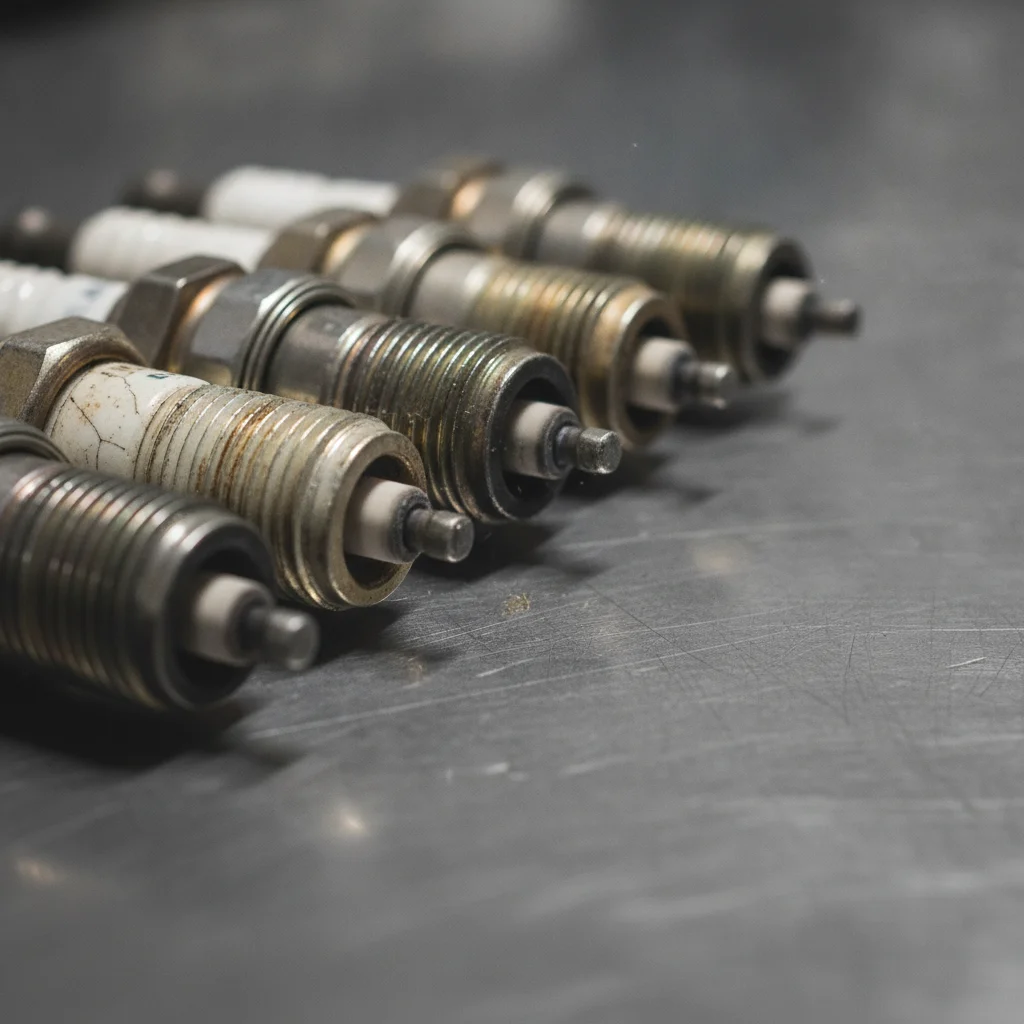
- Inspect the old plug. Tan or gray deposits are normal wear. Black sooty deposits suggest running rich. White or blistered electrodes mean running hot or lean. These readings can point to larger issues worth investigating.
- Gap your new plugs even if they claim to be pre-gapped. Shipping causes movement. Verify against spec.
- Thread in by hand first to avoid cross-threading. If it doesn't thread easily by hand, stop and realign.
- Torque to spec. This is where a torque wrench earns its place. Consult your service manual — typical specs run 13–30 ft-lbs depending on thread size and head material.
- Reconnect coils or wires and confirm each one is fully seated.

While you're in there, this is also a good time to visually inspect plug wires or coil boots for cracks or carbon tracking — degraded ignition components are often found together. For other DIY jobs where small procedural mistakes compound into bigger bills, this guide on common DIY errors is worth reading before your next project.
What It Actually Costs — Parts, Labor, and the Skip Tax
Let's put real numbers to this so you can make an informed call on whether to DIY or pay a shop.
Parts Cost
| Plug Type | Cost Per Plug | Typical Interval |
|---|---|---|
| Copper | $2–$5 | 30,000 miles |
| Platinum (single) | $6–$12 | 60,000 miles |
| Double Platinum | $10–$18 | 60,000–80,000 miles |
| Iridium | $15–$30 | 60,000–100,000 miles |
For a 4-cylinder, you're looking at $8–$120 in parts depending on plug type. A full set of iridium plugs for a V8 might run $160–$240, still far below shop labor rates.
Shop Labor
Labor for a straightforward 4-cylinder plug replacement typically runs $80–$150. V6 engines with accessible cylinders: $150–$250. Difficult-access configurations — certain V6 transverse mounts, some turbocharged engines — can push $300–$500 in labor alone because technicians are billing two to three hours.
The Skip Tax
Here's where the math gets sobering. Running plugs 40,000 miles past their service interval and damaging an ignition coil costs $150–$400 to replace (each). Two failed coils: $300–$800. Add a compromised catalytic converter and you're potentially looking at $1,000–$3,000 in repairs that trace directly back to a $30 part and an hour of work.
Don't Run Plugs Past Their Service Interval
Manufacturer intervals are not conservative estimates — they're the point at which electrode wear begins causing measurable performance and efficiency losses. Running iridium plugs to 120,000 miles when they're rated for 100,000 isn't saving money; it's shifting risk to your ignition coils and exhaust system. Set a mileage-based reminder and treat it like an oil change.
Used Car Buyers: Assume Plugs Are Overdue
If you bought a used vehicle without full service records, do not assume the spark plugs were replaced on schedule. The previous owner may have deferred this exact item. A fresh set of plugs at purchase gives you a verified baseline and eliminates one variable if drivability issues arise later.
Resale value is also in the picture. A vehicle with documented, on-schedule maintenance — including plug replacement — commands meaningfully better trade-in value. Service records are a signal to buyers that the car was cared for systematically, not reactively.
Knowing Your Interval and Setting a Reminder
The most practical thing you can do right now is find out what plug type your car uses and when they were last replaced. Check your owner's manual for the OEM-specified interval. If you don't have service records, a visual inspection will tell you a lot — pull one plug and look at the electrode gap and deposit pattern.
As a general rule:
- Copper plugs: Replace at 30,000 miles or every 3 years
- Platinum plugs: Replace at 60,000 miles
- Iridium plugs: Replace at 60,000–100,000 miles per manufacturer spec
If you have a high-mileage used car and no records, treat plug replacement as a known-state reset — put in a fresh set, document it, and work from a clean baseline going forward.
Set a calendar reminder tied to your odometer. It sounds basic, but the reason plugs get skipped is usually not budget or complexity — it's that there's no visible trigger reminding you the interval is due. Build the trigger yourself.

One more note: if you drive an electric vehicle, you'll never deal with spark plugs — but that doesn't mean maintenance disappears. EVs have their own maintenance needs that are just as easy to overlook. And if your next job is the 12V battery rather than the plugs, battery replacement has its own set of steps most guides skip — worth reviewing before you start.
The bottom line: spark plug replacement is one of the few maintenance tasks where the DIY case is nearly airtight. Low part cost, manageable skill requirement, and the downstream cost of skipping it is steep enough to make the math obvious. Do it on schedule, do it right, and it's one less expensive problem on your horizon.

All claims are backed by peer-reviewed research. Sources on request.