Key Takeaways
Engine Displacement & Fuel Economy
Engine displacement refers to the total volume swept by all of a car's pistons, measured in liters (e.g., 2.0L, 5.7L). It's long been used as a shorthand for how powerful — and how thirsty — an engine is. But modern technology like turbocharging, direct injection, and cylinder deactivation has broken that old rule: a smaller turbocharged engine can often match or beat a larger naturally aspirated one in real-world fuel economy.
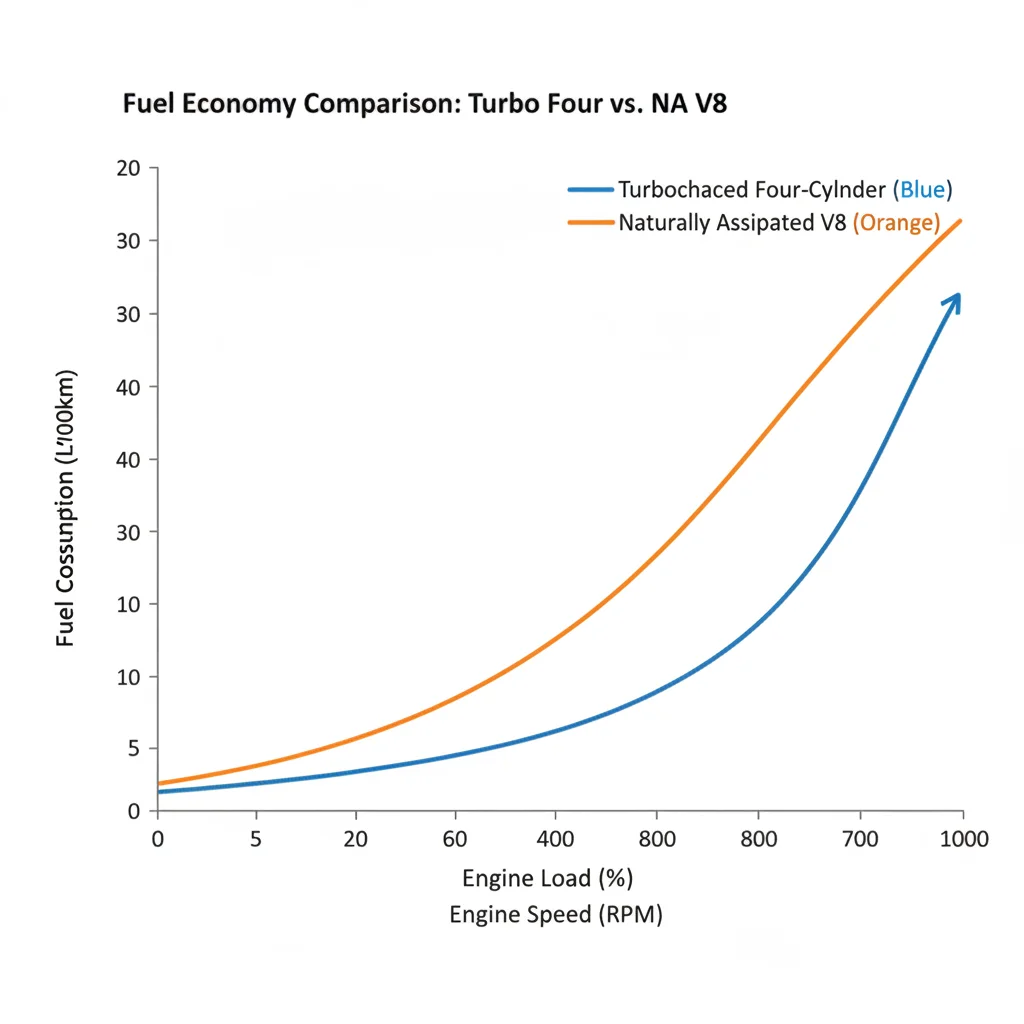
Brake-specific fuel consumption (BSFC) maps show that engines are most efficient within a narrow RPM and load band. Turbocharging allows a smaller-displacement engine to operate closer to that sweet spot more often, which is the core reason downsizing can improve MPG.
The Old Rule — and Why It No Longer Holds
For decades, the math was simple: a bigger engine burns more fuel. A 5.0L V8 guzzled gas; a 1.6L four-cylinder sipped it. Buyers who wanted to save money at the pump chose the smallest engine on the options sheet and called it a day.
That logic made sense in a world of carbureted engines with few efficiency tricks. Today it's far more complicated — and more interesting. A turbocharged 2.0L four-cylinder in a full-size sedan can now produce outputs that once required a 3.5L naturally aspirated V6, while posting EPA numbers that would have seemed impossible for an engine of that muscle a generation ago.
Understanding why that's true — and when it actually holds up in the real world — is what separates a smart engine choice from a decision based on outdated assumptions.
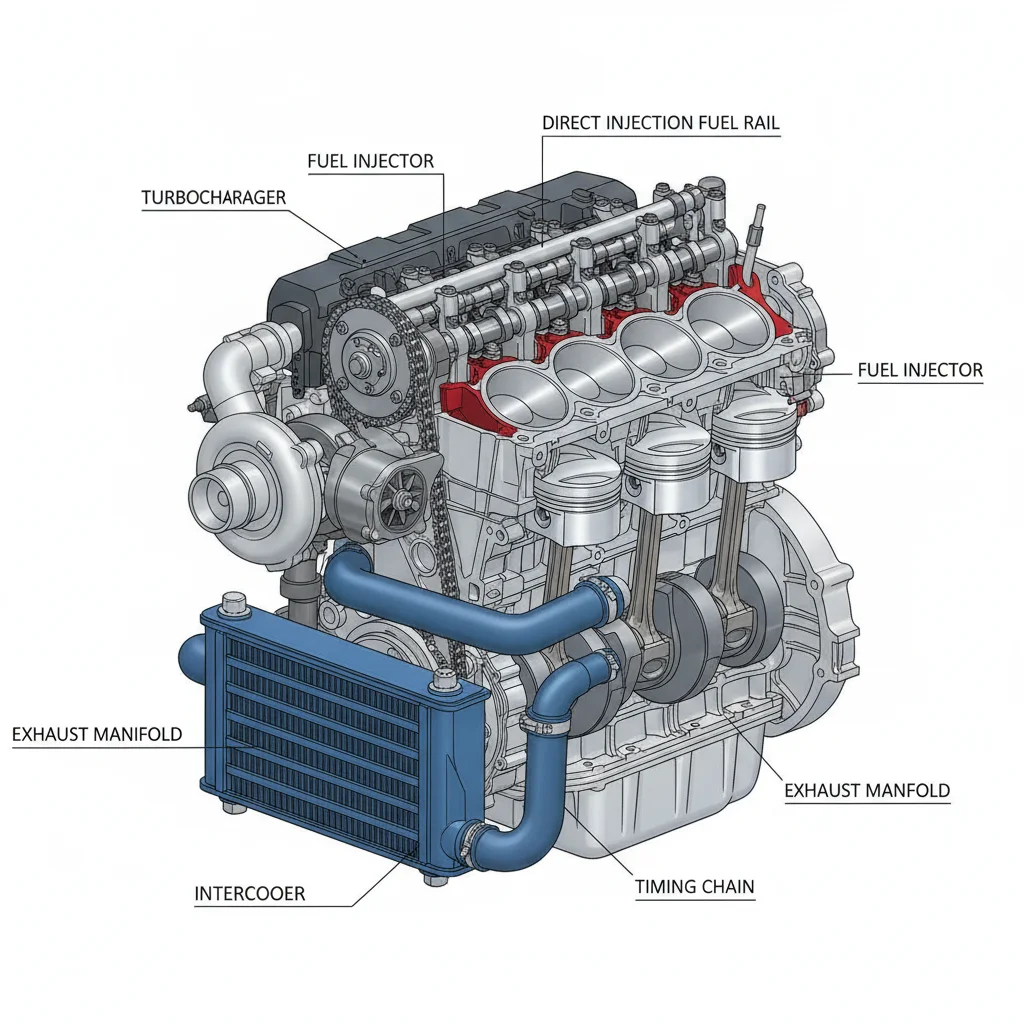
The short version: engine displacement sets a ceiling on potential power, but how efficiently an engine uses fuel depends on how well it's loaded — meaning how close it's operating to its peak thermal efficiency point at any given moment. Modern engineering has given automakers powerful tools to keep engines in that sweet spot more of the time, regardless of cylinder count.
What Displacement Actually Measures
Displacement is the combined swept volume of all cylinders — the space each piston travels through on its stroke, multiplied by the number of cylinders. A 3.0L V6 has six cylinders sweeping a combined 3,000cc of volume per cycle.
More displacement generally means:
- More air and fuel drawn in per cycle
- More potential power at low RPM (torque)
- More fuel consumed at a given throttle opening
The last point is what matters for economy. At idle or light cruise, a large engine is still moving its pistons through a lot of volume, compressing a relatively thin air-fuel mixture, and losing energy to friction from all those moving parts. It's doing a lot of mechanical work just to sustain low output.
10–15%
Typical MPG penalty from heavy load on small turbocharged engines
U.S. Department of Energy data shows that operating a turbocharged engine near its performance ceiling significantly increases fuel consumption relative to its rated economy.
25%
Average fuel economy improvement from engine downsizing with turbocharging
Studies from the European Automobile Manufacturers' Association found that turbocharged downsized engines offered roughly 20–25% better fuel economy compared to naturally aspirated engines of equivalent output in similar driving cycles.
1–2%
Fuel economy loss per 100 lbs of added vehicle weight
According to fueleconomy.gov, every extra 100 lbs reduces a vehicle's fuel economy by approximately 1–2%, an effect more pronounced on smaller-displacement engines.
5–8 MPG
Real-world MPG gap between rated and actual for aggressive drivers
Owner data aggregated by the EPA's MPG tracker shows drivers who self-report aggressive driving habits often see 5–8 MPG below the city/highway combined estimate, regardless of engine size.
A small engine under the same light load is doing proportionally more meaningful work. It's more fully loaded relative to its capacity, which puts it closer to peak thermal efficiency. That's the core reason a 1.5L engine can sometimes beat a 2.5L in city driving — not because it's technically superior, but because it's operating more efficiently for the task at hand.
Where larger engines win back ground is under heavy load: towing, merging at highway speeds, carrying a full vehicle of passengers. Push a small turbocharged engine hard and its fuel economy advantage can evaporate — or even reverse.
Turbocharging: The Technology That Changed Everything
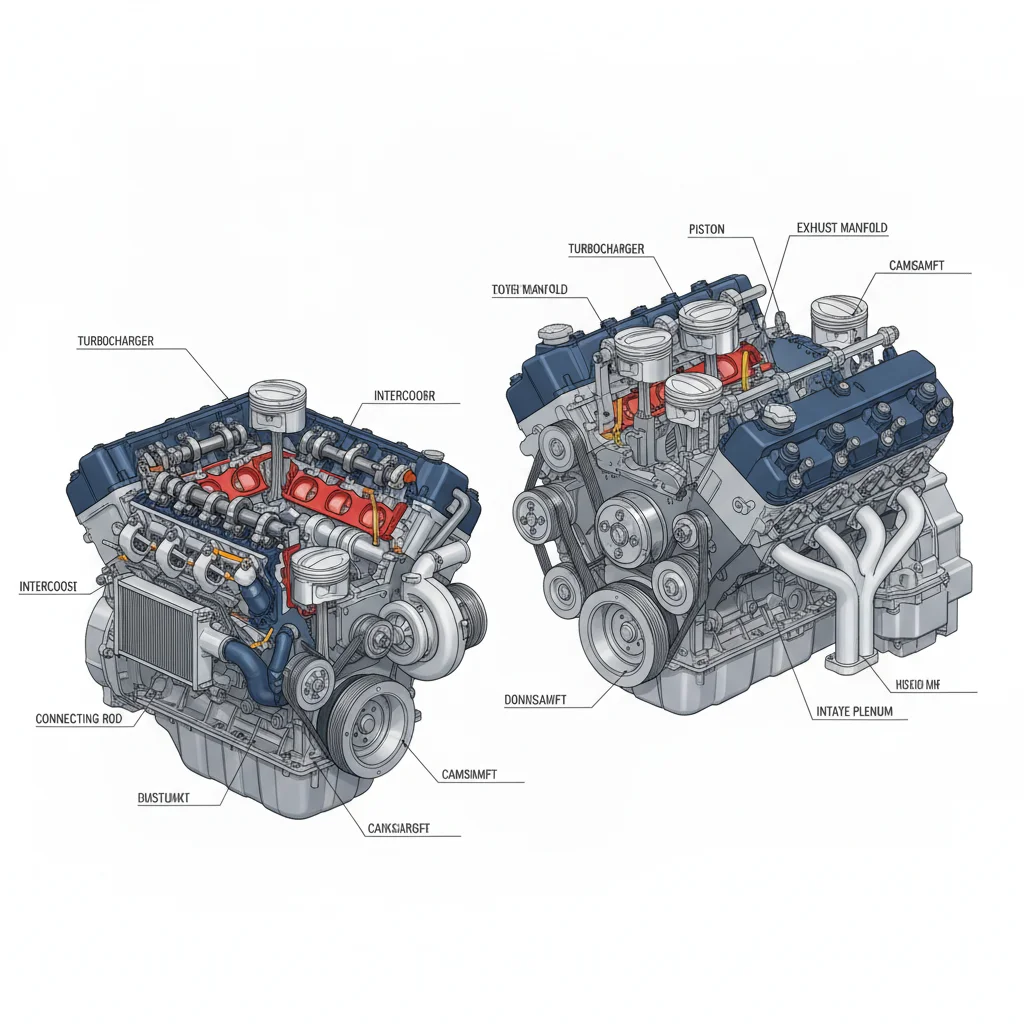
A turbocharger forces more air into each cylinder than the engine could draw naturally, allowing a smaller displacement to produce big-engine power on demand. When you're not demanding that power — which is most of the time in normal driving — the turbo is barely spooling and the engine behaves like the small, frugal unit it is.
This is the promise of turbocharged downsizing, and in many driving scenarios it delivers. The EPA highway numbers for turbocharged four-cylinders frequently match or beat larger engines, and city numbers can be competitive too — as long as you're not constantly flooring it.
“The best engine for fuel economy is the one that's appropriately sized for the actual work being asked of it. A small engine working at its limit is never as efficient as its EPA label implies.”
— John German, Senior Fellow, International Council on Clean Transportation (ICCT)
There's a catch, though. Turbocharged engines are sensitive to driving style in a way that larger naturally aspirated engines are not. Hit the throttle hard repeatedly and the turbo spools up, fuel delivery increases sharply, and your real-world MPG can drop well below the EPA estimate. A driver who loves on-ramp acceleration tests may find their turbocharged four-cylinder is no more economical than the V6 they traded in.
Common fuel efficiency myths often overstate how much engine choice matters compared to driving behavior. The EPA label on a turbocharged engine assumes a particular usage pattern — one that rewards steady throttle inputs over aggressive driving.
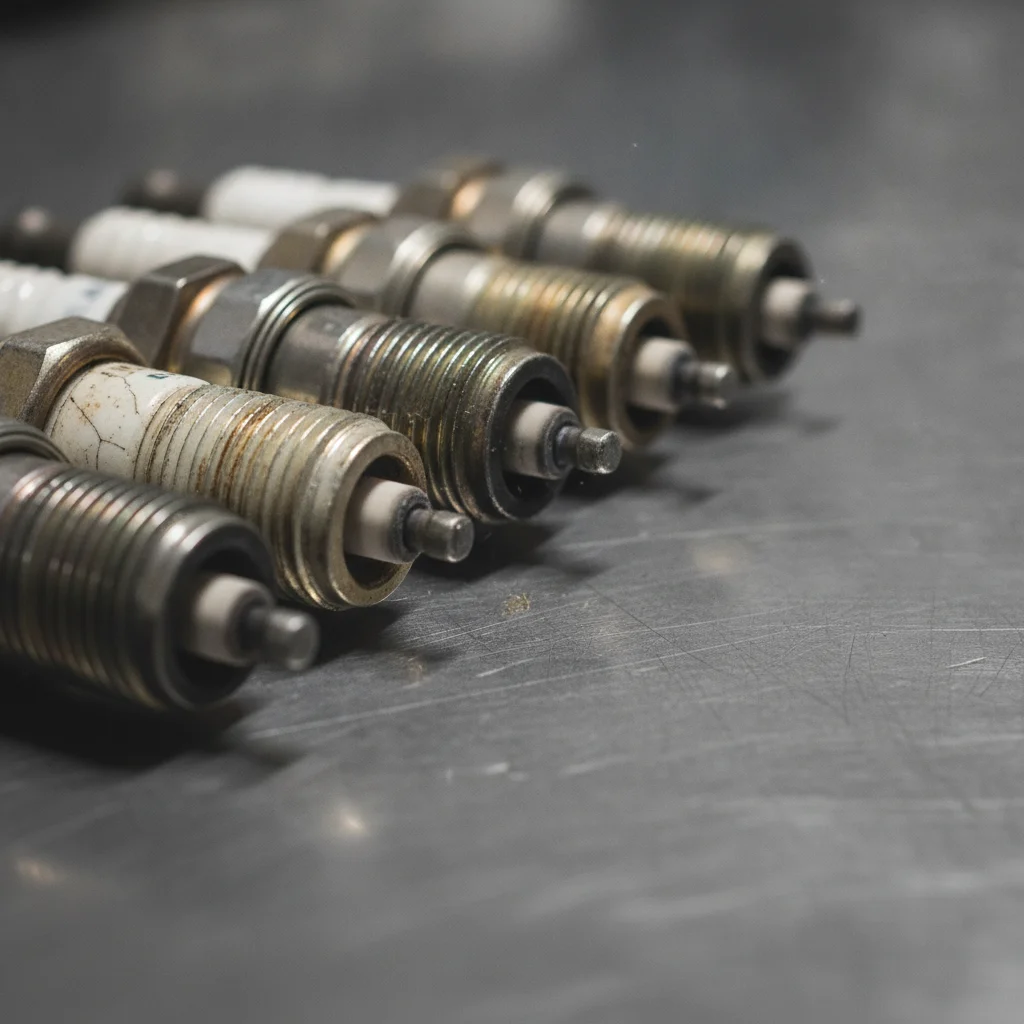
There's also the question of engine maintenance. Turbocharged engines run hotter and at higher stress. Keeping up with oil changes and spark plug replacement matters more than ever, because worn plugs in a turbocharged engine affect both performance and fuel economy more noticeably than in a low-strung V8.
When Bigger Engines Catch Up (or Win)
Large-displacement engines have their own efficiency tools. Cylinder deactivation — found in many V6 and V8 engines — shuts off half the cylinders during light driving, effectively turning a V8 into a V4 on the highway. General Motors' Dynamic Fuel Management system can shut off cylinders in real time, running on as few as two of eight cylinders. Ram's eTorque mild-hybrid V8 adds a small electric assist to further soften fuel consumption at low loads.
The result is that a modern 5.7L V8 with cylinder deactivation can post highway MPG numbers surprisingly close to some smaller turbocharged engines — particularly at steady highway speeds where the cylinders that remain active are running efficiently and the deactivated ones impose no friction penalty.
Cylinder Deactivation Has Real-World Limits
Cylinder deactivation works best at steady speeds on flat terrain. In hilly driving, stop-and-go traffic, or with the air conditioning running hard, the system activates and deactivates cylinders frequently, which can reduce its efficiency benefit. Some drivers also report a subtle vibration when the system switches modes — most modern implementations have refined this significantly, but it's worth noting on a test drive.
Premium Fuel Requirements Can Offset MPG Gains
Some turbocharged engines — particularly in performance-oriented vehicles — require premium 91-octane fuel. If the price difference between regular and premium is 20–30 cents per gallon in your area, the per-mile fuel cost of a turbocharged engine can exceed that of a larger engine running regular. Always factor fuel grade into your real cost comparison, not just the MPG number.
Towing and hauling flip the script entirely. If you regularly pull a boat, a trailer, or a heavy camper, a large-displacement engine is almost always the more fuel-efficient choice for that specific task. A small turbocharged engine working at or near its limits to tow is running rich (to protect the turbo from heat), consuming fuel at a rate that can exceed what a larger, less-stressed engine would use doing the same job.
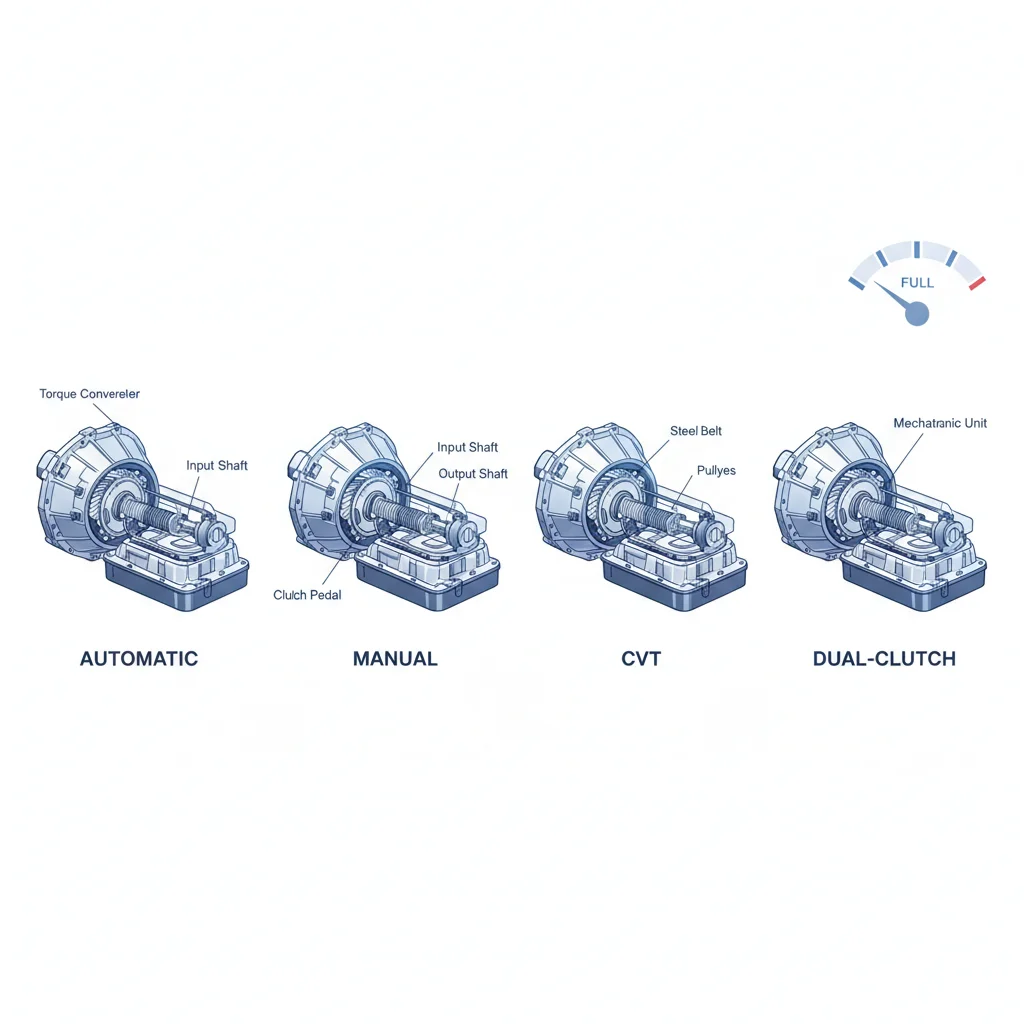
The same principle applies to mountain driving, where sustained grades demand sustained power. Transmission type interacts here too — a continuously variable transmission (CVT) can keep a small engine closer to its efficiency sweet spot on hills, while a conventional automatic might hunt between gears and spike fuel consumption.
How Load, Speed, and Habits Shape the Real Numbers
The single most underappreciated variable in fuel economy is how you use the throttle. An engine's efficiency isn't fixed — it varies with RPM and load at every moment of a drive. Aggressive acceleration forces any engine into a fuel-rich, high-load state that burns gas quickly. Steady moderate acceleration and early upshifting keep the engine in a leaner, more efficient band.
Highway speed is the next big factor. Aerodynamic drag increases with the square of speed — doubling speed quadruples drag. At 75 mph, your vehicle's engine is working significantly harder than at 65 mph, regardless of its displacement. The EPA tests at speeds that favor highway fuel economy labels; real-world highway driving at higher speeds can cut actual MPG by 10–20%.
See how the EPA fuel economy ratings are generated to understand why your real-world numbers almost always differ from the window sticker.
Drive to the Engine's Strength
If you chose a turbocharged engine for its fuel economy, drive accordingly. Smooth, progressive acceleration allows the turbo to stay in a low-boost state and keeps consumption close to the rated figure. Reserve the full throttle for when you genuinely need it — merging onto a fast highway, for example — rather than using it as a default.
Match Your Engine Choice to Your Heaviest Regular Use
Don't size your engine around your lightest driving tasks — size it around your most demanding ones. If you tow a boat six weekends a year, that use case should drive your engine decision more than your daily commute. A too-small engine working hard under load will cost you more in fuel (and potentially reliability) than the efficiency gains on lighter days can offset.
Load — passengers, cargo, roof racks — matters more than most drivers realize. Adding 300 lbs to a compact car can reduce fuel economy by 1–2% per 100 lbs, according to the U.S. Department of Energy. On a small turbocharged engine, extra weight also means more frequent turbo engagement, which compounds the consumption effect.
Air conditioning is a meaningful draw on smaller engines. A 1.5L four-cylinder powering the A/C compressor on a hot day can see fuel economy drop 5–10% more than a larger engine handling the same parasitic load, because the compressor represents a larger fraction of the smaller engine's total capacity.
Choosing the Right Engine for How You Actually Drive
The practical question isn't "which engine has the best EPA rating?" It's "which engine will be most efficient for my specific driving pattern?" Those are different questions, and answering the second one requires honest self-assessment.
Consider these scenarios:
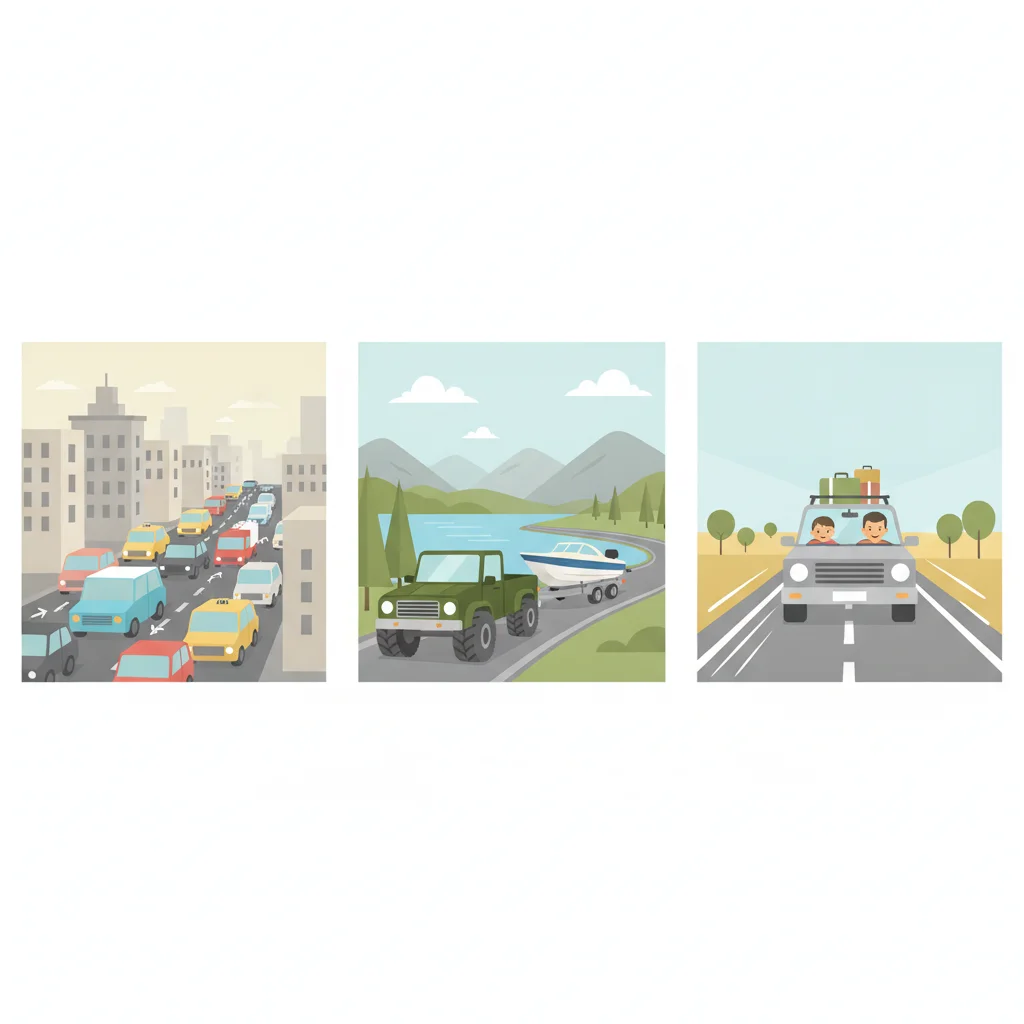
- Mostly urban stop-and-go, short commutes: A small turbocharged engine or a hybrid powertrain will serve you well. You're rarely at high load, so the turbo rarely spools hard, and you benefit from low-speed efficiency.
- Long highway miles at moderate speeds: Turbocharged engines and large engines with cylinder deactivation are both competitive. Transmission type matters significantly here — CVTs and efficient automatics can make a meaningful difference.
- Regular towing or hauling: Opt for the larger, purpose-built engine. A V8 or a large diesel towing within its rating will nearly always be more efficient than a smaller engine working at its limit.
- Mixed driving with occasional spirited acceleration: Be honest about this one. A turbocharged four-cylinder in the hands of an enthusiastic driver may not deliver its rated economy. A naturally aspirated V6 might be more predictable in real-world consumption.
It's also worth thinking about long-term costs beyond fuel. Some turbocharged engines require premium fuel, which adds to the per-mile cost even when MPG is favorable. Aftermarket efficiency products rarely overcome a fundamental mismatch between your driving pattern and your engine choice — the right powertrain upfront is a better investment than any add-on.
And if you're considering a plug-in hybrid, be aware that PHEVs don't always deliver advertised savings unless your driving pattern actually uses the electric range consistently. The pattern matters there too.
Drive to the Engine's Strength
If you chose a turbocharged engine for its fuel economy, drive accordingly. Smooth, progressive acceleration allows the turbo to stay in a low-boost state and keeps consumption close to the rated figure. Reserve the full throttle for when you genuinely need it — merging onto a fast highway, for example — rather than using it as a default.
Match Your Engine Choice to Your Heaviest Regular Use
Don't size your engine around your lightest driving tasks — size it around your most demanding ones. If you tow a boat six weekends a year, that use case should drive your engine decision more than your daily commute. A too-small engine working hard under load will cost you more in fuel (and potentially reliability) than the efficiency gains on lighter days can offset.
The Bottom Line on Engine Size and Efficiency
Engine displacement is one variable in a complex equation. Modern turbocharged engines have genuinely closed much of the efficiency gap with larger motors — and often surpassed them in typical driving conditions. But "typical" is doing a lot of work in that sentence.
If your driving is calm, consistent, and mostly urban or moderate-highway, a well-designed turbocharged four-cylinder is probably the most fuel-efficient choice available to you in a given vehicle segment. If you drive hard, tow regularly, or spend long hours at high highway speeds, the efficiency math shifts — and a larger, less-stressed engine might actually save you money at the pump despite its bigger displacement.
Cylinder Deactivation Has Real-World Limits
Cylinder deactivation works best at steady speeds on flat terrain. In hilly driving, stop-and-go traffic, or with the air conditioning running hard, the system activates and deactivates cylinders frequently, which can reduce its efficiency benefit. Some drivers also report a subtle vibration when the system switches modes — most modern implementations have refined this significantly, but it's worth noting on a test drive.
Premium Fuel Requirements Can Offset MPG Gains
Some turbocharged engines — particularly in performance-oriented vehicles — require premium 91-octane fuel. If the price difference between regular and premium is 20–30 cents per gallon in your area, the per-mile fuel cost of a turbocharged engine can exceed that of a larger engine running regular. Always factor fuel grade into your real cost comparison, not just the MPG number.
The reassuring truth is that you don't need to become an engineer to make a good decision here. You need to know your driving pattern, check real-world MPG data from sources like fueleconomy.gov and owner communities, and resist the temptation to assume that the engine with the smaller number on the badge is automatically the frugal choice.
Make the decision based on your actual life, not the best-case scenario on a window sticker.

All claims are backed by peer-reviewed research. Sources on request.