Key Takeaways
Our Verdict
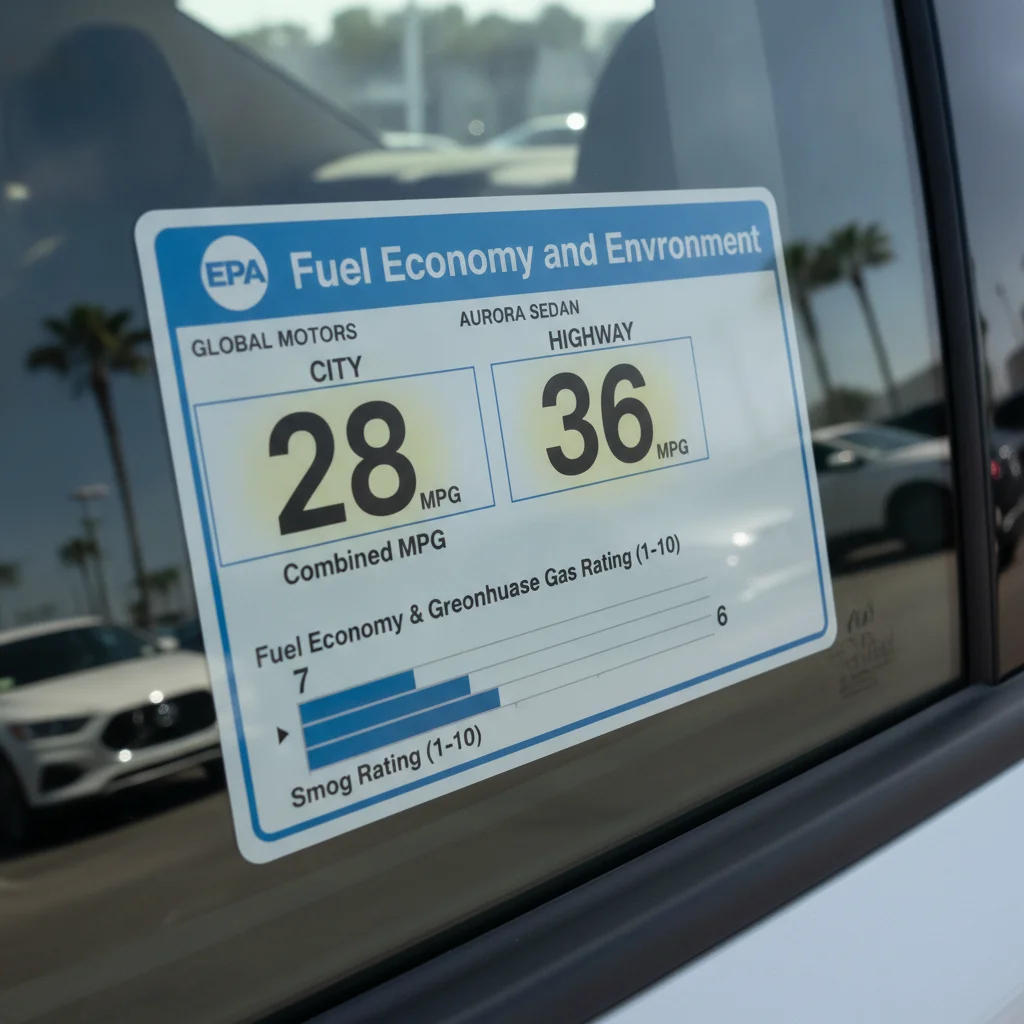
No single transmission type wins across every driving scenario. CVTs consistently shine in city traffic, dual-clutch units reward highway drivers, and a well-driven manual can hold its own in both. The automatic remains the most balanced all-rounder for everyday mixed driving. Ultimately, your driving environment and habits will determine which transmission delivers the efficiency the window sticker promises.
| Best for | Recommended |
|---|---|
| Commuters dealing with heavy city stop-and-go traffic | CVT |
| Highway drivers seeking maximum efficiency and seamless power delivery | Dual-Clutch (DCT) |
| Engaged drivers who want direct control and are willing to drive deliberately | Manual |
| Drivers who want a reliable, well-rounded experience across mixed conditions | Traditional Automatic |
Why Transmission Type Matters More Than You Might Think
When most people think about fuel economy, they focus on engine size or whether a car is a hybrid. But the transmission — the system that translates engine power into wheel motion — is just as influential in determining how many miles you'll squeeze out of every gallon.
Every time your engine produces power, it's the transmission's job to deliver that power as efficiently as possible to the wheels. Different transmission designs make very different engineering trade-offs: some prioritize smoothness, some prioritize driver engagement, and some are purpose-built to keep the engine in its most fuel-efficient operating range as much as possible.
What complicates things further is that these trade-offs play out differently depending on how and where you drive. A transmission that's incredibly efficient on the highway can be a fuel hog in city traffic — and vice versa. That's why EPA fuel economy ratings often don't tell the full story: they're measured under controlled lab conditions that may not match your commute at all.
Understanding the four main transmission types — traditional automatic, manual, continuously variable (CVT), and dual-clutch (DCT) — gives you a meaningful edge when choosing a car and when managing the one you already have.
The Four Transmission Types: How Each One Works
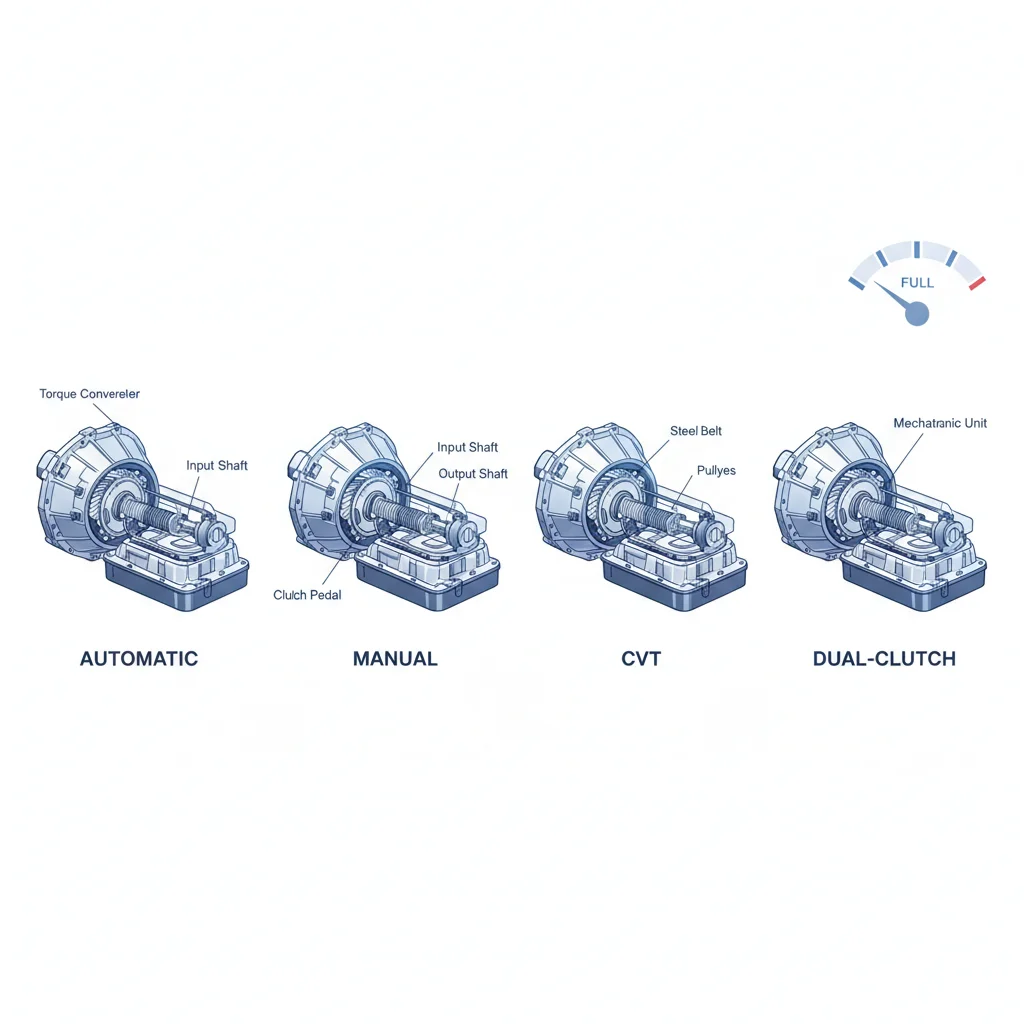
Traditional Automatic
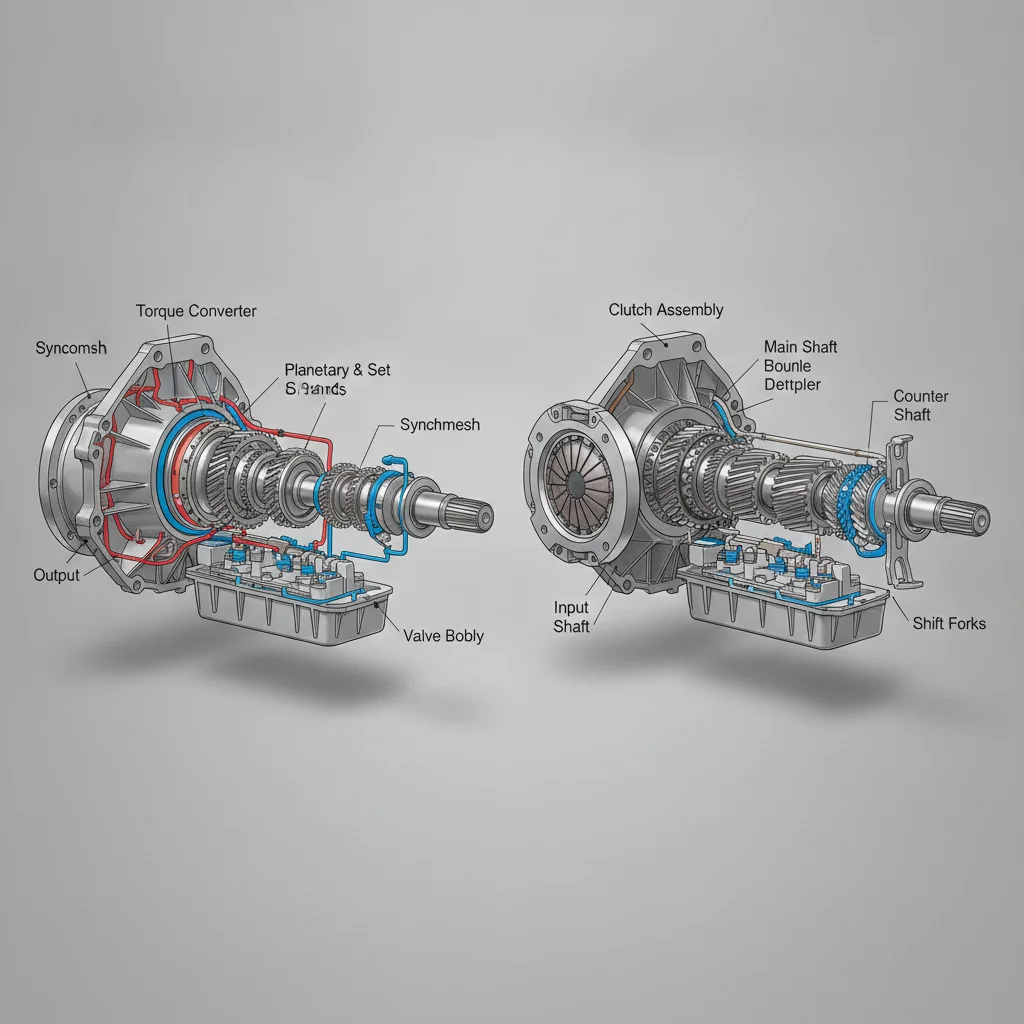
The conventional automatic transmission uses a torque converter and a set of planetary gearsets to shift between a fixed number of gears — commonly 6, 8, or even 10 in modern vehicles. It shifts automatically based on throttle input and speed, and modern versions have become remarkably efficient thanks to lock-up torque converters and adaptive shift programming that reads your driving style.
Manual (MT)
In a manual, the driver directly controls gear selection via a clutch pedal and gear lever. There's no fluid coupling between the engine and gearbox — it's a direct mechanical connection. This simplicity means less energy lost in transmission, but it puts efficiency squarely in the driver's hands. A skilled driver can optimize every shift; an inattentive one can waste fuel just as easily.
Continuously Variable Transmission (CVT)
A CVT replaces fixed gears with a belt-and-pulley system that can infinitely vary the gear ratio. This allows the engine to stay at its ideal RPM — typically its most fuel-efficient operating speed — regardless of road speed. It's the engineering reason why so many fuel-sipping sedans and small SUVs use CVTs today.
Dual-Clutch Transmission (DCT)
A dual-clutch transmission uses two separate clutch packs — one for odd gears, one for even gears — allowing the next gear to be pre-selected before the shift happens. The result is lightning-fast, seamless gear changes with minimal power interruption. DCTs combine the efficiency of a manual's direct mechanical connection with the convenience of an automatic.
| Traditional Automatic | Manual (MT) | CVT | Dual-Clutch (DCT) | |
|---|---|---|---|---|
| City fuel economy | Good | Variable (driver-dependent) | Best | Fair (can struggle at low speeds) |
| Highway fuel economy | Very Good | Good (skilled driver) | Good | Best to Very Good |
| Driver effort required | Low | High | Low | Low |
| Shift smoothness | Very smooth | Driver-controlled | Seamless | Very fast, firm |
| Low-speed behavior | Smooth | Requires clutch skill | Very smooth | Can be jerky |
| Maintenance complexity | Moderate | Low to moderate | Moderate (specialized fluid) | Moderate to high |
| Best suited for | Mixed daily driving | Engaged, skilled drivers | City/suburban commuting | Performance & highway driving |
City Driving: Where CVTs Pull Ahead
Stop-and-go city traffic is the hardest environment on fuel economy — and the scenario where transmission type makes the biggest difference. In dense traffic, your car is constantly accelerating from low speeds, which means the transmission is frequently hunting for the right gear ratio to balance power delivery with efficiency.
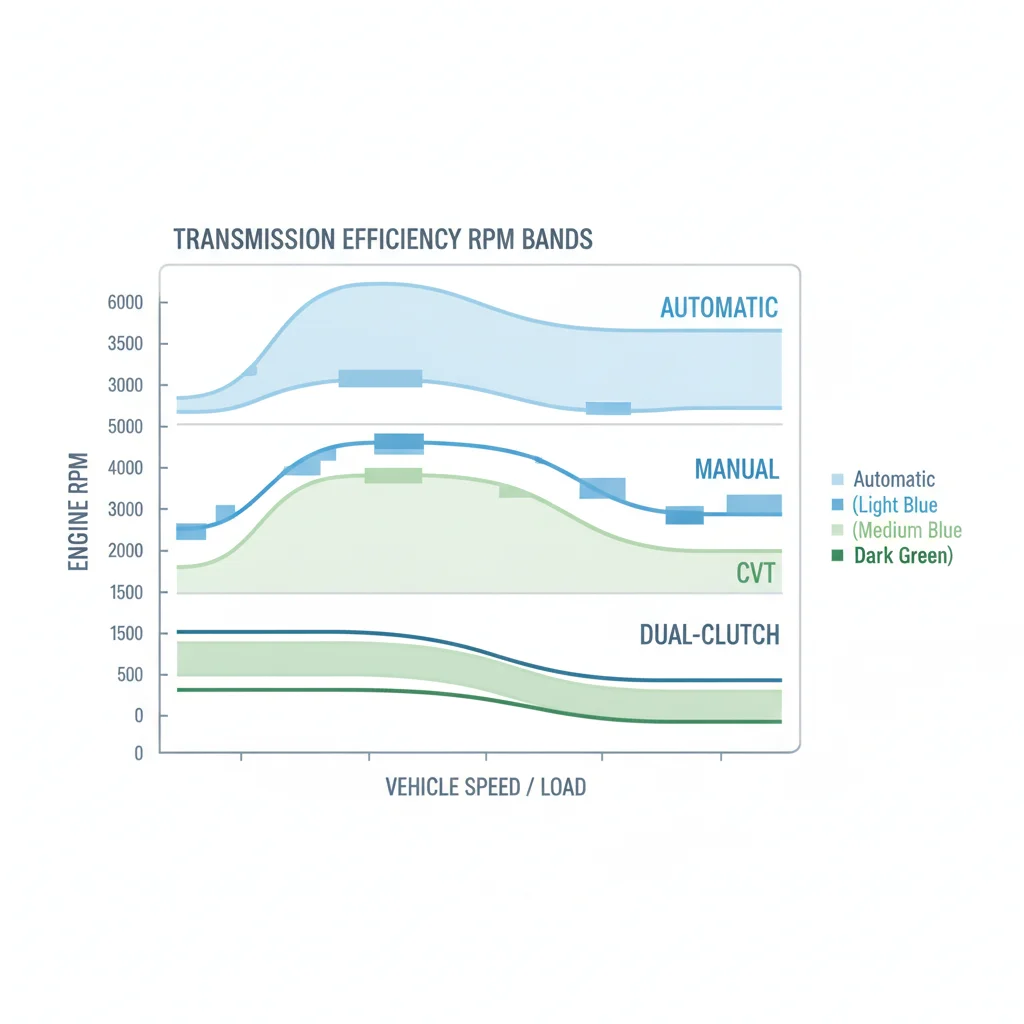
CVTs handle this environment better than any other transmission type. Because they have no fixed gear steps, a CVT can hold the engine at peak efficiency while the car moves through the choppy speed variations of city streets. There's no gear-hunting, no hesitation between shifts, and no brief efficiency drop as the torque converter unlocks and re-locks in a conventional automatic.

Traditional automatics with 8 or 10 speeds have closed the gap significantly, but they still lose a small amount of energy each time they step through the gear sequence. In pure city driving, this adds up. Modern automatics also use start-stop systems to cut the engine at red lights, which helps — but the CVT's baseline efficiency advantage in low-speed operation remains.
Manual transmissions in city traffic present a mixed picture. A skilled driver who short-shifts (moving to higher gears early) and anticipates traffic to avoid unnecessary braking can genuinely stretch fuel further than a CVT in some conditions. But for most drivers navigating a busy commute, the constant clutch work leads to more aggressive throttle inputs and less precise shift timing — undermining the theoretical efficiency advantage.
Dual-clutch transmissions, despite their sophistication, can actually struggle in heavy city traffic. Their clutch packs aren't designed for the repeated, prolonged slip-and-catch of crawling stop-and-go conditions. Some DCTs are notoriously jerky at low speeds, and drivers often find themselves feeding more throttle to keep the car moving smoothly — burning more fuel in the process. See our guide on where fuel goes in city vs. highway driving for more on how environment shapes consumption.
Maximize Your CVT in City Traffic
CVTs perform best when you feed them gentle, steady throttle inputs. Rapid, aggressive acceleration forces the transmission to mimic a 'kickdown,' essentially pulling the engine to higher RPMs and undermining the efficiency advantage. In city driving, think smooth and progressive — your MPG will thank you.
Short-Shifting Works in Any Manual
You don't need to rev to 3,000 RPM before every shift in a manual transmission. Under normal driving loads, shifting at 2,000–2,500 RPM keeps the engine in its most economical range. Practice anticipating when you can shift early, and you'll consistently beat the EPA estimate without trying hard.
Highway Driving: Dual-Clutch and Automatics Compete
On the highway, conditions favor a different set of transmission characteristics. Steady-state cruising at 65–75 mph is a much gentler environment: the engine is at a consistent load, speed changes are gradual, and the transmission spends most of its time locked in the highest available gear.
This is where dual-clutch transmissions earn their reputation. At highway speeds, a DCT is essentially operating like a manual transmission in its most efficient state — with a direct mechanical connection between the engine and the drivetrain. Every upshift happens in milliseconds, with no torque interruption, and the clutch is fully locked in cruise. The result is highway fuel economy that often matches or beats both CVTs and conventional automatics.
Modern 8- and 10-speed automatic transmissions also perform extremely well on the highway. Their extra ratios mean the engine can run at very low RPMs in top gear — sometimes as low as 1,400–1,600 RPM at highway cruise — keeping fuel consumption minimal. Brands like Ford, GM, and ZF have put enormous engineering resources into optimizing their highway efficiency, and it shows in real-world highway MPG figures.
CVTs, interestingly, are sometimes less impressive on the highway than their city numbers might suggest. At sustained high speeds, the belt-and-pulley system can generate slightly more internal friction than a direct gear mesh, and the engine may be held at a less-than-ideal RPM depending on load and grade.
Manual transmissions in highway driving are where a disciplined driver can genuinely shine. Running in top gear at moderate RPMs, a well-maintained manual has minimal parasitic losses — and the driver has full control over whether the engine is working harder than it needs to. If you're curious about how maintenance differs across transmission types, keeping your manual in good condition is especially important for sustaining this efficiency advantage over time.
~5–8 MPG
Real-world gap between best and worst transmission efficiency
Industry testing and owner data suggest the spread between transmission types in the same vehicle can reach 5–8 MPG in city-heavy driving cycles.
10-speed
Maximum gear count in modern production automatics
Ford and GM's 10-speed automatic, co-developed for use in trucks and performance cars, allows RPMs as low as 1,400 at highway cruise — a significant efficiency gain over older 4- and 5-speed units.
Up to 15%
Fuel economy improvement from CVT vs. older 4-speed automatic
EPA testing comparisons for vehicles retooled from older automatics to CVTs have shown real-world efficiency gains of up to 15% in combined city/highway cycles.
~30%
Share of new vehicles sold with CVT in the US
CVT adoption has grown steadily across compact cars and crossovers, reflecting manufacturer confidence in their fuel economy advantages in everyday driving.
The Role of Driving Habits Across All Transmission Types
Here's the part that often gets overlooked in transmission comparisons: no transmission type can overcome poor driving habits. The efficiency potential of any gearbox is largely realized or squandered by the person behind the wheel.
Aggressive acceleration from stops is the single biggest fuel-economy killer, regardless of transmission. When you floor the throttle, you're asking the engine to operate at wide-open throttle — the least efficient part of its operating range. A CVT will try to compensate, but it can only do so much when the driver is demanding maximum power output.
Coasting and anticipation matter enormously. If you can see a red light ahead and ease off the throttle early, you're allowing the engine to decelerate with minimal fuel input (most modern fuel-injected engines cut fuel delivery entirely during deceleration). This benefits drivers with every transmission type, but manual drivers have the additional option of selecting a lower gear to use engine braking strategically — or staying in gear longer to coast with zero fuel cut.
Speed itself is one of the biggest variables. Aerodynamic drag increases with the square of velocity, meaning the difference between 65 mph and 75 mph is far more significant than it looks. No transmission can compensate for the increased drag penalty at high speeds — but a transmission with a tall overdrive ratio (like a modern 10-speed automatic) does help by keeping engine RPMs low even as speed climbs.
Understanding how your car's fuel systems work — including start-stop systems, variable valve timing, and fuel injection behavior — helps you understand why these habit changes produce real results, regardless of which transmission you drive.
Don't Skip CVT Fluid Changes
CVT fluid degrades differently from conventional automatic transmission fluid, and the consequences of neglecting it go beyond wear — degraded CVT fluid directly increases internal friction, which reduces fuel economy before it causes mechanical problems. Most manufacturers recommend CVT fluid changes every 30,000–60,000 miles, but check your owner's manual for your specific vehicle.
Dual-Clutch Transmissions Don't Like Crawling
If you're shopping a DCT-equipped vehicle and your commute involves heavy, slow-moving city traffic, test-drive it in those exact conditions first. Some DCTs — particularly older wet-clutch designs — handle prolonged low-speed clutch slip poorly, leading to shuddering, overheating, and potentially expensive repairs. This is less of a concern with newer-generation DCTs, but it's worth verifying.
What to Look for When Buying: Matching Transmission to Your Life
If you're shopping for a new or used car and fuel economy is a priority, your driving environment should be the primary lens through which you evaluate transmission type — not just the sticker MPG or what a review says in isolation.
Ask yourself: What percentage of my driving is city versus highway? Do I sit in stop-and-go traffic daily? Am I a disciplined driver who'd genuinely benefit from a manual, or would a CVT do the work for me automatically?
A CVT-equipped compact sedan or crossover makes strong sense if you're a primarily city driver doing a suburban commute. The Honda CR-V, Toyota Corolla, and Nissan Rogue are popular examples where CVTs contribute meaningfully to real-world efficiency. If you're a highway traveler, look at vehicles with modern 8- or 10-speed automatics or DCTs — many German and American vehicles in this segment use these to strong effect.
If you're considering a manual, be honest about your environment and skill level. A manual can be a genuinely efficient choice — but only if you'll actually drive it well. If you're in stop-and-go traffic every day, the advantage disappears and you'll likely burn more fuel while adding significant driver fatigue.
It's also worth noting that the gap between transmission types in terms of fuel economy has narrowed considerably over the past decade. A well-engineered 8-speed automatic in a 2024 sedan is a very different machine from the 4-speed automatics of the early 2000s. When comparing vehicles, always look at specific trim and powertrain combinations — the same engine can return meaningfully different MPG depending on which transmission it's paired with. Before your next purchase, check out our guide on evaluating transmission behavior on a test drive so you know exactly what to listen and feel for.
Finally, consider the long-term ownership picture. Engine size and technology interact with transmission choice in ways that compound over years of ownership — factoring in both fuel costs and maintenance expenses gives you the full picture.
Quick Tips to Maximize Efficiency With Any Transmission
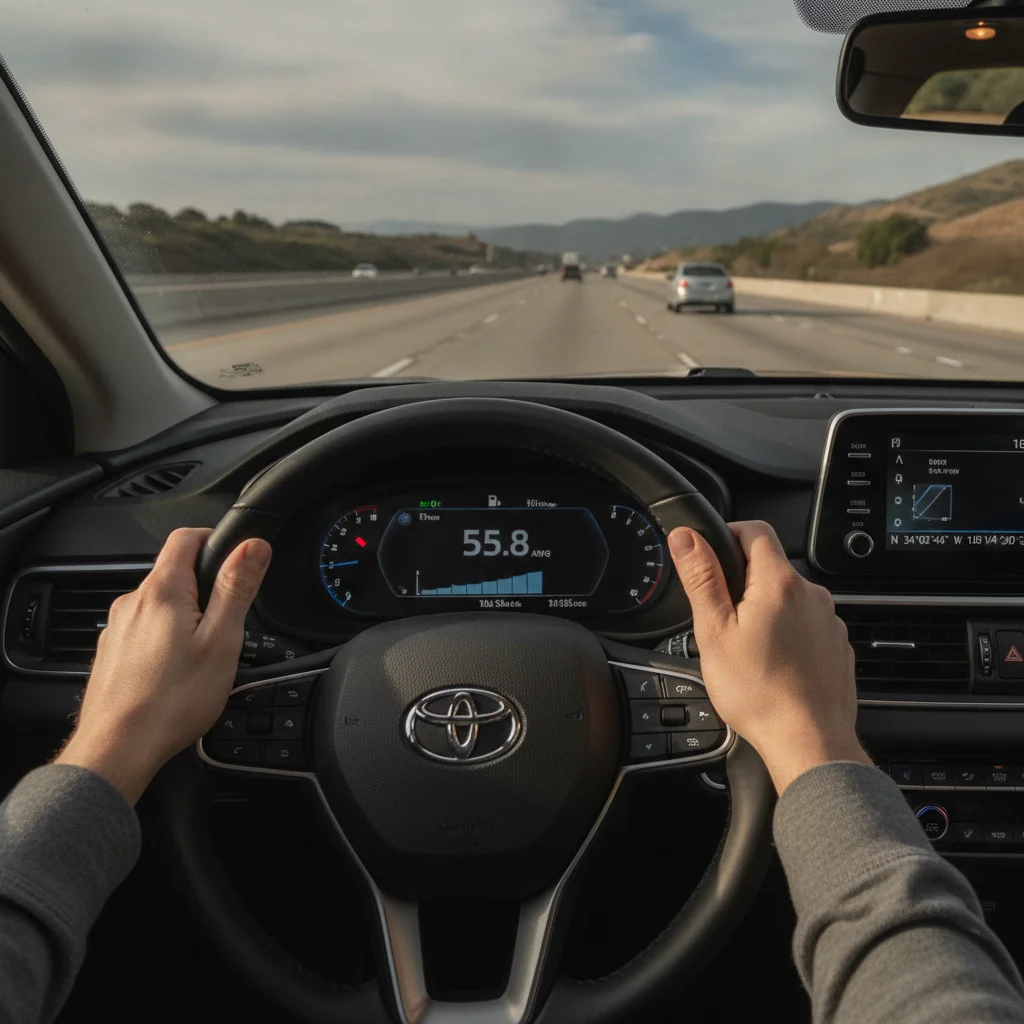
- Accelerate gently from stops. Smooth, progressive throttle input is the single most effective habit change for any transmission type — especially CVTs, which respond best to calm inputs.
- Anticipate traffic flow. Looking ahead and coasting to slowdowns rather than braking hard allows your engine to contribute to deceleration without burning extra fuel.
- Avoid jackrabbit starts. Even in a vehicle with a CVT optimized for city driving, hard acceleration from rest is expensive in fuel terms.
- Use cruise control on the highway. Steady-state speed dramatically reduces the number of shift events (in geared transmissions) and helps CVTs find their most efficient operating band.
- Keep up with transmission service. Fresh fluid in any transmission — automatic, CVT, DCT, or manual — reduces internal friction and preserves efficiency over the long term. CVT fluid in particular degrades in ways that directly impact fuel economy.
- Don't warm up excessively in cold weather. Modern transmissions don't need extended idling to warm up — driving gently for the first few minutes achieves this more efficiently and wastes less fuel.
- For manual drivers: short-shift. Shifting into higher gears earlier (at lower RPMs) keeps the engine out of its thirsty upper range. Most modern manuals shift optimally around 2,000–2,500 RPM under normal load.
These habits work with — not against — whatever transmission your vehicle has, and they compound over time into meaningful savings at the pump.

All claims are backed by peer-reviewed research. Sources on request.