Key Takeaways
Mileage-Based Depreciation
Mileage-based depreciation is the drop in a vehicle's market value that happens as odometer numbers climb. Buyers and pricing tools treat certain mileage thresholds as psychological and mechanical risk markers, so crossing them can cause your car's value to fall faster than simple age-related wear would predict. The relationship isn't perfectly linear — there are specific ranges where the drop accelerates noticeably.
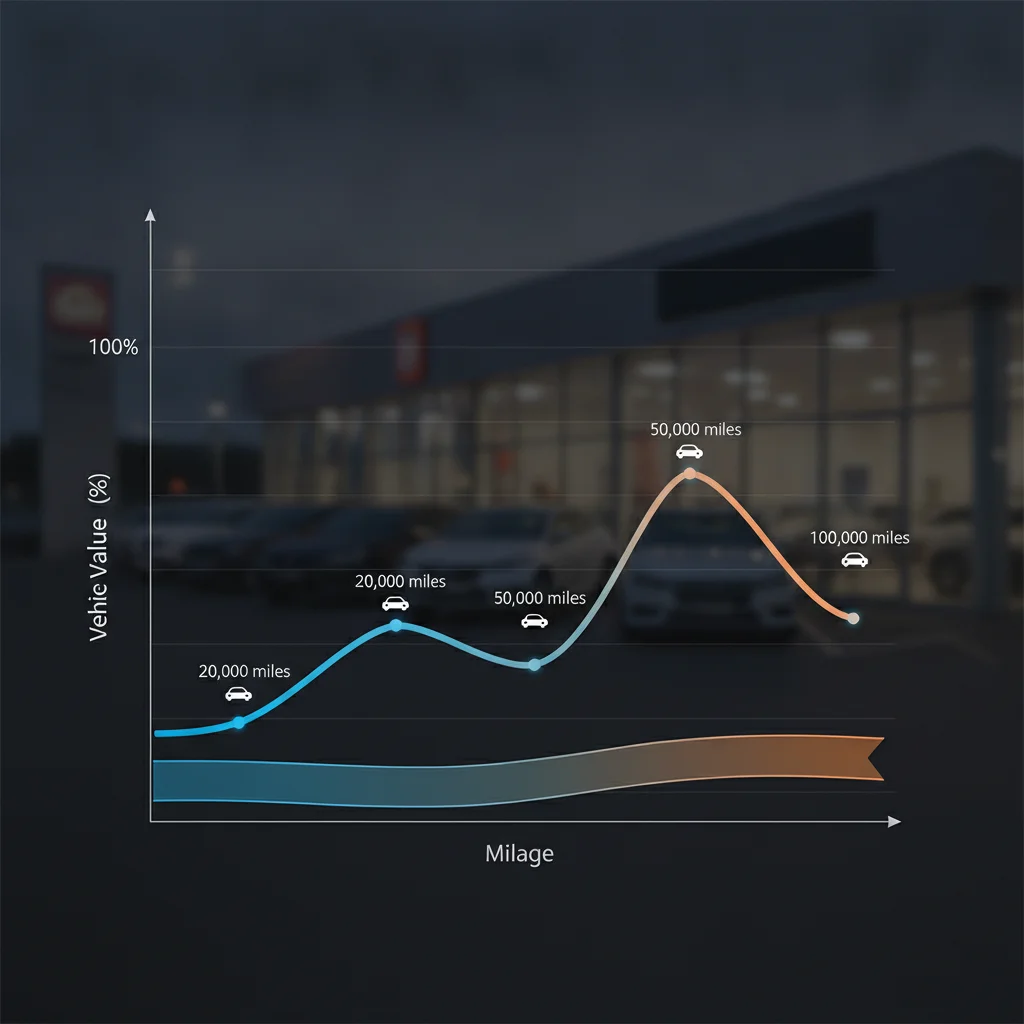
Valuation models from sources like Kelley Blue Book and Black Book apply non-linear depreciation curves that steepen at approximately 30,000, 60,000, 75,000, and 100,000 miles — points that roughly correspond to major service intervals and warranty expiration events.
Why Mileage Depreciation Isn't a Straight Line
Most people assume that a car loses value at a steady, predictable rate the more miles you put on it. That's not how it works in practice. Depreciation curves have kinks — points where value drops faster than the miles-per-dollar ratio you'd expect if you just divided the price by the odometer.
Those kinks exist for two reasons: mechanics and psychology. On the mechanical side, certain mileage ranges correspond to when major maintenance items come due — timing belts, transmission fluid flushes, water pumps, spark plugs. Buyers either know this or sense it, and they price in the risk of upcoming costs. On the psychological side, round numbers like 100,000 miles carry weight in the market even when a well-maintained car at 101,000 miles is mechanically indistinguishable from the same car at 98,000 miles.
Understanding where those kinks fall — and why they exist — lets you make smarter decisions about when to sell, when to buy, and how to position a vehicle in the market. For a broader look at what drives used-car prices down, the depreciation basics hub is a good starting point.
The Major Mileage Thresholds — and What Changes at Each One
Here's where buyers and valuation models consistently get more conservative, and why each threshold matters:
Around 30,000 Miles
This is where the new-car glow is fully gone. Factory bumper-to-bumper warranties on most mainstream vehicles run 3 years or 36,000 miles, so buyers approaching this range know they're getting close to unprotected ownership. The car also typically needs its first round of meaningful service — brakes may be getting thin, tires could be near the end, and fluid changes are due. Resale value takes its initial post-early-depreciation dip here. The actual steepest drop happens in the first 0–20K miles (new-car premium evaporating), but the 30K range marks the first buyer hesitation point driven by service costs.
Around 60,000 Miles
This is where a lot of extended powertrain warranties cut off, and where timing belt replacement schedules hit on many engines. Buyers at this range are looking at a car that will need attention soon — and they want a discount for that. Sellers who can show completed 60K service documentation hold their value noticeably better than those who can't. Expect pricing tools to start showing a more aggressive penalty in this range.
~20%
First-year new car depreciation
Industry data consistently shows most new vehicles lose roughly 15–20% of their value in the first 12 months of ownership, with that rate slowing in subsequent years.
$1,000–$3,000
Value gap crossing 100K miles
Analyses of used-car listings show the price difference between comparable vehicles just under and just over 100,000 miles typically falls in this range depending on segment.
12,000–15,000
Average miles per year benchmark
Kelley Blue Book and most major valuation tools use this annual mileage range as the baseline for calculating expected depreciation curves.
50%
Average value lost in 5 years
According to Carfax market data, the average vehicle retains roughly 40–50% of its original value after five years, though mileage pace significantly shifts where individual vehicles land.
Around 75,000 Miles
The 75,000-mile mark has become a meaningful threshold, especially for certified pre-owned (CPO) eligibility. Many manufacturer CPO programs cap mileage between 70,000 and 80,000 miles. Once a car can no longer qualify for CPO, it loses access to that buyer pool entirely — and those buyers are typically willing to pay a premium. If you're thinking about this from a buying perspective, see how mileage limits shape a CPO car's real value before ruling anything out.
Around 100,000 Miles
Six figures on the odometer still carries psychological weight, even though modern engines routinely run well past 200,000 miles with proper care. Algorithmically, most pricing tools apply a measurable penalty at this boundary. For the seller, this is the most important threshold to be aware of. If you're planning to sell and you're sitting at 97,000 miles, waiting until 102,000 is almost certainly costing you money. For deeper guidance once you're already past this mark, pricing a high-mileage car when standard valuation tools fall short explains why online estimates get less reliable here and what to do about it.
150,000 Miles: A Softer Threshold
While 100K gets the most attention, 150,000 miles functions as a secondary threshold in the market. At this point, many buyers shift their expectations entirely — they're no longer looking for a reliable daily driver in the traditional sense but rather a budget vehicle priced accordingly. The good news: well-maintained vehicles from brands with strong reliability reputations can still command reasonable prices here because buyers in this range are typically more mechanically informed.
How Vehicle Type Changes the Equation
Not every car experiences these thresholds equally. The make, model, and segment all influence how sharply value falls at each milestone.

Trucks and Work-Oriented SUVs
High-mileage trucks hold value better than almost any other category. Buyers in this segment expect to put hard miles on a vehicle and are comfortable with higher odometers if the truck has been maintained. A well-kept pickup at 120,000 miles may still command a strong price in a way a luxury sedan at the same mileage wouldn't.
Economy and Compact Cars
Models with proven long-term reliability — Japanese manufacturers in particular — also hold up well at higher mileage. Buyers know these engines are built for longevity, and the market reflects that. A car with a track record of lasting 200,000+ miles loses less value per mile in the upper ranges than a less proven model.
Luxury Vehicles
Luxury cars face a double penalty at high mileage. First, the mechanical complexity is higher, so anticipated repair costs rise faster. Second, the buyer pool shrinks considerably — luxury buyers often want near-new condition, and high-mileage examples struggle to find them. A premium car hitting 75,000 or 100,000 miles can see sharper value drops than the raw numbers suggest.
“Buyers aren't really afraid of miles — they're afraid of uncertainty. Give them documentation and transparency, and the odometer number matters a lot less than they thought it would.”
— Ravi Shankar, Senior analyst, used-vehicle market research
What Maintenance Records Actually Do to Your Number
Documentation is one of the few things a seller can control that genuinely moves the needle at higher mileage. Here's the honest reality: a car at 95,000 miles with a complete service folder will consistently fetch more than the same car at 80,000 miles with zero paper trail. Buyers aren't just buying miles — they're buying confidence about what those miles cost the engine.
The records that matter most are the ones tied to the expensive jobs: timing belt replacements, transmission services, coolant flushes, and major tune-ups. If you've done the 60,000-mile service by the book, show that. If you've had tires, brakes, and rotors replaced, show that too. These documents shift the buyer's mental model from "this car might need a lot of work" to "this car has been looked after."
Start Your Folder Before You Need It
Don't wait until you're ready to sell to gather service records. Start a physical folder or a simple phone photo album the day you buy a car — receipt from every oil change, every tire rotation, every repair. When the time comes to sell, that folder is worth real money. Buyers can feel the difference between a seller who has documentation and one who says 'yeah, I kept up with everything.'
Pre-Purchase Inspections Pay For Themselves
Before buying any used vehicle near or past a major mileage threshold, spend $100–$150 on an independent pre-purchase inspection. Ask a mechanic who has no financial stake in the sale to put the car on a lift and check for deferred maintenance, leaks, and wear items. The cost is trivial against the potential repair bills you might be buying into — and a clean inspection gives you real confidence that the miles have been well-managed.
It's also worth noting that mileage is only one part of the story. Factors that quietly tank your trade-in value covers the less-obvious variables — things like color, trim level, and prior rental history — that can hurt your offer just as badly as a high odometer reading, sometimes without you even realizing it.
Timing Your Sale Around Mileage — A Practical Framework
If you're approaching a threshold and considering selling, here's a simple way to think about it:
- Check where you stand relative to the nearest threshold. The key milestones are 30K, 60K, 75K, and 100K. If you're within 3,000–5,000 miles of one, the timing question is worth taking seriously.
- Run your car through a valuation tool on both sides of the line. Enter your current mileage, then re-run at the threshold. If the number drops more than $1,000–$1,500, selling before the threshold has a real financial argument behind it.
- Factor in what selling now actually costs you. If selling before hitting 100K means listing privately right now, is that realistic given your situation? For many owners, holding the car a few more months and losing $1,500 in value is still better than the hassle of a private-party sale on a rushed timeline.
- Don't forget the per-mile calculation. If you're putting on 1,500 miles a month and you're 4,000 miles from 100K, you've got roughly 2–3 months. That's usually enough runway to prepare a listing without panic.

For broader strategies on maximizing what you get at the point of sale, the trade-in strategies hub covers how to position your vehicle when buying another car. And if you want to understand buyer psychology at specific mileage numbers, mileage thresholds that trigger buyer hesitation digs into exactly where and why buyers pump the brakes.
Buying Near a Threshold: How to Use This Knowledge in Reverse
If you're the buyer rather than the seller, everything in this article works in your favor. Cars sitting just above a major threshold — 31,000 miles, 62,000 miles, 101,000 miles — are often priced at a discount relative to their actual mechanical condition. Sellers know the number looks bad and drop the price to compensate. You can potentially buy a car that's mechanically very similar to a lower-mileage example for meaningfully less money.
The move here is to verify condition rather than avoid the number. Get a pre-purchase inspection from an independent mechanic — not the dealer selling the car. Budget roughly $100–$150 for a thorough inspection, and make it non-negotiable on any used car purchase above roughly 60,000 miles. If the inspection comes back clean and the service history is documented, a car just past a threshold can be a genuinely smart buy.
It's also worth comparing how this plays out in the certified pre-owned space. How mileage affects resale value more than you think covers the broader depreciation dynamics if you want to go deeper on how these numbers move across a vehicle's full life cycle.
Start Your Folder Before You Need It
Don't wait until you're ready to sell to gather service records. Start a physical folder or a simple phone photo album the day you buy a car — receipt from every oil change, every tire rotation, every repair. When the time comes to sell, that folder is worth real money. Buyers can feel the difference between a seller who has documentation and one who says 'yeah, I kept up with everything.'
Pre-Purchase Inspections Pay For Themselves
Before buying any used vehicle near or past a major mileage threshold, spend $100–$150 on an independent pre-purchase inspection. Ask a mechanic who has no financial stake in the sale to put the car on a lift and check for deferred maintenance, leaks, and wear items. The cost is trivial against the potential repair bills you might be buying into — and a clean inspection gives you real confidence that the miles have been well-managed.

All claims are backed by peer-reviewed research. Sources on request.