Key Takeaways
Why High-Mileage Pricing Is a Different Problem
Standard valuation tools — Kelley Blue Book, Edmunds, NADA Guides — are built on transaction data. The more transactions in a given segment, the more reliable the estimate. That's fine for a four-year-old Toyota Camry with 50,000 miles. It breaks down fast once you're looking at 120,000, 150,000, or 180,000 miles.
Here's the core issue: the high-mileage segment is thin. There are fewer sales, wider price spreads, and more variation driven by individual vehicle condition than by model-year comps. An algorithm that averages sparse, noisy data produces a wide confidence interval — and it usually doesn't tell you that's what it's doing. It just shows you a number that looks authoritative.
For sellers, this creates a dangerous situation. You can end up pricing too high (because the tool caught a few well-maintained outlier sales) or too low (because it weighted a batch of rough-condition sales heavily). Neither outcome serves you well.
High mileage triggers sharper depreciation thresholds that buyer psychology amplifies — and those thresholds often fall at round numbers like 100k and 150k. Understanding that context matters before you touch any valuation tool.
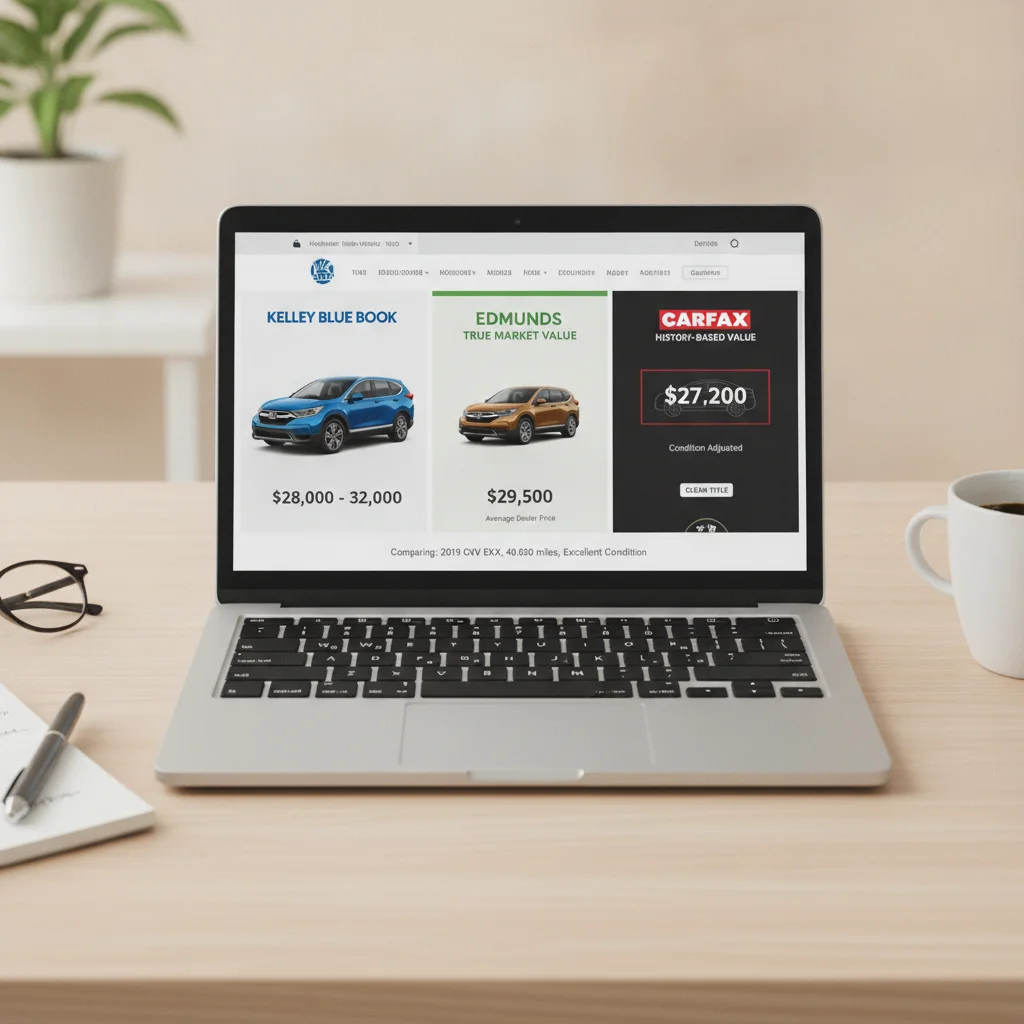
This guide walks through a specific research process: how to pull data from the major tools, how to interpret what each one is actually measuring, and how to layer in live market data to arrive at a defensible asking price.
What the Major Tools Are Actually Measuring
Before you trust a number, you need to know where it comes from. The three tools most sellers use aren't doing the same thing.
Kelley Blue Book
KBB's estimates are anchored to dealer transaction data — primarily what dealers paid at auction and what they sold cars for on their lots. For high-mileage vehicles, this skews toward wholesale reality, which means KBB's "Private Party" value often reflects a floor, not a ceiling. KBB also applies significant condition adjustments, but the condition categories (Excellent, Good, Fair, Poor) are self-reported and don't map cleanly to real-world variation in a 130,000-mile vehicle.
Edmunds
Edmunds uses a blend of dealer transaction data and private party listings, and its "True Market Value" (TMV) attempts to reflect what vehicles are actually selling for — not asking prices. For high-mileage cars, Edmunds tends to produce slightly more conservative estimates than KBB. Their tool is also more granular about regional pricing adjustments, which matters in a market like San Francisco versus rural Ohio.
NADA Guides
NADA is historically a dealer-facing tool and leans on wholesale and retail trade values. Its numbers skew toward what a dealer would offer or ask — not necessarily what private party buyers pay. For high-mileage private sales, NADA often produces the least useful estimates of the three.
What none of these tools capture well is condition specifics, recent major repairs, service history documentation, or local demand signals. Those factors can move a high-mileage car's real market price by 15–25% in either direction.

The practical takeaway: run all three tools, note the range, and treat it as a rough starting bracket — not a price. Your actual market research happens next.
Tools and Resources You'll Need
Gathering a defensible asking price for a high-mileage car takes about an hour of structured research if you have the right resources in front of you. Here's what you'll be working with.
Kelley Blue Book (KBB.com)
Provides Private Party value estimates based primarily on dealer transaction data — useful as a baseline floor reference.
Edmunds.com True Market Value
Blends dealer and private party transaction data with regional adjustments — often the most market-reflective of the three major tools.
NADA Guides (nadaguides.com)
Provides dealer-oriented wholesale and retail value ranges — useful as a ceiling reference but less accurate for private party sales.
Facebook Marketplace
Search active local private party listings to see what competing sellers in your area are asking for comparable vehicles.
CarGurus
Aggregates dealer and private listings with price-to-market ratings that show whether a car is priced competitively versus comps.
eBay Motors (Completed Listings filter)
Shows actual sold transaction prices for private party sales — the most reliable source of real buyer-paid data available publicly.
Craigslist
High-volume local listing platform where active price research reveals regional market conditions for your vehicle.
Spreadsheet (Excel or Google Sheets)
Organizes your comp data, tool estimates, and condition adjustments into a clear pricing model you can reference during negotiations.
What you will need
Step-by-Step: Building a Price You Can Defend
Work through these steps in order. Each one narrows your range and adds a layer of market evidence. By the end, you should have a price you can explain to any serious buyer who asks why it's what it is.
Pull estimates from all three major tools — same day
Go to KBB.com, Edmunds.com, and NADAguides.com and enter your vehicle's year, make, model, trim, mileage, ZIP code, and condition. Use the Private Party value on KBB and Edmunds. On NADA, use the Clean Retail value as a ceiling reference point.
Record all three numbers in a simple spreadsheet or note. You're looking for the range and the midpoint. If the spread is more than $1,500, note that — it signals high data uncertainty for your specific vehicle at this mileage.
Search active local listings for your exact vehicle
Go to Facebook Marketplace, Craigslist, and CarGurus. Search for your year, make, model, and trim within 75–100 miles. Filter to vehicles within 20,000 miles of yours (so if you have 130,000, look at 110k–150k range).
Screenshot or note every active listing — price, mileage, location, and any stated condition details. You want at least 5 comps. If your local market has fewer than that, expand your radius to 150 miles but note that shipping costs become a factor for buyers.
This is your real market data. These are the prices buyers in your area are currently seeing. Your car is competing directly with every one of these listings.
Check sold listings to confirm what buyers are actually paying
Asking prices and sale prices are different things. To find actual transaction data for private party sales, use eBay Motors' completed listings filter. Search your vehicle, click "Sold Items" in the sidebar, and filter to the relevant mileage range. This shows you what buyers actually paid — not what sellers hoped to get.
The gap between asking and sold prices in the high-mileage segment often runs 8–15%. If you see consistent patterns — say, cars listed at $7,500 selling at $6,500–$6,800 — that's your calibration data.
Calculate your target price range
With your three tool estimates, active listing prices, and sold data in hand, build your price range:
- Floor: The lower end of your comparable sold listings (or KBB Private Party if sold data is sparse). This is the minimum you'd accept.
- Ceiling: The midpoint of active comparable listings. Pricing at or above the highest active comp means buyers will see better-priced alternatives first.
- Ask price: Set your initial ask 5–10% above your floor to leave negotiation room. If your floor is $5,800 and your ceiling is $7,200, a starting ask of $6,800–$7,000 is defensible.
Write down your walk-away number before you list. It's easy to get worn down by lowball offers and accept less than your floor when you're emotionally done with the process.
Adjust for your vehicle's specific condition
Apply documented condition premiums or deductions to your ask price:
- Complete service records: +5–8%
- Recent major service (timing belt, water pump, brakes, tires): +$200–$500 per item
- Known unresolved issues (check engine light, leaks, worn components): -$500 to -$1,500 depending on severity
- Interior odor or significant cosmetic damage: -$300 to -$800
Be honest here. Buyers who discover discrepancies between your listing claims and the vehicle's actual condition will walk — or worse, use them as leverage for a lowball after they've already invested time in inspecting the car.
Set your listing price and document your rationale
Finalize your asking price and write one paragraph in a private note explaining how you arrived at it. Include your comps, your condition adjustments, and your floor. This serves two purposes:
- It prevents you from second-guessing yourself mid-negotiation.
- It gives you something concrete to reference if a buyer challenges your price. "I looked at seven comparable listings in this area and priced below the average asking price" is a much stronger position than "I used KBB."
Publish your listing with clear photos (minimum 15–20, including engine bay, interior, all four corners, and any notable wear), your mileage, condition summary, and maintenance highlights. Price transparency — meaning you explain your pricing basis in the listing — typically reduces time-wasters and improves the quality of inquiries you receive.
Once you've set your asking price, make sure your listing reflects the evidence you've gathered. Buyers shopping high-mileage vehicles are inherently skeptical — they've been burned before. A listing that mentions fresh tires, a recent timing chain replacement, and a full service history binder available for review converts that skepticism into confidence faster than any price adjustment will.
Sellers who anchor to the highest estimate they find consistently end up sitting on their listings longer and ultimately accepting less. A price built on real market data — even if it's a few hundred dollars lower than your optimistic starting point — moves the car faster and with less friction.
List Before You Fix (Sometimes)
Not every repair is worth doing before listing. If your car needs $800 in work that a buyer would factor in at $1,500 off the price, do the repair. If it needs $2,000 in work that a buyer would factor in at $2,200 off, let the buyer negotiate and do their own repair. Run the math on each known issue before defaulting to "fix everything first."
Refresh Your Comps Every Week
High-mileage vehicle inventory in local markets can shift quickly. A batch of dealer trade-ins hitting Facebook Marketplace can change your competitive landscape in days. Re-check your comparable listings weekly while your car is listed and adjust your price if the market moves against you.
Disclose Proactively to Attract Better Buyers
Listings that honestly describe known wear items — "brakes have about 30% life remaining," "paint has some door dings on the passenger side" — attract buyers who've already accepted those conditions. This pre-qualifies inquiries and reduces the chance of a deal falling apart after an in-person inspection reveals what your listing glossed over.
Accounting for Condition: The Variable Tools Can't See
Condition is the single largest pricing variable for any high-mileage car, and it's the one valuation tools handle worst. A 2014 Honda Accord with 145,000 miles and a documented timing belt replacement, new brakes all around, and a clean Carfax is a fundamentally different asset than the same car with deferred maintenance, unknown service history, and a check engine light.
Buyers shopping in this mileage range have usually educated themselves. They know the failure patterns for the models they're looking at, and they'll discount aggressively for uncertainty. Conversely, they'll pay a meaningful premium for documented certainty.
Undisclosed Problems Kill Deals and Create Liability
In most states, private party sellers are required to disclose known material defects. Hiding a check engine light, a known transmission issue, or a prior accident you're aware of isn't just bad practice — it can expose you to legal liability after the sale. If your car has known issues, price them in and disclose them clearly in writing. Buyers in the high-mileage segment generally accept imperfection; they don't accept deception.
Quantify your condition factors concretely:
- Service records: A complete binder with dated receipts justifies 5–8% above your base market estimate.
- Recent major components: New tires (within 5,000 miles), recent brakes, timing belt/chain done — each adds $200–$500 to defensible price depending on vehicle and market.
- No known issues: A car that passes a pre-purchase inspection with a clean bill of health is worth stating explicitly in your listing.
- Cosmetic condition: Minor exterior wear is expected and mostly priced in. Interior condition — especially odor, staining, and seat wear — affects buyer perception more than most sellers expect.
Buyers familiar with high-mileage failure patterns will inspect your car with specific concerns in mind. Getting ahead of those concerns with documentation — rather than hoping they don't notice — is the more effective strategy.
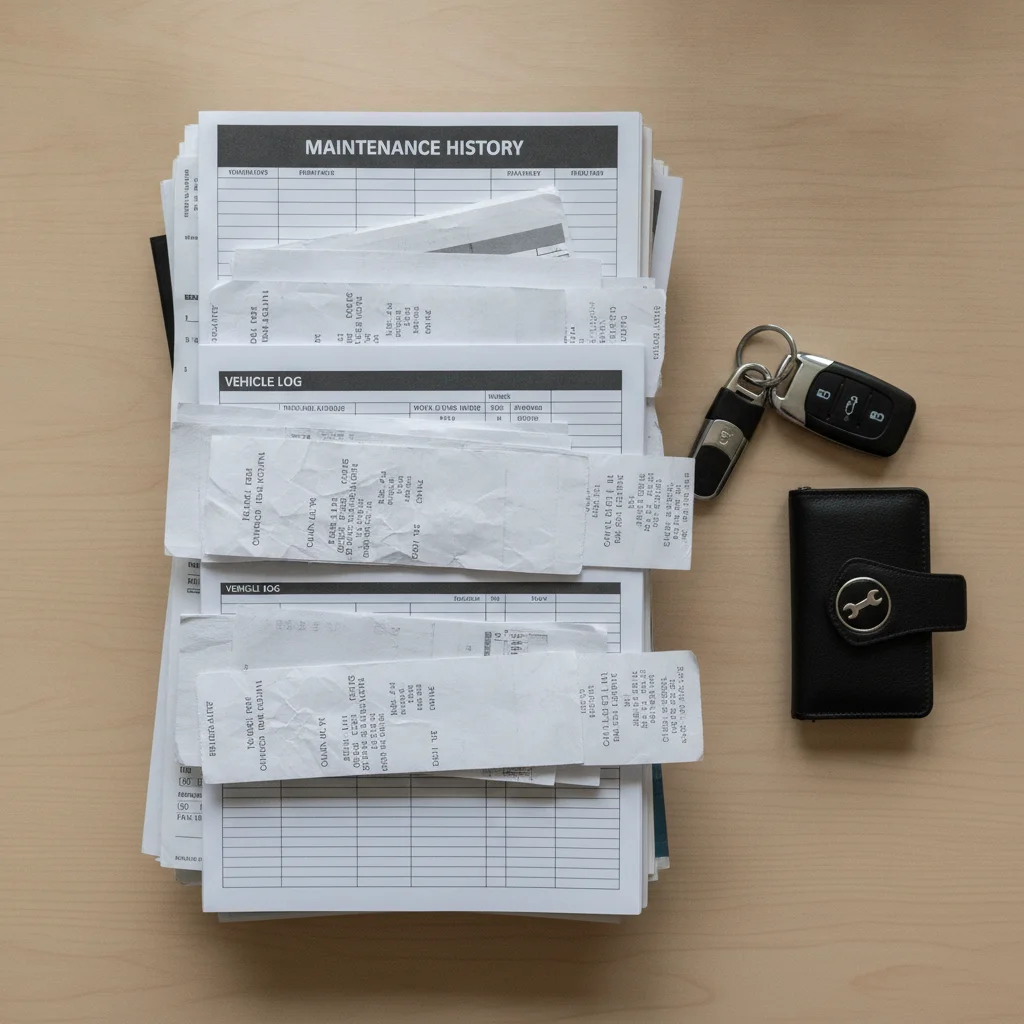
If you haven't already addressed known issues, decide now whether to fix them before listing or price them in. Transparency about unresolved issues, paired with a corresponding price adjustment, almost always outperforms trying to obscure problems that a competent buyer will find anyway.
When Your Asking Price Isn't Getting Traction
If your listing has been live for two to three weeks with no serious inquiries — not lowball offers, not ghosted conversations, but genuine radio silence — your price is almost certainly the problem.
Here's a practical diagnostic:
- Re-run your comparable listings search. Markets move. If three similar cars appeared in your area in the last two weeks at lower prices, that's your answer.
- Review your listing photos. Presentation matters enormously in this mileage range. Poor photos signal a poorly maintained car even when that's not the case.
- Check if your condition claims are believable. Saying "excellent condition" on a 160,000-mile car will lose buyers before they even engage. "Good condition with documented maintenance" is more credible and often generates more interest.
- Consider a 5–7% price reduction. In most markets, this is enough to move your listing into a new algorithmic tier on platforms like CarGurus, where vehicles are ranked partly by price-to-market ratio.
Buyers weighing a high-mileage purchase are doing a real risk-reward calculation. Your job as a seller is to make that calculation come out in your favor — through price, documentation, or both. If neither is working, one of them needs to change.
The broader context here: understanding how depreciation accelerates at high mileage helps you set realistic expectations before you list, not after two weeks of silence. Sellers who go in with grounded expectations negotiate better and close faster.
Avoid Reducing Price Too Quickly
Dropping your price by $500 every week signals desperation and trains buyers to wait you out. If you need to reduce, do it once by a meaningful amount (5–8%) and hold that price for at least two weeks. Frequent small reductions attract lowball offers, not serious buyers.

All claims are backed by peer-reviewed research. Sources on request.