Key Takeaways
Why State Incentives Deserve as Much Attention as the Federal Credit
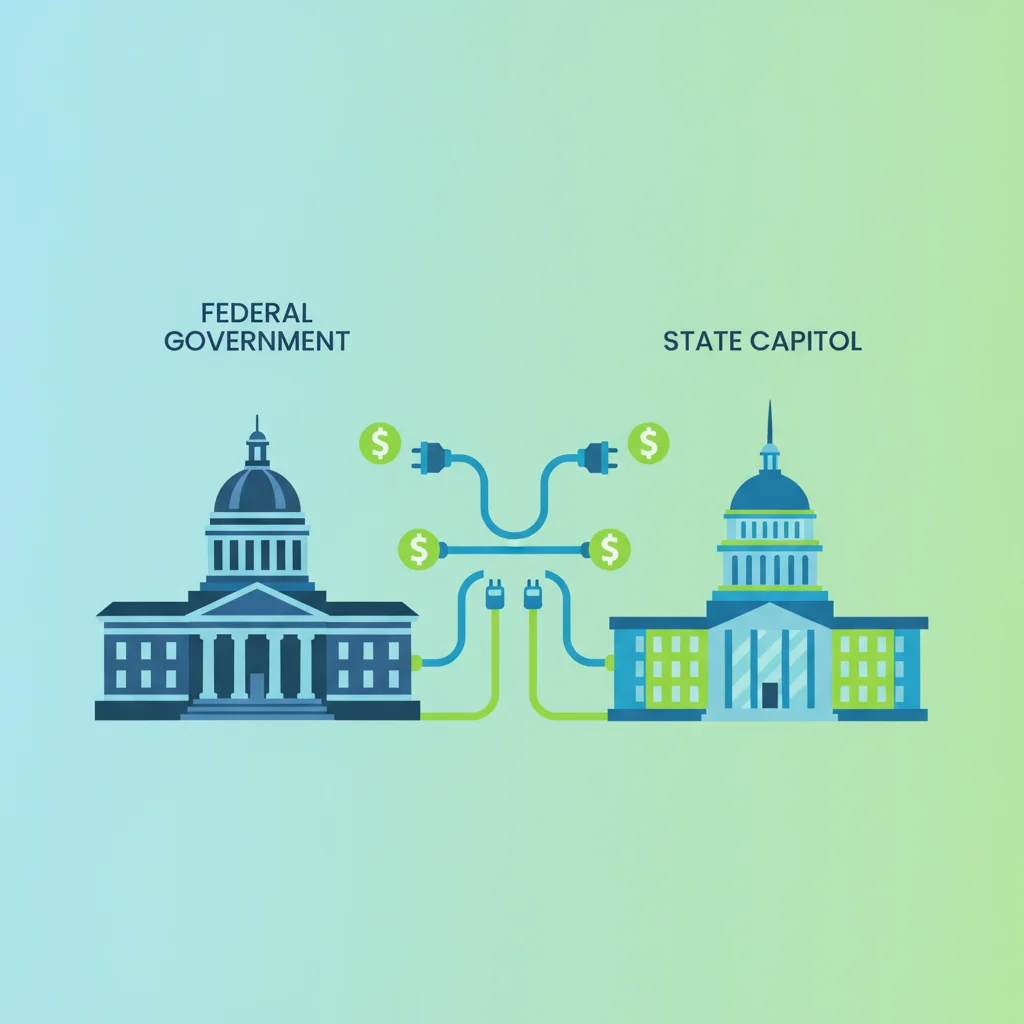
Most EV shoppers know about the federal clean vehicle tax credit — up to $7,500 for new EVs purchased through a qualifying dealer. What many miss is the layer of state programs sitting on top of it. Depending on where you live, those programs can be worth anywhere from a few hundred dollars to several thousand, and unlike the federal credit, many come as direct rebates that don't require you to have a specific tax liability to benefit.
The landscape is fragmented and changes frequently. State legislatures add, modify, and sunset programs every budget cycle. That fragmentation is actually good news for buyers who do their homework, because it means competition between programs, and in some cases, genuine stacking opportunities that compound your savings meaningfully.
For a grounding in how the federal side works before diving into state programs, see our complete walkthrough of EV tax credits. And if you want to understand why a rebate hits differently than a tax credit, this breakdown of credits vs. rebates is worth a few minutes of your time.
California: The Deepest and Most Layered Incentive Stack in the Country
California has more EV incentive programs than any other state, and they genuinely stack. The primary program is the Clean Vehicle Rebate Project (CVRP), which offers up to $2,000 for BEVs and $1,000 for PHEVs for standard-income buyers. Low-income applicants — those at or below 300% of the federal poverty level — can qualify for the Clean Cars 4 All voucher of $5,500 to $9,500 when replacing an older, high-polluting vehicle.
On top of those, the Clean Air Vehicle (CAV) sticker provides access to HOV lanes for solo drivers — a non-cash benefit worth real money to commuters in Los Angeles or the Bay Area. Many California utilities, including PG&E, SCE, and SDG&E, also layer in their own rebates of $500 to $1,000 for EV purchase or home charger installation.
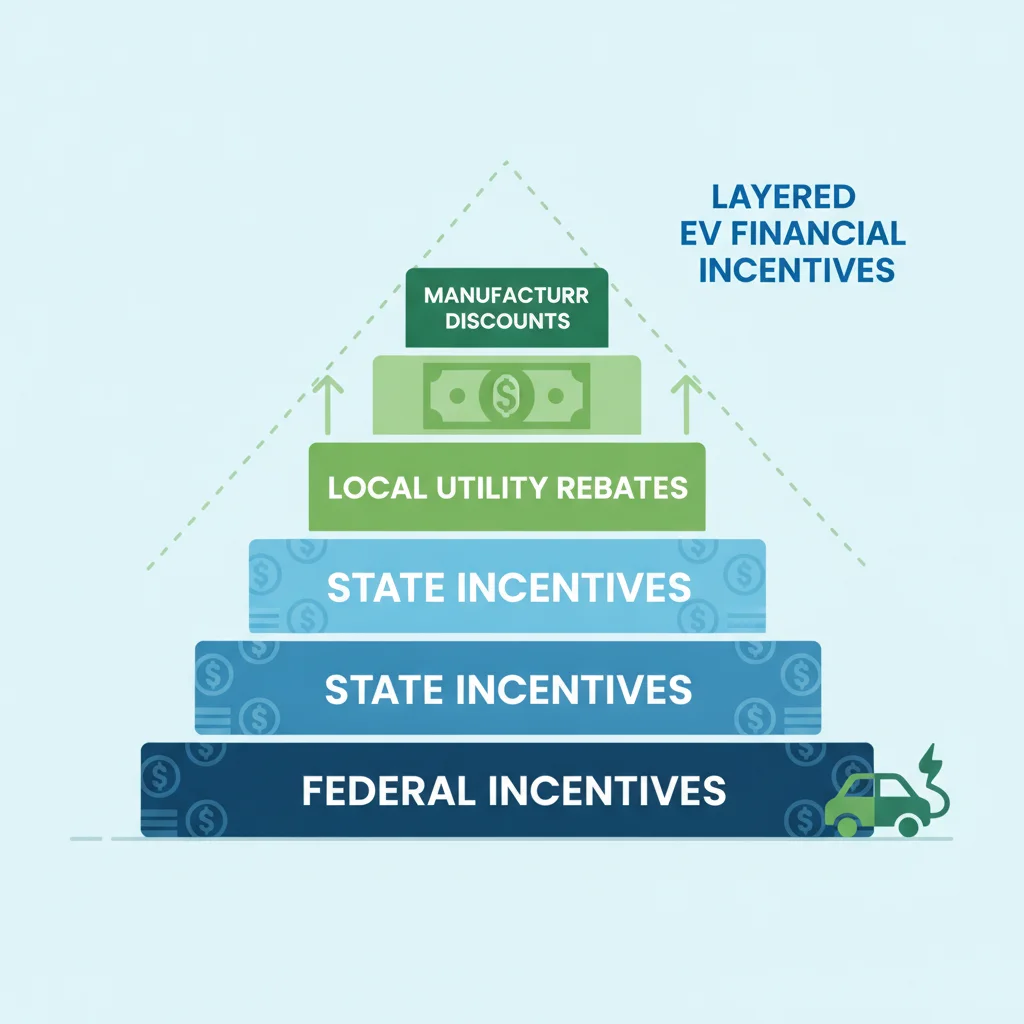
California residents can realistically combine the $7,500 federal credit, a CVRP rebate, a utility rebate, and — if eligible — a Clean Cars 4 All voucher. That's a potential stack exceeding $15,000 in some scenarios. Income and vehicle price caps apply to each layer independently, so check each program's rules separately.
[in_content_images:1]California buyers can realistically stack over $15,000 in combined federal and state EV incentives.
Colorado: A State Tax Credit That Stacks Dollar-for-Dollar With Federal
Colorado offers one of the most straightforward state stacking opportunities: a state income tax credit of $5,000 for new EV purchases, available in addition to the federal credit. For buyers who qualify for both, that's up to $12,500 in combined credits — among the highest totals outside of California's most targeted programs.
Unlike rebate programs, Colorado's credit works like the federal one: it reduces your state income tax liability. You need sufficient Colorado tax liability to use it in the year of purchase. The vehicle must have an MSRP under $80,000 for passenger vehicles (higher for trucks and vans), mirroring the federal price caps.
Colorado also waives sales tax on EV purchases in most jurisdictions, adding another few hundred to a few thousand dollars in savings depending on vehicle price. The combination of federal credit, state credit, and sales tax exemption makes Colorado one of the most financially favorable states for EV buyers nationwide.
Colorado's $5,000 state tax credit stacks directly with the federal credit for up to $12,500 combined.
New York: Rebates at Point of Sale Plus Utility Incentives
New York's Drive Clean Rebate, administered by NYSERDA, offers up to $2,000 for new BEVs and PHEVs with a battery range of 40+ miles. The key advantage: this rebate is applied at the dealership at the time of purchase, like an instant discount, rather than requiring a post-purchase application. You don't need to have the right tax liability — the rebate comes off the purchase price directly.
On top of the state rebate, New York utilities — including Con Edison and National Grid — offer their own EV incentives, including bill credits for off-peak charging and rebates for Level 2 home charger installation. These can add several hundred dollars annually or up to $500 on charger equipment.
New York also exempts EVs from state sales tax, which on a $45,000 vehicle represents roughly $3,800 in savings at the current 8.52% average rate. Stack the federal credit, Drive Clean Rebate, sales tax exemption, and utility programs and you're looking at a substantial combined benefit that meaningfully reduces the effective purchase price.
New York's point-of-sale rebate means you see the savings immediately, not on next year's tax return.
New Jersey: No Sales Tax on EVs — A Large, Automatic Benefit
New Jersey exempts EVs from its 6.625% state sales tax. On a $50,000 vehicle, that's over $3,300 in automatic savings with zero application required. This benefit applies to all qualifying electric vehicles regardless of income, and it stacks with the federal credit without any coordination required on the buyer's part.
Beyond the sales tax exemption, New Jersey offers the Charge Up New Jersey rebate program, which provides up to $4,000 for new EV purchases by residents. The program has had funding cycles that have opened and closed, so availability depends on whether the program is currently funded — check the NJ Board of Public Utilities website before assuming it's active.
New Jersey also offers reduced registration fees for EVs and a dedicated HOV lane benefit. For buyers in the northern part of the state who commute into metro New York, the HOV access alone has meaningful time and fuel value. The NJ Turnpike also offers reduced toll rates for EVs in some circumstances.
New Jersey's sales tax exemption automatically saves buyers over $3,300 on a typical EV — no application needed.
Massachusetts: MOR-EV Rebate Plus Utility Programs
Massachusetts runs the MOR-EV (Massachusetts Offers Rebates for Electric Vehicles) program, which provides a $3,500 rebate for new BEVs and $1,500 for PHEVs with a price cap of $50,000. Applications are submitted after purchase and typically processed within 90 days. The rebate is available to Massachusetts residents who register the vehicle in the state, and it stacks cleanly with the federal credit.
Low-income residents in Massachusetts can access the MOR-EV+ program, which provides an enhanced rebate of $7,500 — matching the top of the federal credit — for income-qualified buyers. This means some Massachusetts residents could receive $7,500 federally and $7,500 from the state, a combined $15,000 in incentives before accounting for utility programs.
Eversource and National Grid, the two dominant utilities in Massachusetts, offer their own EV programs including rebates for home charger installation and time-of-use rate plans that reduce overnight charging costs. The federal and state programs that reduce EV charging costs article covers charger incentives in more detail.
Massachusetts MOR-EV+ can match the federal credit dollar-for-dollar for income-qualified buyers.
Oregon: The Oregon Clean Vehicle and Charge Ahead Rebate Programs
Oregon operates two complementary programs. The Oregon Clean Vehicle Rebate offers $2,500 for new BEVs and $1,500 for new PHEVs. The Charge Ahead Rebate is an additional $7,500 available to income-qualified buyers — those at or below 400% of the federal poverty level — for a used or new EV. When stacked, a qualifying low-income buyer could receive $10,000 from Oregon alone, plus the federal credit.
Oregon's programs are managed by the Oregon Department of Environmental Quality (DEQ) and funded through the state's Clean Fuels Program. Funding has been renewed consistently in recent legislative sessions, but amounts are finite each cycle. Applying quickly after purchase is advisable, as rebates can be claimed on a first-come, first-served basis.
Oregon residents also benefit from the state's lack of a general sales tax — a baseline advantage that applies to all purchases, including EVs. On a $45,000 EV, that's several thousand dollars in savings compared to buying the same vehicle in a high-tax state.
Oregon's Charge Ahead Rebate can add $7,500 for income-qualified buyers on top of the standard state rebate.
Illinois: $4,000 Rebate Under the Illinois Electric Vehicle Rebate Program
Illinois launched its EV rebate program under the Climate and Equitable Jobs Act, offering a $4,000 rebate for new EV purchases. For income-eligible buyers — those at or below 80% of area median income — an additional $2,000 bonus rebate is available, bringing the potential state benefit to $6,000. The program is administered by the Illinois Environmental Protection Agency.
Illinois's MSRP cap for vehicles is $55,000, which is lower than the federal cap and will exclude some luxury EVs. The rebate is applied at the dealership at the time of sale — like New York's Drive Clean Rebate — which is particularly helpful for buyers who don't have a large federal tax liability to offset.
The Illinois program has had funding cycles tied to state budget appropriations, and demand has historically outpaced available funds. Check the Illinois EPA website before purchase to confirm the program is currently accepting applications. When active, the stack of $4,000 to $6,000 state rebate plus the federal credit puts Illinois among the more generous mid-tier states.
[in_content_images:2]Illinois applies the rebate at the dealership, so buyers benefit immediately without waiting for tax season.
Texas: Utility Rebates Fill the Gap Where State Programs Fall Short
Texas does not have a state-level EV rebate or tax credit program, but it's not an incentive desert. The Public Utility Commission of Texas has encouraged utilities to develop EV incentive programs, and several large Texas utilities — including Oncor, CPS Energy in San Antonio, and Austin Energy — have stepped up with meaningful rebates.
Austin Energy, for example, has offered rebates for home EV charger installation and time-of-use rate plans that can reduce overnight charging costs significantly. CPS Energy has offered similar programs. The specifics change year to year, so contacting your utility directly is the right move.
Texas EV buyers do pay full state and local sales taxes — which average over 8% statewide — but the federal credit stacks with utility programs without restriction. If you're a Texas buyer, the federal credit plus a utility rebate is your most realistic incentive combination, which may still represent $8,000 to $9,000 in combined benefits depending on vehicle and utility.
In Texas, utility programs are the primary incentive layer on top of the federal credit — not state government programs.
Maryland: Excise Tax Credit and EVSE Rebates
Maryland offers an excise tax credit of up to $3,000 for new EVs, applied at vehicle registration rather than through an income tax return. This makes it accessible to buyers regardless of their annual tax liability, since it reduces what you owe at the Motor Vehicle Administration when you register the car — not at IRS filing time.
Maryland also administers the Electric Vehicle Supply Equipment (EVSE) Rebate Program through the Maryland Energy Administration, which covers up to 40% of the cost of a Level 2 home charger and installation, capped at $700 for residential applicants. For renters or those installing in multi-unit housing, a separate category applies.
The combination of Maryland's excise tax credit, the EVSE rebate, and the federal credit is clean and stackable. Maryland's program has been consistently funded, making it more reliable than some programs that have lapsed in other states. The excise credit's registration-point structure also means less complexity for buyers who aren't sure how the federal credit will interact with their specific tax situation.
Maryland's excise tax credit reduces your registration fee directly — no tax liability calculation required.
Connecticut: Hydrogen and Battery EVs Both Qualify for CHEAPR
Connecticut's CHEAPR (Connecticut Hydrogen and Electric Automobile Purchase Rebate) program offers rebates from $750 to $9,500 depending on vehicle type, income level, and whether you're trading in an older vehicle. Standard rebates for BEVs start at $2,250; CHEAPR Enhanced rebates for moderate-income buyers (up to 300% of federal poverty level) go up to $9,500 when a trade-in is included.
The program is administered by the Connecticut Department of Energy and Environmental Protection (DEEP) and has been expanded multiple times since its original launch. Connecticut residents should check the CHEAPR portal directly to confirm current rebate tiers, as amounts are adjusted periodically.
Connecticut also offers a sales tax exemption on EVs priced under $50,000, which adds another $1,700 to $3,300 in savings depending on purchase price. Stack CHEAPR, the sales tax exemption, and the federal credit and a Connecticut buyer could realistically see $15,000 or more in combined incentives at the top of the Enhanced tier.
Connecticut's CHEAPR Enhanced rebate plus sales tax exemption can push combined savings past $15,000 for eligible buyers.
How to Actually Claim What You're Owed
Stacking incentives requires deliberate sequencing. The federal credit is claimed on IRS Form 8936 at tax time, or transferred directly to the dealer at point of sale for an immediate price reduction under rules that took effect in 2024. State rebates typically require a separate application — often filed through a state energy office, air quality management district, or utility — and most have windows of 30 to 90 days after purchase to apply.
Time Your Application Before Funding Runs Out
Many state rebate programs are funded with fixed appropriations that run out mid-year. California's CVRP, Illinois's program, and others have all experienced funding gaps. Apply the moment you take delivery — don't wait until the end of the quarter. Most programs allow you to submit within 90 days, but applying the day you register the vehicle is the safer strategy.
Check Your Utility's Program Before You Buy
Your electric utility may offer its own EV purchase rebate, home charger rebate, or discounted time-of-use rate — completely separate from state government programs. Contact your utility's energy efficiency department or check their website before signing at the dealership. Utility programs often have shorter application windows than state programs and can require pre-purchase enrollment in some rate plans.
Keep Every Purchase Document
State rebate applications typically require your purchase agreement, vehicle registration, proof of residency, and sometimes income verification. Some programs also require photos of the VIN and the installed charger. Assemble a digital folder of all these documents on delivery day so you're ready to submit applications immediately and completely.
Before you sign anything at the dealership, download the application for your state's rebate program. Know the vehicle eligibility requirements, income documentation you'll need, and submission deadline. Dealers are not required to walk you through state programs, and many won't.
Vehicle eligibility is its own complexity. Not every EV qualifies for every program. PHEVs may qualify for a smaller rebate tier or be excluded entirely from some state programs that are BEV-only. If you're uncertain about how vehicle type affects your eligibility at the federal level, our article on which EV types qualify for federal tax credits lays out the rules clearly. Many states mirror federal vehicle classification rules, but some use their own definitions.
Programs Change — Verify Before You Buy
State EV incentive programs are subject to legislative budget cycles, rulemaking changes, and fund exhaustion. The programs described here reflect information available at the time of writing, but specifics — including rebate amounts, income limits, and vehicle price caps — may have changed. Always verify current program details directly with the administering state agency before making a purchase decision.
Federal Credit Transfer Rules Affect Stacking Logistics
Since 2024, the federal clean vehicle credit can be transferred to the dealer at point of sale, effectively reducing the purchase price. This transfer is separate from state rebate applications, which must still be submitted independently. If you transfer the federal credit to the dealer, you are not filing Form 8936 yourself — but you still need to submit state rebate applications on your own timeline after purchase.
Not Every EV Qualifies for Every Program
Vehicle eligibility rules differ between federal and state programs. A PHEV might qualify for the federal credit but be excluded from a state BEV-only rebate. A vehicle above $55,000 might clear the federal MSRP cap but fail a state's lower cap. Always verify your specific model against each program's eligible vehicle list before assuming you qualify. Most state program websites publish current eligible vehicle lists.
For buyers with lower incomes, the stacking opportunity can be even richer. A number of states have dedicated programs for moderate- and low-income households that go beyond standard rebate levels. Our guide to EV incentives for low-income buyers covers those programs in depth.

All claims are backed by peer-reviewed research. Sources on request.