Key Takeaways
The Dashboard Won't Always Tell You Something Is Wrong
Most EV owners operate under a reasonable but incomplete assumption: if something is seriously wrong with the battery, a warning light will appear. In reality, battery management systems are designed to tolerate a fairly wide range of conditions before triggering an alert. That means a pack can be losing meaningful capacity, experiencing cell imbalances, or developing thermal irregularities long before any indicator lights up on your display.
That gap between what the car reports and what's actually happening is where battery problems quietly compound. By the time a BMS fault code surfaces, you may already be dealing with an issue that's measurably worse — and more expensive — than it needed to be.
This article focuses on the warning signs that precede formal fault codes: the behavioral shifts, charging anomalies, and physical symptoms that experienced EV technicians recognize as early indicators of a battery in trouble. Knowing these signs won't make you a battery engineer, but it will make you a more observant owner — which is worth real money when it comes to catching problems early.
Worth noting: if you're seeing any dashboard alerts — not just battery-specific ones — that appear and disappear without explanation, don't ignore them. The broader warning sign picture applies to EVs just as much as to ICE vehicles. And if you're unsure how your battery was specced to begin with, reviewing what to look for in EV battery specs gives you the baseline you need to evaluate any changes you're observing.
Unexplained range loss that persists across conditions
Every EV loses some range in cold weather, at highway speeds, or when running climate systems hard. That's physics, not failure. What you're watching for instead is range loss that persists even under favorable conditions — moderate temperatures, gentle driving, a full charge — and that appears to be getting gradually worse over weeks or months.
The typical yardstick technicians use: if your estimated range at 100% charge has dropped more than 20–25% from the original EPA-rated figure, and you're within the first 8–10 years of ownership, that's worth investigating. Some degradation is normal — most packs lose 2–3% per year under reasonable use — but steeper drops, or sudden step-change losses that appear over a few weeks rather than gradually, suggest something beyond normal wear.
Keep a simple log. Note your estimated range at full charge once a week for a month, along with temperature and recent charging behavior. If the trend line is clearly downward at a rate that doesn't match seasonal norms, you have objective data to bring to a technician rather than a vague complaint.
[in_content_images:1]A sudden step-change in range over a few weeks — not gradual fade — is the pattern that demands a diagnostic.
Charging that stops short, slows abnormally, or becomes inconsistent
Normal EV charging follows a predictable curve: fast early on, tapering as the pack approaches capacity, and stopping cleanly at your target percentage. Any deviation from that pattern is a signal worth taking seriously.
Red flags include: the charger stopping before reaching your set target with no error shown, charging speed that drops dramatically earlier in the charge curve than it used to, sessions that appear complete on the app but show a lower SoC than expected when you get in the car, or inconsistent session behavior that varies even when using the same charger at the same time of day.
Before attributing any of these to the battery, first rule out the charger itself. Try a different EVSE or a public DC fast charger and see whether the behavior changes. If the anomaly follows the car rather than the charger, the battery or its management system is the more likely culprit. Our home charging setup hub covers how to assess whether your home equipment is performing as expected.
If charging anomalies follow the car rather than the charger, the battery management system is the prime suspect.
Unusual heat around the battery area or floor pan
EV batteries generate heat during charging and discharging, and thermal management systems — whether liquid-cooled or air-cooled — are designed to keep that heat within safe operating parameters. What owners occasionally notice is heat that exceeds what they'd expect: a floor that's noticeably warm to the touch after an overnight charge at low power, a hot smell coming from under the vehicle, or the car's climate system running loudly and continuously even after charging has stopped.
Any of these observations should be taken seriously. Thermal runaway — where battery cell temperatures escalate in a self-reinforcing cycle — is rare but genuinely dangerous. The vast majority of unusual heat complaints turn out to be cooling system issues, faulty sensors, or blocked coolant flow rather than active runaway, but all of those underlying causes still require professional evaluation. Do not continue regular use of a vehicle that smells of burning or that feels unusually hot near the battery pack until it has been inspected.
[note_callout]Heat or burning smell near the battery pack is never a wait-and-see situation — get it inspected immediately.
The battery management system warning light activates — even briefly
When the BMS warning light, high-voltage system indicator, or turtle mode icon appears on your display — even if it extinguishes after a restart — treat it as a documented event rather than a resolved one. Many owners reboot the infotainment system or cycle the car off and on, see the light gone, and move on. That approach misses the point: modern EVs store fault codes in memory even after a warning clears, and those codes contain diagnostic information that a technician can retrieve and interpret.
A brief BMS alert that clears on its own could indicate a momentary sensor issue, a software glitch, or an early-stage cell imbalance that the system corrected temporarily. Each of those possibilities has a different trajectory and a different cost if left unmonitored. Getting the codes read after any BMS alert — even a brief one — gives you clarity and, if the car is under warranty, creates the documentation you may need later.
This is meaningfully different from the 12V battery and alternator warnings that appear in conventional vehicles. The high-voltage traction battery system in an EV is distinct from the 12V auxiliary battery, and the warnings associated with each require different responses.
A BMS warning that clears on its own still leaves fault codes in memory — read them before assuming everything is fine.
Dramatic performance drop-off before the battery is depleted
One of the clearest behavioral signs of a battery problem is the car entering reduced-power mode — sometimes called turtle mode or limp mode — at a state of charge where you'd normally expect full performance. If your vehicle starts restricting acceleration or power delivery at 30–40% SoC rather than in the final 5–10% buffer, that's the BMS protecting cells that can no longer safely deliver rated output at those charge levels.
This symptom is particularly common when certain cells within the pack have degraded faster than others — a condition called cell imbalance. The BMS is calibrated to protect the weakest cell, so as the imbalance grows, the usable range and power available from the full pack effectively shrinks. You may still show 35% charge on the display, but the car is behaving as if the pack is nearly empty because one group of cells genuinely is.
Cell imbalance isn't always fixable through software or recalibration alone. Depending on severity and the battery architecture involved, a technician may recommend a full pack replacement or, in some modular systems, replacement of the affected module. Either way, getting an accurate diagnosis before the condition progresses is both financially and operationally smarter.
Power restriction at 30–40% charge — not the final 5% buffer — is a textbook sign of cell imbalance worth investigating.
State of health below 75–80% reported by third-party apps or diagnostic tools
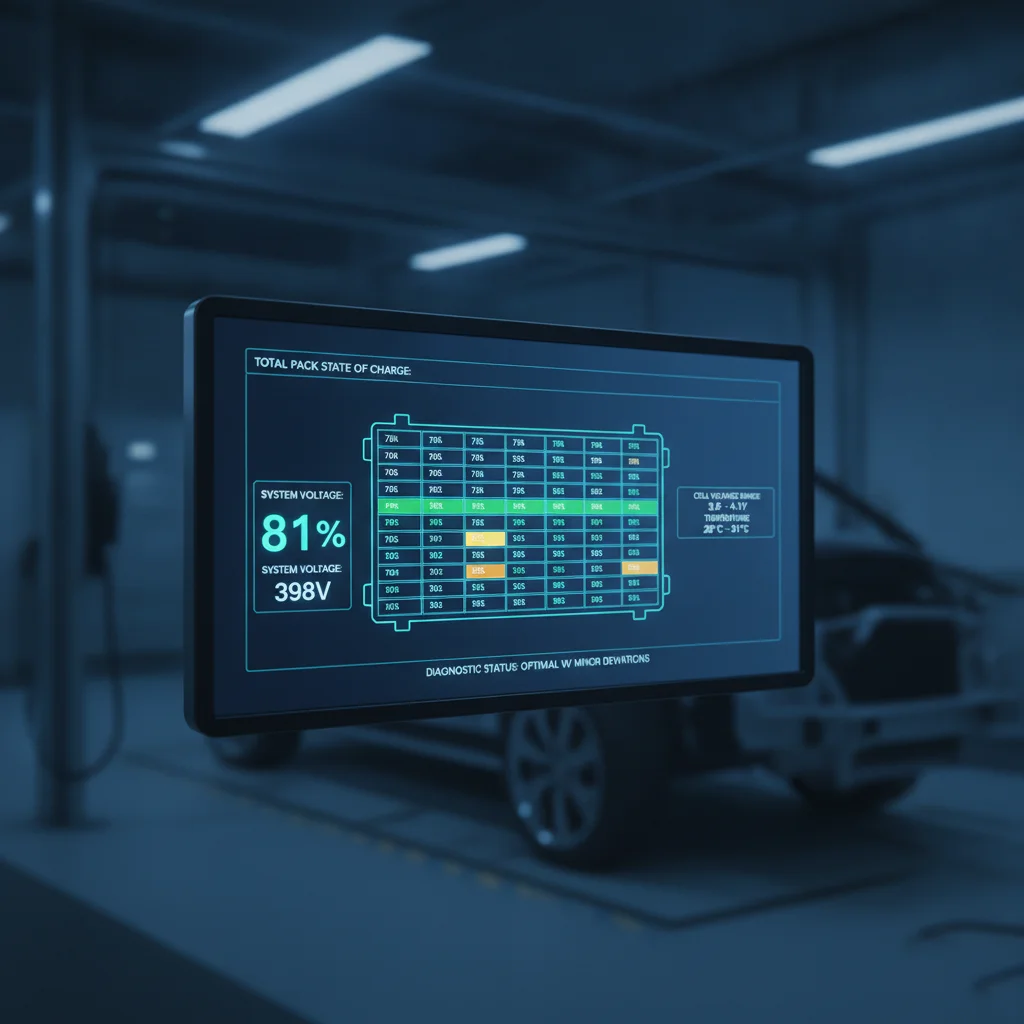
A growing ecosystem of third-party apps — Recurrent, ABRP, various OBD-linked tools depending on your make — can pull state of health (SoH) data directly from your battery management system. If any of these tools report your SoH at or below 75–80% of original capacity, that's a threshold that most EV technicians and consumer advocates would flag as worth a professional review, regardless of whether any dashboard light has appeared.
It's important to understand what SoH represents: it's a calculated estimate, not a precise measurement, and the methodology varies across tools and manufacturers. A reading of 78% from one app on a Tuesday and 82% from a different tool on Thursday doesn't necessarily mean your pack is fluctuating wildly — it may reflect different calculation approaches. What matters is a consistent trend over time and readings that drop meaningfully below the expected degradation curve for your vehicle's age and mileage.
Some manufacturers publish their own SoH data through their apps or in-vehicle displays. Cross-referencing the official manufacturer figure with a third-party tool reading gives you a more complete picture than either source alone.
[in_content_images:2]Consistent SoH readings below 80% — regardless of dashboard warnings — meet the bar for a professional diagnostic.
Swelling, fluid leaks, or physical changes to the underbody
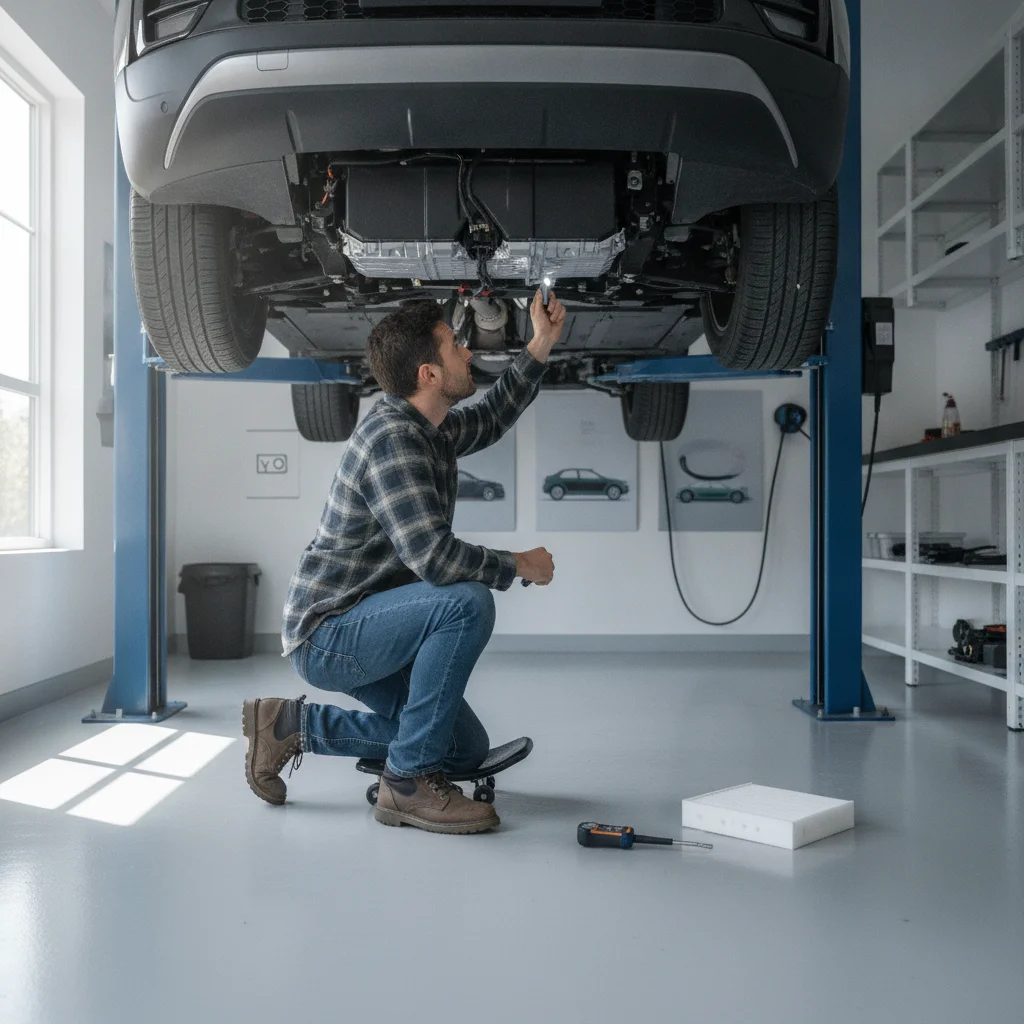
This is the most urgent category on this list. Physical changes to the battery pack or its housing — visible swelling of cells or the pack casing, any fluid leaking from the high-voltage battery area (distinct from condensation or AC drainage), or damage to the underbody that may have compromised the pack — require immediate professional evaluation. Do not continue driving the vehicle.
Battery swelling (also called cell bloat) typically results from internal gas buildup within individual cells, often caused by overcharge, deep discharge, or thermal damage. It is not something that resolves on its own or that any owner-accessible tool can address. In a lithium-ion pack, a swollen cell is a precursor to more serious failure and creates a genuine fire risk.
Similarly, if you've driven over significant road debris or bottomed out the vehicle on a hard surface, the battery pack — which sits low in the chassis in most EV designs — may have sustained damage that isn't visible from inside the cabin and won't show up as a fault code until the damage progresses. A post-impact inspection by an EV-certified technician is the only way to rule that out with confidence. For context on what warning signs at the vehicle level look like beyond what the dashboard tells you, it's worth knowing your baseline.
Visible battery swelling or any fluid near the high-voltage pack means stop driving and get a same-day inspection.
What Comes Next If You Spot These Signs
Identifying a potential problem is only half the equation. Acting on it correctly matters just as much. The right move in almost every case is a professional battery diagnostic — not a reset, not a software update applied at home, and not simply waiting to see if it gets worse.
Document before you go to the shop
When scheduling a battery diagnostic, bring as much objective data as you can: screenshots of range estimates at full charge over time, charging session logs from your app, dates when specific symptoms appeared, and any fault codes you've retrieved via third-party tools. Technicians can work faster and more accurately with documented patterns than with verbal descriptions alone. If your car is under warranty, this documentation also strengthens any claim.
Warranty coverage is a use-it-or-lose-it asset
Federal law requires that EV manufacturers warrant the traction battery for at least 8 years or 100,000 miles, and many manufacturers cover capacity loss below a defined threshold — typically 70% of original capacity. If you're within that window and experiencing measurable range loss, a professional diagnostic is free risk: if a covered defect is found, the repair is on the manufacturer. If no defect is found, you at least have a documented baseline for future reference.
Most EV manufacturers and independent EV-certified shops can run a full battery health report using OBD access and proprietary software. This report typically includes state of health (SoH), individual cell voltages, thermal history, and any stored fault codes — whether or not those codes triggered a visible warning. If your vehicle is still under the battery warranty (federal law requires a minimum of 8 years/100,000 miles for most EVs), a documented diagnostic is also the paper trail that supports a warranty claim.
For deeper context on what a technician can do versus what you can reasonably handle yourself, see our guide on DIY EV maintenance vs. technician tasks. Battery diagnostics and any work that involves opening the pack are firmly in the professional column — these systems operate at voltages that are lethal without proper training and equipment.
Thermal events vs. normal warm battery
It's normal for an EV battery pack to feel slightly warm after a DC fast charge session or a hard highway drive — these are high-demand scenarios. The concern is heat that appears during or after low-demand activity (overnight Level 1 charging, short city trips) or that comes with an unusual smell. If you're unsure whether what you're experiencing is normal, a quick call to your dealer's service department — before going in — can help you triage.
12V auxiliary battery is a separate system
EV owners occasionally confuse symptoms related to the 12V auxiliary battery — which powers accessories and the car's startup systems — with the high-voltage traction battery. A dead or weak 12V battery can cause a variety of strange behaviors, including failure to power on, odd accessory glitches, and even some BMS communication errors. Your technician will check both systems in any comprehensive diagnostic.
Federal warranty minimums explained
Under U.S. federal emissions warranty rules, EV and plug-in hybrid battery packs must be warranted for at least 8 years or 100,000 miles — whichever comes first. California and states that follow California emissions standards extend this to 10 years or 150,000 miles. Some manufacturers go beyond the minimum. Check your specific ownership documentation for coverage thresholds, particularly the capacity retention percentage that triggers a covered replacement.
Battery problems are rarely isolated events. If you've noticed any of the signs described above, it's also worth reviewing your charging habits — because behavior-driven degradation and hardware-level issues often overlap. Addressing one without the other leaves the underlying cause in place.

All claims are backed by peer-reviewed research. Sources on request.