Key Takeaways
Summary
28 items · 30–60 minutes
Why EV Road Trip Prep Is Different From Gas Car Prep
Fueling a gas car on a road trip is reactive — you pull in when the gauge hits a quarter tank. EV road tripping is proactive by nature. Charging infrastructure, network memberships, adapter compatibility, and real-world range under load all demand decisions that should happen at your kitchen table, not at mile 200 with 18 miles of range left.
The good news: the planning overhead shrinks dramatically with a repeatable pre-departure routine. The checklist below covers every layer of that routine — from account setup and hardware to route logic and in-car settings — so you can leave the driveway confident rather than anxious.
Before you focus on charging alone, remember that EV or not, the fundamentals of mechanical readiness still apply. See The Pre-Road-Trip Maintenance Check Every Driver Should Run for tire, brake, and fluid checks that are easy to overlook when you're laser-focused on kilowatt-hours.
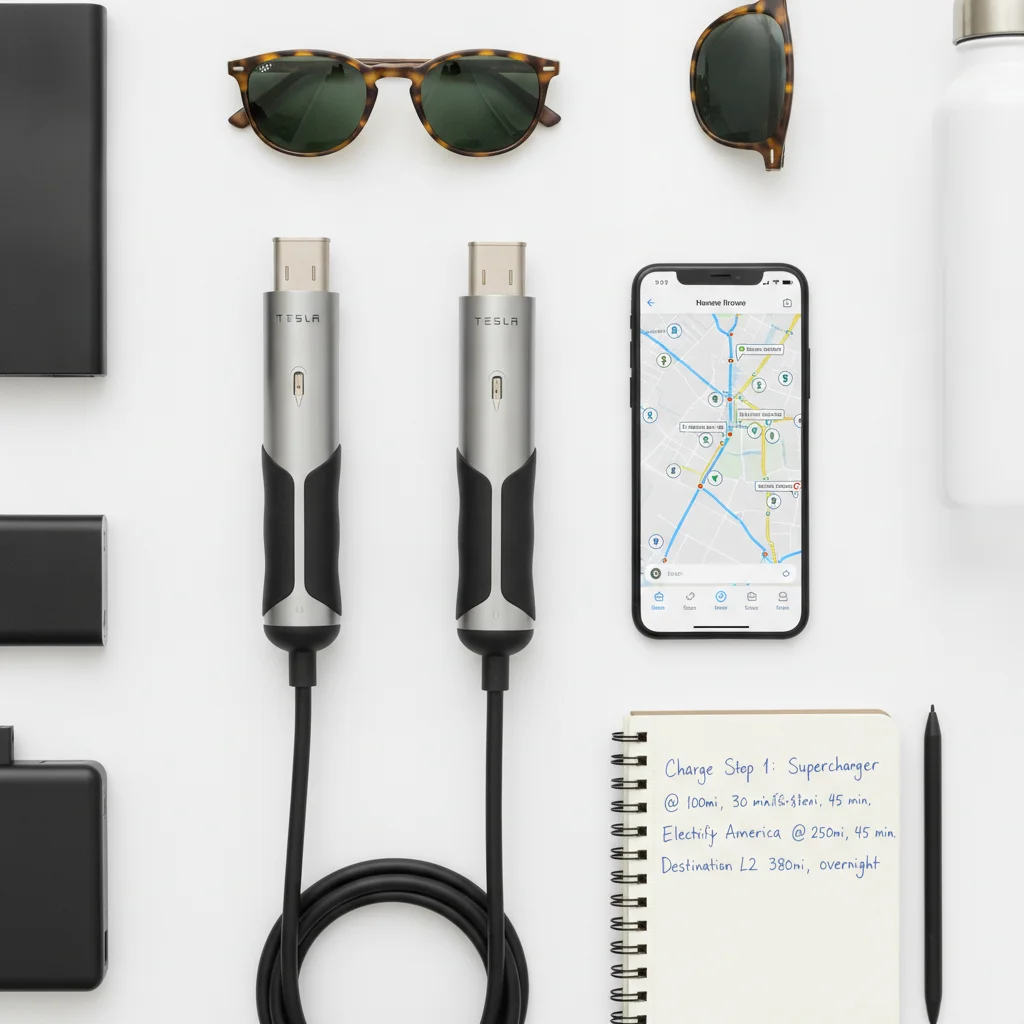
This checklist is built around the three phases of pre-departure readiness: account and hardware prep (things you do days before the trip), route and range planning (the night before), and vehicle and software setup (morning of departure). Work through each group in order and you'll have covered every common failure mode before the wheels start turning.
Tools and Resources You'll Need
You don't need much gear to execute this checklist, but having the right apps and hardware assembled before you start will save time. Here's what to gather:
A Better Route Planner (ABRP)
Models your specific EV's real-world range on your exact route, accounting for elevation, speed, and weather, then maps optimal charging stops.
PlugShare
Crowdsourced charger status and user check-ins let you verify that specific stations are operational before you arrive.
Network apps (Electrify America, EVgo, ChargePoint, Blink, Tesla)
Required for payment and session initiation at each respective network's stations — install and log in before departure.
NACS (Tesla) adapter
Allows non-Tesla EVs with CCS ports to access the Tesla Supercharger network, dramatically expanding fast-charging availability on most U.S. corridors.
J1772 to native-port adapter
Enables access to the broad Level 2 public charging network for destination and overnight charging.
Vehicle owner's manual or manufacturer app
Reference for your specific battery pre-conditioning procedure, recommended charge limits for travel, and OTA update status.
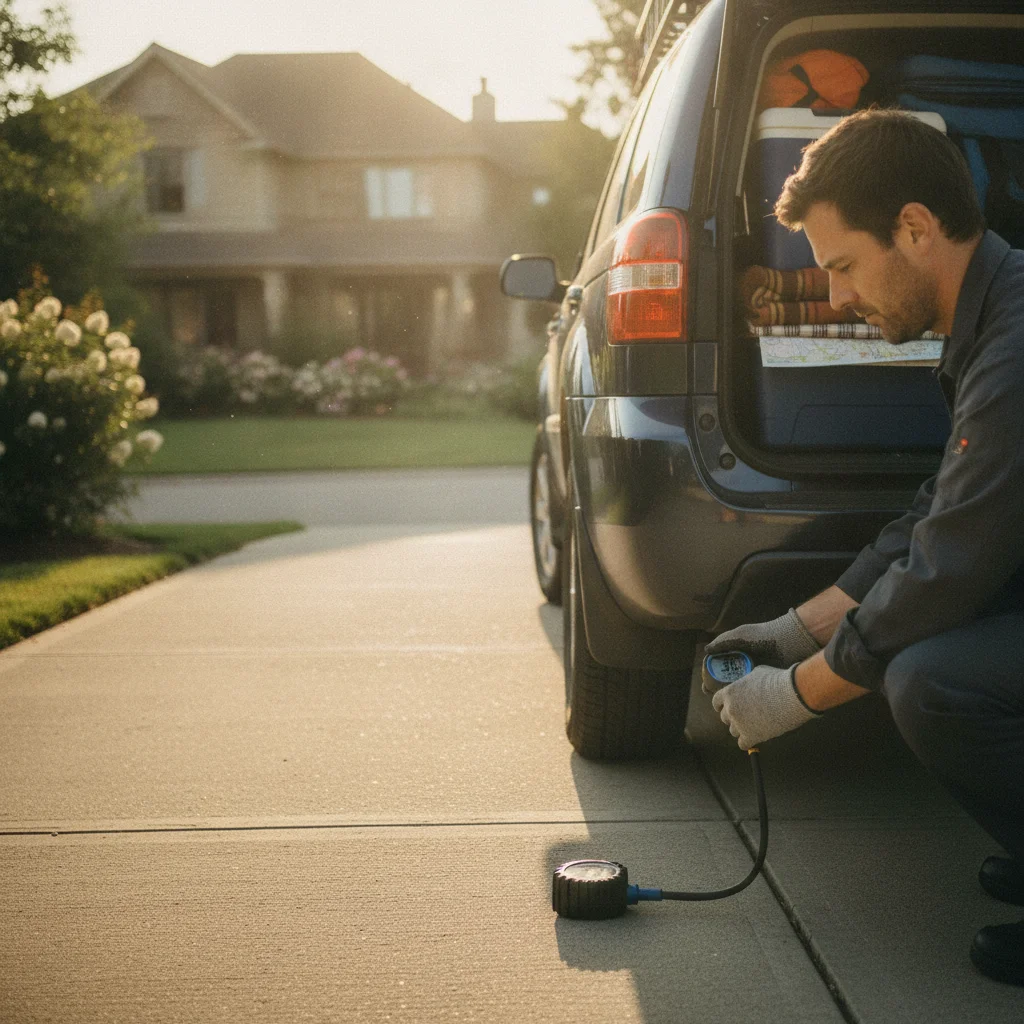
Tire pressure gauge
Cold morning temperatures drop tire pressure by 1–2 PSI per 10°F, reducing both range and handling — verify all four corners before departure.
If you're still dialing in your home charging setup — the foundation of every EV road trip — Home EV Charging Setup: Everything You Need to Know Before You Begin walks through charger types, panel requirements, and installation costs in detail.
The Complete Pre-Road-Trip EV Charging Checklist
Work through these groups in sequence. Items marked must are non-negotiable for a safe, successful trip. Should items strongly improve reliability and comfort. Nice-to-have items are optimizations worth adding once the basics are locked in.
Account & Network Setup (Do This Days Before)
Hardware & Adapters
Route Planning
Range & Weather Assessment
Vehicle Software & Settings
Don't Rely on a Single Charging Network
Even the largest fast-charging networks have corridor gaps and periodic station outages. Carrying only one network's app and no adapter alternatives is the single most common cause of EV road trip delays. Redundancy — multiple accounts, multiple adapters, a mapped backup stop — is inexpensive insurance against an otherwise trip-ruining situation.
OTA Updates Can Disrupt Pre-Trip Charging
Some over-the-air software updates temporarily suspend charging sessions or reset charge limit settings while the vehicle reboots. Always install pending updates at home, well before departure — not the night before a 6 a.m. start when you might not catch a mid-update stall.
Free Charging Trials Expire — Verify Before You Depend on Them
Many new EVs ship with complimentary DC fast-charging sessions (often 1–3 years of free Electrify America charging). These trials expire, and the billing transition is not always clearly communicated. Log into your account before the trip to confirm your credit balance or subscription status so you aren't surprised at the pump.
For a granular look at how charging costs accumulate across a multi-day drive — and strategies to reduce them — see Road Trip Charging Costs: Planning the Financial Side of Long-Distance EV Travel. The Charging Costs & Savings hub also aggregates per-kWh rate comparisons across major networks.
Understanding Real-World Range: The Numbers That Actually Matter
EPA-rated range is a laboratory figure. On a highway road trip — sustained 70–75 mph, climate control running, cargo loaded — expect your real-world range to land 20–30% below the EPA number in mild weather, and 30–45% below in temperatures under 40°F. That gap is where poorly planned trips break down.
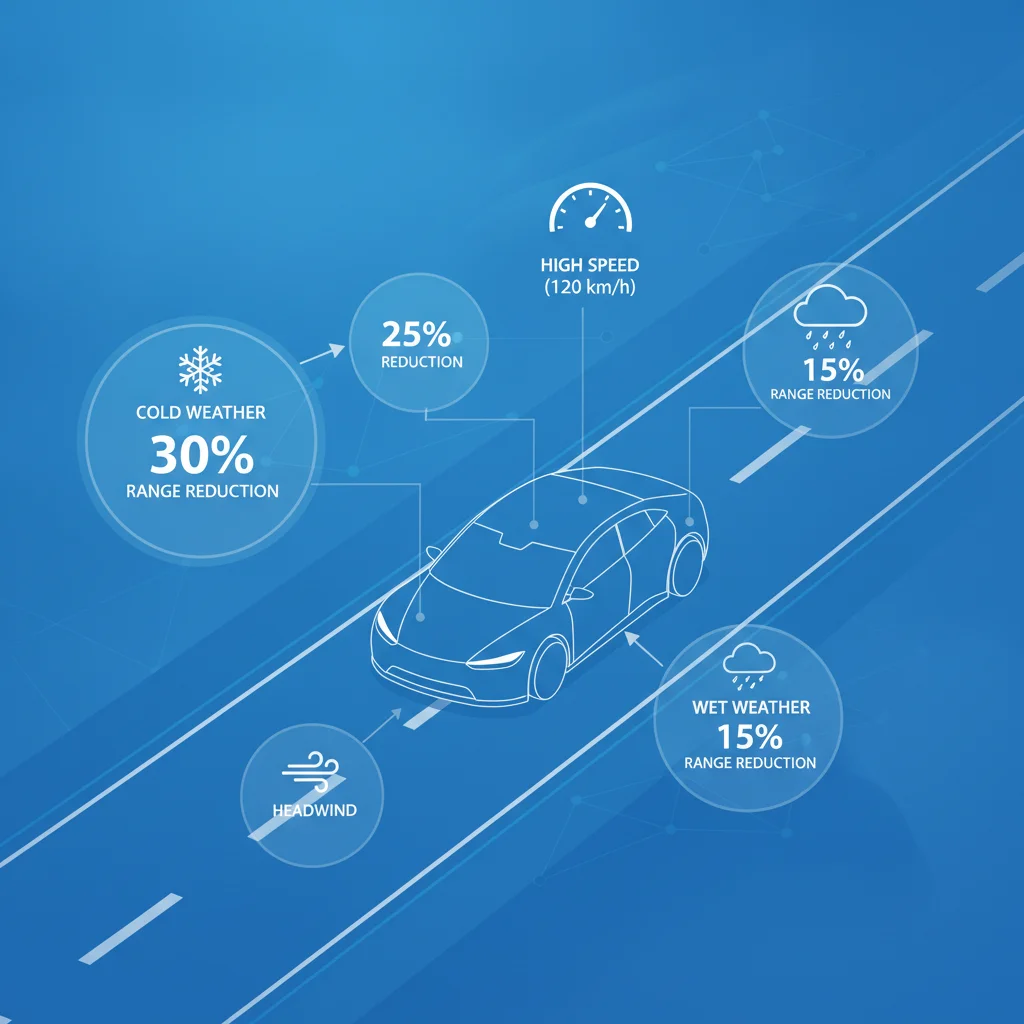
| Condition | Typical Range Reduction vs. EPA |
|---|---|
| Highway 70 mph, 70°F | 15–25% |
| Highway 70 mph, 20°F | 30–45% |
| City driving, 70°F | 0–10% (often exceeds EPA) |
| AC at max, 95°F | 10–20% |
| Heat at max, 25°F | 25–40% |
Use these figures as planning buffers, not excuses for anxiety. A 300-mile-rated EV realistically covers 220–240 miles between stops on a summer interstate run. Plan charging stops at 70–75% of your real-world estimate to keep a comfortable buffer and account for chargers that aren't at full power. For a full playbook on stretching range between stops, see Maximizing EV Range on a Long Road Trip.
Never Plan to Arrive at a Charger Below 5% State of Charge
EV batteries managed to near-zero repeatedly experience accelerated long-term degradation. More immediately, arriving at a malfunctioning station with under 5% charge leaves you stranded with no margin to reach an alternative. Plan each leg to arrive at 10–15% minimum — it's the single most important buffer number in EV road trip planning.
Cold-Weather Range Loss Is Not a Bug — Plan Accordingly
Lithium-ion cells lose charge acceptance and discharge capacity in cold temperatures due to electrochemical physics, not a vehicle defect. In temperatures below 20°F, some EVs may deliver less than 60% of their EPA-rated range. Battery pre-conditioning (heating the pack before a charge session) is the most effective mitigation — without it, you may experience both reduced range and significantly slower charging speeds, compounding your stop time.
Backup Plans: What to Do When a Charger Is Down
Even on well-mapped routes, roughly 5–10% of DC fast chargers are out of service at any given time, based on recurring reliability audits published by J.D. Power and Plug In America. Building a backup plan into your route is not pessimism — it's engineering margin.
Before you leave, identify at least one alternative charging option within 20 miles of each planned fast-charging stop. Candidates include:
- A second DCFC station on the same corridor from a different network (another reason multiple app accounts matter)
- A Level 2 destination charger at a hotel, restaurant, or shopping center near the fast charger — slower, but available while you eat or rest
- A campground with 50-amp RV hookups — an adapter makes these a functional, if slow, overnight option
Log your backup options in a notes app or the navigation system's favorites list so you're not searching when you need them most. For broader safety preparation beyond charging, Before a Long Road Trip: The Safety Checks That Matter Most covers the full spectrum of pre-departure risk reduction.
Finally, if you haven't reviewed your EV insurance coverage recently, EV Insurance Policy Checklist Before You Sign can surface gaps in battery coverage and roadside assistance that matter specifically on long-distance drives.
Morning of Departure: The Final Five-Minute Check
With all the upstream prep done, departure morning is a quick confirmation pass — not a planning session. Run through these five items before pulling out of the driveway:
- Battery state of charge: Should read 90–100% (or your vehicle's recommended pre-trip maximum). If it's below 80%, reconsider your departure time or your first charging stop distance.
- Tire pressure: Cold morning air drops pressure 1–2 PSI per 10°F drop. Under-inflated tires meaningfully reduce range and handling. Check all four corners plus the spare if equipped.
- Route loaded in nav: Confirm charging stops appear in the sequence you planned, and that ETAs account for current traffic.
- Adapter bag in the car: A quick physical check — open the trunk and confirm it's there. This is the most commonly forgotten item.
- Pre-conditioning activated: If your vehicle supports scheduled departure or remote pre-conditioning, trigger it 15–20 minutes before you leave so the cabin is at temperature and the battery pack is in its optimal operating range before you hit the road.
That's it. Everything else was handled in the prep phases. The point of a repeatable checklist is that departure morning becomes low-stress because the decisions are already made.
All claims are backed by peer-reviewed research. Sources on request.