Key Takeaways
Home Electrical Panel
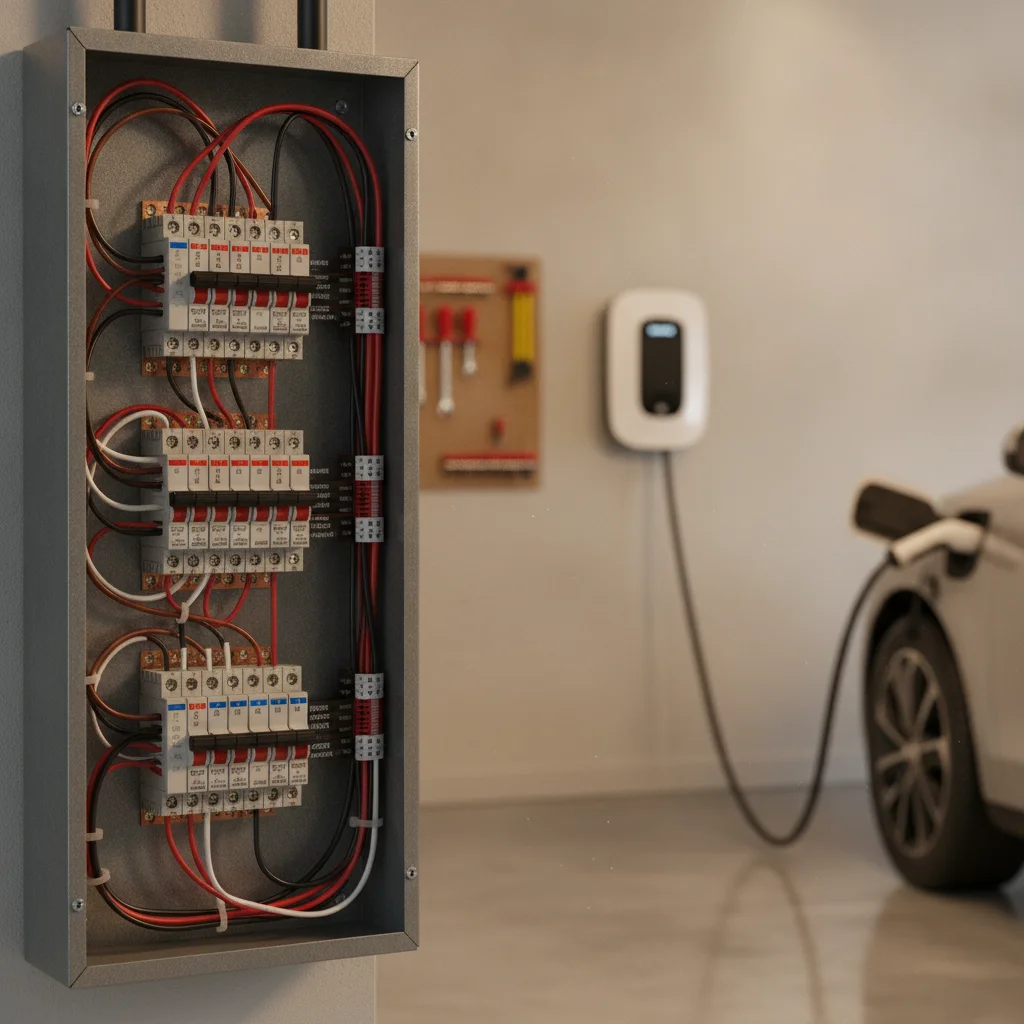
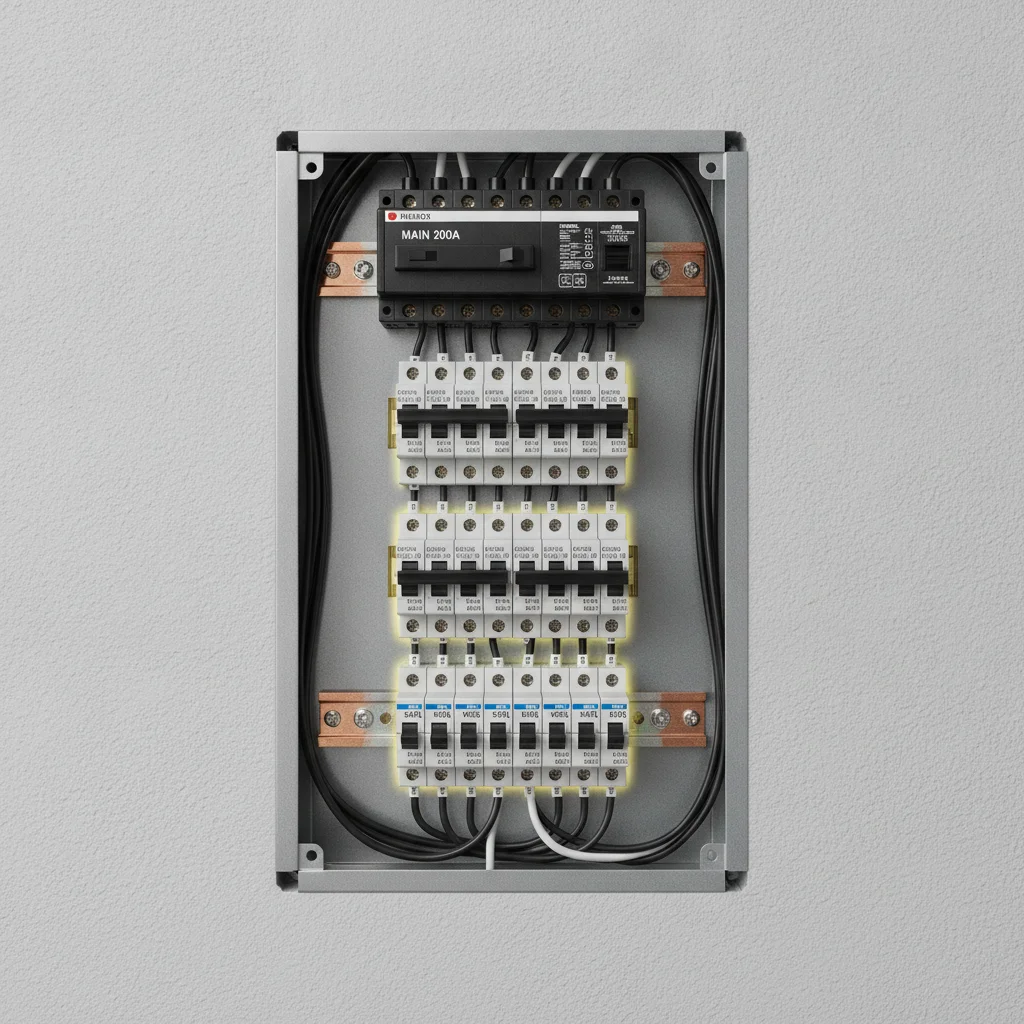
Your home's electrical panel — also called a breaker box or load center — is the central hub that receives power from the utility grid and distributes it to every circuit in your house. It contains circuit breakers that protect each circuit from drawing more current than the wiring can safely handle. For EV charging, the panel's total capacity (measured in amps) and the availability of open breaker slots determine whether you can add a dedicated charging circuit without an upgrade.
Panel capacity is rated in amperes (A) at 120/240 volts. A 200A panel at 240V delivers a theoretical maximum of 48,000 watts, but the National Electrical Code recommends loading panels to no more than 80% of rated capacity for continuous loads — which includes EV chargers.
Why Your Electrical Panel Is the First Stop Before Charging
Before you shop for an EV charger, before you call an electrician, and before you look up installation costs, there's one document you need to understand: your electrical panel. Everything about home EV charging — how fast you can charge, whether you need new wiring, whether you need a panel upgrade — flows from what's inside that gray metal box on your garage or utility room wall.
The good news is that you don't need an electrical engineering degree to make a smart decision here. You need to understand four things: what your panel's total capacity is, how much of that capacity is already spoken for, whether you have open breaker slots, and which charging level actually fits your driving needs. This explainer walks you through each one.
For a broader look at the full setup process, see our comprehensive home EV charging setup guide. This article focuses specifically on the panel side of that equation.
Electrical Panel Basics: Amps, Breakers, and Capacity
Your electrical panel receives alternating current (AC) from the utility at a set amperage rating — most commonly 100 amps or 200 amps for residential homes, though older properties sometimes have 60-amp service and newer large homes can have 400-amp service. That amperage rating is your total budget for electrical consumption.
Inside the panel, individual circuit breakers divide that total capacity among the circuits in your home. Each breaker is rated for a specific amperage — 15A or 20A for general lighting and outlet circuits, 30A or 50A for large appliances like dryers, and potentially 40A to 60A for a dedicated EV charging circuit. When a circuit draws more current than its breaker allows, the breaker trips — that's the protection mechanism working as designed.
200A
Standard panel size in most US homes built after 1970
According to the US Energy Information Administration, the majority of post-1970 single-family homes were wired with 200-amp service as electric appliances became standard.
3–5 mph
Miles of range added per hour on Level 1 charging
U.S. Department of Energy data shows Level 1 EVSE (120V, 12A) delivers approximately 1.3–1.9 kW, translating to 3–5 miles of range per hour for most EVs.
15–30 mph
Miles of range added per hour on Level 2 charging
The DOE's Alternative Fuels Data Center reports that a typical 7.2 kW Level 2 charger adds 15–30 miles of range per hour depending on vehicle efficiency.
80%
NEC maximum continuous load limit per circuit
The National Electrical Code (NEC Article 625 and 210.19) requires EV charger circuits to be rated at 125% of the charger's continuous load, effectively capping continuous draw at 80% of breaker capacity.
$300–$800
Typical cost to add a 50-amp EV circuit to an existing 200A panel
HomeAdvisor and Angi market data (2023–2024) show a licensed electrician typically charges $300–$800 for a dedicated 240V EV circuit on an existing adequate panel, excluding permit fees.
Two numbers matter most when you're planning EV charging:
- Total panel amperage — the rated capacity of the entire panel (100A, 200A, etc.)
- Available capacity — total capacity minus what your existing circuits actually draw
Available capacity is what you have left to work with. But there's a catch: the National Electrical Code (NEC) requires that continuous loads — and EV chargers qualify as continuous loads under Article 625 — draw no more than 80% of a circuit's rated amperage. So a 50-amp breaker can only supply 40 continuous amps to a charger. This 80% rule applies at both the circuit level and, in practice, should inform how you think about overall panel headroom.
The 80% Rule Is Non-Negotiable for Continuous Loads
EV chargers are classified as continuous loads under NEC Article 625 because they operate for three hours or more at a time. This means your charger circuit must be rated at 125% of the charger's maximum draw — or equivalently, the charger can only use 80% of the circuit's rated amperage. Ignoring this rule is a code violation and a fire risk. It's also why a 48-amp charger requires a 60-amp breaker, not a 50-amp one.
Permit Requirements Vary by Jurisdiction
While nearly all US municipalities require permits for new 240V circuits, the specific process, cost, and timeline vary by locality. Some jurisdictions have expedited EV-related permit programs that turn around approvals in 24–48 hours. Ask your electrician about local timelines before you set a target installation date — in some areas, inspections can be scheduled within days; in others, the wait can stretch to weeks.
Level 1 vs. Level 2 Charging: What Each Demands From Your Panel
The charging level you choose has a direct relationship to your panel's electrical requirements. Here's the practical breakdown:
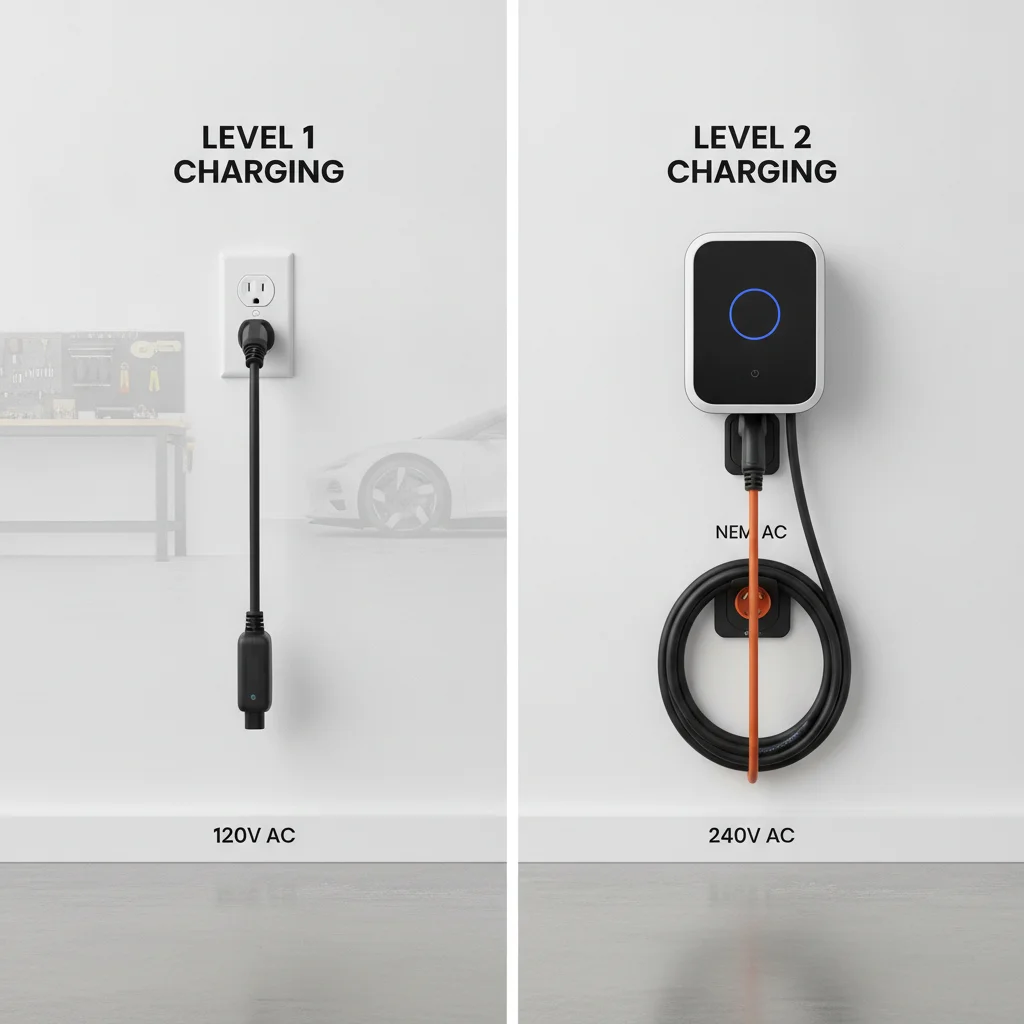
Level 1 Charging (120V)
Level 1 uses a standard three-prong 120V household outlet — the same type used by your refrigerator or laptop. Every EV comes with a Level 1 cord set (sometimes called an EVSE or mobile charger) in the box. No panel upgrade, no new circuit, no electrician required — assuming your existing outlet is on a properly functioning 15- or 20-amp circuit. Charge rate: roughly 3 to 5 miles of range per hour.
Level 1 works for drivers who charge overnight and travel fewer than 30–40 miles daily. If your commute is short, your EV spends 10+ hours plugged in each night, and you can tolerate slow top-ups, Level 1 may be all you ever need — and it costs essentially nothing extra to implement.
Level 2 Charging (240V)
Level 2 uses a 240V circuit — the same voltage as your electric dryer or range. It requires a dedicated circuit with its own breaker, appropriate gauge wiring (typically 6-gauge copper for a 50-amp circuit), and a NEMA 14-50 outlet or hardwired EVSE. Charge rate: roughly 15 to 30 miles of range per hour, depending on the charger's amperage output and your vehicle's onboard charger capacity.
The breaker size depends on the charger you select. Under the NEC 80% rule:
- A 32-amp charger needs a minimum 40-amp breaker
- A 40-amp charger needs a minimum 50-amp breaker
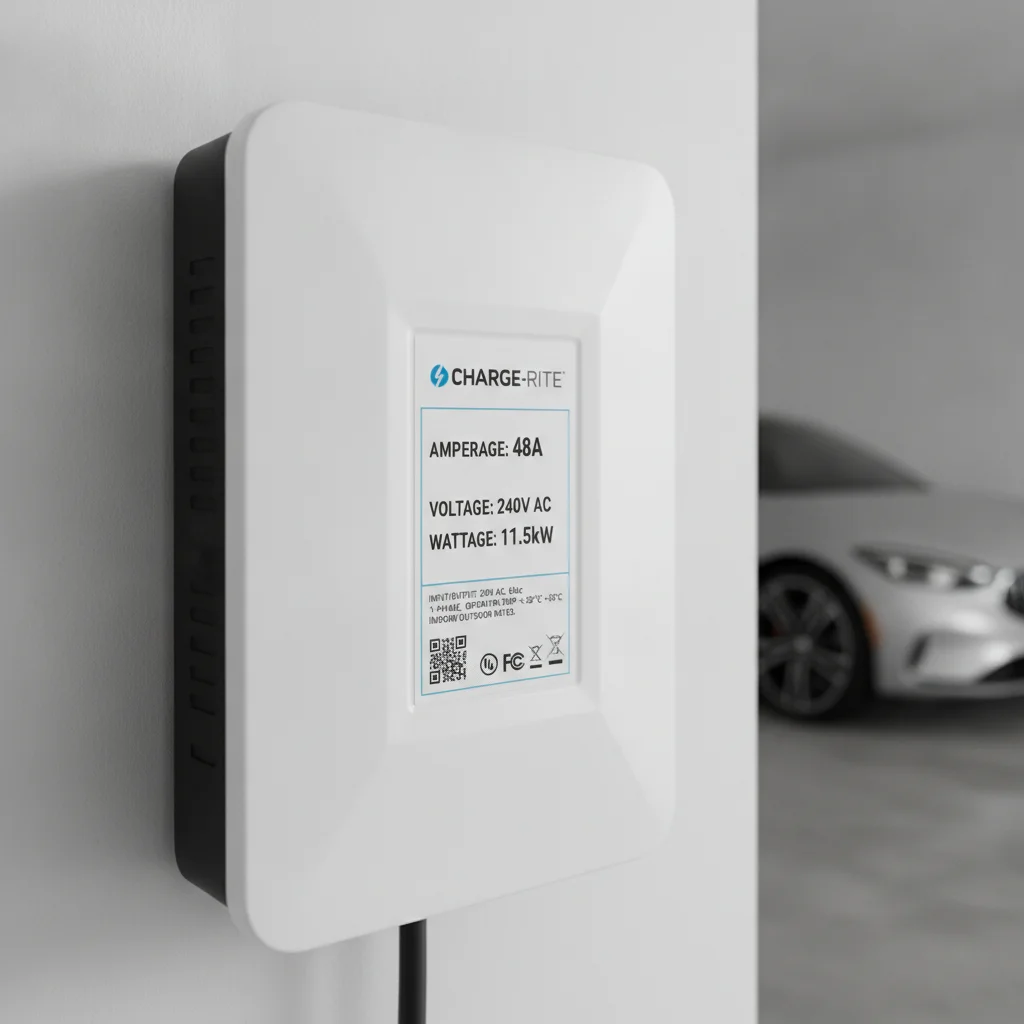
- A 48-amp charger needs a minimum 60-amp breaker
Most installers use a 50-amp breaker with a 40-amp-rated charger as the residential sweet spot — fast enough for most drivers, common enough that parts and labor are widely available.
Not sure how to decode the numbers on a charger's spec sheet? Our guide on reading an EV charger spec sheet breaks down kW, amps, and voltage in plain terms.
Ask for a NEMA 14-50 Outlet, Not Just Hardwiring
When having a Level 2 circuit installed, consider asking your electrician to terminate it in a NEMA 14-50 outlet rather than hardwiring the charger directly to the wall. This lets you swap chargers in the future without additional electrical work — a useful future-proofing move as charger technology and your EV fleet may change.
Time-of-Use Rates Can Cut Your Charging Costs Significantly
Many utilities offer time-of-use (TOU) rate plans where electricity is significantly cheaper during off-peak hours — often midnight to 6 a.m. Most Level 2 chargers let you schedule charging to those windows. Combine a TOU rate with overnight charging and you could cut your per-mile energy cost by 30–50% compared to charging at peak hours.
How to Know If Your Panel Can Handle EV Charging
The only way to know for certain is a load calculation performed by a licensed electrician. But you can do a quick self-assessment to understand where you likely stand before making the call.
Step 1: Find Your Panel's Amperage Rating
Open the panel door (the outer cover, not the inner dead-front cover — don't touch the wiring). The main breaker at the top is labeled with your service rating: 100A, 150A, or 200A are the most common. Write it down.
Step 2: Check for Available Breaker Slots
Count the empty slots — spaces where no breaker is installed. A Level 2 charger needs a double-pole breaker (one that takes two slots). If your panel is full, you'll either need a panel replacement, a sub-panel, or a tandem breaker strategy — all of which require an electrician's judgment.
Step 3: Estimate Your Current Load
Add up the amperage of your largest continuous loads: central HVAC (typically 15–60A), electric water heater (18–30A), electric dryer (30A), electric range (40–50A), and any other 240V appliances. Compare this rough total to your panel's rated capacity. If you're already consuming 150+ amps on a 200-amp panel on a hot summer day with the AC running, adding a 40-amp EV charger pushes you uncomfortably close to the limit.
Step 4: Get a Professional Load Calculation
An electrician uses NEC Article 220 load calculation methods to determine your panel's actual available capacity, accounting for demand factors (not all loads run simultaneously at full power). This is the number that drives the upgrade decision — not guesswork. The calculation typically costs little or nothing when bundled with an installation quote.
Panel Upgrade vs. Smart Charging: Choosing Your Path
If your load calculation reveals insufficient headroom for a Level 2 charger, you have two main paths forward:
Path 1: Panel Upgrade
Upgrading from 100A to 200A service is the most straightforward solution for an older home. Costs typically run $2,000–$4,500 all-in, including permit fees, the new panel, and labor. The utility company may also need to briefly disconnect service and may charge a coordination fee. The upside: you solve the capacity problem permanently and have headroom for future loads (EV #2, heat pump, induction range).
Path 2: Smart Load Management
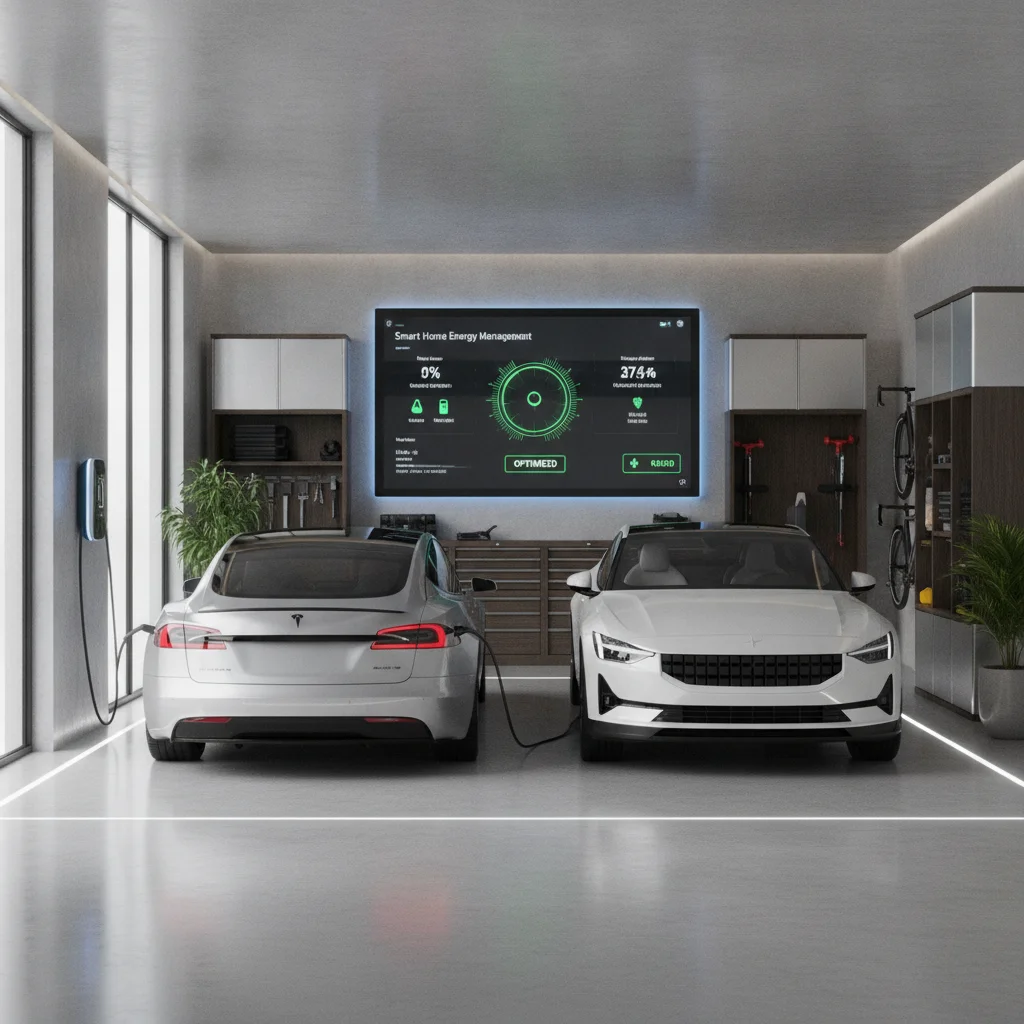
If your panel capacity is borderline — not severely undersized, just tight — a smart EV charger with dynamic load management can be the more cost-effective solution. These chargers use a current transformer (CT) sensor clamped to your panel's main conductors to monitor total home power draw in real time. When big appliances kick on, the charger automatically reduces its output to keep total consumption within safe limits. When demand drops, it ramps back up.
This approach can make a Level 2 charger viable on a panel that would technically require an upgrade under worst-case assumptions. It won't help if your panel is severely undersized or physically full of breakers, but for many homeowners it eliminates a $3,000+ upgrade.
For households managing two EVs on a single panel, load management becomes even more critical. See our overview of load management for homes with multiple EVs for how these systems work in practice.
“The most common mistake homeowners make is buying the charger before consulting an electrician. The panel is the constraint — the charger is just the endpoint. Start with the panel, and the rest of the decisions become straightforward.”
— Brett Holloway, Master Electrician and EV infrastructure installer with 20+ years residential experience
Permits, Inspections, and Why Shortcuts Cost More
Any new 240V circuit for EV charging requires a permit and inspection in virtually every US jurisdiction. This is not optional bureaucracy — it's what ensures your wiring is safe, your breaker is correctly sized, and your home remains insurable. Unpermitted electrical work can void your homeowner's insurance, complicate a home sale, and create genuine fire hazards.
The permit process is typically straightforward: your electrician pulls the permit, does the work, and schedules an inspection with the local building department. The inspector checks that the circuit is correctly wired, the breaker is properly sized, and the EVSE is installed per the manufacturer's requirements. Total added cost is usually $50–$150 in permit fees.
The 80% Rule Is Non-Negotiable for Continuous Loads
EV chargers are classified as continuous loads under NEC Article 625 because they operate for three hours or more at a time. This means your charger circuit must be rated at 125% of the charger's maximum draw — or equivalently, the charger can only use 80% of the circuit's rated amperage. Ignoring this rule is a code violation and a fire risk. It's also why a 48-amp charger requires a 60-amp breaker, not a 50-amp one.
Permit Requirements Vary by Jurisdiction
While nearly all US municipalities require permits for new 240V circuits, the specific process, cost, and timeline vary by locality. Some jurisdictions have expedited EV-related permit programs that turn around approvals in 24–48 hours. Ask your electrician about local timelines before you set a target installation date — in some areas, inspections can be scheduled within days; in others, the wait can stretch to weeks.
Some EV manufacturers and charging companies offer installation bundles that handle permitting as part of the service. These can simplify the process, but always verify that the permit is actually being pulled — not just assumed.
Speaking of costs, once your charger is running, your electricity bill will look different. Our guide to reading your EV electricity bill explains which line items to watch and how time-of-use rates can dramatically affect your charging costs.
The Bottom Line: Matching Your Panel to Your Charging Needs
Here's the decision framework in plain terms:
- Drive under 30–40 miles daily, have a 120V outlet in your garage or driveway, and charge overnight? Level 1 may be sufficient. Zero upfront cost.
- Drive more, want faster charging, or have an older 200A panel with open slots? A dedicated Level 2 circuit is likely straightforward and affordable — typically $300–$800 for an electrician to install a 50-amp circuit and NEMA 14-50 outlet on an existing adequate panel.
- Have a 100A panel, a panel that's nearly full, or an older home with aging wiring? Budget for a panel upgrade or explore smart load management as an alternative. Get at least two electrician quotes.
The one move every EV owner should make before any other decision: call a licensed electrician and ask for a load calculation and installation quote. In most cases it's free or low-cost, and it replaces guesswork with actual numbers.
Understanding how your panel works is also foundational to understanding your EV itself — for a broader grounding in how electric vehicles work, including how onboard chargers convert AC grid power to DC battery storage, that context is worth having.
Ask for a NEMA 14-50 Outlet, Not Just Hardwiring
When having a Level 2 circuit installed, consider asking your electrician to terminate it in a NEMA 14-50 outlet rather than hardwiring the charger directly to the wall. This lets you swap chargers in the future without additional electrical work — a useful future-proofing move as charger technology and your EV fleet may change.
Time-of-Use Rates Can Cut Your Charging Costs Significantly
Many utilities offer time-of-use (TOU) rate plans where electricity is significantly cheaper during off-peak hours — often midnight to 6 a.m. Most Level 2 chargers let you schedule charging to those windows. Combine a TOU rate with overnight charging and you could cut your per-mile energy cost by 30–50% compared to charging at peak hours.

All claims are backed by peer-reviewed research. Sources on request.