Key Takeaways
EV Battery Degradation
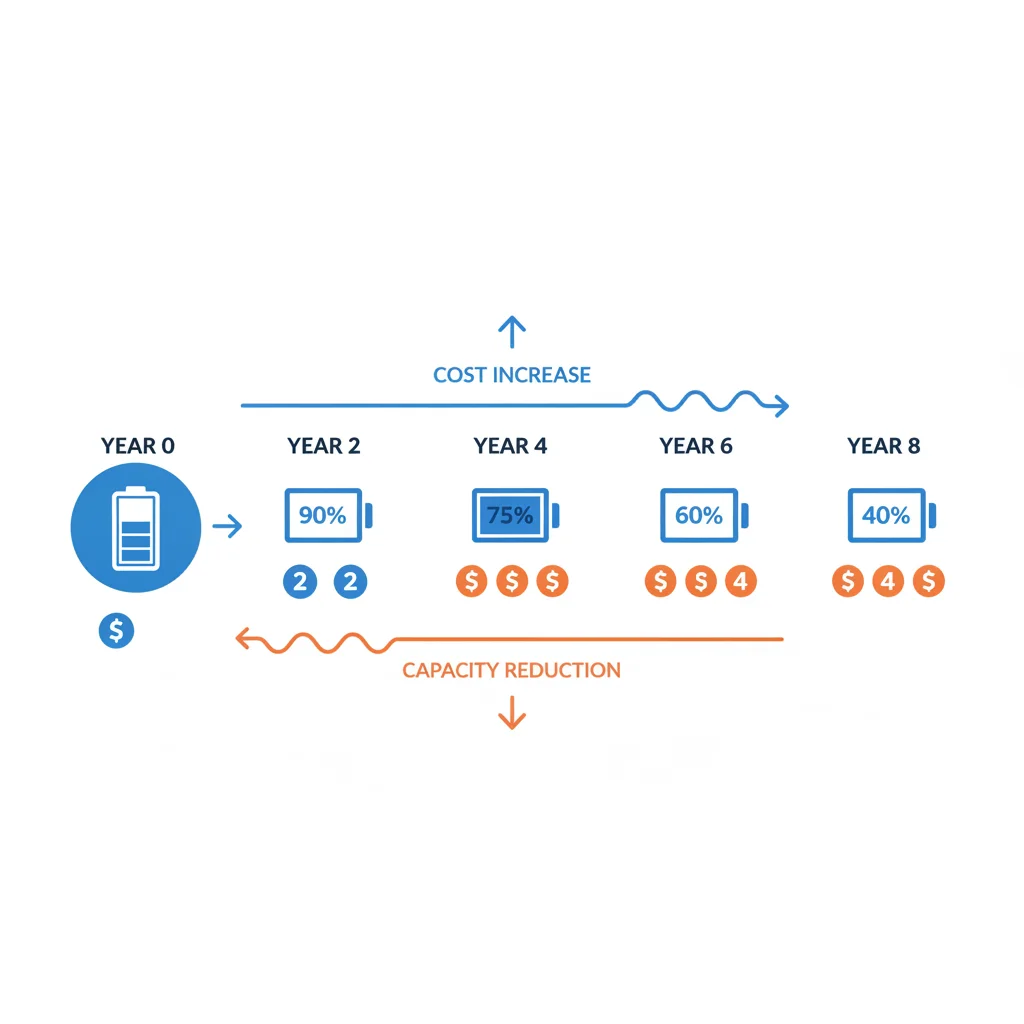
EV battery degradation is the gradual loss of a battery's ability to hold a full charge over time. As degradation progresses, the battery stores less total energy, which reduces the vehicle's maximum range and forces more frequent charging stops. This slow decline is a normal chemical process, but its pace — and its cost consequences — vary significantly depending on how the vehicle is charged, driven, and stored.
Degradation is measured as a percentage loss of usable capacity relative to the original rated capacity. Most modern EV batteries lose roughly 2–3% capacity per year under typical conditions, though lithium iron phosphate (LFP) and nickel manganese cobalt (NMC) chemistries degrade at different rates.
Why Degradation Is a Charging Cost Problem, Not Just a Range Problem
Most EV coverage frames battery degradation as a range story: your car travels fewer miles per charge as the battery ages. That framing is accurate but incomplete. The deeper financial implication is that degradation directly inflates your effective per-mile charging cost — and it does so quietly, over years, without ever triggering a dashboard warning.
Think of it this way: when you buy an EV, your charging economics are built around a specific battery capacity. A 75 kWh pack rated for 300 miles translates to a certain cost-per-mile at your local electricity rate. But as that pack degrades to 60 kWh of usable energy, you're paying to charge more frequently to cover the same weekly mileage. The electricity price hasn't changed. Your driving habits haven't changed. But your fuel budget has grown.
This is a particularly important consideration for buyers focused on the long-term savings case for EVs. The math in most EV-versus-gas comparisons uses the vehicle's original rated efficiency. As degradation advances, that comparison shifts — sometimes meaningfully. Understanding where the costs emerge, and how quickly, is the first step toward managing them.
For a fuller picture of every variable that feeds into your charging expenses, see our end-to-end guide to EV charging costs.
The Mechanics of Degradation: What's Actually Happening Inside the Battery
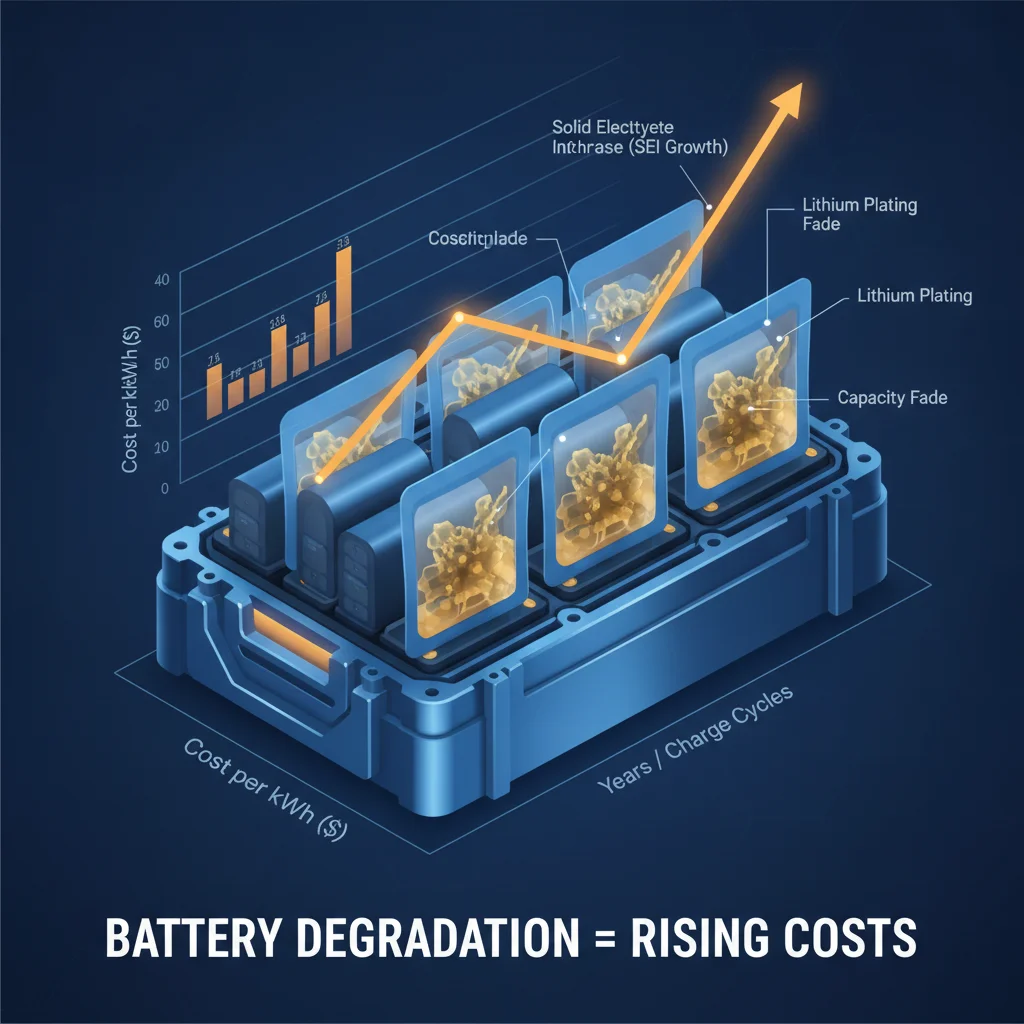
Lithium-ion batteries — the chemistry used in the vast majority of consumer EVs — store energy by moving lithium ions between a cathode and an anode during charge and discharge cycles. Over time, several chemical processes reduce how efficiently this cycle operates.
- SEI layer growth: A solid electrolyte interphase forms on the anode over time, consuming lithium ions permanently and reducing available capacity.
- Lithium plating: Fast charging, especially in cold temperatures, can cause metallic lithium to deposit on the anode surface rather than intercalate properly. This is irreversible and can accelerate capacity loss significantly.
- Cathode degradation: Repeated cycling causes structural changes in cathode materials, reducing the number of sites available to accept lithium ions.
- Electrolyte decomposition: Heat accelerates chemical breakdown of the liquid electrolyte, increasing internal resistance and reducing charge acceptance.
The practical result of all these processes is a battery that holds less charge, delivers power less efficiently, and in some cases charges more slowly than it did when new. For the driver, that translates directly to more frequent stops at home chargers or public stations.
LFP vs. NMC: Chemistry Changes the Curve
Lithium iron phosphate (LFP) batteries, increasingly common in base-trim Teslas and many new EV entrants, degrade more slowly than nickel manganese cobalt (NMC) packs and tolerate regular charging to 100% better. However, LFP batteries have lower energy density, which is why manufacturers using this chemistry often recommend charging to 100% daily to maintain usable range. If you're choosing between trim levels that use different chemistries, factor degradation rates into the decision.
Cold Weather Range Loss Is Temporary — But Costly
The range drop you experience in freezing temperatures is largely reversible — warm the battery back up and most capacity returns. However, charging a cold battery at a DC fast charger causes the BMS to limit input power significantly, extending session time and cost. Preconditioning your battery to operating temperature while still plugged in at home before winter departures addresses both range and fast-charging performance.
Battery Health Monitoring Tools Are Worth Using
Several third-party apps and manufacturer platforms now offer state-of-health estimates based on charging session data. Recurrent provides free reports for many Tesla, Chevy Bolt, and Nissan Leaf owners. Tesla's own app shows battery degradation implicitly through range estimates. Tracking this data over time gives you early warning of unusual capacity loss — important for warranty claims, which typically require documented evidence.
Battery chemistry matters here. Lithium iron phosphate (LFP) batteries — used in some Tesla Model 3 and Model Y variants, as well as many Chinese-market EVs — are inherently more stable and show slower degradation than NMC chemistries, though they offer lower energy density. Range and efficiency ratings are closely tied to chemistry choice.
Quantifying the Cost: A Real-World Degradation Scenario
To make the financial impact concrete, consider a mid-range EV with the following baseline specs:
| Parameter | New (Year 1) | 8 Years (20% Degraded) |
|---|---|---|
| Usable battery capacity | 75 kWh | 60 kWh |
| EPA-rated range | 300 miles | 240 miles |
| Home charging cost (@ $0.16/kWh) | $12.00 per full charge | $9.60 per full charge |
| Cost per mile (home charging) | $0.040/mile | $0.040/mile |
| Annual miles driven | 12,000 | 12,000 |
| Charging sessions needed per year | ~40 | ~50 |
| Annual home charging cost | ~$480 | ~$480 |
At first glance, home charging cost looks unchanged in this scenario — and mathematically, it is, because you're simply putting back what you use. The per-mile cost stays flat. But this clean math breaks down the moment public fast charging enters the picture.
2.3%
Average annual EV battery capacity loss
According to Recurrent Auto's analysis of over 15,000 EVs in the U.S. fleet, average annual degradation across brands runs approximately 2–3% per year under typical conditions.
~20%
Capacity lost after 8 years at average degradation
At the federal warranty floor of 70% retention, an owner could lose nearly a third of original range before triggering a warranty claim — underscoring why the floor matters.
40%
Range reduction in extreme cold temperatures
The U.S. Department of Energy has documented range losses of 25–40% in temperatures around 20°F (-6°C), adding temporary but significant charging frequency in cold-climate states.
$288
Annual cost increase from 20% degradation (DCFC-heavy user)
Calculated using a 300-mile rated vehicle degraded to 240 miles, driven 12,000 miles annually at a public DC fast charging rate of $0.48/kWh.
10–15%
Typical U.S. fleet capacity loss at 100,000 miles
Third-party fleet data from Recurrent and similar services consistently shows most well-managed EVs retain 85–90% capacity at the 100,000-mile mark.
At a DC fast charger priced at $0.48/kWh — typical for major networks — covering 12,000 annual miles on a degraded battery costs roughly $1,440 per year versus $1,152 on a new battery. That's a $288 annual increase attributable purely to degradation-driven efficiency loss. Over 10 years of road trip use, the cumulative difference becomes substantial.
The picture gets worse if the degraded battery also charges more slowly at DC fast stations, meaning more session time — and potentially more sessions — to reach a usable state of charge.
For a deeper dive into why real-world range diverges from EPA figures and what that means for your actual cost per mile, read how real-world range changes your effective charging cost.
Which Charging Behaviors Accelerate Degradation Most
Not all charging is equal. The way you replenish your battery has a measurable effect on how quickly it ages — and therefore how quickly your charging economics erode.
Use DC Fast Charging Strategically, Not Daily
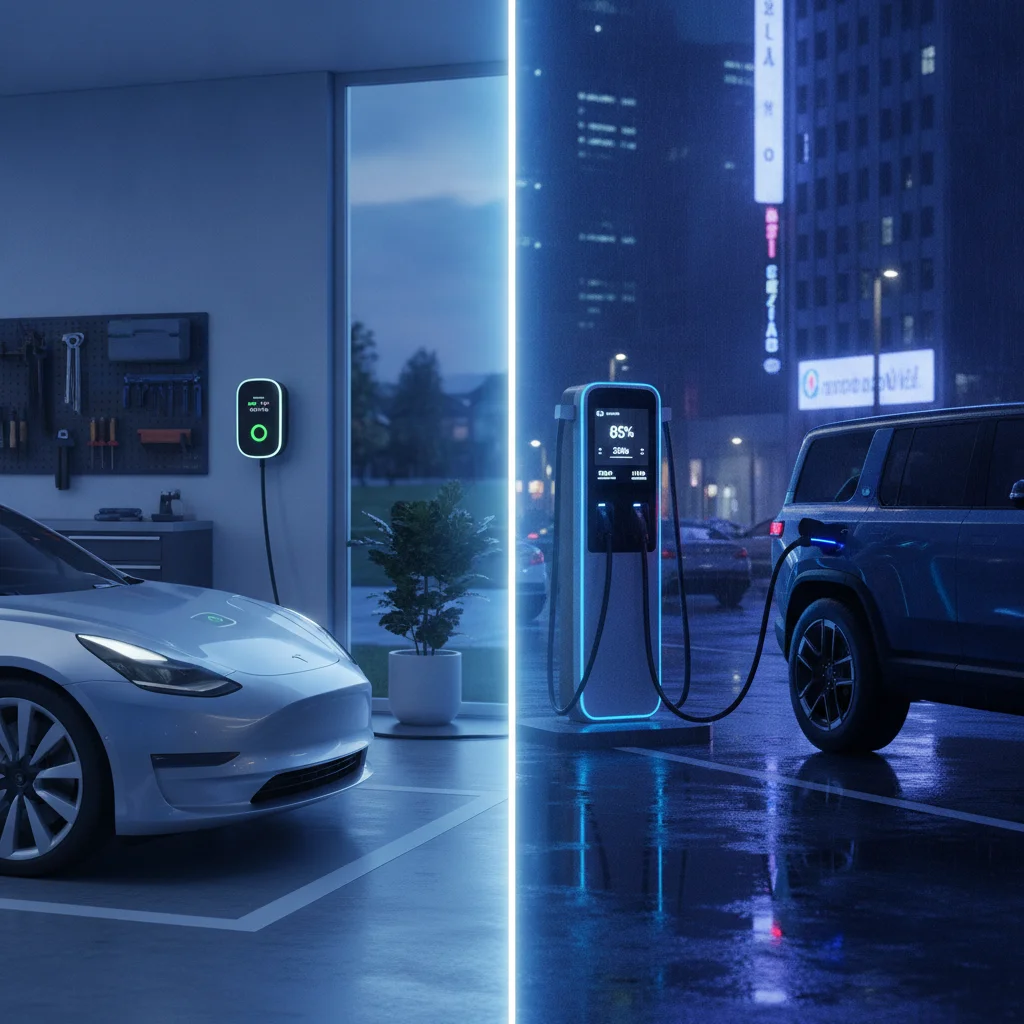
DC fast charging is not inherently harmful in moderation — most modern EVs are engineered to handle it. The problem arises when it becomes the default charging method. Aim to conduct at least 80% of your charging sessions on Level 2 at home or work. Reserve DC fast charging for highway travel and situations where time is genuinely constrained.
Check Warranty Terms Before You Buy
Before purchasing any EV, read the battery warranty fine print carefully. Look for the capacity retention guarantee percentage (70% vs. 80% is a significant difference), the mileage cap, and whether the warranty is transferable if you sell the vehicle. A stronger capacity warranty often signals better engineering confidence in the battery system.
DC Fast Charging: The Convenient Culprit
DC fast charging is the primary accelerant of battery degradation outside of heat exposure. A 2022 study by Recurrent Auto found that EVs relying heavily on DC fast charging showed measurably faster capacity loss than comparable vehicles charged predominantly on Level 2. The mechanism is thermal: fast charging generates significant heat inside the cells, and heat is the primary driver of SEI layer growth and electrolyte decomposition.
This doesn't mean avoiding DC fast charging entirely — for long-distance travel, it's essential. But using it as your primary daily charging method adds unnecessary stress to the pack over time.
Consistently Charging to 100%
Most manufacturers recommend keeping state of charge between 20% and 80% for daily driving. Pushing to 100% regularly keeps cells at maximum voltage stress, accelerating degradation. Tesla, for instance, explicitly recommends setting the daily charge limit to 80–90% and reserving 100% for trips. Many other manufacturers echo this guidance in their owner manuals.
Allowing Deep Discharge
Regularly running the battery down to single-digit charge levels also stresses cells and contributes to capacity loss. Ideally, plug in before the battery drops below 15–20%.
For a comprehensive look at which charging patterns cause the most damage — some of which are surprisingly counterintuitive — see charging habits that quietly degrade your EV battery.
“The battery is the engine of an electric vehicle. How you treat it in the first two or three years of ownership sets the trajectory for the rest of its life. The habits are simple — the savings are real.”
— Scott Case, CEO of Recurrent Auto, a leading EV battery analytics platform
Climate, Parking, and the Thermal Factor
Heat is a battery's most consistent enemy. Studies of EV fleets in hot-climate states like Arizona and Florida consistently show faster degradation rates than identical vehicles operated in moderate climates like the Pacific Northwest. Ambient temperatures above 86°F (30°C) measurably accelerate the chemical aging processes inside lithium-ion cells.
Cold climates present a different challenge. Lithium-ion batteries deliver significantly less usable energy in freezing temperatures — sometimes 20–40% less — because ion transport through the electrolyte slows. This temporary range reduction isn't the same as permanent degradation, but it does mean more frequent charging during winter months, adding to seasonal operating costs.
LFP vs. NMC: Chemistry Changes the Curve
Lithium iron phosphate (LFP) batteries, increasingly common in base-trim Teslas and many new EV entrants, degrade more slowly than nickel manganese cobalt (NMC) packs and tolerate regular charging to 100% better. However, LFP batteries have lower energy density, which is why manufacturers using this chemistry often recommend charging to 100% daily to maintain usable range. If you're choosing between trim levels that use different chemistries, factor degradation rates into the decision.
Cold Weather Range Loss Is Temporary — But Costly
The range drop you experience in freezing temperatures is largely reversible — warm the battery back up and most capacity returns. However, charging a cold battery at a DC fast charger causes the BMS to limit input power significantly, extending session time and cost. Preconditioning your battery to operating temperature while still plugged in at home before winter departures addresses both range and fast-charging performance.
Battery Health Monitoring Tools Are Worth Using
Several third-party apps and manufacturer platforms now offer state-of-health estimates based on charging session data. Recurrent provides free reports for many Tesla, Chevy Bolt, and Nissan Leaf owners. Tesla's own app shows battery degradation implicitly through range estimates. Tracking this data over time gives you early warning of unusual capacity loss — important for warranty claims, which typically require documented evidence.
Parking indoors during extreme heat and preconditionging the battery while still plugged in during cold weather are two of the most effective environmental interventions an EV owner can take. Both reduce thermal stress without affecting your driving routine.
Thermal management system quality also varies significantly across manufacturers. EVs with liquid-cooled battery systems — like those from Tesla, GM, and Hyundai — consistently outperform air-cooled designs on long-term retention. The original Nissan Leaf's air-cooled battery is frequently cited as a cautionary example; owners in hot climates experienced disproportionate capacity loss within the first few years.
Warranty Protections and What They Actually Cover
Federal regulations require EV manufacturers to provide a minimum 8-year, 100,000-mile warranty on the battery pack. Most manufacturers also include a capacity retention guarantee — typically 70% — within that window. If your battery drops below the guaranteed threshold, the manufacturer is obligated to repair or replace it.
In practice, this means most buyers are protected against the worst degradation scenarios during the primary ownership period. But there are important nuances:
- The 70% floor is the minimum. Many buyers don't realize that losing 29% of capacity — a significant hit to range and charging economics — is still within warranty tolerances at some brands.
- Thresholds vary by manufacturer. Hyundai and Kia guarantee 70% for the full 10-year warranty period on most models. Tesla guarantees 70% retention at 8 years or 150,000 miles on Long Range variants.
- Documentation matters. If you suspect excessive degradation, request a battery health report from your dealer. Many brands can generate this from the vehicle's BMS data.
Use DC Fast Charging Strategically, Not Daily
DC fast charging is not inherently harmful in moderation — most modern EVs are engineered to handle it. The problem arises when it becomes the default charging method. Aim to conduct at least 80% of your charging sessions on Level 2 at home or work. Reserve DC fast charging for highway travel and situations where time is genuinely constrained.
Check Warranty Terms Before You Buy
Before purchasing any EV, read the battery warranty fine print carefully. Look for the capacity retention guarantee percentage (70% vs. 80% is a significant difference), the mileage cap, and whether the warranty is transferable if you sell the vehicle. A stronger capacity warranty often signals better engineering confidence in the battery system.
After the warranty period, replacement battery packs are expensive — typically $10,000–$20,000 depending on vehicle and chemistry. However, the used EV market and third-party remanufactured battery suppliers are making this less prohibitive than it was five years ago. The calculus is improving, but it's still a cost to plan for in long ownership scenarios.
Practical Steps to Slow Degradation and Control Long-Term Costs
Degradation is inevitable, but its rate is not fixed. Owners who adopt consistent habits can meaningfully extend battery health — and by extension, keep their long-term charging economics closer to what they calculated when they bought the vehicle.
- Set a daily charge limit of 80%. Most EVs allow this in the settings menu. Reserve 100% charges for days when you genuinely need the full range.
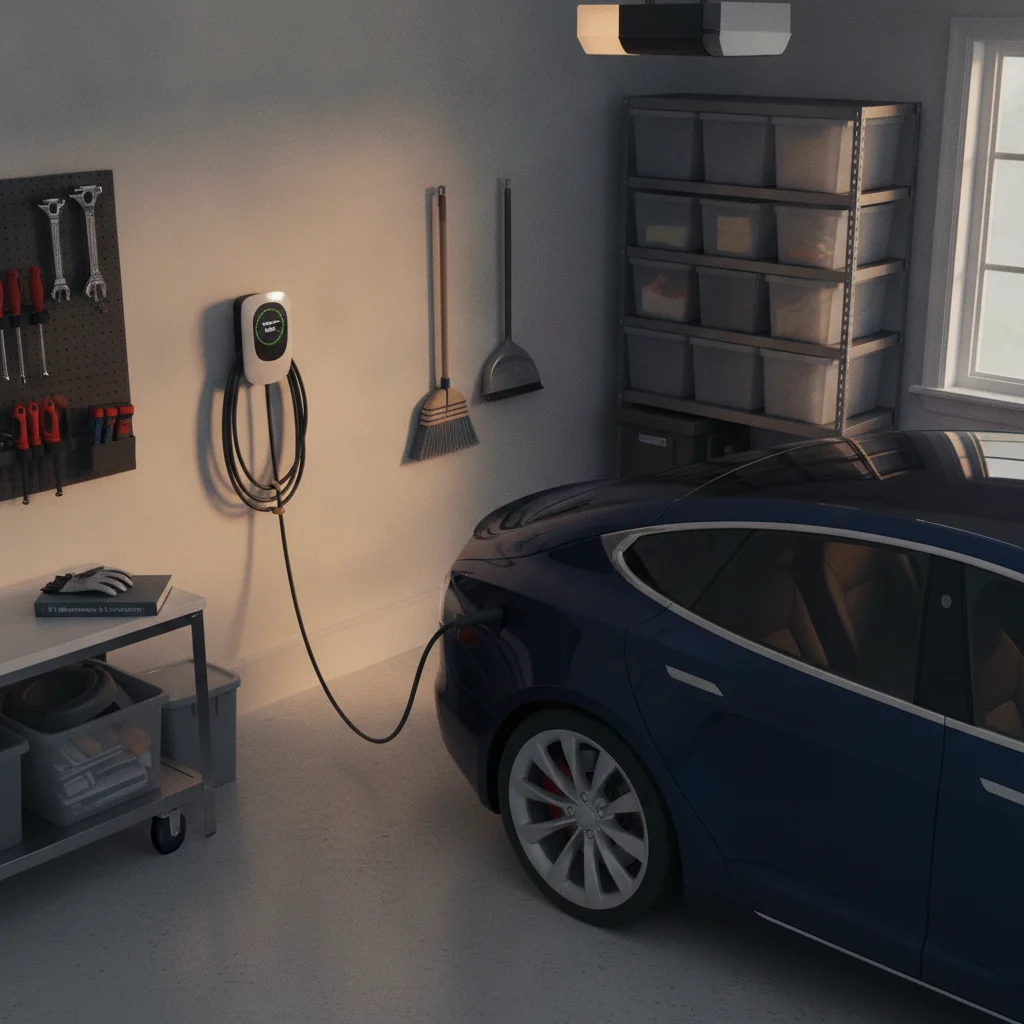
- Prioritize Level 2 charging at home. Install a home charger if you haven't already, and use DC fast charging as a supplement rather than a habit.
- Avoid deep discharges. Plug in at 15–20% state of charge rather than running toward zero.
- Park in shade or a garage during extreme heat. If your vehicle has a cabin preconditioning feature that also conditions the battery, use it while still plugged in.
- Precondition in cold weather while plugged in. This warms the battery before departure, improving both immediate range and long-term cell health.
- Monitor battery health annually. Some apps (like Recurrent for certain models, or manufacturer apps) provide capacity tracking. Early detection of unusual loss can prompt a warranty claim before you fall further.
For a detailed breakdown of ownership habits with the biggest impact on battery health across the full ownership lifecycle, see habits that preserve long-term EV battery capacity. These practices are also covered as part of the broader EV maintenance basics hub.
The Long View: Degradation in the Context of Total EV Ownership Cost
Battery degradation is one piece of a larger ownership cost equation. EVs still carry significant advantages over internal combustion vehicles in fuel and maintenance costs, even accounting for gradual efficiency loss. The relevant question isn't whether degradation costs you money — it does — but whether those costs change the overall EV value proposition for your situation.
For most owners who charge primarily at home, the answer is that degradation adds modest but manageable costs over time. The scenario becomes more complex for drivers who rely heavily on public fast charging, live in extreme climates, or plan to keep the vehicle beyond 10 years. In those cases, the cumulative cost of degradation-driven charging inefficiency is worth incorporating into your ownership budget from the start.
The owners who are best positioned are those who bought with realistic expectations, adopted smart charging habits early, and chose vehicles with proven battery longevity records. Degradation is a slow, quiet process — but understanding it puts you in control of its financial consequences rather than discovering them by surprise at year seven.
For context on how these costs fit into the complete picture of what you'll pay to keep an EV charged over its lifetime, revisit everything that affects the cost of charging an EV.
All claims are backed by peer-reviewed research. Sources on request.