Key Takeaways
Safety Ratings & ADAS Discounts
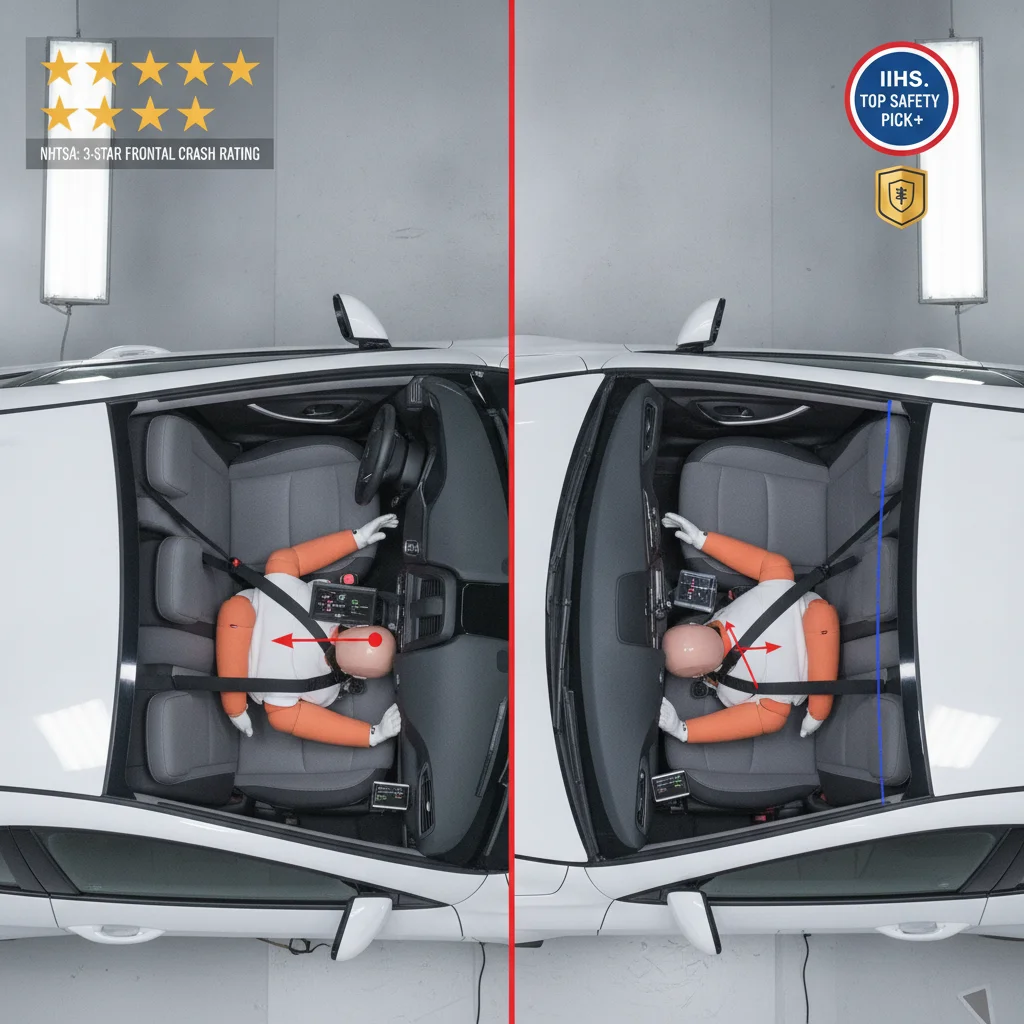
Auto insurers often reduce premiums for vehicles that earn high crash-test scores from the NHTSA or IIHS, and for cars equipped with advanced driver-assistance systems (ADAS) like automatic emergency braking or lane-keeping assist. These discounts reflect the statistical reality that safer vehicles and safety technology lead to fewer and less-severe claims. The savings can range from a few percentage points to double-digit reductions on specific coverage types.
Insurers apply actuarial data linking vehicle safety profiles to claim frequency and severity. ADAS discounts are typically applied to collision and bodily injury liability coverage lines, where crash-prevention tech has the most measurable impact.
Why Insurers Pay Attention to Safety Ratings
Auto insurance pricing is fundamentally a prediction problem. Insurers collect vast amounts of claims data and use it to estimate how likely a given vehicle — driven by a given person, in a given location — is to generate a claim and how costly that claim will be. Vehicle safety ratings fit directly into that equation.
The National Highway Traffic Safety Administration (NHTSA) and the Insurance Institute for Highway Safety (IIHS) both conduct systematic crash tests on new vehicles and publish their findings publicly. Insurers use this data, alongside their own claims histories, to build actuarial models that link specific vehicles to predicted claim frequency and severity.
A car that earns IIHS's Top Safety Pick+ designation or NHTSA's full 5-star rating has demonstrated, under controlled test conditions, that it protects occupants better in the types of crashes most likely to occur on American roads. From an insurer's perspective, that translates to lower expected payouts on bodily injury and medical payments claims — which in turn justifies a lower premium.
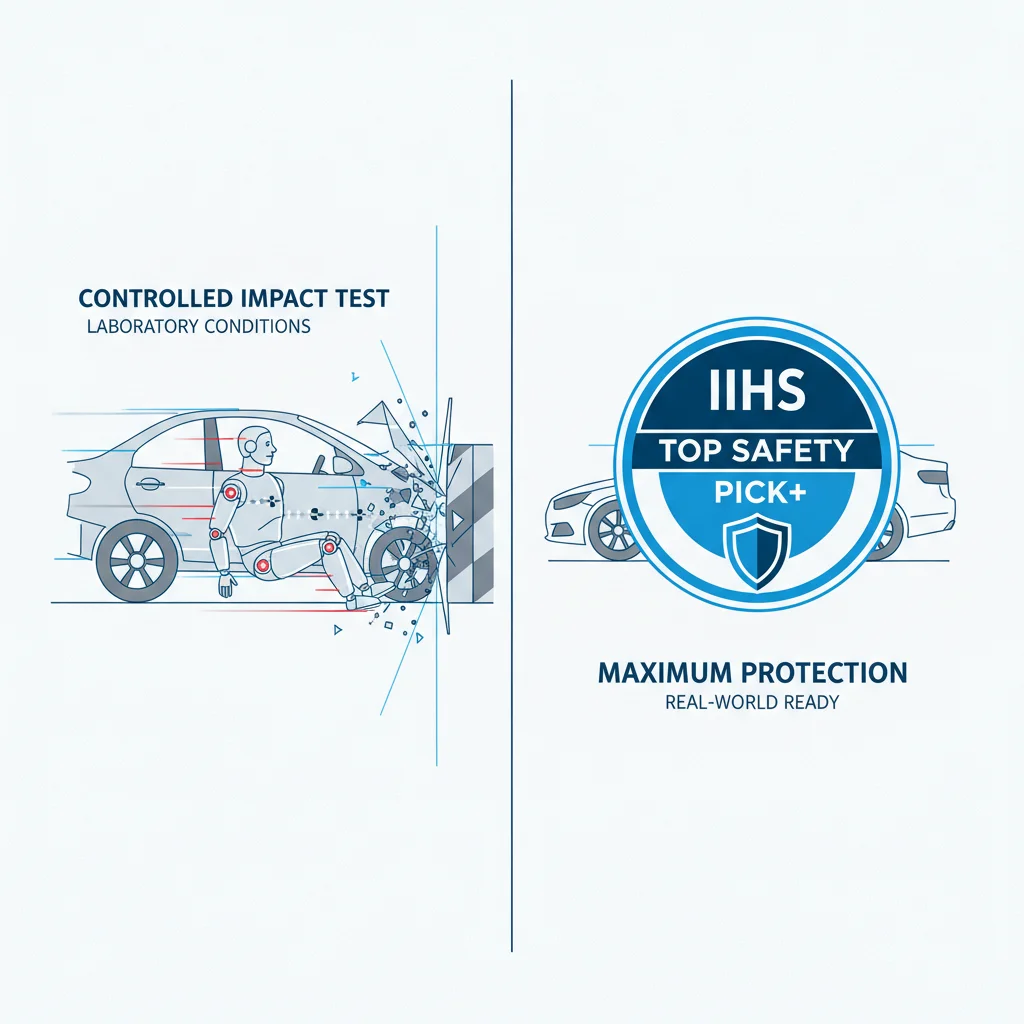
It's worth noting that the two rating systems are not equivalent. NHTSA and IIHS test very different crash scenarios, and a vehicle can score well on one system while performing modestly on the other. Some insurers specify which system they reference; many use both as inputs into a broader vehicle-risk profile.
NHTSA vs. IIHS: Not All Stars Are Equal
A 5-star NHTSA rating and an IIHS Top Safety Pick+ designation are awarded through fundamentally different test programs. NHTSA tests at higher speeds and focuses on frontal, side, and rollover scenarios. IIHS tests include a demanding small overlap frontal test, updated side test, and headlight evaluations that many vehicles struggle to pass. Some insurers weight one system more heavily than the other; it's worth confirming which your carrier references. For a full comparison, see <a href="/buying-a-car/new-vs-used-cars/buying-new-cars/safety-ratings-decoded-nhtsa-and-iihs-scores-compared">how NHTSA and IIHS scores compare</a>.
How ADAS Features Enter the Pricing Picture
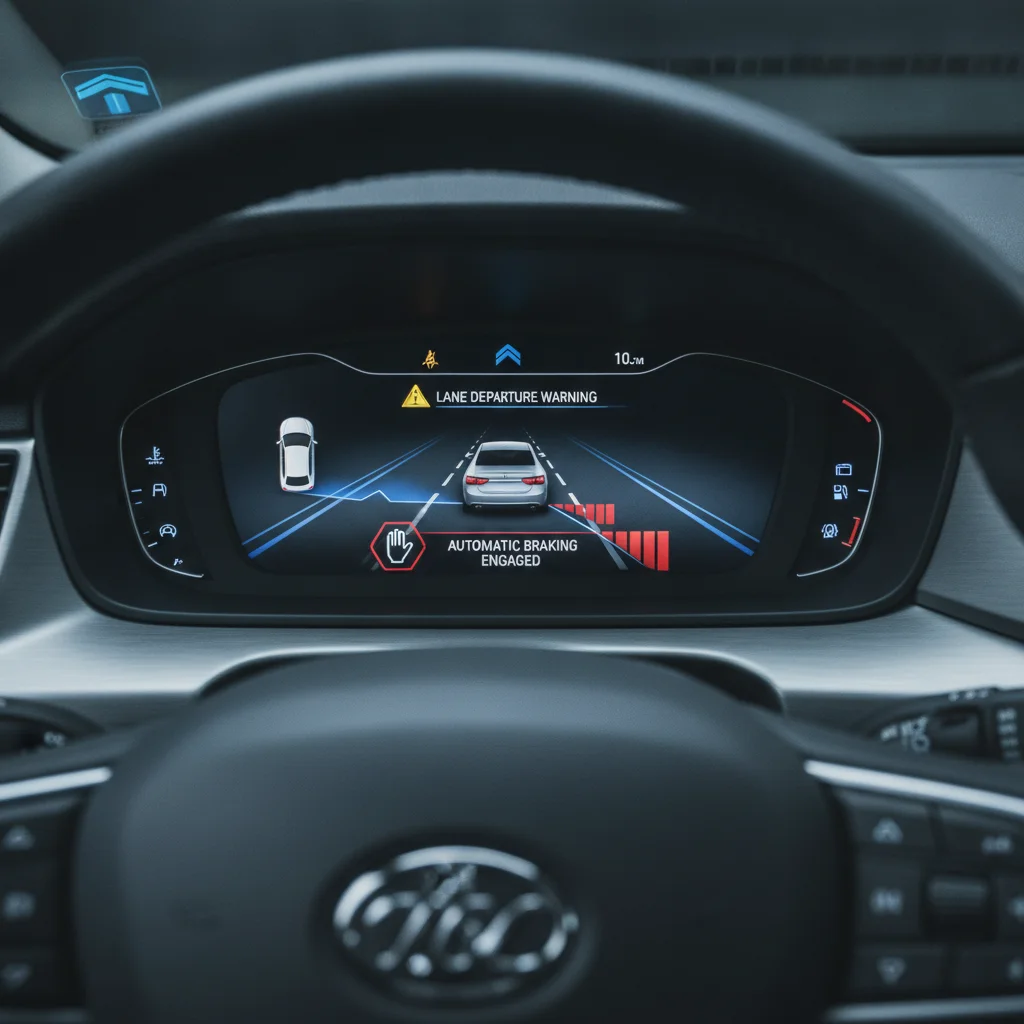
Crash-test scores tell insurers how well a vehicle protects occupants after a collision happens. Advanced driver-assistance systems (ADAS) try to prevent the collision in the first place — and that distinction matters enormously to actuaries.
The evidence base for specific ADAS technologies has grown substantially over the past decade. IIHS research has found that automatic emergency braking (AEB) reduces rear-end crash rates by roughly 50% and rear-end crashes with injuries by even more. Lane departure warning systems have shown measurable reductions in sideswipe and head-on crashes. Blind-spot monitoring reduces lane-change crash rates. Not all safety tech performs equally, but the technologies with the strongest data behind them are increasingly baked into insurance pricing.
~50%
Reduction in rear-end crashes from AEB
IIHS research has consistently found that automatic emergency braking reduces rear-end crash rates by approximately 50% compared to vehicles without the technology.
94%
Of serious crashes involve human error
NHTSA estimates that human error is a critical factor in approximately 94% of serious crashes, underscoring why crash-prevention technology attracts insurer attention.
$1,500+
Average ADAS sensor repair cost per incident
Industry repair data suggests that recalibrating or replacing a single ADAS sensor suite after a minor collision can cost $1,500 or more, according to CCC Intelligent Solutions repair trend reports.
Up to 10%
Potential collision discount for eligible ADAS features
Several major carriers, including Nationwide and Liberty Mutual, have published ADAS discount ranges of up to 10% on applicable coverage lines for qualifying vehicles.
3 in 4
New vehicles sold with AEB standard (2024)
The voluntary NHTSA/IIHS agreement requiring AEB as standard equipment has accelerated adoption, with industry data showing the feature present in approximately three-quarters of new vehicles sold in 2024.
Insurers respond to this data in two main ways. Some offer explicit ADAS discounts — named line items on your policy for features like AEB, forward collision warning, or adaptive headlights. Others absorb the vehicle's safety technology profile into the base rate for that year, make, and model, so the discount is real but invisible on your policy declarations page. Either approach reflects the same underlying actuarial logic: fewer crashes mean fewer claims.
Request Your Vehicle's Full Feature Documentation
When purchasing a new or used vehicle, retain the original Monroney (window) sticker and any factory build-sheet documentation. These records confirm which ADAS features were factory-installed — not just what the trim level typically includes. Providing this to your insurer can help correct data gaps and unlock discounts that might otherwise be missed in automated VIN lookups.
Shop With VIN, Not Just Make and Model
When comparing insurance quotes across carriers, always use the specific VIN of the vehicle you're considering rather than a generic make/model search. VIN-based quotes surface the actual factory equipment list and return premiums that reflect real safety-feature credits. Two vehicles of the same model year and trim can have different factory configurations — and meaningfully different insurance costs.
The specific features that earn discounts vary by carrier. Progressive, Nationwide, and Liberty Mutual, among others, have published guidelines identifying ADAS features they reward. But the discount structure changes as carriers update their actuarial models — what earned a discount two years ago may now be standard and already priced in.
The Repair Cost Complication
There's a counterforce that tempers the savings ADAS technology can deliver: repair costs. Modern safety systems rely on a dense network of cameras, radar units, lidar sensors, and ultrasonic detectors embedded throughout the vehicle. A minor fender-bender that once cost $400 to fix can now cost $1,500 or more once you factor in sensor recalibration, camera replacement, and the specialized labor required to restore the system to factory specifications.
This dynamic puts insurers in a nuanced position. The same technology that reduces crash frequency also increases the average cost of each crash that does occur. Depending on the vehicle and the insurer's claims data for that model, the ADAS discount on liability or collision coverage may be partially or fully offset by higher collision and comprehensive rates driven by elevated repair costs.

The net effect on your total premium depends on your vehicle's specific configuration, your coverage selections, and how your insurer has modeled the tradeoff for that year and trim level. As a general rule, lower-trim vehicles with standard ADAS packages tend to see cleaner savings than high-trim vehicles with complex, multi-sensor systems that are expensive to calibrate after even low-speed impacts.
Car age also plays a role in how these tradeoffs shake out. Newer vehicles are more likely to have factory-installed ADAS with OEM calibration standards, while aftermarket retrofits — even when available — rarely qualify for the same discounts.
“Insurers are fundamentally data businesses. When we see consistent, replicated evidence that a technology reduces claim frequency by double-digit percentages, that gets priced in. The question is always how quickly the industry data catches up to the real-world performance of new technology.”
— David Zuby, Former Executive Vice President, Insurance Institute for Highway Safety
How Insurers Actually Apply These Discounts
Understanding the mechanics helps you know what to ask for. Here's how the discount pipeline typically works:
- Vehicle identification: When you get a quote, the insurer pulls data tied to your vehicle's VIN. This tells them the exact factory-installed features — not just what the trim level typically includes, but what your specific vehicle left the factory with.
- Rating lookup: The insurer cross-references the vehicle's NHTSA and IIHS scores using their internal actuarial tables. These tables are updated periodically as new test data becomes available.
- Feature-based discount application: If the carrier offers named ADAS discounts, eligible features are matched against your vehicle's equipment list and applied to specific coverage lines — most commonly collision, bodily injury liability, and medical payments.
- Base rate adjustment: Even if no named discount appears, the vehicle's safety profile influences the base rate for that year/make/model. You're getting the benefit; it's just embedded in the rate rather than itemized.
Because the process is largely automated, errors can occur. A vehicle with factory-installed AEB may not have that feature correctly coded in the insurer's system if the data provider has a gap. Providing documentation — such as the original window sticker (Monroney label) — can sometimes prompt a manual review and correction.
It's also worth comparing how safety discounts interact with other savings opportunities. Good driver discounts reward your behavior behind the wheel, while safety-rating discounts reward the vehicle itself. The two can stack, and together they represent some of the most accessible savings available to drivers who haven't had recent incidents.
What to Do With This Information at Purchase and Renewal
Safety ratings and ADAS discounts aren't just abstract policy factors — they're actionable at multiple points in your ownership journey.
At the point of purchase
Before committing to a vehicle, get insurance quotes using the exact VIN of the car you're considering. This surfaces the actual premium, including any safety-related adjustments, rather than a generic estimate based on make and model. If you're comparing two similar vehicles, the insurance cost difference can be a meaningful factor in the total cost of ownership calculation.
During a test drive or inspection, confirm which ADAS features are factory-installed versus dealer-added. Factory features are more reliably recognized by insurer data systems; dealer-installed add-ons may not appear in VIN data at all.
At renewal
Request a full discount audit from your insurer at each renewal. Ask specifically: Is my vehicle's safety rating factored into my rate? Are any ADAS features on my vehicle being credited? If you've added a dashcam or other security feature since your last renewal, those may qualify for additional savings as well.
When shopping
Because insurers vary significantly in how they value safety technology, shopping your policy every one to two years remains one of the highest-return activities available to car owners. Usage-based programs at major insurers can complement safety-rating discounts, particularly for drivers with clean records who don't log high annual mileage.
Request Your Vehicle's Full Feature Documentation
When purchasing a new or used vehicle, retain the original Monroney (window) sticker and any factory build-sheet documentation. These records confirm which ADAS features were factory-installed — not just what the trim level typically includes. Providing this to your insurer can help correct data gaps and unlock discounts that might otherwise be missed in automated VIN lookups.
Shop With VIN, Not Just Make and Model
When comparing insurance quotes across carriers, always use the specific VIN of the vehicle you're considering rather than a generic make/model search. VIN-based quotes surface the actual factory equipment list and return premiums that reflect real safety-feature credits. Two vehicles of the same model year and trim can have different factory configurations — and meaningfully different insurance costs.
For younger drivers managing elevated baseline premiums, stacking multiple discount types — including vehicle safety ratings, good student credits, and telematics programs — can make a measurable difference. Choosing a vehicle with strong safety credentials is one of the few ways a young driver can influence their premium through a factor other than their own driving history.
Finally, explore the full range of discounts available on your policy. Safety-rating and ADAS discounts are valuable, but they're rarely the only savings left on the table.

All claims are backed by peer-reviewed research. Sources on request.