
Key Takeaways
Age-Based Insurance Rating
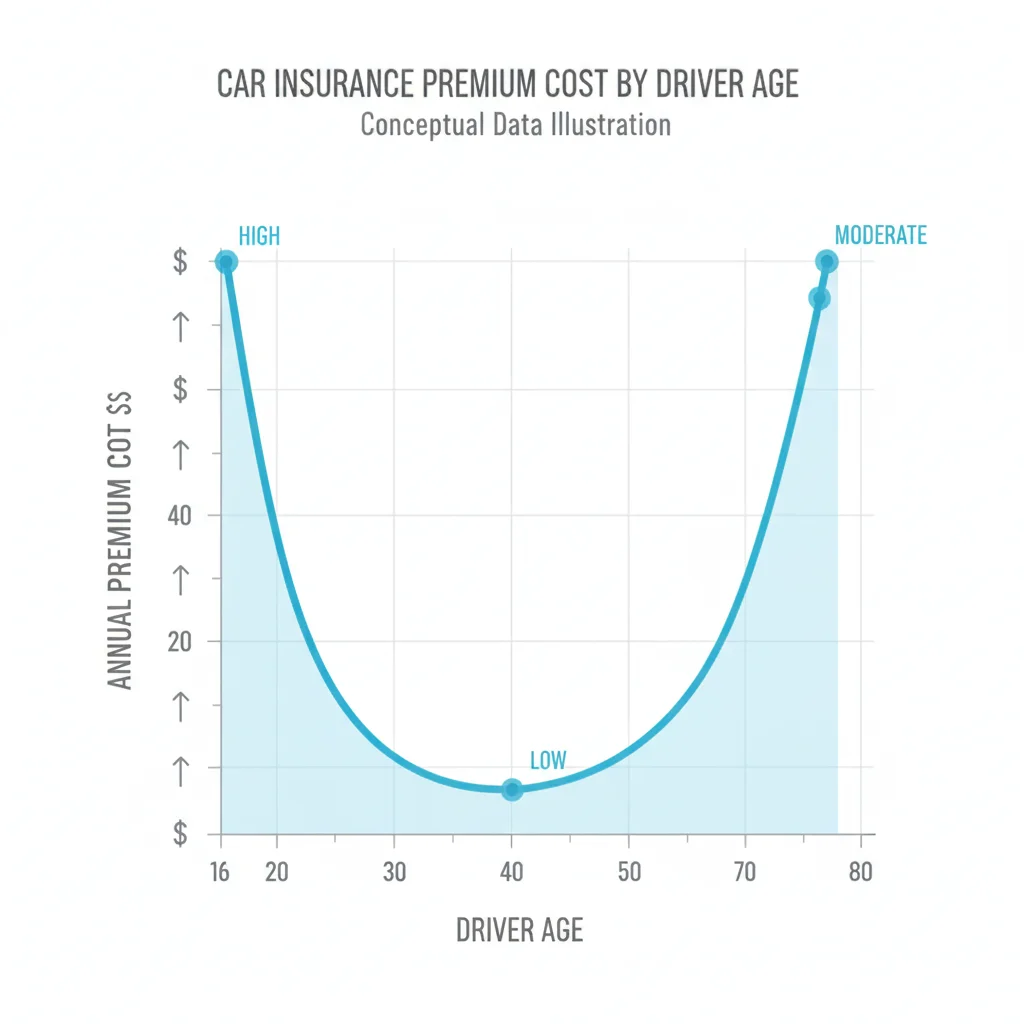
Age-based insurance rating is the practice insurers use to adjust your auto premium based on your age group. Because driving risk — measured by crash rates, claims frequency, and claim severity — varies significantly across age groups, insurers treat age as a statistical proxy for risk. Younger drivers and, to a lesser degree, elderly drivers typically pay more than middle-aged motorists.
In actuarial terms, age is a "rating factor" applied via multiplicative tables that adjust a base premium up or down. Some states, including California, Hawaii, and Massachusetts, restrict or prohibit the use of age as a standalone rating variable.
Why Insurers Care So Much About How Old You Are
Auto insurers are in the business of predicting future losses. They collect enormous datasets on crashes, claims, repair costs, and injury payouts — and they slice that data every way possible to find variables that reliably predict risk. Age turns out to be one of the strongest predictors they have.
This isn't a guess or a stereotype. It's actuarial science. The Insurance Institute for Highway Safety (IIHS) and the National Highway Traffic Safety Administration (NHTSA) consistently show that crash rates per mile driven are highest among teenagers, drop sharply through the 20s, flatten during middle age, and then rise modestly again after roughly age 70. Insurers translate that risk curve almost directly into premium structures.
It's worth being clear about what age-based pricing captures — and what it doesn't. When an insurer charges a 17-year-old more than a 45-year-old, it's not making a judgment about that specific teenager's driving ability. It's applying the statistical behavior of the group. A careful 17-year-old will still pay teen rates; an inattentive 45-year-old enjoys middle-aged rates. That gap is one reason your individual driving record, credit score, and vehicle choice also factor heavily into what you ultimately pay. See how insurers calculate your renewal rate for a full breakdown of every variable in that equation.
Age interacts with other rating factors in compounding ways. A young driver in a high-horsepower vehicle, for instance, may face a surcharge on top of a surcharge — because both the vehicle profile and the driver's age independently push risk higher. The car you drive shapes your insurance price in ways that amplify or dampen whatever age-based rate you start with.
When Age Isn't the Dominant Factor
In California, Hawaii, and Massachusetts, state regulations restrict how heavily insurers can use age as a rating factor. Instead, driving record, years of experience, and annual mileage must carry more weight. If you live in one of these states, your premium may look significantly different from national averages cited in industry surveys. Always check state-specific data when comparing your rate to published benchmarks.
Age and Credit Score: A Compounding Effect
In most states, insurers also use a credit-based insurance score alongside age to set premiums. Young drivers often have thin or no credit histories, which can compound the age-based surcharge. Building credit responsibly during your 20s doesn't just help you get loans — it can meaningfully reduce your insurance costs over time as your score matures alongside your driving record.
EVs and Age-Based Pricing: An Emerging Variable
Electric vehicles introduce additional cost layers into the standard age-rating framework. Higher repair costs and specialized parts can inflate collision premiums regardless of driver age — but younger drivers considering an EV as a first car may face a compounded rate from both the vehicle profile and their age bracket. Review both variables carefully before purchase.
The Teen Years: Highest Risk, Highest Rates
No age group pays more for car insurance than drivers aged 16 to 19. The numbers are stark. According to NHTSA data, drivers in this age bracket are involved in fatal crashes at nearly three times the rate of drivers aged 20 and older, when measured per mile driven. Insurers respond accordingly.
3x
Teen crash rate vs. drivers 20+
NHTSA data consistently shows drivers aged 16–19 are involved in fatal crashes at roughly three times the rate per mile driven compared to older motorists.
$4,300+
Average annual premium for teen drivers
According to Bankrate's 2024 analysis, a 16-year-old added to a family policy faces average annual costs exceeding $4,300 for their coverage portion alone.
25%
Typical rate drop at age 25
Industry data and insurer rate tables show many carriers apply an automatic rate reduction of 20–30% when a driver crosses the age-25 threshold with a clean record.
40s–50s
Age bracket with lowest average premiums
Multiple industry analyses, including data from J.D. Power and Quadrant Information Services, identify drivers in their mid-40s to mid-50s as consistently receiving the lowest age-adjusted base rates.
19%
Average premium increase for drivers over 70
A 2023 study by the Insurance Research Council found premiums begin rising for most drivers after age 70, with an average increase of approximately 19% by age 80 compared to peak mid-life rates.
What drives the elevated risk? Research points to a mix of inexperience, brain development, and behavioral factors. Teenagers have logged far fewer hours behind the wheel, so they lack the automatic responses that experienced drivers apply to hazards. Studies also show that the prefrontal cortex — the area governing impulse control and risk assessment — isn't fully developed until the mid-20s. Add peer passengers and nighttime driving into the mix, and the risk compounds quickly.
For parents adding a teen to their household policy, the financial impact can be significant. Depending on the insurer, the state, and the vehicle, adding a 16-year-old driver can increase certain coverage costs by 50 to 100 percent or more. How a new teen driver affects the entire household rate explains how insurers allocate that risk across your policy, not just on the teen's assigned vehicle.

Fortunately, there are meaningful ways to reduce teen premiums. Good student discounts (typically requiring a B average or better), driver's education course credits, and telematics programs that monitor driving behavior are among the most impactful. Which discounts actually move the needle for young drivers separates the genuinely effective programs from the marginal ones.
Best Discounts for Teen Drivers
Good student discounts (B average or better), driver's education completion credits, and telematics programs are the three most impactful tools for reducing teen premiums. Enrolling a teen in a usage-based program can save 10–30% if their actual driving data is safe — the app does the work of proving they're different from the statistical average.
Senior Discount Opportunities Worth Asking About
If you're over 65, ask specifically about mature driver course discounts, low-mileage programs, and any affinity group rates tied to organizations like AARP or AAA. Many carriers also offer paperless billing and auto-pay credits that are small individually but meaningful in combination. Don't assume your current insurer has your rate optimized — comparison shopping is especially valuable for drivers over 70.
The 20s and 30s: A Gradual Rate Decline
As drivers move through their 20s, premiums tend to fall — but not all at once, and not at a uniform pace. The sharpest drop usually occurs between ages 19 and 25, as insurers reclassify drivers out of the highest-risk bracket. Many carriers apply a meaningful rate reduction automatically at age 25, though the exact threshold varies by company.
That said, a 22-year-old with a clean driving record and a practical sedan will pay substantially less than a 22-year-old with two speeding tickets and a sports car. Age provides the baseline; behavior and vehicle choice determine how far you land from it.
“Experience behind the wheel is something you can't fake or shortcut. The data shows that crash risk drops most steeply in the first five to seven years of driving — not because drivers get older, but because they get genuinely more practiced. Age is a stand-in for that experience, and a reasonably good one.”
— Anne Fleming, Senior researcher, Insurance Institute for Highway Safety
Through the 30s, rates typically continue to ease, reflecting the combination of accumulated driving experience and, statistically, a period of more settled lifestyle choices — less late-night driving, fewer high-risk behaviors. Drivers who also own a home often benefit from bundling discounts that compound the age-related savings.
One thing that can arrest the rate decline during this period is a poor claims history. A single at-fault accident can push rates upward by 30 to 50 percent and remain on your record for three to five years depending on state regulations. The age discount doesn't insulate you from the consequences of your individual record — it simply sets the starting point. Understanding how renewal rates are calculated helps clarify why a clean record matters so much over time.
Middle Age: The Sweet Spot for Insurance Rates
Drivers roughly between the ages of 35 and 65 occupy what the industry effectively treats as the lowest-risk zone. This is when premiums tend to reach their floor — assuming a reasonable driving record and no other adverse rating factors. The combination of experience, maturity, and statistical safety performance means insurers have the least reason to apply age-related surcharges.
This doesn't mean everyone in this bracket pays the same low rate. Location, vehicle, credit-based insurance score, annual mileage, and claims history all continue to matter. But age stops being a drag on your premium and may, in some rating systems, work mildly in your favor.
For middle-aged drivers who purchased their policy years ago and haven't revisited it, this is also a good period to reassess coverage levels. If you're driving an older vehicle, full comprehensive and collision coverage may no longer make financial sense relative to the car's actual cash value. The right way to adjust coverage as your car ages outlines a straightforward framework for making that call.
Middle-aged drivers who explore available discounts they may be overlooking — including affinity group discounts, loyalty credits, and low-mileage programs — can push rates even lower during this naturally favorable period.
Senior Drivers: When Rates Begin to Rise Again
Beginning around age 70 — though the precise inflection point varies by insurer and state — premiums often start to tick upward again. The reasons are different from those driving teen surcharges, but the actuarial logic is similar: risk statistics shift.
Older drivers as a group are involved in fewer crashes than teenagers in absolute terms, but they are significantly more likely to be injured or killed in the crashes they do have. That's because the human body becomes more fragile with age, and injury claims are among the most expensive payouts an insurer faces. Medical bills, rehabilitation costs, and in severe cases, long-term care expenses all factor into the loss calculations that underpin senior premiums.
Reaction time and vision changes are also documented factors. The IIHS notes that drivers over 70 have higher crash rates per mile driven than middle-aged adults, even if they tend to self-regulate by driving less and avoiding highways or night driving.

Several discounts are available specifically for seniors. Many insurers offer credits for completing mature driver improvement courses — the AARP and AAA both run widely recognized programs. Low-mileage discounts are another lever for retired drivers who no longer commute daily. Seniors who own their homes and bundle policies may also retain significant multi-policy credits that partially offset age-related increases.
Best Discounts for Teen Drivers
Good student discounts (B average or better), driver's education completion credits, and telematics programs are the three most impactful tools for reducing teen premiums. Enrolling a teen in a usage-based program can save 10–30% if their actual driving data is safe — the app does the work of proving they're different from the statistical average.
Senior Discount Opportunities Worth Asking About
If you're over 65, ask specifically about mature driver course discounts, low-mileage programs, and any affinity group rates tied to organizations like AARP or AAA. Many carriers also offer paperless billing and auto-pay credits that are small individually but meaningful in combination. Don't assume your current insurer has your rate optimized — comparison shopping is especially valuable for drivers over 70.
It's also worth knowing that some states impose restrictions on how heavily insurers can penalize older drivers based on age alone, separate from driving record. If you're in your 70s and feel your rate increase seems disproportionate, comparing quotes across multiple carriers is an especially productive exercise — pricing practices for senior drivers vary more across companies than for any other age group.
State Regulations and What They Mean for Your Rate
Age-based rating isn't uniformly legal across the U.S. A small number of states restrict or significantly limit how insurers can use age in setting premiums. California, Hawaii, and Massachusetts are the most prominent examples — in these states, insurers must weight driving record, annual mileage, and years of experience more heavily than raw age.
The practical effect is that teen drivers in California may pay somewhat less than their peers in unrestricted states, while safe middle-aged drivers in California who happen to have a spotty record may pay more. The variables shift — age becomes less powerful, and behavior-based factors gain weight.
When Age Isn't the Dominant Factor
In California, Hawaii, and Massachusetts, state regulations restrict how heavily insurers can use age as a rating factor. Instead, driving record, years of experience, and annual mileage must carry more weight. If you live in one of these states, your premium may look significantly different from national averages cited in industry surveys. Always check state-specific data when comparing your rate to published benchmarks.
Age and Credit Score: A Compounding Effect
In most states, insurers also use a credit-based insurance score alongside age to set premiums. Young drivers often have thin or no credit histories, which can compound the age-based surcharge. Building credit responsibly during your 20s doesn't just help you get loans — it can meaningfully reduce your insurance costs over time as your score matures alongside your driving record.
EVs and Age-Based Pricing: An Emerging Variable
Electric vehicles introduce additional cost layers into the standard age-rating framework. Higher repair costs and specialized parts can inflate collision premiums regardless of driver age — but younger drivers considering an EV as a first car may face a compounded rate from both the vehicle profile and their age bracket. Review both variables carefully before purchase.
Even in states without formal age restrictions, competitive market dynamics constrain how aggressively any single insurer can price by age. If one carrier charges teens dramatically more than competitors for similar coverage, those teens will shop elsewhere. That market pressure doesn't eliminate age-based pricing, but it does moderate its extremes.
Understanding your state's regulatory environment is useful context when you're comparing quotes. A rate that seems high in your state may actually be near the regulated floor — or it may simply reflect a carrier whose age-based tables are out of step with competitors. Shopping multiple quotes is always the most direct test.
Practical Strategies Across Every Age Group
Regardless of which age bracket you fall into, a few principles apply universally when it comes to managing your premium.
Keep your driving record clean
This is the single most controllable variable in your rate. At-fault accidents and moving violations can erase years of age-related savings and persist on your record for three to five years. Defensive driving habits pay compound dividends over time.
Review your policy when your circumstances change
Age transitions — turning 25, retiring, a teenager joining or leaving the household — are natural moments to reassess coverage. Don't wait for renewal to notice an opportunity. Adjusting coverage as your vehicle ages is one example of how life changes and vehicle changes often need to be addressed simultaneously.
Use telematics if your driving supports it
Usage-based insurance programs track actual driving behavior — hard braking, speed, time of day, mileage — and can override age-based pricing for drivers whose real-world behavior is safer than their demographic suggests. For young drivers especially, a telematics program can produce meaningful savings if the data supports it.
Compare quotes at every major life transition
Loyalty to a single carrier has costs. At pivotal age moments — turning 25, turning 65, adding or removing a driver — the market may have shifted significantly since you last compared rates. Spending an hour shopping quotes at these moments is often worth hundreds of dollars annually.

Finally, consider that electric vehicle ownership introduces additional insurance nuances regardless of age. EV insurance works differently in ways that can amplify or complicate the standard age-based rate structure, particularly for younger drivers considering an EV as their first vehicle.
When Age Isn't the Dominant Factor
In California, Hawaii, and Massachusetts, state regulations restrict how heavily insurers can use age as a rating factor. Instead, driving record, years of experience, and annual mileage must carry more weight. If you live in one of these states, your premium may look significantly different from national averages cited in industry surveys. Always check state-specific data when comparing your rate to published benchmarks.
Age and Credit Score: A Compounding Effect
In most states, insurers also use a credit-based insurance score alongside age to set premiums. Young drivers often have thin or no credit histories, which can compound the age-based surcharge. Building credit responsibly during your 20s doesn't just help you get loans — it can meaningfully reduce your insurance costs over time as your score matures alongside your driving record.
EVs and Age-Based Pricing: An Emerging Variable
Electric vehicles introduce additional cost layers into the standard age-rating framework. Higher repair costs and specialized parts can inflate collision premiums regardless of driver age — but younger drivers considering an EV as a first car may face a compounded rate from both the vehicle profile and their age bracket. Review both variables carefully before purchase.

All claims are backed by peer-reviewed research. Sources on request.