Key Takeaways
Our Verdict
Stacking discounts is the lower-risk path to a cheaper premium — it reduces what you pay without changing what you owe if something goes wrong. Raising your deductible makes sense when you have the savings cushion to back it up and enough premium to make the math work. For most drivers, the smartest move is to exhaust every available discount first, then consider a deductible adjustment for any remaining savings gap.
| Best for | Recommended |
|---|---|
| Drivers with limited emergency savings | Stacking Discounts |
| Safe drivers with a solid cash cushion and high current premiums | Raising Your Deductible |
| Drivers who want the deepest possible savings | Both strategies combined |
| Leased or financed vehicle owners with lender deductible limits | Stacking Discounts |
Two Levers, Very Different Consequences
When your auto insurance renewal arrives and the premium has crept up again, two go-to moves get the most attention: raise your deductible or hunt down every discount you can apply. Both can meaningfully cut your bill. But they work in opposite directions when something goes wrong on the road.
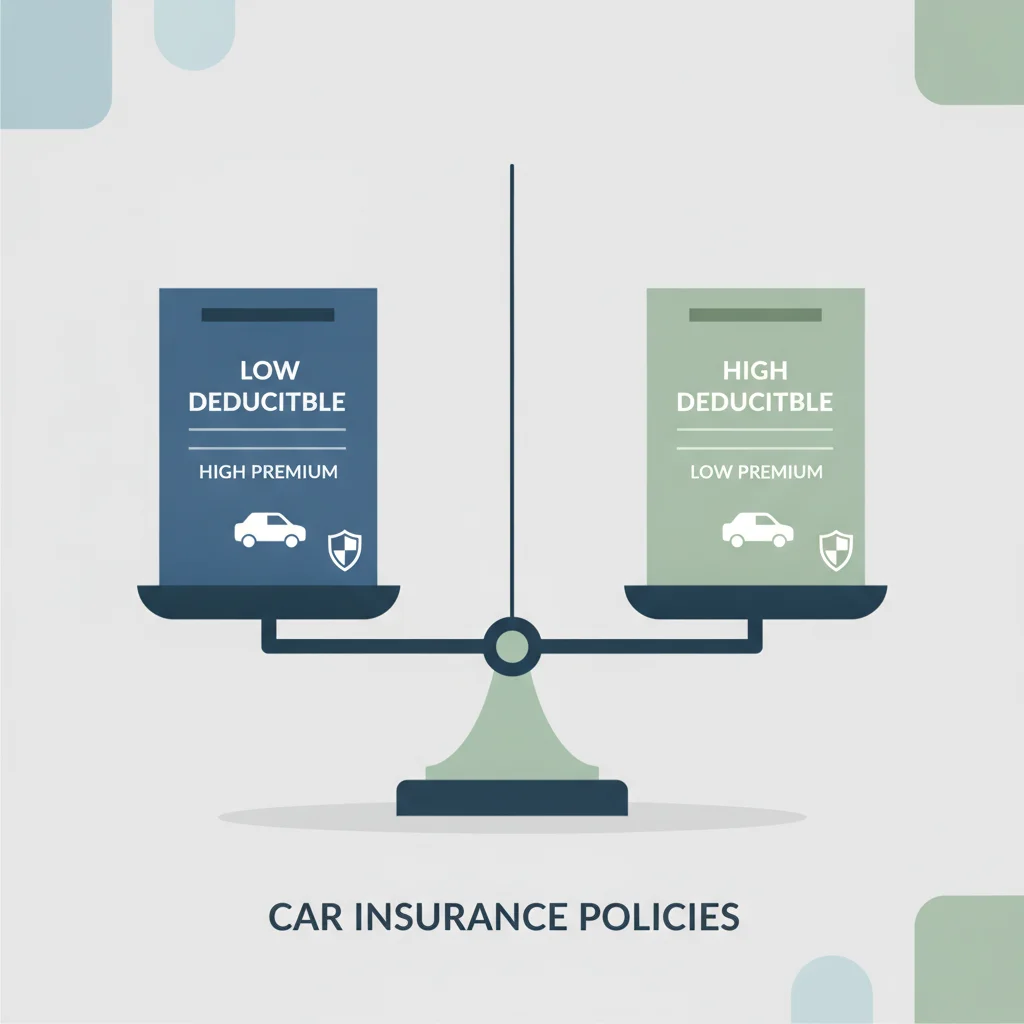
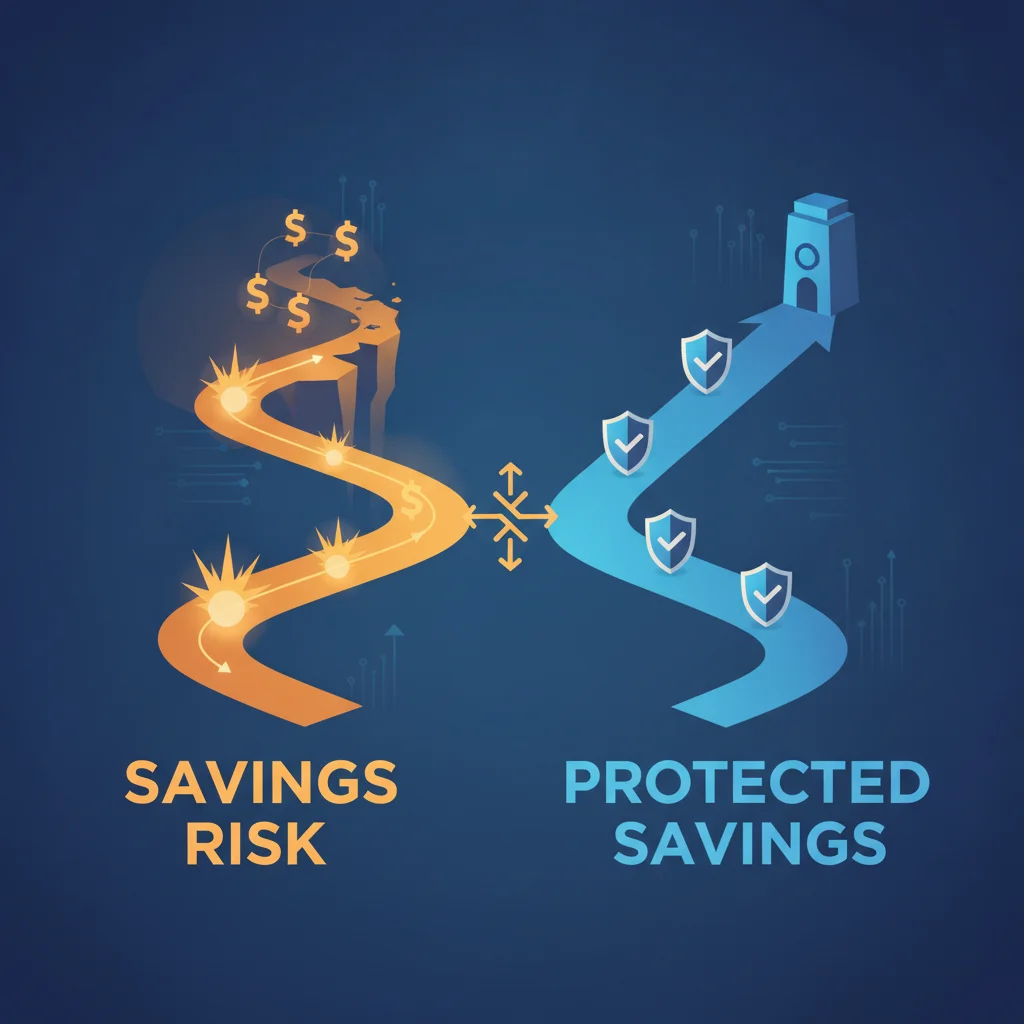
Raising your deductible is a risk transfer. You pay less every month, but you agree to absorb more out-of-pocket cost the moment you file a claim. Stacking discounts is a reward for behaviors and circumstances you already exhibit — it reduces your premium without touching your financial exposure after an accident.
Understanding that distinction changes how you approach the decision. This isn't simply about which option saves more dollars today. It's about which option fits your financial position and your actual risk profile. Rate factors like your driving history, location, and vehicle all influence how much either strategy can move the needle for you specifically.
How Raising Your Deductible Works
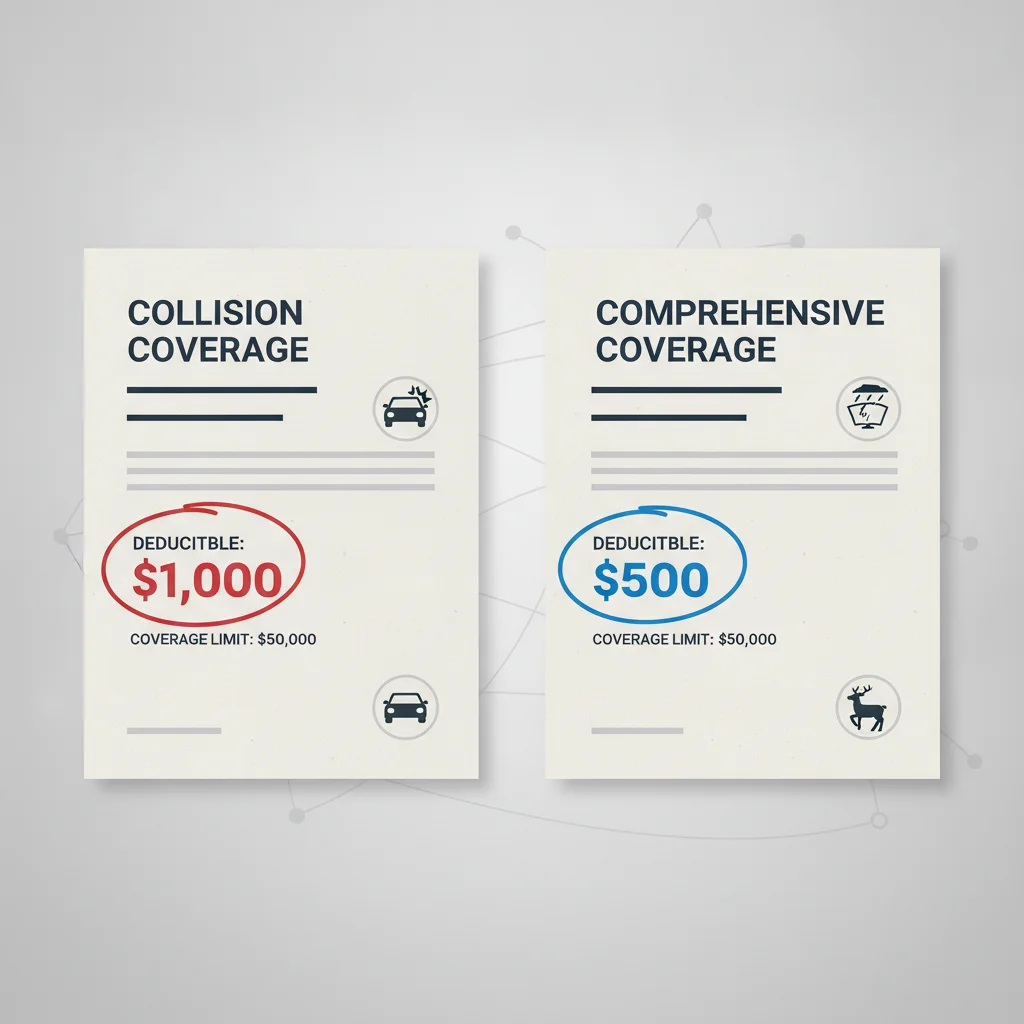
Your deductible is the amount you pay out of pocket before your insurer covers the rest of a claim. It applies to collision and comprehensive coverage — not to liability. Raise it from $500 to $1,000 and your premium drops; raise it to $1,500 or $2,000 and it drops further.
The premium reduction from a deductible increase is real, but it's not linear and it's not guaranteed to be large. Typical savings from moving a collision deductible from $500 to $1,000 run roughly 10%–15% on the collision portion of your policy, according to industry estimates. Since collision coverage is only one component of your total premium, the all-in impact on your bill is usually more modest — often $100–$250 per year for average drivers.
10–15%
Typical collision premium drop per $500 deductible increase
Industry data consistently shows this range, though the all-in premium impact is smaller since collision is one component of your total bill.
~$130
Average annual premium reduction per $500 deductible increase
Based on industry averages for a full-coverage policy on a mid-range vehicle; actual savings vary by insurer, state, and driver profile.
Up to 25%
Multi-policy bundling discount range
Bundling auto with home or renters insurance is typically the single highest-value discount category available to most drivers.
67%
Drivers who haven't checked their discounts in over a year
Consumer surveys suggest a majority of policyholders never audit their applied discounts, leaving meaningful savings on the table at renewal.
There are also structural constraints worth knowing. If your vehicle is financed or leased, your lender almost certainly sets a maximum deductible — commonly $500 or $1,000 — in your loan or lease agreement. Exceeding it violates your contract. Check before you adjust. You can also set collision and comprehensive deductibles independently at most insurers, which opens up some nuance. Mismatching your collision and comprehensive deductibles can sometimes produce better savings than a uniform increase across both.
The core math question is simple: how many claim-free years does it take for the premium savings to offset the higher deductible you'd owe if you did have a claim? If you raise your deductible by $500 and save $150 per year, you break even after 3.3 years — assuming zero claims. One at-fault accident in that window and you've lost the bet. Calculating whether the deductible tradeoff actually works in your favor requires honest accounting of both your claim frequency and your savings balance.
Don't Raise Your Deductible Beyond Your Savings
A deductible you can't afford to pay isn't really coverage — it's a policy that can't function when you need it. If a $1,000 deductible would require you to borrow money or go into credit card debt, the interest costs will quickly outweigh the premium savings. Always benchmark your maximum deductible against what you can access in liquid savings within 30 days, not your theoretical net worth.
How Stacking Discounts Works
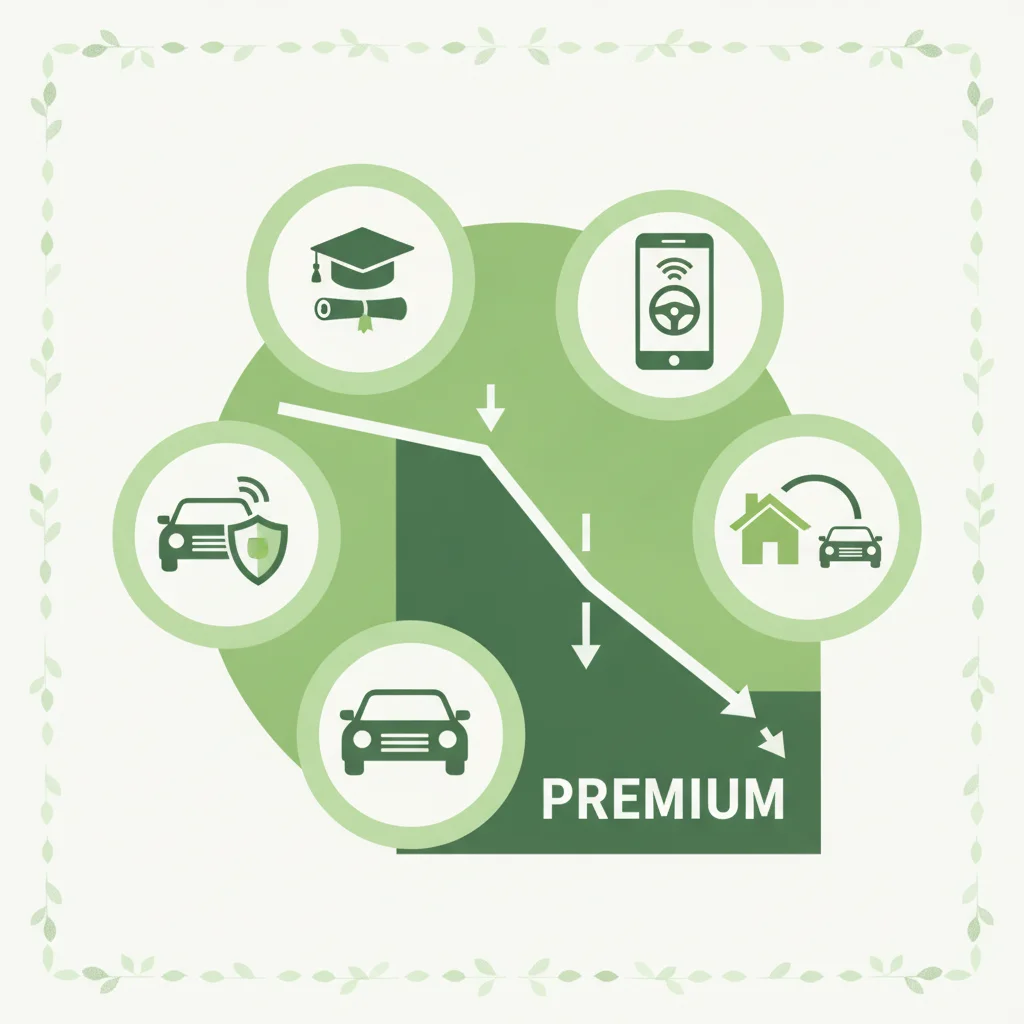
Discounts reduce your premium without changing your policy structure. They're applied as percentage reductions — typically stacked multiplicatively, not additively — so three or four discounts can compound into meaningful savings. The key problem: insurers don't always surface every discount you qualify for. You have to ask.
The most common and high-value discount categories include:
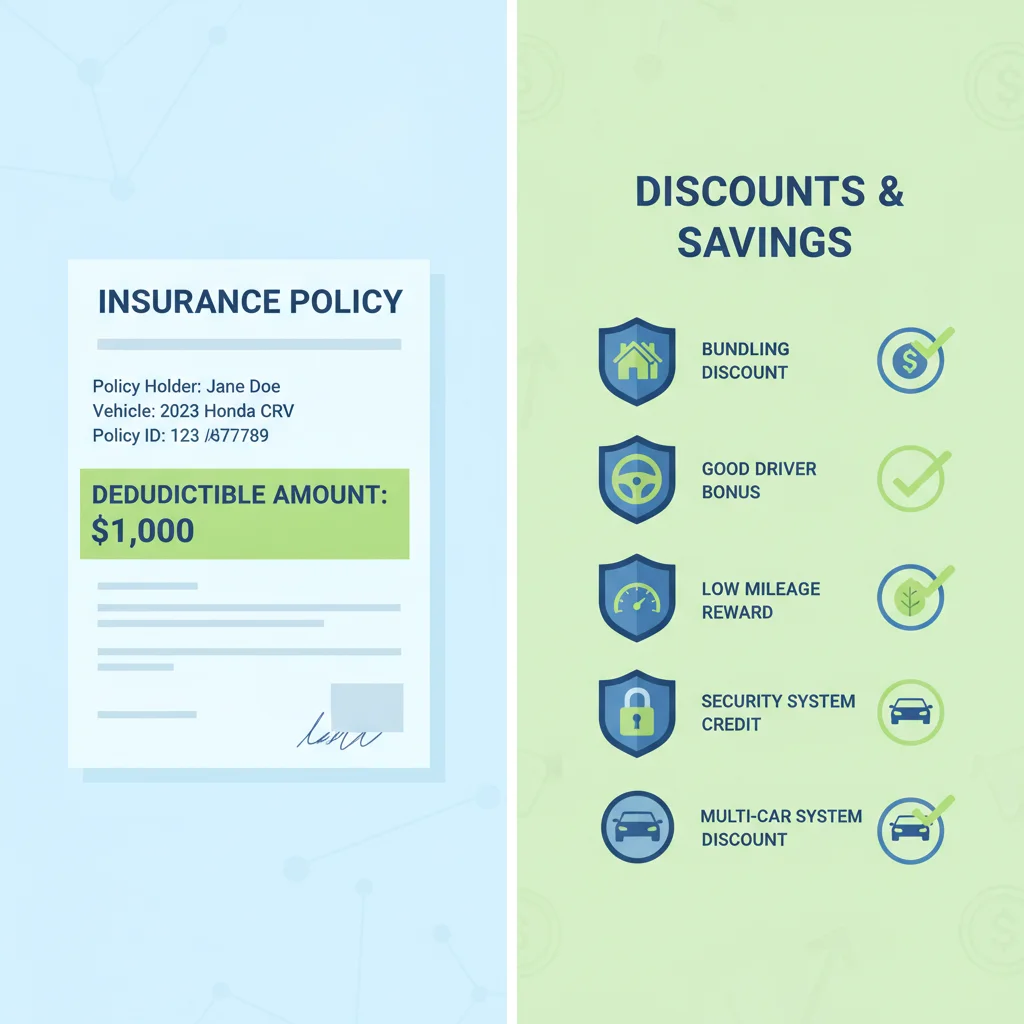
- Multi-policy (bundling): Combining auto with home, renters, or life insurance typically saves 5%–25% on your auto premium, depending on the insurer.
- Multi-vehicle: Insuring two or more vehicles on the same policy usually triggers a 10%–25% reduction per vehicle.
- Good driver / claim-free: Three to five years without an at-fault accident or moving violation can save 10%–30% at many carriers.
- Telematics / usage-based programs: Apps and plug-in devices that monitor your actual driving behavior offer initial discounts of 5%–10% just for enrolling, with safe-driving rewards of up to 30%–40% at some carriers.
- Good student: Full-time students under 25 with a B average or better commonly qualify for 8%–25% savings.
- Defensive driving course: Completing an approved course — often available online — can reduce your premium 5%–10%, and most states mandate insurers offer it.
- Vehicle safety features: Anti-lock brakes, anti-theft systems, automatic emergency braking, and lane departure warning may each earn small but stackable discounts.
- Low mileage / pay-per-mile: Drivers who log fewer than 7,500–10,000 miles annually often qualify for low-mileage discounts or can switch to per-mile billing models.
- Affinity / membership discounts: Alumni associations, professional organizations, military branches, credit unions, and employer groups frequently carry negotiated rates with specific carriers.
- Paperless and autopay: Small discounts (typically 2%–5%) for going digital and setting up automatic payments.
The realistic ceiling varies by insurer and driver, but a driver who legitimately qualifies for bundling, a telematics program, good driver status, and a couple of vehicle discounts can realistically stack 30%–50% in combined reductions off their base rate. That's significant — and it requires no change to your financial exposure after a claim.
Ask Directly — Discounts Aren't Always Offered
When you call your insurer, ask specifically: 'Which discounts are currently applied to my policy, and which ones might I qualify for that aren't applied yet?' Many carriers have discounts for professional associations, alumni groups, military service, and employer programs that never get surfaced automatically. A five-minute phone call regularly uncovers savings most drivers don't know they're eligible for.
Try Telematics Before Dismissing It
Usage-based insurance programs have gotten significantly better at distinguishing good drivers from risky ones. If you drive conservatively, avoid late-night trips, and don't brake hard, a telematics program can yield some of the deepest single-category discounts available — often 20%–30% at top carriers. Most programs offer an enrollment discount just for signing up, so you benefit even before your driving data is scored.
Side-by-Side: What Each Strategy Actually Delivers
The comparison below captures the practical differences across the dimensions that matter most to a typical driver making this decision.
| Raising Your Deductible | Stacking Discounts | |
|---|---|---|
| How it lowers your premium | You absorb more risk per claim | You're rewarded for qualifying behaviors |
| Impact if you file a claim | Higher out-of-pocket cost | No change to out-of-pocket cost |
| Typical savings potential | $100–$300/year on collision portion | Up to 30–50% off base rate when stacked |
| Requires emergency savings buffer | Yes — critical prerequisite | No — no financial risk created |
| Lender / lease restrictions | Often capped by contract terms | Not restricted by lenders |
| Effort to implement | One policy change at renewal | Research, enrollment, documentation needed |
| Suitable for financed vehicles | Sometimes — check contract first | Yes, always compatible |
| Best for | Well-funded, low-risk drivers | Most drivers regardless of savings level |
One dimension the table can't fully capture is the interaction between these strategies and your insurer relationship. Discount stacking often rewards loyalty — but not always. Comparing loyalty discounts against switching bonuses is worth doing every 12–24 months, because a new insurer may apply your qualifying discounts to a lower base rate than your current carrier charges.
The Emergency Fund Factor
This is the variable that most premium-reduction guides gloss over: your actual ability to pay the deductible if you need it tomorrow.
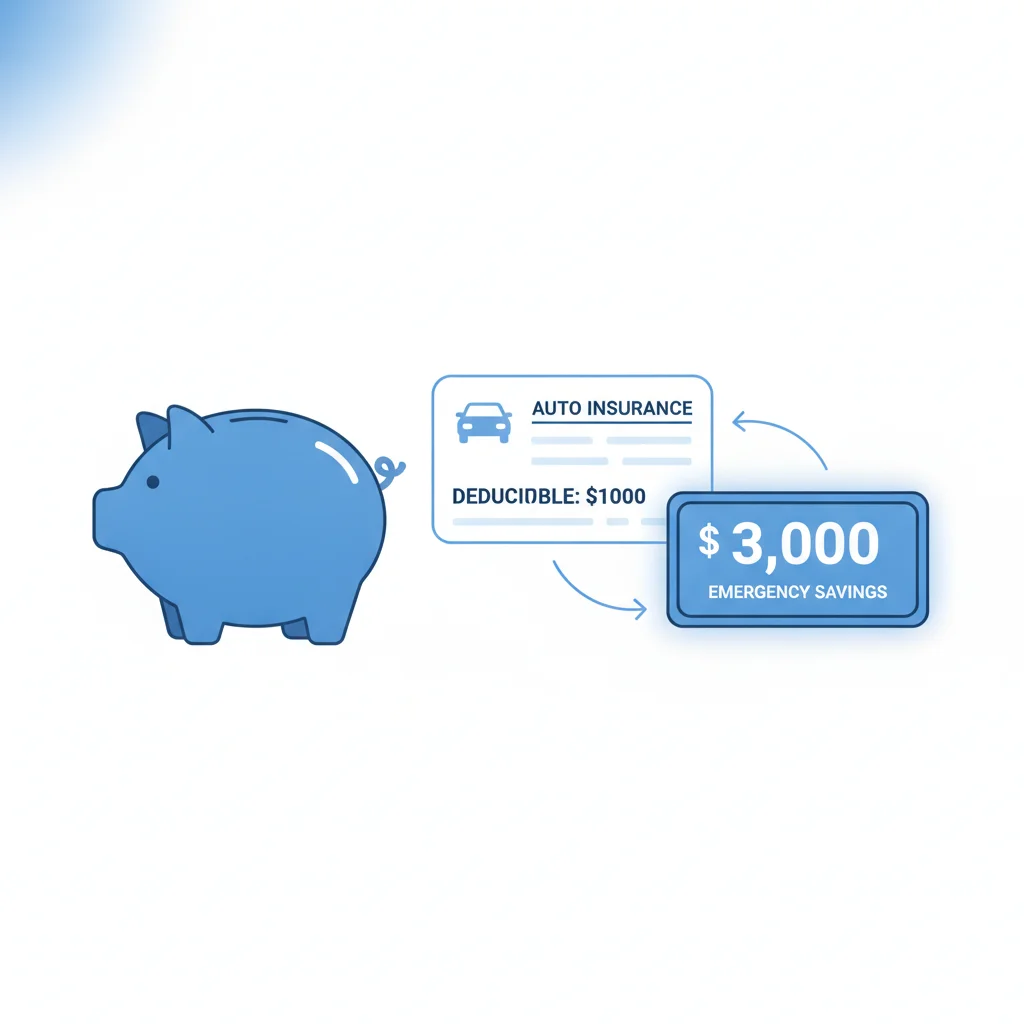
A $1,500 deductible is a perfectly rational choice if you have $5,000 in accessible savings and a clean driving record. It becomes a trap if your checking account regularly runs close to zero and a fender-bender would force you onto a credit card at 24% APR. The premium savings evaporate fast under those conditions.
The general guideline worth applying: don't raise your deductible above the amount you can comfortably access within 30 days without borrowing. That number is different for everyone. If you're not there yet on savings, discounts are the right first lever — they reduce your cost without putting you in a bind after an accident.
The hidden cost of a low deductible policy makes the same point from the other direction: keeping a low deductible when you have the savings to absorb more risk is an expensive form of peace of mind. The key is matching your deductible to your actual financial buffer, not defaulting to $500 because that's what the dropdown suggested when you first bought coverage.
When to Use One, the Other, or Both
These two strategies aren't mutually exclusive. The decision tree most drivers should work through looks like this:
- Audit your current discounts first. Call your insurer or log into your account and ask specifically which discounts are applied to your policy. Then ask which ones you might qualify for that aren't currently applied. Do this before touching your deductible.
- Apply every discount you legitimately qualify for. Enroll in the telematics program if your driving habits support it. Bundle your policies if you haven't. Complete a defensive driving course if your state allows the discount. These moves cost nothing and carry no downside risk.
- Then evaluate the deductible math. After stacking your discounts, reassess your remaining premium. If it's still higher than you'd like and you have the savings cushion, run the break-even calculation on a deductible increase. The math often looks different after discounts have already compressed your base.
- Consider your claim history honestly. If you've filed two claims in the last four years, a higher deductible is a riskier bet. If you've been claim-free for a decade and drive conservatively, the break-even horizon is more forgiving.
- Check your lender constraints. If you finance or lease, confirm your maximum allowable deductible before changing anything.
Some insurers also offer programs that blur the line between these two strategies — diminishing deductible programs, for example, reduce your deductible over time as a reward for claim-free years, essentially turning safe driving into a discount on your future out-of-pocket costs. Understanding how diminishing deductible programs actually work can help you decide if that's worth factoring in.
Ask Directly — Discounts Aren't Always Offered
When you call your insurer, ask specifically: 'Which discounts are currently applied to my policy, and which ones might I qualify for that aren't applied yet?' Many carriers have discounts for professional associations, alumni groups, military service, and employer programs that never get surfaced automatically. A five-minute phone call regularly uncovers savings most drivers don't know they're eligible for.
Try Telematics Before Dismissing It
Usage-based insurance programs have gotten significantly better at distinguishing good drivers from risky ones. If you drive conservatively, avoid late-night trips, and don't brake hard, a telematics program can yield some of the deepest single-category discounts available — often 20%–30% at top carriers. Most programs offer an enrollment discount just for signing up, so you benefit even before your driving data is scored.
Common Mistakes to Avoid
A few errors come up repeatedly when drivers try to optimize their premiums through either approach:
- Assuming the insurer has applied every discount automatically
- Many discounts require you to ask, provide documentation, or enroll in a program. A good student discount typically requires a transcript or GPA verification. A defensive driving discount requires proof of course completion. Assume nothing is automatic.
- Raising the deductible on a low-value vehicle
- If your car is worth $6,000, a $2,000 deductible means your insurer is only on the hook for $4,000 max — and that's before considering depreciation. As vehicle value shrinks, high deductibles stop making economic sense and may make dropping collision coverage entirely more logical.
- Stacking coverages instead of just stacking discounts
- More coverage is not always better coverage. Identifying redundant coverage you're already paying for elsewhere — through a credit card's rental car protection, a health plan's injury benefits, or an auto club's towing service — can be just as effective as earning a new discount.
- Treating the deductible decision as permanent
- You can adjust your deductible at renewal. If your financial situation improves, raise it. If your savings take a hit, lower it back. Treat it as a dynamic variable, not a set-and-forget decision.
- Not shopping the combined package
- Your current insurer may not be the most competitive carrier for your specific discount profile. Comparing full policy quotes — with all your applicable discounts factored in — every 12–24 months remains one of the highest-leverage actions any driver can take.


All claims are backed by peer-reviewed research. Sources on request.