Key Takeaways
Option A
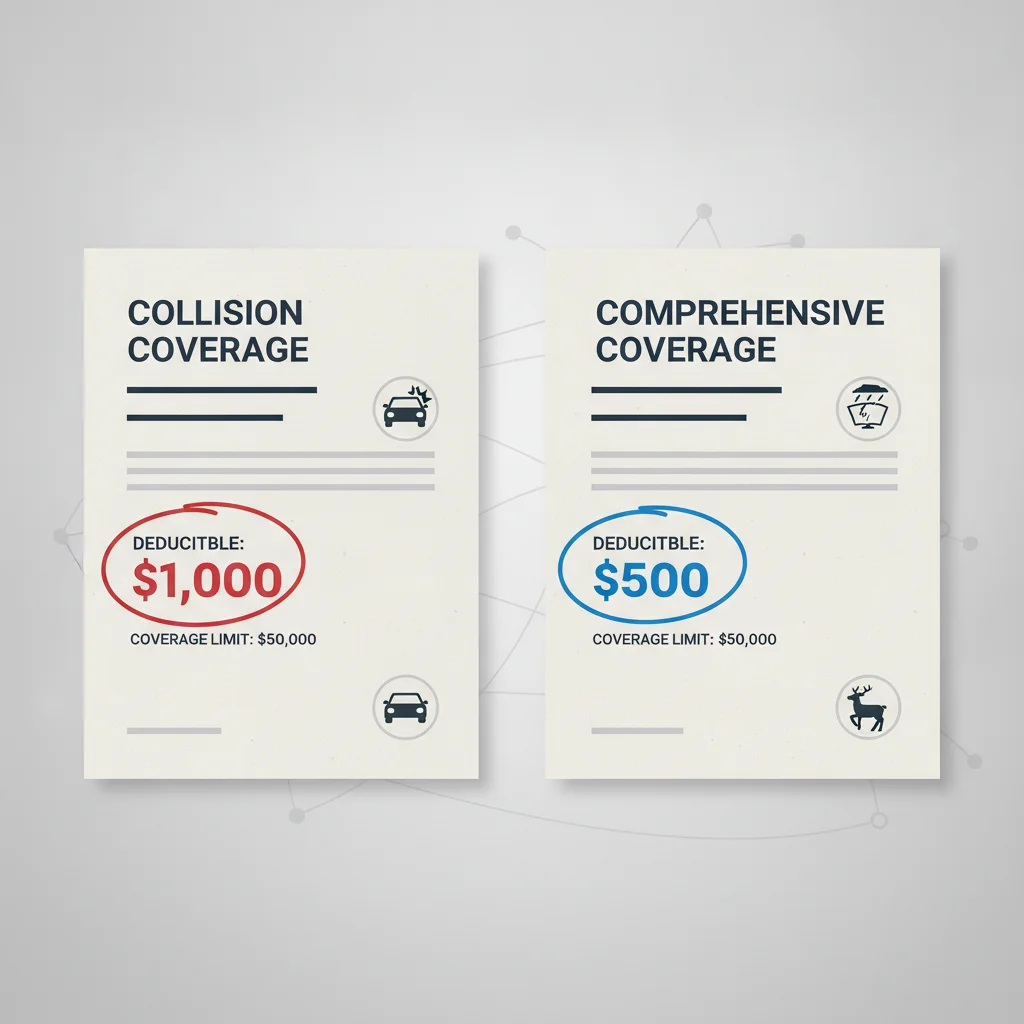
Collision Deductible
The higher-frequency, higher-cost coverage anchor.
Best for: Drivers who want to reduce premiums on the coverage most likely to generate a claim — at-fault accidents and impact damage.
Option B
Comprehensive Deductible
The low-frequency, unpredictable-event buffer.
Best for: Drivers who want affordable protection against theft, weather, and other non-collision events they can't control or predict.
If you drive frequently in congested urban areas
Lower Collision Deductible
Higher traffic density correlates with more frequent fender-benders and at-fault accidents, making a lower collision deductible statistically worthwhile despite a modestly higher premium.
If you live in a region prone to hail, flooding, or vehicle theft
Lower Comprehensive Deductible
Comprehensive events are climate- and geography-driven. A lower deductible limits your out-of-pocket exposure when natural disasters or theft strike without warning.
If you have a solid emergency fund and are focused on minimizing monthly premiums
Higher Deductibles on Both
Raising both deductibles to $1,000 or more can meaningfully cut your annual premium, and your savings buffer means you can self-insure the gap without financial stress.
If you're financing or leasing your vehicle
Match Lender Requirements
Many lenders cap allowable deductibles — often at $500 or $1,000 — so your deductible choices may be constrained regardless of your personal preference.
If you rarely drive and park in a low-crime, low-weather-risk area
Higher Collision Deductible, Moderate Comprehensive Deductible
Low mileage reduces collision probability, making a higher collision deductible a reasonable premium lever. A moderate comprehensive deductible still protects against the random events that occur even when a car is parked.
The Short Answer: No, They Don't Have to Match
There's a persistent assumption among car owners that collision and comprehensive deductibles must be set at the same amount. It's an easy conclusion to reach — many insurance quote tools present them side by side with identical defaults, and agents don't always volunteer the fact that they can be split. But in most states and with most major insurers, these two deductibles are entirely independent line items that you can configure separately.
That flexibility matters because collision and comprehensive are fundamentally different types of coverage protecting against fundamentally different risks. Treating them identically by default means you may be either overpaying for protection you're unlikely to use, or under-protected on the side where your exposure is actually greatest.
To understand why mismatching can make sense, it helps to be clear on what each coverage does. Collision covers damage from impact events — hitting another car, backing into a post, rolling into a ditch. Comprehensive covers the wide universe of non-collision events: theft, vandalism, hail, flooding, fire, falling objects, and animal strikes. Your deductible for each is the dollar amount you agree to pay out of pocket before your insurer pays the rest of a covered claim.

The strategic question isn't which deductible is "correct" in the abstract — it's which configuration best matches your actual risk profile, your vehicle's value, and your financial cushion.
How Collision and Comprehensive Deductibles Actually Work
Before weighing deductible strategy, it's worth anchoring on the mechanics. When you file a physical damage claim, the insurer calculates the repair or replacement cost, subtracts your deductible, and pays you (or the repair shop) the difference. If your car sustains $3,200 in hail damage and your comprehensive deductible is $500, your insurer pays $2,700. If the same car gets rear-ended causing $1,100 in damage but your collision deductible is $1,500, you're absorbing the entire repair cost yourself — your insurer pays nothing because the damage is below the deductible.
That last scenario illustrates why deductible sizing is not just a premium-reduction lever. It's a decision about how much financial risk you're willing to self-insure. The higher your deductible, the lower your premium — but the wider the gap between "something bad happened" and "insurance actually helps."
| Criterion | Collision Deductible | Comprehensive Deductible |
|---|---|---|
| What triggers a claim | Impact with another car or object | Theft, weather, fire, animals, vandalism |
| Claim frequency (national avg.) | More frequent | Less frequent |
| Driver control over risk | Partially controllable | Largely uncontrollable |
| Typical premium cost | Higher | Lower |
| Premium sensitivity to deductible changes | High — bigger savings from raising deductible | Lower — savings are more modest |
| Geographic risk variation | Driven by traffic density and mileage | Driven by weather, theft rates, geography |
| Common deductible range | $250–$1,500 | $100–$1,000 |
| Must match the other coverage? | No — independently set | No — independently set |
Deductible options typically run from $100 to $2,500, with $250, $500, and $1,000 being the most common choices. The premium savings from increasing a deductible are usually not linear — the jump from $250 to $500 often saves more proportionally than the jump from $1,000 to $1,500. Choosing the right deductible amount involves comparing those savings against the realistic probability that you'll file a claim and the financial hit if you do.
6 in 100
Drivers filing a collision claim annually
According to the Insurance Information Institute, roughly 6% of insured drivers file a collision claim in a given year, making it the most common physical damage claim type.
2.5%
Annual comprehensive claim rate
The Insurance Information Institute estimates approximately 2.5% of insured drivers file a comprehensive claim annually — roughly less than half the rate of collision claims.
$500
Most common deductible chosen by drivers
Industry data consistently shows $500 as the most frequently selected deductible for both collision and comprehensive, though it is rarely the optimized choice for every driver.
15–30%
Premium reduction from doubling deductible
The Insurance Information Institute estimates that increasing a collision deductible from $200 to $500 can reduce collision premium by 15–30%, depending on insurer and driver profile.
$3,588
Average collision claim payout
The Insurance Research Council reported average collision claim severities in excess of $3,500, underscoring why deductible sizing has real financial stakes for most claimants.
Why These Two Coverages Carry Different Risk Profiles
The case for setting different deductibles rests on a core insight: collision and comprehensive events don't happen at the same frequency or under the same circumstances, so there's no strong reason to insure them identically.
Collision: More Frequent, More Controllable
Collision coverage responds to accidents — events that, while not entirely within your control, are influenced by how much you drive, where you drive, and how you drive. The National Highway Traffic Safety Administration has consistently found that crash rates correlate with vehicle miles traveled, urban density, and driver behavior. A commuter driving 20,000 miles a year through city traffic faces a materially different collision probability than someone who drives 5,000 miles annually in a rural area.
Because collision claims are more predictable in aggregate, a lower collision deductible has a cleaner actuarial logic: you pay a bit more each month to limit out-of-pocket exposure on the type of event that is statistically more likely to hit you.
Comprehensive: Lower Frequency, Higher Unpredictability
Comprehensive events are different in character. Hailstorms, flash floods, wildfires, and catalytic converter theft don't follow your daily commute pattern. They can strike a vehicle sitting in a driveway for months. This lower average frequency is one reason comprehensive coverage is almost universally cheaper to carry than collision — sometimes by a wide margin. A higher comprehensive deductible may cost you very little in additional premium savings precisely because the expected payout is already low.
However, geography scrambles this calculus. If you live in a hail corridor spanning parts of Texas, Colorado, Kansas, or Nebraska, or in a coastal flood zone, or in a metro area with elevated vehicle theft rates, your comprehensive exposure is substantially higher than the national average. In those environments, a lower comprehensive deductible becomes more defensible. Understanding which coverage applies to your specific situation helps you assess where your real vulnerability lies.

The upshot: matching deductibles treats two distinct risk categories as equivalent. They often aren't.
Common Deductible Mismatch Strategies — and When Each Makes Sense
There are a handful of configurations that drivers and advisors commonly use, each suited to different circumstances.
Higher Collision, Lower Comprehensive
This is arguably the most counterintuitive split — and for many drivers, the most financially sound. It's built on the observation that collision events are frequent enough that you're likely to absorb some damage over time, but individual collision repair bills are often moderate and spread out. Meanwhile, a comprehensive event (say, a total hail loss on a relatively new car) can be large and completely unexpected.
A driver who sets their collision deductible at $1,000 and their comprehensive deductible at $250 accepts more out-of-pocket exposure on the day-to-day risk while protecting themselves against the sudden catastrophic hit. If the premium savings from the higher collision deductible exceed the cost of the lower comprehensive deductible, the net effect can be premium-neutral while offering better protection where it's most needed.
Lower Collision, Higher Comprehensive
This is the more traditional split. It's appropriate for drivers who log a lot of miles, work in demanding traffic conditions, or have reason to believe their collision exposure is elevated. A delivery driver, a ride-share operator, or a new driver in a household might rationally set collision at $250 or $500 while running comprehensive at $1,000, knowing that a fender-bender is more likely in their reality than a hailstorm.
Mismatched to Manage Cash Flow
Some drivers set deductibles based on what they could actually produce in cash within 30 days if they needed to. If your emergency fund comfortably covers $1,000, setting both at $1,000 is fine. But if you know you could handle $500 for a hail repair but not a $1,000 collision repair bill that arrives alongside other monthly obligations, setting collision at $500 and comprehensive at $1,000 is a rational cash-flow decision — even if it doesn't optimize for premium minimization. Comparing deductible changes to discount stacking can help you understand which lever produces more savings for your situation.
Check Before You Change: Not All Insurers Offer Full Flexibility
While most major U.S. insurers allow independent deductible selection for collision and comprehensive, a minority of carriers or specific policy tiers may require matched deductibles. Before building a strategy around mismatching, confirm with your insurer or agent that your policy allows it. This is especially relevant if you're using a non-standard or specialty carrier.
Deductible Changes and Mid-Policy Timing
You can typically adjust your deductibles mid-policy, not just at renewal. The premium change is usually prorated for the remainder of your policy term. However, any claim filed after a deductible change but before the endorsement is processed may default to your previous deductible amount — confirm timing with your insurer before assuming the new deductible is in effect.
State-Specific Variations Worth Knowing
A handful of states have regulations that affect how physical damage deductibles work — for example, some states limit what insurers can charge for comprehensive claims involving windshield repair or replacement. In a few states, zero-deductible glass coverage is mandated. These variations don't change the core collision-vs-comprehensive deductible strategy but are worth factoring in when you're evaluating comprehensive deductible options specifically.
Lender Rules, Lease Terms, and Other Constraints
Before you start mixing and matching deductibles, check whether you actually have full freedom to do so. If you're financing your vehicle through a bank, credit union, or captive lender, or if you're leasing, the terms of your loan or lease agreement likely specify maximum allowable deductibles for both collision and comprehensive.
The most common restriction is a $500 cap, though some lenders allow up to $1,000. The logic is straightforward: the lender has a financial interest in the vehicle until the loan is paid off. If you set a $2,000 deductible and your car is totaled in an accident worth $4,000, you absorb half the loss — but the lender's collateral is still gone. Capping your deductible limits that exposure.
If your loan or lease imposes a $500 maximum on both coverages, your optimization options narrow. You can still compare the premium difference between a $250 and $500 deductible for each coverage separately, but you can't push either above that ceiling without potentially triggering a contract breach that could leave you personally responsible for any loss exceeding what the coverage would have paid.
Always review your financing documents or call your lender before adjusting deductibles. And if you're shopping for a new policy, comparing policies carefully means checking whether the quotes you're evaluating comply with any lender restrictions you're operating under.
For drivers who own their vehicles outright, no such constraint applies — the full range of deductible options is available, which is one of the genuine financial freedoms of owning your car free and clear. At some point, the calculus shifts further: if a car's market value drops low enough, it may not make sense to carry either coverage at all. Understanding when to drop collision or comprehensive walks through that threshold in detail.

Running the Numbers: Is Mismatching Worth It?
The honest answer is that it depends — but the math is not difficult to run. The principle is the same whether you're matching or mismatching: compare the annual premium savings from a higher deductible against the additional out-of-pocket cost you'd absorb if you filed a claim, adjusted for how often you realistically expect to file.
Here's a simplified example. Suppose you're choosing between a $500 and a $1,000 collision deductible, and the higher deductible saves you $180 per year. If you file one collision claim every five years on average, you'd save $900 in premiums over that period but absorb an extra $500 in deductible cost when the claim hits — a net gain of $400. The higher deductible wins.
Now apply the same logic to comprehensive. If moving from a $250 to a $500 comprehensive deductible saves you only $40 per year — common in low-comprehensive-risk areas where comprehensive premiums are already modest — you'd need to go 6.25 claim-free years to break even on that extra $250 in exposure. In a hail-prone state where you've already filed two comprehensive claims in four years, the lower deductible looks more attractive.
The variables that most affect this calculation:
- Your local claim frequency — how often do drivers in your area actually file collision or comprehensive claims?
- Your vehicle's age and value — a $30,000 car justifies more careful deductible strategy than a $7,000 car where you might consider dropping coverage entirely
- Your driving pattern — high-mileage urban commuters face different collision odds than low-mileage rural drivers
- Your liquidity — can you absorb your deductible without financial strain if a claim hits tomorrow?
The decision to carry both collision and comprehensive is a related question worth examining alongside deductible strategy — because the right deductible on a coverage you should probably drop is still a suboptimal outcome.

The broader takeaway: there is no universal "correct" deductible split. But there is a correct split for your specific situation — and most drivers have never been asked to think it through independently for each coverage type. Starting with the question "what's my realistic claim probability for each coverage?" puts you in the right analytical frame.

All claims are backed by peer-reviewed research. Sources on request.