Key Takeaways
Option A
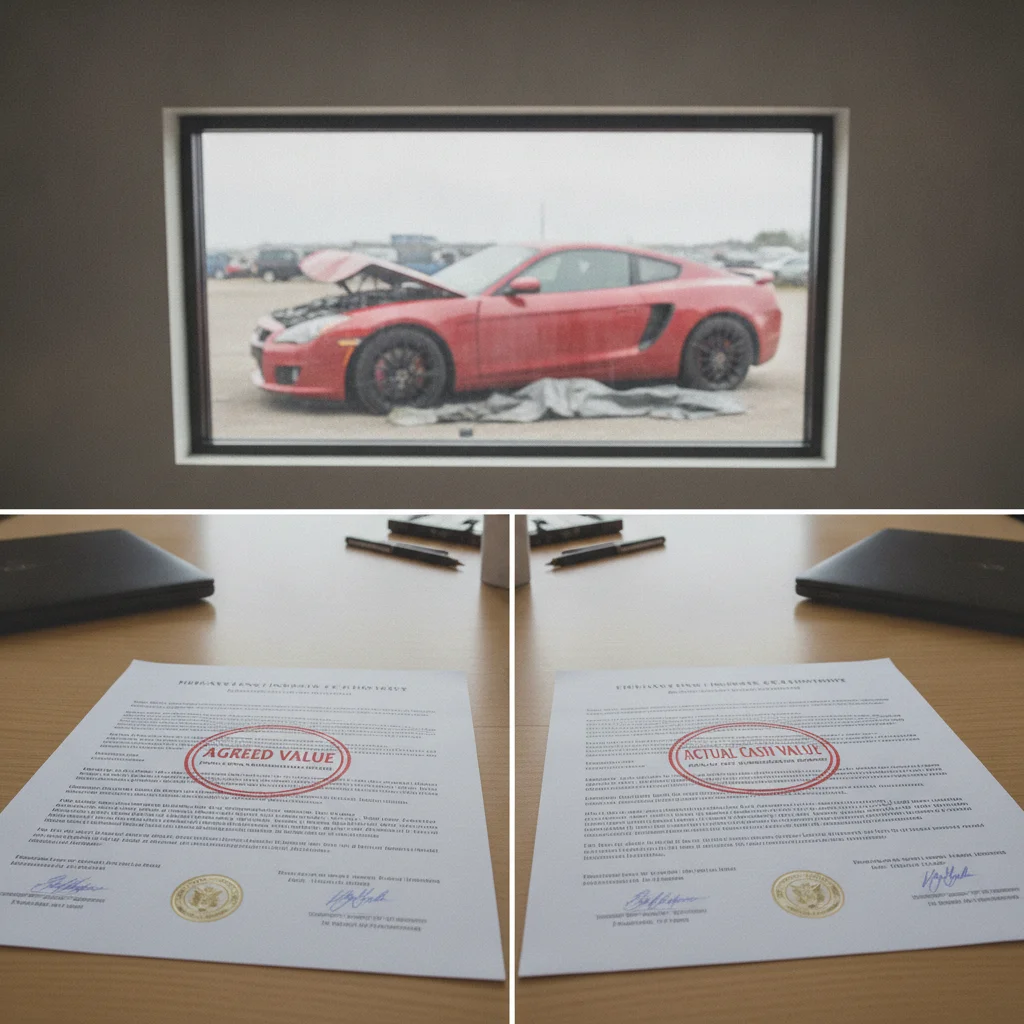
Agreed Value
The locked-in, no-surprises payout.
Best for: Classic cars, collector vehicles, heavily modified cars, and owners who want certainty about their settlement before a loss ever happens.
Option B
Actual Cash Value (ACV)
The market-rate standard for everyday vehicles.
Best for: Drivers of standard late-model vehicles who want the lowest available premium and are comfortable with depreciation-adjusted settlements.
If you own a classic, collector, or heavily modified vehicle
Agreed Value
Standard ACV formulas can't accurately price a 1967 muscle car or a custom build. Agreed Value ensures you're compensated for the vehicle's true, documented worth.
If you drive a standard late-model car and want lower premiums
Actual Cash Value (ACV)
ACV coverage is widely available at lower cost. For everyday vehicles that depreciate predictably, it's a practical choice — especially when paired with gap insurance on a loan.
If you own a high-value EV with uncertain depreciation
Agreed Value
EV residual values shift rapidly with software updates, battery capacity changes, and market fluctuations. Locking in a value upfront removes that uncertainty from your settlement.
If you're financing a new car and want the cheapest compliant coverage
Actual Cash Value (ACV)
Most lenders require comprehensive and collision at ACV minimum. Add gap insurance to cover the loan balance shortfall rather than paying for specialty agreed value coverage.
If your vehicle has appreciated or holds stable value over time
Agreed Value
For vehicles that don't follow typical depreciation curves, ACV will consistently underpay. Agreed Value protects you from a settlement that ignores real-world market appreciation.
Why Valuation Method Matters More Than Coverage Limits
Most drivers shop auto insurance by comparing premium quotes and liability limits. What they rarely scrutinize is the clause that determines how much money actually lands in their pocket after a total loss: the valuation method. Two policies with identical liability coverage and the same deductible can produce settlements that differ by tens of thousands of dollars depending on whether the policy uses Agreed Value or Actual Cash Value (ACV).
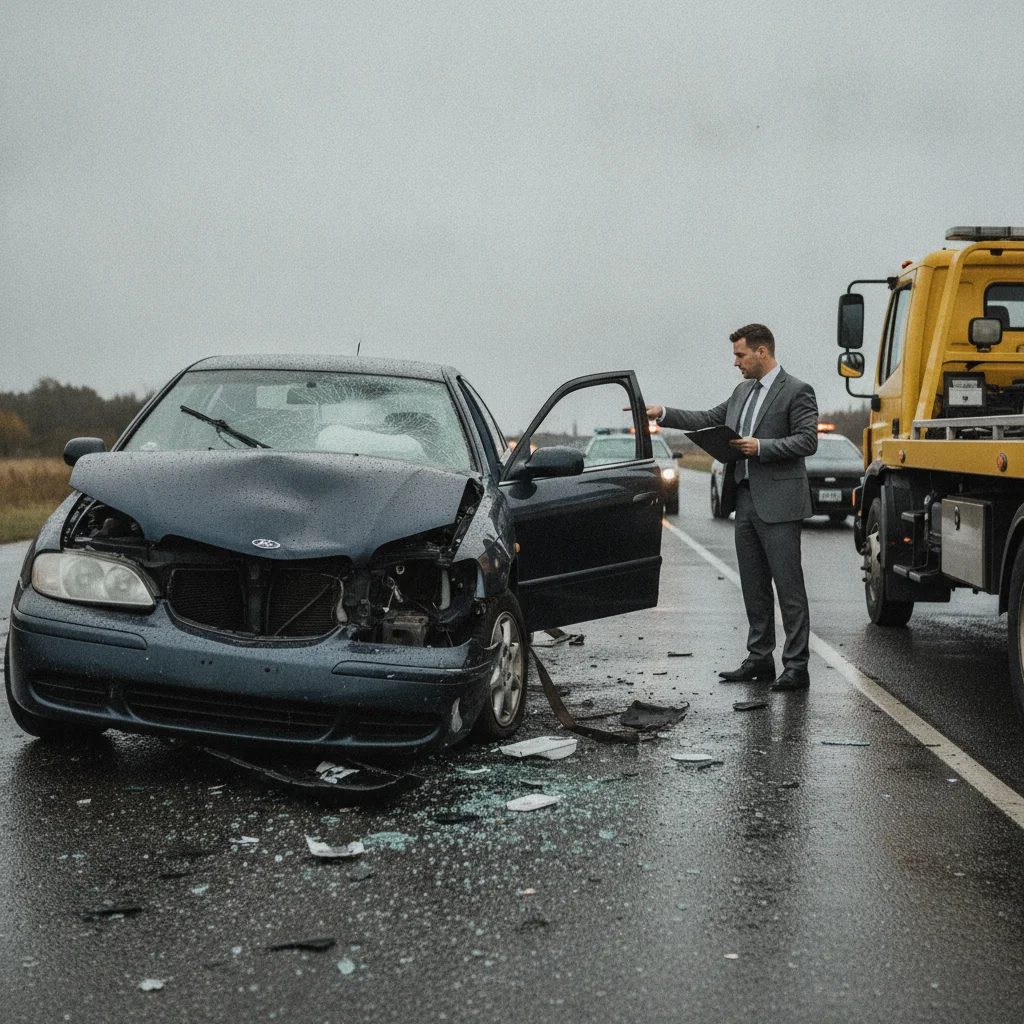
This distinction matters most when your car is totaled — meaning repair costs exceed the insurer's threshold for the vehicle's value. At that point, the insurer calculates your payout based on the valuation method written into your policy. If you don't know which method applies to you, you won't know what you're owed until it's too late to negotiate the terms. See our guide to how insurers declare a total loss for a breakdown of how that threshold is set.
The goal here isn't to tell you one option is always better. It's to help you understand exactly what you're buying so you can make the call that fits your vehicle and your financial exposure.

How Each Valuation Method Actually Works
Actual Cash Value: Depreciation Is the Mechanism
ACV is the default method used by virtually every standard auto insurer in the U.S. When your car is totaled, the insurer determines what your vehicle was worth on the open market at the exact moment of the loss — not what you paid for it, not what it would cost to replace it with a new one.
Insurers calculate ACV by starting with the vehicle's original value and subtracting depreciation based on age, mileage, condition, and comparable local sales data. They typically reference tools like Kelley Blue Book, Edmunds, NADA, and CCC ONE — their own proprietary valuation platform — to arrive at a number. Valuation tools like KBB and Edmunds are useful for understanding the range, but insurers often weight their own data more heavily.
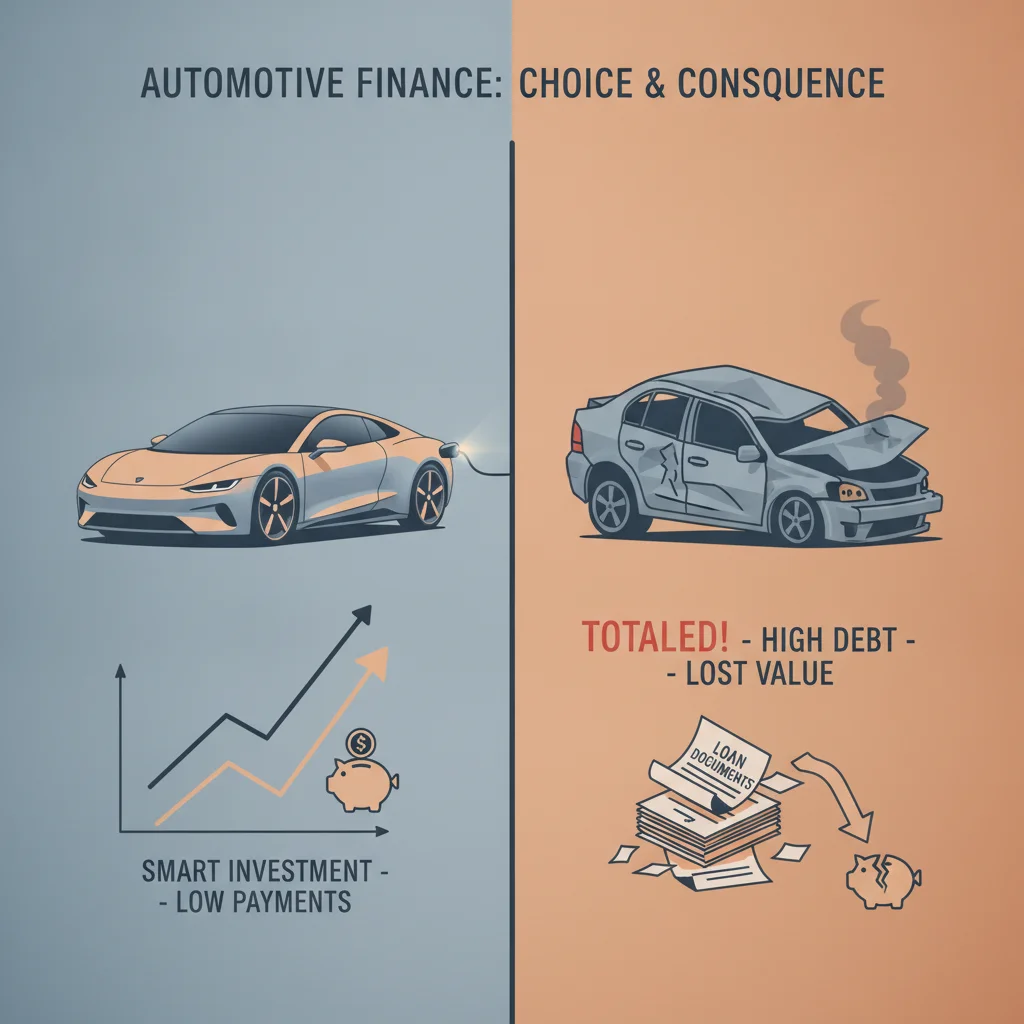
The result: if you bought a sedan three years ago for $32,000 and it has depreciated to $21,000 at market rates, an ACV settlement pays $21,000 minus your deductible. If you owe $26,000 on a loan, you're $5,000 short — a gap you either absorb personally or cover with gap insurance.
Agreed Value: The Settlement Is Set Before the Loss Happens
Agreed Value works differently at its core. Before the policy is issued, you and the insurer negotiate and formally document the value of the vehicle. That figure is locked into the policy. If the car is totaled, you receive that agreed-upon amount — minus your deductible — with no depreciation calculation at the time of claim.
This method is common for classic cars, collector vehicles, kit cars, custom builds, and certain high-value exotics. Insurers offering this coverage typically require a professional appraisal, a vehicle inspection, and supporting documentation (photos, receipts for upgrades, provenance records) before they'll lock in the value. The insurer takes on the risk that the vehicle might depreciate; in exchange, you pay a higher premium.
| Criterion | Agreed Value | Actual Cash Value (ACV) |
|---|---|---|
| How payout is determined | Fixed at policy inception via negotiation | Calculated at time of loss using market data |
| Depreciation impact | None — value locked in upfront | Direct reduction to settlement amount |
| Premium cost | Higher (15%–40% above ACV equivalent) | Lower — standard market rate |
| Availability | Specialty and classic car insurers; select standard carriers | All standard auto insurers nationwide |
| Appraisal required | Yes — documented appraisal typically required | No upfront appraisal needed |
| Best vehicle type | Classic, collector, modified, high-value vehicles | Standard late-model everyday vehicles |
| Settlement certainty | High — amount known before loss occurs | Low — subject to market conditions and insurer formulas |
| Loan balance protection | Strong if agreed amount exceeds loan balance | Weak — often falls short of remaining loan balance |
| Dispute risk at claim time | Minimal — value is pre-agreed | Moderate — ACV calculations are contestable |
Stated Amount Is Not the Same as Agreed Value
Many standard policies offer a 'stated amount' option that sounds similar to Agreed Value but works very differently. Under a stated amount policy, the insurer pays the lesser of the stated figure or the vehicle's ACV at the time of loss. This means depreciation still applies — the stated amount simply caps the maximum payout, it doesn't guarantee it. Always confirm whether your policy uses true Agreed Value or stated amount before assuming your settlement is locked in.
The Real Cost Difference: Running the Numbers
Abstract explanations only go so far. Here's what the gap looks like in practical terms across a few common scenarios.
Scenario 1: A 5-Year-Old Pickup Truck
You bought a full-size pickup for $48,000 new. Five years later, with 65,000 miles, market comps put ACV at $29,500. A total loss under an ACV policy pays $29,500 minus your deductible. If you still owe $33,000, you're underwater by $3,500 before the deductible even comes off. Agreed Value on this truck, had you negotiated it, might have been set at $38,000 at policy inception — still lower than purchase price, but far closer to your loan balance.
Scenario 2: A 1972 Muscle Car
A restored classic doesn't follow standard depreciation curves. It may have appreciated significantly. An ACV formula applied to a 1972 muscle car will produce a number based on comparable sales data that may not capture condition, provenance, or documented restoration costs. If the car is insured for ACV and the insurer's formula produces $35,000 when the vehicle is realistically worth $72,000, you've absorbed a $37,000 loss through no fault of your own. Agreed Value eliminates that risk entirely — the number is established and agreed upon before a loss occurs.
Scenario 3: A Two-Year-Old Electric Vehicle
EVs present a unique valuation challenge. Rapid model updates, battery degradation perceptions, and shifting demand can cause EV residual values to diverge sharply from standard depreciation tables. EVs depreciate differently from gas-powered vehicles, and an ACV formula calibrated for traditional cars may not reflect what your EV is actually worth in today's market — in either direction.

20%
Average first-year vehicle depreciation
According to Carfax data, most new vehicles lose approximately 20% of their value within the first year of ownership, directly affecting ACV settlement calculations.
~50%
Depreciation in first five years
The Insurance Information Institute estimates that the average vehicle depreciates by roughly 50% of its original value within five years, significantly widening the ACV-to-loan-balance gap.
$3,000–$10,000
Typical ACV-to-loan gap on financed vehicles
Consumer Financial Protection Bureau data suggests the average underwater loan gap on totaled financed vehicles falls between $3,000 and $10,000 at the time of loss.
15–40%
Premium increase for Agreed Value over ACV
Industry estimates from specialty insurers indicate Agreed Value endorsements typically add 15% to 40% to annual premiums compared to standard ACV collision and comprehensive coverage.
Premium Difference: What You Pay for Certainty
Agreed Value coverage carries a higher premium than standard ACV. How much higher depends on the vehicle type, the agreed amount, and the insurer. For classic car specialty insurers — companies like Hagerty or Grundy that focus on collector vehicles — the premium increase may be surprisingly modest relative to the protection gained, because the insurer also imposes mileage restrictions and storage requirements that limit exposure.
For standard personal auto policies with agreed value endorsements (offered by some carriers for high-value vehicles), expect premiums that run 15% to 40% higher than a comparable ACV policy on the same vehicle. Whether that's worth it comes down to two factors: how much your vehicle might depreciate by the time a claim occurs, and how large the gap between ACV and agreed value would likely be.
The math is straightforward. If adding agreed value coverage costs you $400 more per year and you'd hold the policy for five years, you've spent $2,000 in extra premiums. If an ACV settlement would leave you $8,000 short in the event of a total loss, the agreed value coverage more than pays for itself in a single claim. Understanding the difference between ACV and replacement cost settlements helps frame what you're giving up if you rely solely on the default valuation.

How to Assess Which Method Your Current Policy Uses
Don't assume — check your declarations page and policy documents directly. Here's where to look and what to confirm:
- Declarations page: Look for language like "Actual Cash Value," "ACV," "stated amount," or "agreed amount" under your comprehensive and collision coverage sections. Note that stated amount is not the same as agreed value — stated amount typically means the insurer will pay the lesser of the stated figure or ACV, which leaves depreciation risk on the table.
- Policy definitions section: Most policies include a definitions section that spells out how "loss" is calculated. Look for depreciation language. If the policy says the settlement is based on "the cost to replace the vehicle with a vehicle of like kind and quality, less depreciation," that's ACV.
- Endorsements or riders: Agreed Value is often added as a separate endorsement rather than built into the base policy. Check for any attached endorsements and read their terms carefully.
- Call your agent directly: Ask one specific question: "If my vehicle is totaled today, is my settlement based on an agreed, fixed amount, or will it be calculated based on market value at the time of loss?" A clear answer takes 30 seconds and removes all ambiguity.
If your current policy uses ACV and you're concerned about the potential shortfall — particularly if you carry a loan balance or own a vehicle that doesn't depreciate conventionally — it's worth reviewing how ACV affects collision and comprehensive claims before you need to file one.

Making the Decision: Agreed Value or ACV
The right choice isn't universal — it depends on your vehicle, your financial exposure, and your tolerance for uncertainty at claim time. Here's a direct framework:
Choose Agreed Value if:
- Your vehicle is a classic, collector, antique, or kit car where standard depreciation tables don't apply
- You've made significant documented improvements or restorations that increase the vehicle's value beyond original purchase price
- Your vehicle is appreciating or holds stable value rather than depreciating
- You own a high-value EV and are uncertain about how depreciation models will treat it at claim time
- You want complete certainty about your settlement figure with no negotiation required after a loss
Choose ACV if:
- You drive a standard late-model vehicle with predictable depreciation
- You want the lowest legally compliant premium and are comfortable with a market-rate settlement
- You carry gap insurance to cover any loan balance shortfall that an ACV settlement might leave
- Your lender requires comprehensive and collision but does not specify a valuation method beyond that
One final point: if you're on the fence about ACV and your vehicle is financed, run the numbers on gap insurance as a complement rather than an alternative. Gap coverage costs relatively little added to your policy and specifically addresses the loan-balance shortfall scenario that catches most ACV policyholders off guard after a total loss. You can compare the mechanics in our new car replacement vs. gap insurance comparison.
Bottom line: the valuation clause in your policy is not fine print to skip. It's the sentence that determines your payout when you need the policy most. Know which method you have. Know what it means in dollars. Then decide if it's sufficient for your situation.

All claims are backed by peer-reviewed research. Sources on request.