Key Takeaways
Why the Distinction Between Fixed and Controllable Factors Matters
Auto insurance pricing is built on dozens of variables, some of which are genuinely immutable — your age, your driving history from years past, the state you live in. But a surprising portion of what goes into your premium is either directly adjustable or can be influenced through deliberate decisions over time. The problem is that most policyholders never learn to tell the difference.
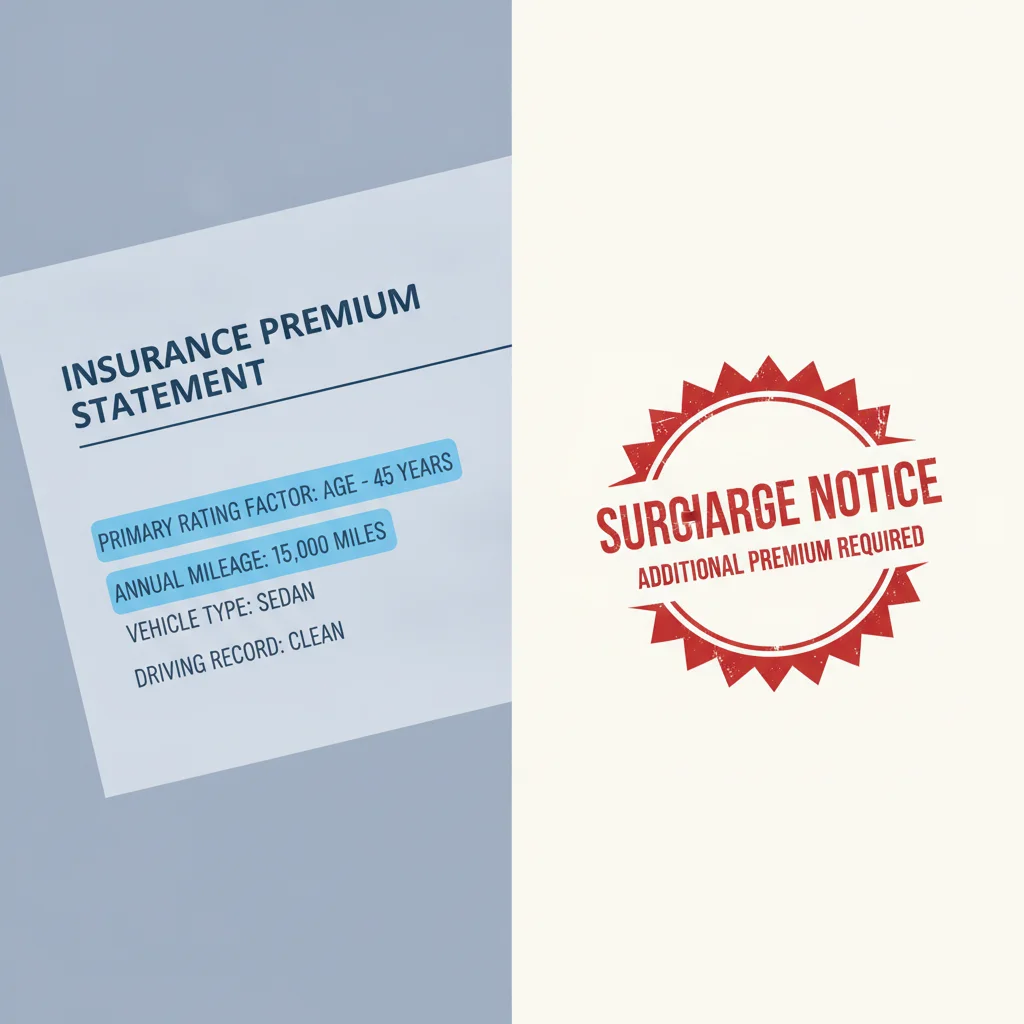
Insurers use what are called rating factors to segment policyholders into risk tiers. Each factor carries a weight, and together they produce a base rate that's then modified by discounts and, in some cases, surcharges. Understanding the difference between a rating factor and a surcharge matters here — because they work differently, and disputing or adjusting them requires different strategies.
The goal of this guide is narrower and more actionable than a general explainer: it focuses specifically on the variables you can move, what realistic savings look like for each one, and the practical steps to actually work them in your favor.

Your Credit-Based Insurance Score: The Highest-Leverage Factor Most People Ignore
In most states, insurers use a proprietary credit-based insurance score — distinct from your FICO score but derived from the same underlying credit file — to predict the likelihood you'll file a claim. The correlation is well-documented in actuarial research, and regulators in most states permit its use. (A handful of states, including California and Massachusetts, ban or restrict it — see which states limit insurer rating factors for details.)
Why does this matter so much? Because the spread between the rate offered to a driver with poor credit versus excellent credit can exceed 70% with some carriers — more than almost any other single factor. And unlike your age or your accident history from four years ago, your credit profile responds to deliberate action within months.
Up to 76%
Premium gap by credit score tier
According to a 2023 rate analysis by the Consumer Federation of America, drivers with poor credit can pay up to 76% more than those with excellent credit for identical coverage with the same insurer.
10–30%
Potential discount from telematics programs
Major carriers including Progressive, Allstate, and State Farm report that safe-driving telematics participants earn average discounts in the 10–30% range on eligible coverages.
5 years
Typical lookback window for at-fault accidents
Most insurers use a three-to-five-year lookback period for at-fault accidents when calculating rates, though DUIs and major violations can remain a factor for up to ten years in some states.
$461
Average annual savings from policy shopping
A 2023 analysis by ValuePenguin found that drivers who switched carriers saved an average of $461 per year — underscoring the premium that competitive shopping can generate.
The practical moves are well-established: pay down revolving balances to reduce your credit utilization ratio (the single most responsive short-term lever), avoid opening multiple new accounts in a short window, and dispute any errors on your credit report. Most major bureaus allow online disputes, and verified errors must be corrected within 30 days under the Fair Credit Reporting Act.
One underused tactic: ask your insurer to re-run your credit-based insurance score at renewal if you've made meaningful improvements since your last policy term. Not all carriers offer this proactively, but many will accommodate the request.
Ask Your Insurer to Re-Score Your Credit
If you've made significant credit improvements since your last renewal — paid down debt, resolved derogatory marks, or corrected errors — contact your insurer and ask whether they'll re-run your credit-based insurance score mid-term or at renewal. Not all carriers advertise this option, but many will do it on request. Even a modest improvement in your insurance score can move you into a lower rate tier.
Driving Record Management: What's Erasable and on What Timeline
Your driving record is the rating factor most people instinctively understand — but far fewer know how to actively manage it. Most violations and at-fault accidents affect your premium for three to five years, depending on severity and state rules. Minor infractions often age off faster; DUIs can linger for up to ten years in some states.
The actionable insight here is about timing and behavior modification, not regret. If you had a speeding ticket two years ago, you're already partway through the lookback window. Staying clean from this point forward means you may be eligible for a lower-tier rate at the next renewal after the incident ages off. Some factors work in your favor automatically — and this is one of them, provided you stop adding new incidents to the ledger.
Defensive driving courses are another lever. Many insurers offer a 5–10% discount for completing an approved course, and some states mandate that insurers offer the credit. The discount typically applies for three years. For a driver paying $1,500 annually, that's $225–$450 in savings for a few hours of coursework.

One caution: if errors exist in your driving record — incorrect violations, accidents attributed to the wrong person — those can inflate your rate unfairly. Disputing inaccurate rating factors is a legitimate and sometimes lucrative process, but it requires documentation and persistence.
Driving Record Errors Are More Common Than You'd Think
Motor vehicle records maintained by state DMVs occasionally contain errors — wrong violation codes, incidents attributed to the wrong license number, or outdated information that should have been expunged. Because insurers typically rely on these records without independent verification, an error in your MVR flows directly into your premium. Request your MVR from your state DMV annually — the fee is usually under $10 — and compare it to what your insurer has on file.
Some Rate Levers Require Lead Time
Credit improvements take months to register meaningfully in your score. Driving record incidents age off on fixed timelines that you can't accelerate. The most effective rate management approach accounts for this lag — start making improvements well before your renewal date rather than the week before. Setting a calendar reminder 60–90 days before renewal gives you time to make moves that actually influence that term's rate.
Coverage Structure and Deductible Choices: Engineering Your Premium from the Inside
Many drivers treat their coverage structure as something that was set up once and never revisited. That's leaving money on the table. The coverage types you carry, the limits you select, and especially the deductibles you choose are entirely within your control at every renewal.
Raise your deductible deliberately and bank the savings
Most drivers never file a collision claim in any given year, which means a higher deductible rarely gets triggered while the premium savings accumulate every term. The long-run math typically favors higher deductibles for drivers with a clean record and some emergency savings to cover the gap.
Review and adjust coverage on older vehicles at every renewal
As a vehicle depreciates, the maximum insurer payout for a total loss shrinks — but the annual premium for collision and comprehensive doesn't automatically follow. Carrying full coverage on a low-value vehicle means you're paying a disproportionate share of the vehicle's worth in annual premiums.
Request a coverage limits review when your life circumstances change
Liability limits chosen years ago may no longer reflect your actual asset exposure — too low if your net worth has grown, or potentially excessive if you're carrying high limits on a vehicle you rarely use. Right-sizing limits prevents both underinsurance and unnecessary overspending.
Match your policy's annual mileage to your actual driving
Insurers use annual mileage as a proxy for exposure — more miles driven means more time at risk. Drivers who significantly overestimate or fail to update their mileage are effectively subsidizing their own higher-mileage neighbors.
The deductible adjustment is the clearest example. Raising your comprehensive and collision deductible from $500 to $1,000 typically reduces the cost of those coverages by 10–20%, depending on the insurer and vehicle. On a car where you're paying $600 a year for collision, that's $60–$120 in annual savings — and if you go five years without a claim, you've saved $300–$600, which more than covers the extra $500 you'd pay out-of-pocket in the event of an accident.
The calculus changes if you have a loan or lease. Lenders typically require you to maintain collision and comprehensive with a deductible at or below a specified threshold — usually $500 or $1,000. Check your loan agreement before adjusting.
For older vehicles with low market value, dropping collision entirely may be rational. A rule of thumb used by many financial advisors: if the annual cost of collision and comprehensive combined exceeds 10% of the vehicle's current market value, consider dropping those coverages. Use valuation tools like KBB and Edmunds to get a realistic read on what your car is actually worth before making that call.
Vehicle Choice and How You Use It: Factors That Shift at Purchase Time
You can't change the car you're already driving without buying a different one — but vehicle selection is a controllable factor at the point of purchase, and it's one that carries long-term rate implications most buyers underestimate.
Insurers rate vehicles based on repair costs, theft frequency, safety performance, and historical claim data. A vehicle with high repair costs, frequent theft, or poor crash outcomes will carry a higher insurance rate regardless of how clean your driving record is. Before finalizing a purchase decision, it's worth getting insurance quotes on the specific make, model, trim, and model year you're considering — not a rough estimate, but actual quotes.

How you use the vehicle also matters. Annual mileage is a rating factor most insurers ask about explicitly, and it affects your rate meaningfully. Drivers who commute long distances carry statistically higher exposure to accidents simply because they spend more time on the road. If you've shifted to remote work, retired, or otherwise significantly reduced your driving, report that change to your insurer. A reduction from 18,000 miles per year to 8,000 can move you into a lower mileage tier and shave 5–15% off your premium depending on the carrier.
Garaging location is a related factor. Vehicles garaged in ZIP codes with high theft rates, dense traffic, or severe weather patterns cost more to insure. If you move — even within the same city — update your address promptly. Some moves reduce rates; others increase them, but the rate should reflect your actual situation. Misrepresenting your garaging address is considered material misrepresentation and can void a claim.
Discounts, Bundling, and Usage-Based Programs: Stacking What's Available
Discounts represent the most immediately accessible lever for most drivers. The challenge is that insurers don't always volunteer them — you often have to know to ask. Common categories include:
- Multi-policy (bundling): Insuring your home or renters policy with the same carrier as your auto policy typically yields 5–15% off each policy.
- Multi-vehicle: Adding a second or third vehicle to the same policy generates per-vehicle discounts at most carriers.
- Defensive driving / safety course: As noted above, usually 5–10%, available to drivers of qualifying ages or upon request.
- Good student: Full-time students with a GPA of 3.0 or above qualify at most major carriers — worth checking if you're insuring a young driver on your policy.
- Pay-in-full: Paying your six-month or annual premium upfront rather than in monthly installments eliminates installment fees and sometimes generates an additional discount of 3–8%.
- Paperless / autopay: Minor discounts, but they compound with others and require zero ongoing effort.
Usage-based insurance (UBI) programs — often called telematics programs — deserve separate attention. These programs use an app or plug-in device to monitor your actual driving behavior: speed, braking, cornering, time of day. Safe drivers who score well can earn discounts of 10–30% at some carriers. The risk is minimal for genuinely careful drivers; the savings potential is real. Most carriers now offer these programs, and enrollment is typically opt-in.
“The drivers who pay the most for insurance are often not the riskiest — they're the least engaged. The pricing system rewards people who understand it and act accordingly.”
— J. Robert Hunter, Former Director of Insurance, Consumer Federation of America
One structural move worth considering: shopping your policy at every renewal, not just when you've had a rate increase. Insurers price new customers differently than renewals in many cases, and the competitive landscape shifts. Spending two hours comparing quotes every twelve months is one of the highest-return activities available to a typical policyholder. Note that common myths about insurance pricing — like the idea that loyalty always rewards you — can keep drivers from taking this step.

Putting It Together: A Sequenced Approach to Rate Reduction
The most effective approach treats these levers as a coordinated system rather than isolated tactics. A sequenced strategy might look like this:
- Pull your credit report and insurance score context. Understand where you stand and identify any quick improvements — especially error disputes and balance paydowns — that could move the needle before your next renewal.
- Review your driving record for accuracy. Obtain your motor vehicle report (MVR) from your state DMV and compare it against what your insurer has on file. Errors happen more often than drivers realize.
- Audit your current coverage structure. Are you carrying collision on a vehicle that's worth less than $4,000? Are your deductibles set at their defaults? Run the math on adjustments.
- Inventory available discounts. Call your insurer or log into your account and explicitly ask what discounts you currently receive and which ones you might qualify for but haven't claimed.
- Enroll in a telematics program if you're a safe driver. If you drive moderately and avoid hard braking, the upside is substantial and the downside is limited.
- Shop competing carriers before every renewal. Use the same coverage structure across quotes so you're comparing apples to apples. If your current carrier is meaningfully more expensive, that's leverage for negotiation or a reason to switch.
The credit score factor has overlap with your broader financial health — the same moves that improve your insurance pricing also affect your auto loan rate. If you're financing a vehicle, see how your credit score affects loan rates and everything that shapes your auto loan rate for the full picture of how these variables interact across your auto finances.
Rate management isn't a one-time task. Insurers re-underwrite at every renewal, and your risk profile changes — in both directions — as your life does. Treating your auto insurance as an active financial instrument rather than a passive bill is the mindset shift that separates drivers who consistently pay fair rates from those who quietly overpay for years.
Driving Record Errors Are More Common Than You'd Think
Motor vehicle records maintained by state DMVs occasionally contain errors — wrong violation codes, incidents attributed to the wrong license number, or outdated information that should have been expunged. Because insurers typically rely on these records without independent verification, an error in your MVR flows directly into your premium. Request your MVR from your state DMV annually — the fee is usually under $10 — and compare it to what your insurer has on file.
Some Rate Levers Require Lead Time
Credit improvements take months to register meaningfully in your score. Driving record incidents age off on fixed timelines that you can't accelerate. The most effective rate management approach accounts for this lag — start making improvements well before your renewal date rather than the week before. Setting a calendar reminder 60–90 days before renewal gives you time to make moves that actually influence that term's rate.

All claims are backed by peer-reviewed research. Sources on request.