
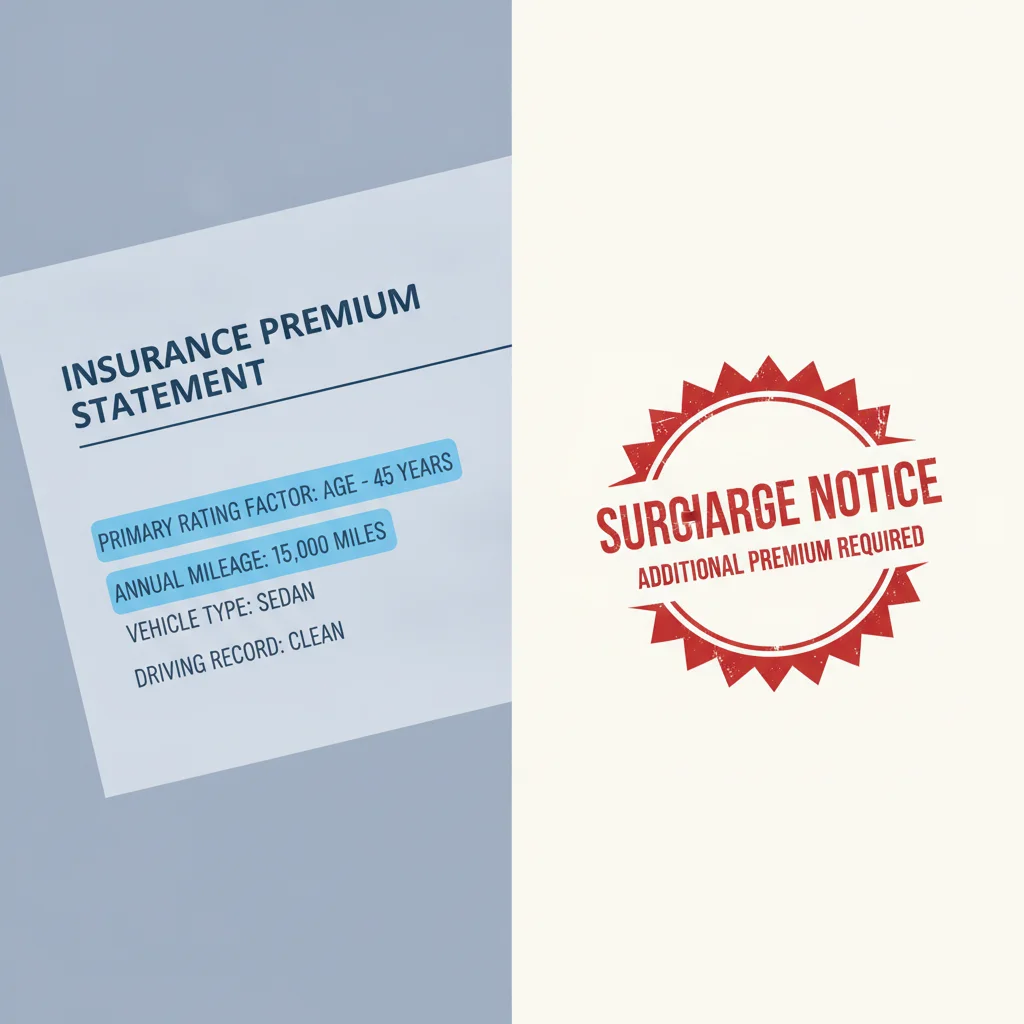
Key Takeaways
Option A
Rating Factor
The baseline variable that shapes your premium from day one.
Best for: Understanding the foundational inputs — like age, vehicle type, or annual mileage — that insurers use to calculate every policy's starting price.
Option B
Surcharge
The penalty added on top of your existing premium after a triggering event.
Best for: Understanding why your renewal premium jumped after an at-fault accident, speeding ticket, or DUI conviction.
If you're trying to understand why your first quote came in higher than expected
Rating Factor
Your initial premium is built entirely from rating factors. Reviewing which variables the insurer weighted most heavily — credit score, ZIP code, vehicle type — explains the starting price before any incidents are involved.
If your renewal premium jumped and you recently had an at-fault accident or traffic violation
Surcharge
Renewal increases tied to specific incidents are almost always surcharges. Understanding how long they stay on your record and what percentage they add helps you plan when and whether to shop for a new carrier.
If you want to proactively lower your premium without waiting for an incident to clear
Rating Factor
Rating factors are the levers you can actually pull — moving to a lower-risk ZIP code, reducing annual mileage, or improving your credit-based insurance score can all reduce your base rate without waiting years for a surcharge to expire.
If you received a premium notice that seems inaccurate and you want to challenge it
Rating Factor
Disputable errors almost always live in the rating factor layer — wrong vehicle data, incorrect garaging address, or a mileage estimate that no longer reflects reality. Surcharges tied to verified incidents are rarely reversible through a dispute.
If you're comparing quotes across multiple carriers after a recent ticket or accident
Surcharge
Different carriers apply surcharges at different rates for the same incident. Shopping around immediately after a triggering event can surface carriers that penalize that specific incident less severely than your current insurer.
Two Ways Insurers Adjust What You Pay
Auto insurance pricing can feel like a black box, but most of the math comes down to two distinct mechanisms: rating factors and surcharges. Insurers use them for different purposes, at different points in the policy lifecycle, and under different regulatory rules. Conflating the two leads to real confusion — especially when a premium increase arrives and you're not sure whether something about your profile changed or whether you're being penalized for a specific incident.
The short version: rating factors are the variables used to construct your base premium from scratch. Surcharges are penalties layered on top after something happens. Both influence your final premium, but understanding which one is responsible for a given cost shift tells you whether you can dispute it, how long it will last, and what — if anything — you can do to reduce it.
This distinction matters more than most policyholders realize. When you're comparing policies across carriers, knowing whether a quoted difference stems from how an insurer weights your credit-based insurance score versus how aggressively they surcharge a three-year-old speeding ticket can meaningfully change which carrier makes the most sense for your situation.
What Is a Rating Factor?
A rating factor is any variable an insurer uses to calculate your premium at the time a policy is written or renewed. Think of it as an input in a pricing formula. Insurers assign a numerical weight to each factor — sometimes called a relativity — and multiply those weights together to arrive at your base premium before any discounts or additional penalties are applied.
Common rating factors include:
- Driver characteristics: Age, years licensed, marital status, and gender (where permitted by state law)
- Driving history: Prior violations, at-fault accidents, and claims over a defined lookback period
- Vehicle attributes: Make, model, model year, trim level, safety ratings, and theft frequency
- Geography: Garaging ZIP code, which influences local accident rates, litigation climate, and repair costs
- Usage patterns: Annual mileage, primary use (commute vs. pleasure), and — increasingly — telematics data
- Credit-based insurance score: Available in most states, this scoring model is distinct from a lending credit score and is calculated differently than your FICO score
Each of these factors reflects something about your statistical risk profile. An insurer isn't judging you personally — they're applying actuarially derived correlations between these inputs and expected claim costs across large policyholder populations. That's why a 19-year-old with a clean driving record still pays more than a 45-year-old with a clean record: the rating factor for age reflects the aggregate loss experience of that demographic cohort, not that individual's actual driving behavior.
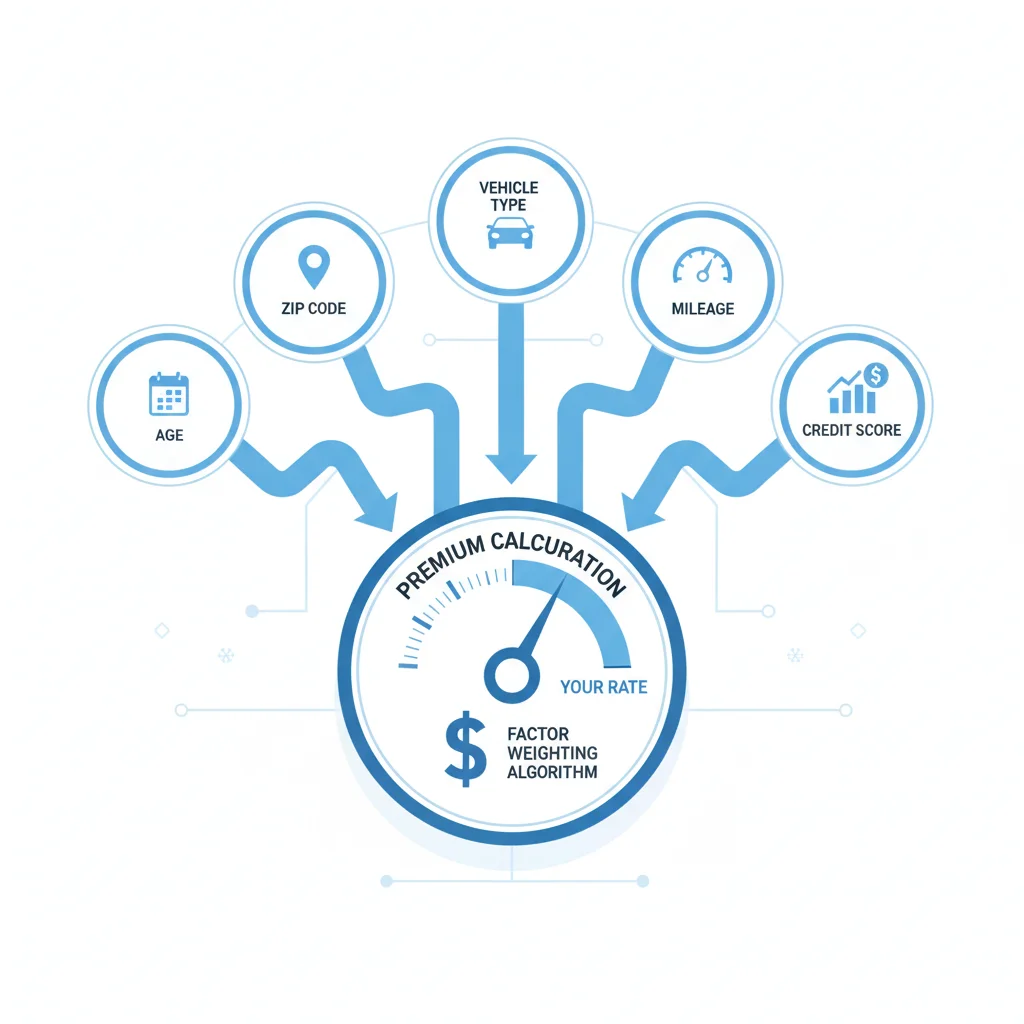
Rating factors are applied at every policy issuance and renewal. If your ZIP code changes, your annual mileage shifts, or you add a vehicle to the policy, the carrier recalculates the relevant factors. Most of the time, these adjustments happen quietly during renewal — which is part of why the same carrier can quote you a meaningfully different price depending on which inputs have changed.
What Is a Surcharge?
A surcharge is a premium increase applied in response to a specific triggering event — most commonly an at-fault accident, a moving violation, a DUI conviction, or a lapse in coverage. Unlike a rating factor, which reflects your profile as it exists now, a surcharge is backward-looking: it penalizes something that already happened.
Surcharges are typically expressed as a percentage increase applied to your base premium. A mid-tier speeding ticket might carry a 15–25% surcharge, while a DUI conviction in many states can increase premiums by 50–100% or more, depending on the carrier and state regulations.
| Criterion | Rating Factor | Surcharge |
|---|---|---|
| When it applies | At policy issuance and every renewal | After a specific triggering event |
| What triggers it | Your demographic and vehicle profile | An at-fault accident, violation, or lapse |
| Duration | Ongoing, as long as the underlying condition exists | Fixed term (typically 3–7 years) |
| Regulatory oversight | Filed with state insurance department | Filed surcharge schedule, varies by carrier |
| Can you dispute it? | Yes, if based on incorrect data | Rarely, if incident is verified |
| Can you reduce it proactively? | Yes — mileage, ZIP, credit score, vehicle choice | Limited — defensive course, telematics, shopping |
| Carrier variation | High — weighting differs widely by insurer | High — same incident penalized differently by carrier |
| Appears on renewal notice | Usually implicit in base premium | Often itemized as a line-item increase |
Most states require insurers to file their surcharge schedules with the state insurance department, meaning the penalty percentages are not arbitrary — they're reviewed and approved as part of the carrier's rate filing. However, the specific surcharge applied for the same incident can vary substantially from one carrier to the next, which is why shopping around after an at-fault accident or serious violation often surfaces meaningful price differences.
~40%
Average premium increase after one at-fault accident
According to Bankrate's 2024 rate analysis, a single at-fault accident raises the average U.S. driver's full-coverage premium by roughly 40%, though carrier variation is wide.
3–5 years
Typical surcharge duration for an at-fault accident
Most state-regulated surcharge schedules and carrier filings set a three-to-five year lookback window for standard at-fault accident surcharges.
Up to 76%
Average premium increase after a DUI conviction
The Insurance Information Institute reports that a DUI conviction can raise annual premiums by 76% on average nationally, with significant variation by state and carrier.
6–10%
Typical impact of garaging ZIP code on base premium
Industry actuarial data consistently identifies geographic rating factors as among the most influential inputs, with ZIP-code differences accounting for 6–10% of premium variation in many markets.
Surcharges are also time-limited in most cases. A standard at-fault accident surcharge typically runs three to five years from the date of the incident, after which it drops off your policy at renewal. DUI surcharges often last longer — five to seven years is common — and in a handful of states, a DUI can affect your insurability classification for a decade. If you're managing a surcharge and want to understand exactly when it will expire, ask your insurer for the surcharge expiration date in writing; it should appear in your policy declarations or be available through your online account.
It's also worth noting that some events can simultaneously trigger a surcharge and cause a rating factor to shift. An at-fault accident, for example, may generate a direct surcharge while also updating your driving history — a rating factor — so that future insurers who pull your MVR also see the incident as part of your base risk profile.
Side-by-Side: How They Compare
The clearest way to see how rating factors and surcharges differ is to look at them across the same dimensions: when they apply, what triggers them, how long they last, and whether you can do anything to contest or reduce them.
State Law Limits How Both Can Be Used
Every state insurance department reviews and approves the rating factors and surcharge schedules that insurers use in that state. Some states ban specific rating factors entirely — California, Hawaii, and Massachusetts, for example, prohibit the use of credit-based insurance scores in auto pricing. Michigan limits how much geography can influence rates. This means the factors driving your premium in Texas may be legally unavailable to an insurer pricing a comparable policy in New Jersey. Always check your state's insurance department website for guidance on permitted rating variables.
Not All Premium Increases Are Surcharges
If your premium rises at renewal but you had no incidents, the cause is likely a rating factor change — not a surcharge. Common culprits include a credit score shift, a new driver added to the household, or a carrier-wide rate increase that affects all policyholders in your state. Carrier-wide rate increases are also filed with and approved by state regulators and are not tied to any individual policyholder's behavior or history.
One nuance worth emphasizing: from a technical underwriting standpoint, a surcharge is a type of rating factor. Insurance regulators and actuaries use the term broadly to mean any variable that adjusts price. In practice, however, the industry and most state regulations draw a functional distinction between the stable, profile-based variables that set a base rate and the event-triggered penalties that get added on afterward. When your insurer sends a notice explaining a premium increase, that practical distinction is what matters for understanding and responding to the change.
If you've recently received a rate increase and aren't sure which mechanism caused it, check your renewal notice carefully. Insurers in most states are required to provide an explanation when a premium increases by more than a set threshold. The explanation should reference either a change in one or more rating factors or the application of a specific surcharge tied to a named incident. If the explanation is vague or the numbers don't add up, that's worth investigating — knowing how to dispute a rating factor can help you catch errors that inflate your premium unnecessarily.
Can You Change or Remove Them?
Your ability to influence a rating factor or surcharge depends heavily on which one you're dealing with and why it's on your policy.
Disputing a Rating Factor
Rating factors are based on data — and data can be wrong. Common errors include an incorrect garaging ZIP code (especially if you recently moved), a mileage estimate that reflects commuting habits you no longer have, a vehicle listed with the wrong trim level, or a driving record error caused by a misreported violation that wasn't actually yours. These kinds of mistakes can be corrected, and correcting them can reduce your premium meaningfully.
The process typically involves requesting a copy of the data sources your insurer used — your MVR, CLUE report, and any telematics data if applicable — and then identifying discrepancies. If you find an error, you can submit documentation to the insurer requesting a re-rate. Most carriers have a formal process for this, though response times vary.

Reducing the Impact of a Surcharge
Surcharges tied to verified incidents are generally not reversible through a dispute process. If you had an at-fault accident and your insurer has confirmed it through a claims record, the surcharge is valid. Your options are different here:
- Wait it out: Know exactly when the surcharge expires and plan to shop for rates once it drops off. Your leverage with other carriers increases once your record is clean.
- Shop other carriers now: Different insurers weight the same surcharge differently. If your current carrier imposes a 40% surcharge for a single at-fault accident and a competitor's filed rate for the same incident is 20%, switching can produce immediate savings even while the incident is still on your record.
- Complete a defensive driving course: Many states allow a violation surcharge to be reduced or waived if you complete an approved driver improvement course. This typically applies to minor moving violations, not major incidents like DUI.
- Consider telematics programs: Some carriers offer usage-based programs that can offset surcharge costs for drivers who demonstrate safe behavior through in-app or device monitoring.
For EV owners, this calculus has an additional layer — repair costs that affect surcharge severity can differ substantially from those for gas-powered vehicles, and EV insurance works differently in several important ways that can affect how incident-based penalties are structured.
The Practical Takeaway for Policyholders
The distinction between rating factors and surcharges isn't just academic. It shapes what you can do when a premium increase hits your mailbox and how you should think about the insurance market at different stages of your driving record.
If your premium feels high from the start — before any incidents — the answer lies in your rating factors. Reviewing your profile for data errors, considering vehicles with better loss histories, or improving your credit-based insurance score over time are all legitimate levers. These factors are also why identical drivers in different ZIP codes can pay vastly different rates: geography is a powerful rating input that's often underappreciated.
If your premium jumped at renewal and something happened in the intervening period — an accident, a ticket, a lapse in coverage — a surcharge is likely the cause. In that case, the most productive steps are understanding when the surcharge expires, comparing what other carriers charge for the same incident, and documenting your ongoing safe driving behavior through whatever means the market offers.
In both cases, the starting point is the same: ask your insurer to explain exactly what changed and why. A premium increase notice that simply says "rate adjustment" without specifics is not sufficient under most state regulations. You're entitled to an itemized explanation, and that explanation will tell you which category of adjustment you're dealing with — and therefore what your realistic options are.

All claims are backed by peer-reviewed research. Sources on request.