

Key Takeaways
Passive Rate Improvement Factors
Passive rate improvement factors are variables in your auto insurance pricing that move in your favor automatically as time passes — without you taking any deliberate action. These include your age reaching lower-risk milestones, your tenure building with a single insurer, and past violations aging off your driving record. Insurers continuously reassess these factors at each policy renewal.
Insurers use actuarial models that weight each rating factor differently by state and carrier. The timeline for passive improvements can vary by jurisdiction, since state regulators control which factors are permissible and how heavily they can be weighted.
The Forces Working in Your Favor Right Now
Most conversations about lowering your auto insurance rate focus on what you can do — bundle policies, raise your deductible, take a defensive driving course. That advice is valid, but it overlooks a quieter category of improvement: the factors built directly into insurance pricing models that move in your favor simply because time is passing.
Insurers don't price every driver the same at every age, at every point in a carrier relationship, or at every stage of a driving record's history. They run continuous actuarial calculations that account for statistical risk patterns across millions of policyholders. As you move through life's ordinary milestones — aging past certain thresholds, building years with one carrier, watching old violations expire — your risk profile in those models improves, and your premium reflects it.
Understanding the timeline for each passive factor doesn't require you to act differently. But knowing when to expect a drop, and by roughly how much, can help you make smarter decisions about when to shop around, whether to stay with your current carrier, and how to read your renewal notices with more clarity.
See our guide to controllable rate factors if you want to layer active strategies on top of these passive ones.
Age: The Single Biggest Passive Variable in Auto Insurance
No other passive factor produces as dramatic a shift in your premium as age — particularly during the years between 16 and 25. Young drivers represent a disproportionate share of serious accidents on American roads. The NHTSA consistently shows that drivers aged 16–19 have crash rates nearly three times higher than drivers aged 20 and older. Insurers price for that reality.
3x
Higher crash rate for teen drivers vs. adults
NHTSA data shows drivers aged 16–19 have crash rates approximately three times higher than drivers 20 and older, directly driving higher premiums for young policyholders.
10–15%
Average rate drop at age 25
Most major U.S. carriers reflect a 10–15% reduction in average annual premium when a driver crosses the age 25 threshold, assuming a clean driving record.
3 years
Typical insurer lookback for minor violations
The majority of U.S. auto insurers use a 3-year lookback window for minor moving violations when calculating renewal premiums, after which the surcharge is removed.
47
States permitting credit-based insurance scores
As of 2024, 47 U.S. states and D.C. allow insurers to use credit-based insurance scores as an auto insurance rating factor, making credit history maturation a broadly applicable passive improvement lever.
Up to 15%
Maximum loyalty discount at major carriers
Several major U.S. auto insurers offer loyalty discounts reaching up to 15% for policyholders who maintain continuous coverage for 10 or more years with the same company.
The good news is that the actuarial curve works as aggressively in your favor as it initially worked against you. Here's roughly how the age-based rate trajectory plays out:
- Ages 16–18: Peak pricing. Expect the highest per-mile risk surcharges, especially for males. Being added to a parent's policy is typically cheaper than a standalone policy, but premiums are still steep.
- Ages 19–20: Modest improvement, primarily from a full year of clean driving experience on record. Some carriers recognize this with small incremental discounts.
- Ages 21–24: More meaningful reductions begin. Carriers segment this group differently from teenagers, and the absence of violations during early driving years compounds the improvement.
- Age 25: The milestone most commonly cited in the industry. Average premium drops of 10–15% are reported at this threshold by most major carriers, though the exact reduction depends on your record and carrier.
- Ages 26–64: Gradual continued improvement through the low-risk adult driving years, with rates generally flattest between 35 and 55.
- Age 65+: Rates may begin creeping upward again as accident frequency and severity data for older drivers rises, though this varies considerably by individual health and driving frequency.
One important nuance: the age benefit is only passive if your driving record stays clean. A DUI at age 22 will almost certainly negate any age-based improvement at your next renewal. The passive and active factors work in combination, not in isolation.
Mark Your Violation Anniversary Date
If you have an active moving violation, note the exact conviction date and add three years to it. That's the earliest your rate could improve from that specific surcharge clearing — assuming your carrier uses a standard 3-year window. Set a calendar reminder a month before your expected renewal so you can verify the surcharge has been removed from your declarations page.
Review Your Declarations Page at Every Renewal
Passive improvements are applied automatically, but errors happen. At each renewal, pull up your declarations page and verify that expected discounts — loyalty tiers, age-based adjustments, and cleared violations — are actually reflected. If a discount appears to be missing, a quick call to your insurer can often resolve it on the spot.
Carrier Tenure: The Loyalty Discount That Builds Automatically
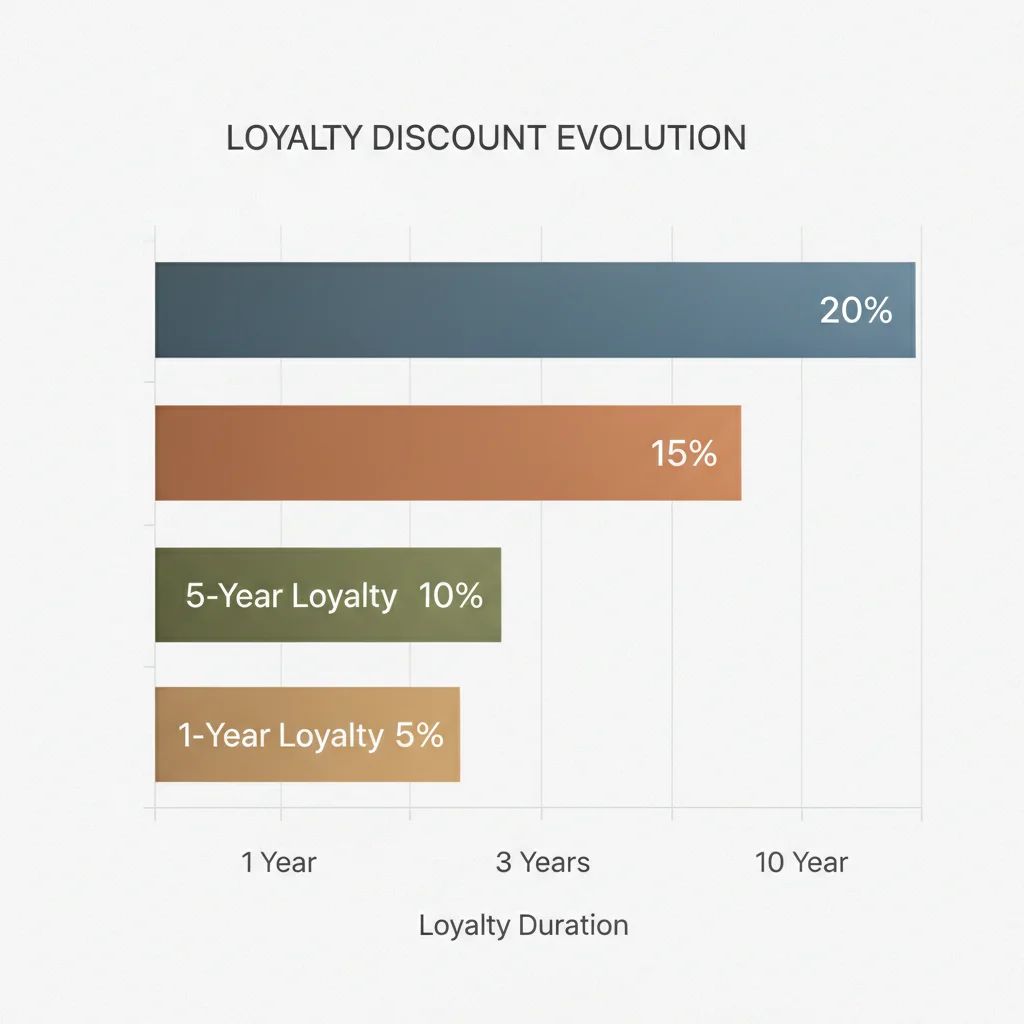
Insurance is a relationship business, and carriers have a financial incentive to retain existing customers — acquiring a new policyholder costs meaningfully more than keeping a current one. That economics play out in the form of loyalty discounts, and most major U.S. carriers structure them in tiers that grow with your tenure.
The typical loyalty discount structure looks something like this:
| Years with Carrier | Typical Loyalty Discount Range |
|---|---|
| 1 year | 2%–5% |
| 3 years | 5%–8% |
| 5 years | 8%–12% |
| 10+ years | Up to 15% at some carriers |
These percentages are applied to your base premium and adjust automatically at renewal. You don't file paperwork or call your agent to trigger them — they're baked into the renewal calculation.
Loyalty Discounts Vary Significantly by Carrier
Not every insurer uses the same loyalty discount structure, and some carriers don't publish their tier schedules publicly. The ranges cited here reflect common industry practice, but your specific carrier may weight tenure differently. Your declarations page or a call to your agent is the most reliable way to confirm what loyalty benefits you're currently receiving.
Credit Scoring Rules Differ by State
If you live in California, Hawaii, Massachusetts, or Michigan, credit-based insurance scoring is prohibited or heavily restricted, so the credit history maturation benefit described in this section does not apply to you. Residents of other states should confirm with their carrier whether credit scoring is being used in their policy pricing.
Market-Wide Rate Increases Can Offset Passive Gains
Passive improvements reduce your individual risk score, but your final premium is also affected by industry-wide factors — rising repair costs, medical inflation, and regional claims trends. It's possible to earn a passive improvement at renewal while still paying the same or slightly more than you did the previous term. Passive factors improve your relative position; they don't guarantee an absolute dollar reduction in every market environment.
There's a legitimate counterargument to pure loyalty, however. Some carriers practice what consumer advocates call "price optimization" — gradually raising rates on customers who statistically show low price sensitivity. This means long-tenured customers sometimes end up paying more than a new customer with an identical profile would be quoted. The practical advice: accept the loyalty discount's passive benefit, but still run a competitive quote comparison every two to three years to ensure your total premium remains reasonable for your market.
If you've recently received a renewal notice that surprised you, here's what's really driving premium changes at renewal — even when your record hasn't changed.
Old Violations Aging Off Your Record: A Defined and Predictable Timeline
Every moving violation that ends in a conviction enters a two-part record: your state's official motor vehicle record (MVR) and the practical lookback window that your insurer uses for pricing. These are not always the same. A violation might live on your MVR for seven years in your state, but your insurer may only look back three years when calculating your rate. Understanding both timelines matters.
Here's a general framework for how violation aging typically works on the insurance pricing side:
- Minor speeding tickets (1–14 mph over limit)
- Most carriers stop counting these after 3 years from the conviction date. Some competitive carriers use a 2-year lookback window.
- Moderate speeding (15–29 mph over) and other moving violations
- Typically affect pricing for 3–5 years. Carriers in high-severity loss states sometimes apply a full 5-year window even for moderate infractions.
- Reckless driving, hit-and-run, and serious violations
- Often treated as major violations with a 5-year impact period. Some carriers flag these for longer in their underwriting guidelines.
- DUI/DWI convictions
- The most persistent category. Most carriers apply surcharges for 5–7 years, and some high-risk carriers use a 10-year window. State law also determines how long the conviction appears on your MVR.
- At-fault accidents
- Similar to moderate violations — typically a 3-year impact, though some carriers maintain a 5-year surcharge for accidents involving injury or significant property damage.
The key insight is that the expiration of a violation's impact doesn't happen gradually — it often clicks off at renewal once the lookback window clears. A driver who had a speeding ticket in April 2021 on a carrier with a 3-year window would see the surcharge removed at their renewal following April 2024.
For a detailed breakdown of how long specific infractions stay active, see how long a traffic violation stays on your record. And for the rate impact mechanics, how traffic violations affect your car insurance rates breaks down which infractions hit hardest.
Credit History Maturation: The Invisible Passive Improver
In 47 states and the District of Columbia, insurers are permitted to use a credit-based insurance score as a pricing factor. (California, Hawaii, Massachusetts, and Michigan prohibit or severely restrict the practice.) This score is distinct from your traditional FICO credit score, though it draws on similar underlying data: payment history, amounts owed, length of credit history, new credit inquiries, and credit mix.
The length of credit history component is where passive improvement happens. As your oldest accounts age, as your average account age increases, and as your credit file thickens with years of on-time payment history, your credit-based insurance score typically rises — even if your spending habits and debt levels remain constant.
Loyalty Discounts Vary Significantly by Carrier
Not every insurer uses the same loyalty discount structure, and some carriers don't publish their tier schedules publicly. The ranges cited here reflect common industry practice, but your specific carrier may weight tenure differently. Your declarations page or a call to your agent is the most reliable way to confirm what loyalty benefits you're currently receiving.
Credit Scoring Rules Differ by State
If you live in California, Hawaii, Massachusetts, or Michigan, credit-based insurance scoring is prohibited or heavily restricted, so the credit history maturation benefit described in this section does not apply to you. Residents of other states should confirm with their carrier whether credit scoring is being used in their policy pricing.
Market-Wide Rate Increases Can Offset Passive Gains
Passive improvements reduce your individual risk score, but your final premium is also affected by industry-wide factors — rising repair costs, medical inflation, and regional claims trends. It's possible to earn a passive improvement at renewal while still paying the same or slightly more than you did the previous term. Passive factors improve your relative position; they don't guarantee an absolute dollar reduction in every market environment.
The practical implication: a 30-year-old driver with a 12-year credit history generally carries a better insurance score than an otherwise identical driver with a 4-year history. The improvement doesn't require paying down debt or closing accounts — it accrues through the simple passage of time and continued responsible credit behavior.
This factor connects directly to the longer arc of financial health. The relationship between credit score and auto loan rates follows a similar logic — lenders and insurers alike reward a longer, stable credit track record.
“Insurance pricing is not a static snapshot — it's a continuously updated model. Every time your policy renews, the insurer is re-running your risk profile against current data. For responsible drivers, that means time is genuinely on their side.”
— J. Robert Hunter, Former Director of Insurance, Consumer Federation of America
How Passive Improvements Stack — and When to Expect Them
Each passive factor operates on its own clock, but they often converge in ways that produce outsized savings at a single renewal. Consider a hypothetical driver who:
- Turns 25 in the same year that a three-year-old speeding ticket clears their insurer's lookback window
- Has now been with the same carrier for five years
- Has a credit file that has matured from eight to eleven years of history
Each of those factors alone would produce a modest reduction. Combined at the same renewal, the cumulative effect can be substantial — sometimes 20% or more relative to what that driver paid at age 22 with an active violation.

Knowing roughly when each factor matures helps you anticipate rather than be surprised. Here's a summary timeline to keep in mind:
| Passive Factor | When Improvement Typically Hits |
|---|---|
| Age milestone (25) | First renewal after your 25th birthday |
| Minor violation aging off | First renewal after 3-year anniversary of conviction |
| Major violation aging off | First renewal after 5–7 year anniversary |
| Carrier loyalty discount tier | Renewal at 1, 3, and 5-year marks with same insurer |
| Credit history maturation | Ongoing, with notable impacts at 7+ years of history |
If you're monitoring your record and want to understand where any active violations stand, this checklist of points accumulation red flags can help you assess your current standing.
Mark Your Violation Anniversary Date
If you have an active moving violation, note the exact conviction date and add three years to it. That's the earliest your rate could improve from that specific surcharge clearing — assuming your carrier uses a standard 3-year window. Set a calendar reminder a month before your expected renewal so you can verify the surcharge has been removed from your declarations page.
Review Your Declarations Page at Every Renewal
Passive improvements are applied automatically, but errors happen. At each renewal, pull up your declarations page and verify that expected discounts — loyalty tiers, age-based adjustments, and cleared violations — are actually reflected. If a discount appears to be missing, a quick call to your insurer can often resolve it on the spot.
What Passive Improvement Can't Do — and What It Can
Passive rate factors are real, meaningful, and reliable — but they operate within a broader market context that you can't control. Industry-wide pricing is subject to macroeconomic pressures: vehicle repair costs have risen sharply in recent years due to supply chain disruptions and the complexity of modern car technology. Medical cost inflation affects bodily injury liability payouts. Weather-related losses in certain regions drive up rates for entire geographic markets.
These forces can and do offset passive improvements. A driver who "should" see a 10% rate reduction due to a cleared violation and an age milestone might instead see their rate hold flat or even rise modestly because their insurer has raised base rates across the board due to increased claims costs in their ZIP code.
That context matters for setting realistic expectations. Passive factors improve your relative position — your individual risk score within your carrier's model — but they don't insulate you from market-wide rate trends. The net effect on your dollar premium depends on the interaction of both.
Loyalty Discounts Vary Significantly by Carrier
Not every insurer uses the same loyalty discount structure, and some carriers don't publish their tier schedules publicly. The ranges cited here reflect common industry practice, but your specific carrier may weight tenure differently. Your declarations page or a call to your agent is the most reliable way to confirm what loyalty benefits you're currently receiving.
Credit Scoring Rules Differ by State
If you live in California, Hawaii, Massachusetts, or Michigan, credit-based insurance scoring is prohibited or heavily restricted, so the credit history maturation benefit described in this section does not apply to you. Residents of other states should confirm with their carrier whether credit scoring is being used in their policy pricing.
Market-Wide Rate Increases Can Offset Passive Gains
Passive improvements reduce your individual risk score, but your final premium is also affected by industry-wide factors — rising repair costs, medical inflation, and regional claims trends. It's possible to earn a passive improvement at renewal while still paying the same or slightly more than you did the previous term. Passive factors improve your relative position; they don't guarantee an absolute dollar reduction in every market environment.
Still, understanding these passive mechanics gives you a meaningful advantage. You know when to expect improvements, you can verify they've been applied by reviewing your renewal declarations, and you can make more informed decisions about whether loyalty is actually serving you or whether a competitive quote would deliver better value at a given renewal cycle.
For the complete picture — including the factors that move against you even without any action on your part — see why your premium changes at renewal even when nothing happened.

All claims are backed by peer-reviewed research. Sources on request.